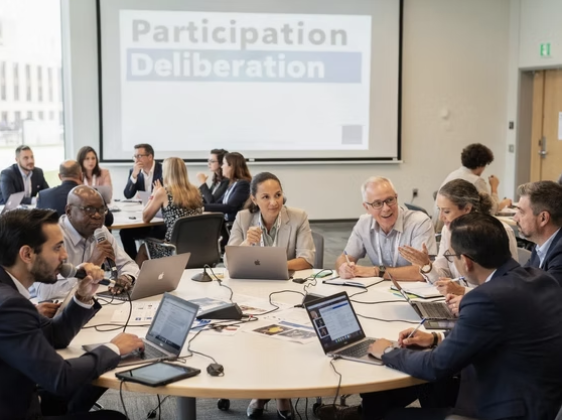
The democracy we know is at a crossroads. According to the Israel Democracy Institute’s Democracy Survey for 2024, only 29% of Israelis express trust in political institutions. Many citizens feel disconnected from the decision-making processes that affect their lives.
Participatory democracy offers a response to this sense of disconnect. It expands opportunities for civic influence beyond election day. Digital technology now makes it possible to implement this idea on a scale that was not possible before, and our manifesto presents the full vision for implementing this approach in Israel.
What Is Participatory Democracy and Why Does It Matter?
Participatory democracy is a governance model in which citizens take an active part in shaping public policy. Unlike the traditional representative model, participation does not end at the ballot box. Citizens influence decisions continuously throughout their representatives’ term, not just once every four years.
The goal is not to replace representative democracy but to deepen it. Public officials continue to make decisions, but they do so while constantly listening to the voice of citizens. The combination of representation and participation creates a system that responds better to public needs. The result is strengthening trust between citizens and government institutions.
The fundamental principles of participatory democracy include:
- Continuous civic involvement – not just on election day but throughout the entire term.
- Full transparency – access to all decision-making processes and public information.
- Equal accessibility – every citizen can influence, regardless of status or geographic location.
- Ongoing dialogue – two-way communication between the public and its elected officials.
The Difference Between Direct, Representative, and Participatory Democracy
To understand the uniqueness of participatory democracy, it is worth comparing it to other models:
Direct democracy is the oldest model, which existed in classical Athens. In the Greek polis, every citizen (adult males only, unfortunately) participated in people’s assemblies and made decisions directly. This model worked in small communities but is not scalable to populations of millions.
Representative democracy developed as a solution to the scalability problem. Citizens elect representatives who make decisions on their behalf. This is the dominant model today in most democratic countries, including Israel. The disadvantage: the citizen is reduced to a passive voter who influences once every few years.
Participatory democracy combines the advantages of both models. It maintains a structure of elected representatives but adds mechanisms for continuous citizen participation. Digital technology makes it possible to do this on a large scale.
The Challenges of Representative Democracy in the 21st Century
Representative democracy faces unprecedented challenges. The sense of disconnect between the public and its representatives is deepening throughout the Western world. Surveys show a continuous decline in public trust in political institutions. The gap between promises made in campaigns and actual policy frustrates many citizens.
Decision-making processes are perceived as slow, cumbersome, and non-transparent. Citizens feel they have no tools to influence decisions that change their lives. Bureaucracy distances them from the system instead of bringing them closer. Partial transparency intensifies the sense of alienation – people don’t know what’s happening behind the scenes.
In addition, the existing political system remains stuck in structures designed in the 18th century. Just as remnants of the industrial revolution still affect our education system, representative democracy has not been updated for the digital age.
Real Participation Versus Democratic Theater
This criticism has been raised in many academic studies: what is the point of participation if it has no real impact on decisions?
A classic example is the planning process for the Twin Towers site in New York in 2002. Thousands of citizens participated in a public forum, but in the end, decisions were made by elected officials and property owners. Critics argued that the participation was only for show.
JustSocial’s approach is fundamentally different. We do not propose listening to citizens symbolically, but measuring public opinions systematically and turning them into data that public officials must address. Not a binding referendum in Brexit style, but an analytics system that presents public positions in real time.
Technology as a Lever for Civic Participation
Technological advancement opens new possibilities for civic participation that did not exist before. Digital tools enable continuous and accessible political expression and dialogue. Social networks, applications, and online platforms shorten the distance between citizens and decision-makers. Every citizen can express their position from their living room.
Artificial intelligence makes it possible to analyze and present public positions as organized data. Natural Language Processing (NLP) models can read thousands of responses and identify trends. Decision-makers can understand public opinion in real time and respond to it.
Web3 technologies and blockchain ensure security, anonymity, and immutability of data. When votes and positions are documented on blockchain, they cannot be forged or deleted. Privacy is preserved through advanced encryption.
Analytics platforms in the style of Google Analytics (but for the public sector) can present public trends to elected officials, journalists, and anyone who wants to know what citizens think.
The advantages that technology can provide for civic participation:
- Universal accessibility – participation from anywhere and at any time.
- Real-time data processing – understanding public trends quickly.
- Transparency and documentation – all processes are documented and open to review.
- Privacy protection – encryption technologies protect participant identity.
- Scalability – millions of citizens can participate simultaneously.
Examples of Digital Democracy Implementation Around the World
Models of digital participation are already operating today in various countries, and we can learn from them:
Estonia led a digital revolution that turned it into “the first digital country in the world.” Since 2005, citizens can vote online in national elections. The system uses digital ID cards and blockchain technology for verification. Over 44% of voters in the 2023 elections voted online.
Taiwan developed the vTaiwan platform for online public consultations. The platform has an embedded AI tool for identifying points of agreement between opposing groups. It led to legislation on Uber regulation and fintech.
Brazil implemented a Participatory Budgeting program in the city of Porto Alegre since the 1990s. Citizens decide directly on the allocation of part of the municipal budget. The model was so successful that it was adopted in over 1,500 cities worldwide.
Iceland conducted a mass constitution-writing process in 2011 with broad public participation. Although the process did not end with a new constitution for political reasons, it proved that citizens can be involved in complex processes.
Finland launched Citizen Initiative – a system where citizens can bring legislative proposals that receive 50,000 signatures directly to parliamentary debate.
International experience proves that the model works if implemented correctly. It increases civic involvement and satisfaction with decision-making processes.
Civic Education as a Foundation for Participatory Democracy
Participatory democracy requires citizens who are capable and willing to participate. This does not happen in a vacuum; education is needed that prepares citizens for active involvement.
An education system that encourages critical thinking prepares the next generation for active citizenship. Teaching discussion, listening, and cooperation in the classroom provides essential skills. Students learn to listen, justify their positions, and accept positions different from their own.
Innovative educational approaches such as Project-Based Learning (PBL), Montessori education, and the anthroposophical approach (Waldorf) already prove that it is possible to educate differently. Integration of technology in the learning process prepares students for a world where they will participate in democracy on a daily basis.
Personalized learning allows each student to develop at their own pace. The digital tools that students know from school will be natural for them as adult citizens too. Investment in democratic education today will bear fruit in the next generation of citizens.
An Updated Social Contract for the Digital Age
The traditional view sees the citizen as a voter and taxpayer, nothing more. Our view sees them as a full partner in public policy over time. The citizen is not only a subject of decisions but influences their design on an ongoing basis.
An advanced democratic state is required to measure public opinion consistently and transparently. Transparency and accessibility of information are a necessary condition for the new social contract. When citizens know what is happening and can influence, trust in the system rises.
In the new social contract, the state commits:
- To measure public opinions systematically and publish the data.
- To justify decisions that deviate from majority opinion.
- To maintain full transparency in decision-making processes.
- To allow every citizen to participate easily and conveniently.
The citizen, for their part, commits:
- To participate responsibly and informedly.
- To respect the right of others to participate.
- To accept decisions even when they contradict their personal position.
Challenges on the Way to Realizing the Vision and Practical Solutions
The implementation of participatory democracy is not simple. There are real challenges that need to be addressed:
Public trust in technology – people fear manipulations and forgeries. The solution: full transparency of the code, use of blockchain for immutable documentation, and independent audits.
Privacy and data security – how do you maintain anonymity while preventing duplicate votes? The solution: advanced encryption technologies and anonymous identification (you can verify that you are a citizen without revealing who you are).
Manipulations and disinformation – fear of foreign influence or bots. The solution: identity verification mechanisms, detection of suspicious activity using AI, and full transparency of information sources.
Accessibility – not everyone knows how to use technology. The solution: simple interfaces, multilingual support, and the option to participate in traditional ways as well.
Equal representation – concern that only certain groups will participate. The solution: intentional design for inclusion, reaching diverse populations, and ongoing measurement of who participates.
Summary: From Vision to Action
JustSocial is a social movement that brings the idea of participatory democracy to practical implementation. We develop technological tools that enable active and continuous civic involvement. For example:
- TakeAction! news app – enabling action, initiating petitions, contacting elected officials, donating, and volunteering.
- rParliament platform – for viewing Knesset committee sessions with the option to respond and tag.
- rConsensus system – for community votes for neighborhoods, schools, and cities.
Our manifesto details the full vision and values that guide us. We are not content with criticism of the existing system; we are building the alternative.
We invite you to join us as supporters, volunteers, or partners. We need developers, designers, product managers, and people who believe that democracy can be done differently. Together we will promote a political culture that truly listens to the public voice.
Frequently Asked Questions
What is the difference between participatory democracy and representative democracy?
In representative democracy, citizens elect representatives who make decisions on their behalf – civic influence is concentrated on election day. In participatory democracy, citizens actively participate in shaping policy between elections as well. The participatory model does not replace the representative one but complements it and deepens civic involvement throughout the entire term.
How can technology promote real civic participation?
Technology enables accessible participation from anywhere and at any time. Digital platforms facilitate the collection of opinions and analysis of public trends. Artificial intelligence helps process large amounts of information and make it accessible to decision-makers in real time. Blockchain technology ensures that data is reliable and cannot be forged.
Are there successful examples of digital democracy in the world?
Yes. Estonia has allowed online voting since 2005 and over 44% of citizens use it. Taiwan developed vTaiwan for public consultations that led to real legislation. Participatory budgeting that began in Brazil was adopted in over 1,500 cities worldwide. Finland allows citizens to bring legislative proposals directly to parliament.
How is privacy maintained in digital participation?
Through advanced encryption technologies, it is possible to verify that a participant is an eligible citizen without revealing their identity. Blockchain technology enables anonymous but reliable documentation. The principle is “separation of identity from position” – the system knows that you are a citizen and that you voted, but does not know what you voted.
How are manipulations and bots prevented on participation platforms?
Identity verification mechanisms ensure that every participant is a real citizen. AI algorithms identify suspicious activity patterns (such as thousands of votes from the same IP address). Full transparency of code and data allows the public and experts to verify that the system works properly.
How can one join participatory democracy initiatives?
You can start by joining organizations that promote the issue like JustSocial. Participation in online public consultations is another way. Local community activity – residents’ councils, neighborhood committees – also strengthens participatory democracy. Every involvement, large or small, contributes to the required cultural change.