What Is Social Justice and Why Does It Matter?
Social justice is the principle of fair existence in society, in terms of distributing the pie of resources, opportunities, and rules of the game, so that everyone can live a dignified life, participate in the public sphere, and influence it.
This is an idea that receives different interpretations in different cultures and groups, and also changes over time. Nevertheless, the principle remains the same: a just society is one that reduces unjustified power gaps and enables every person to realize capabilities, not just rights on paper.
Core principles of social justice:
- Distribution of resources and public services: taxation, education, health, housing, and infrastructure.
- Equal opportunities: fair starting conditions, social mobility, access to the labor market and education system.
- Protection of rights: prevention of discrimination, access to proceedings, transparency, and rule of law.
A Journey Through Time: The Historical Roots of Social Justice
The discussion on social justice issues begins in classical Greece, with Plato and Aristotle, and continues in religious traditions, including Judaism which emphasizes charity and the sabbatical year as institutional logic for reducing gaps. In modern times, the concept was shaped through philosophy, enlightenment, socialism, social liberalism, and civil rights movements.
In each generation, layers were added, from focusing on stable social order, through individual rights, to questions of accessibility and participation.
Theories and Approaches: How Do We Think About Social Justice?
We can look through three practical lenses to understand the concept:
- Distributive justice: how resources and public services are distributed among groups and individuals.
- Corrective justice: correction of historical or current wrongs, compensation, and affirmative action.
- Equal opportunities: equal starting conditions, removal of barriers, targeted support where needed.
Key theoretical contributions:
- John Rawls: Equal basic liberties for all and preference for arrangements that improve the situation of vulnerable groups.
- Amartya Sen: Moving from “how much did we receive” to “what are we capable of giving.”
- Libertarian critiques: Warning against harm to property freedom and economic incentives, calling to limit state intervention.
The Meaning of Social Justice in Israel
In Israel, social justice translates into daily discourse on reducing gaps, access to services, a fair labor market, and integration of excluded populations. The constitutional arrangement is mostly based on Basic Laws and rulings that interpret human dignity and the principle of equality.
In legislation, there are provisions such as prohibition of discrimination in products and services, equal opportunity laws in employment, and laws promoting adequate representation. In case law, the principle was shaped to enable review of discrimination in land allocation, public service, and educational institutions.
Social justice in Israel is also a cultural project: NGOs, field organizations, local authorities, and government ministries experiment with data-based policy, targeted welfare budgets, and public participation, but more transparency, consistency, and measurement are needed to avoid merely symbolic policy.
Social Justice in the International Arena
- Dates and infrastructure: World Day of Social Justice on February 20 raises awareness on the public agenda.
- Organizations: The UN and partner bodies work to promote socio-economic rights and institutional improvement.
- Long-term programs: Goals for reducing inequality, eradicating poverty, and establishing effective and resilient institutions.
Criticism, Challenges, and Dilemmas on the Path to Social Justice
Social justice is a goal, but also an arena of controversy. Counter-arguments touch on issues such as:
- Individual freedom versus collective equality: How much is it right to tax, regulate, or prefer groups to correct wrongs.
- Incentives and growth: The concern that distributive policy will harm innovation and investment.
- Efficiency versus fairness: Universal policy free of stigma versus targeted tools that reach those who truly need them.
- Governance: Expanding state protection versus community empowerment and cooperative models.
To progress, balance is needed. Measure outcomes, conduct genuine public participation, maintain freedom of expression and association, and ultimately ensure that basic rights do not depend on election cycles alone, but can also be influenced in routine times.
From Theory to Action: Social Change and Civic Movements
What turns an idea into policy?
- Civic activism: Field organizations, targeted campaigns, and legal action.
- Community initiatives: Cooperative housing, social economy, incubators for education and accessible digital services.
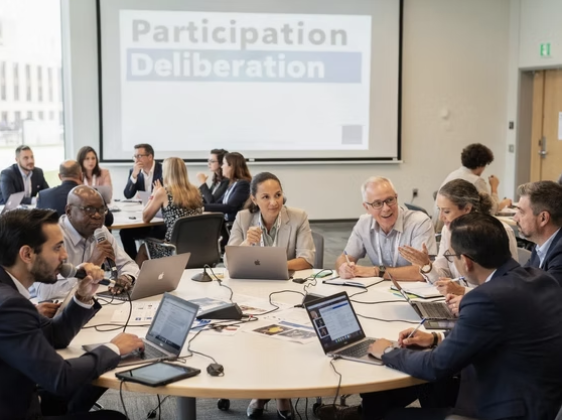
- Smart public participation: Open discussions, citizens’ assemblies, participation in budget setting, and online deliberation.
- Measurements and impact: Use of open data, monitoring policy performance, and tracking gaps over time.
How do you actually influence decision-makers? Formulate a measurable problem, propose a feasible solution, identify resources and obstacles, build a broad coalition, and combine field evidence with data analysis. Along the way, maintain substantive discourse and prepare alternatives so as not to get stuck on a single solution.
Technological Vision: JustSocial and the Future of Digital Social Justice
As the founders of JustSocial, we offer an action framework that connects social justice with digital democracy. The goal is to empower citizens and enable continuous, transparent, and influential participation. To this end, we are developing and promoting tools that will allow expressing positions, acting, and changing policy day-to-day, not just at the ballot box once every few years.
At the center of the approach stands the five branches of government model in which the people are an independent governing branch alongside the executive, legislative, judicial, and academia. When the public receives secure infrastructure for expressing positions, managing community votes, and sharing data with public representatives and the media, a mechanism is created that strengthens accountability and transparency.
We are building an ecosystem of complementary products: TakeAction! for turning news into immediate civic action; rParliament for centralizing committee discussions and making them accessible to the public; and rConsensus for secure community votes and anonymous documentation on Blockchain. Around them, we will deploy a public analytics layer that will present to representatives, journalists, and the public the patterns of participation and policy preferences, without compromising privacy.
Our vision does not replace the representative system, but expands it. When communities conduct regular discussions and votes, when children learn digital literacy and critical thinking, and when public data is accessible and transparent – social justice becomes an institutional routine rather than just a slogan.
To get there, we invite you to join: volunteers from all sectors and parts of society, educators, community leaders, and social investors. Together we will build infrastructure that bridges the idea of social justice with the daily reality of everyone.