Most people are taught that civic participation means one thing: voting on election day. But if democracy is meant to reflect the public will between elections, then participation has to be broader, more continuous, and more practical.
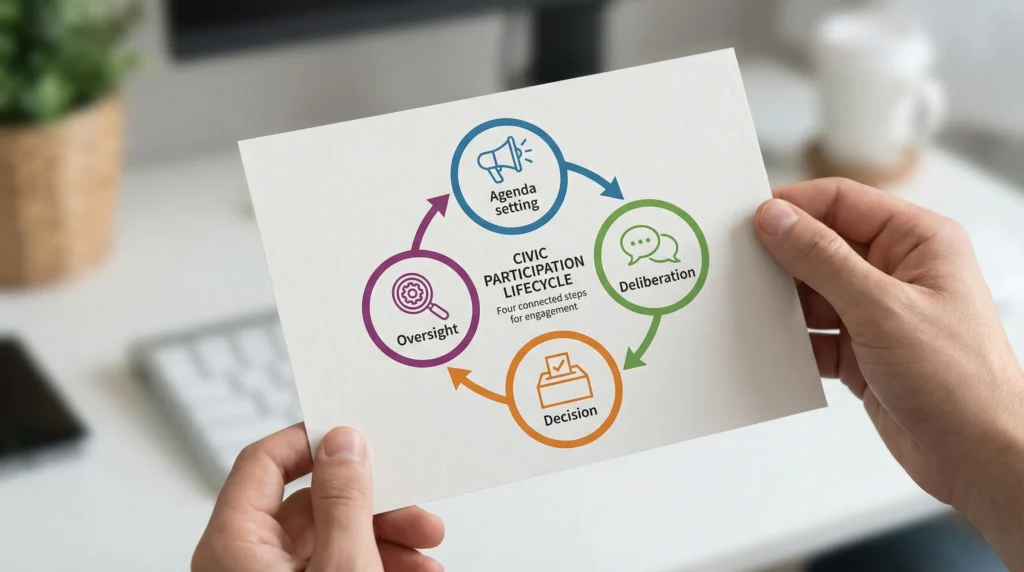
That idea sits at the heart of JustSocial’s manifesto, “The Face of Democracy”: democracy should function like an operating system, with recurring ways for people to shape agendas, weigh evidence, make decisions, and audit outcomes. In that model, participation is not a rare event. It is a civic capability.
Below are 10 types of civic participation you can choose from, depending on your time, risk tolerance, and the kind of impact you want. The goal is not to do all of them. The goal is to pick one that is sustainable, legitimate, and connected to real decisions.
A practical way to choose your “type” of participation
Before the list, it helps to identify what kind of participation you are aiming for. Many engagement efforts fail because they collect opinions without a path to action. JustSocial’s work frequently emphasizes closing the loop: public input should connect to an accountable process and a visible outcome.
Ask yourself three quick questions:
- Where is the bottleneck? Is the problem that the issue is not on the agenda, that public deliberation is low quality, that decisions are opaque, or that implementation is not tracked?
- What is the stake level? A school zoning change and a national referendum both matter, but they demand different safeguards.
- What can you repeat? The most powerful civic action is the one you can do again next month.
10 types of civic participation (and how to take action)
1) Voting and election participation (the baseline)
Voting is still foundational. It is how most systems formally assign governing authority, and it is often the easiest action to take. But voting alone leaves a long “accountability gap” between elections, which is exactly why continuous participation matters.
How to make this type of participation stronger:
- Vote consistently in local, primary, and special elections, not just national ones.
- Learn what offices actually control the decisions you care about (school board, zoning board, prosecutor, utilities, and more).
- Support election integrity norms: transparent rules, clear eligibility, and trust-building practices.
Connection to the manifesto: JustSocial’s manifesto argues for a democracy that does not pause between elections. Voting remains important, but it should be complemented by ongoing public influence and oversight.
2) Contacting decision makers with a decision-ready request
Emails that say “do better” are easy to ignore. Messages that include a concrete ask, a rationale, and a measurable success condition are harder to dismiss.
A decision-ready outreach includes:
- The decision: what exactly should be decided, changed, or funded?
- The authority: who can legally do it?
- The proof: evidence, local data, lived experience, or a credible comparison.
- The accountability hook: what public update you expect, and by when.
This works especially well at the municipal level, where officials often have fewer staff and clearer levers.
Connection to the manifesto: “continuous direct democracy” is not only about voting mechanisms. It is also about building routines and institutions where public input is legible, structured, and connected to actual decisions.
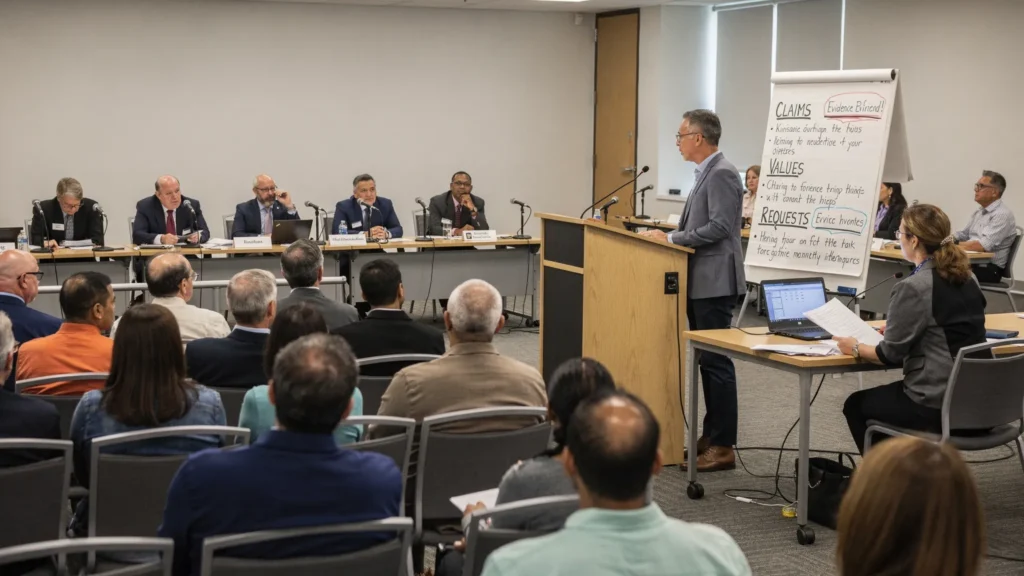
3) Attending and speaking at public meetings (with receipts)
City councils, planning commissions, school boards, and regulatory hearings are still where many real decisions happen. Showing up changes the incentives.
To make meetings worth your time:
- Read the agenda in advance and target one item.
- Submit written comments so your points enter the public record.
- Ask for a clear next step: a vote date, a follow-up memo, or a published response.
This type of participation is especially powerful when paired with transparency practices, such as publishing decision records and tracking implementation.
Connection to the manifesto: the manifesto’s emphasis on transparency and institutional redesign aligns with the idea that public meetings should be auditable and outcome-linked, not performative.
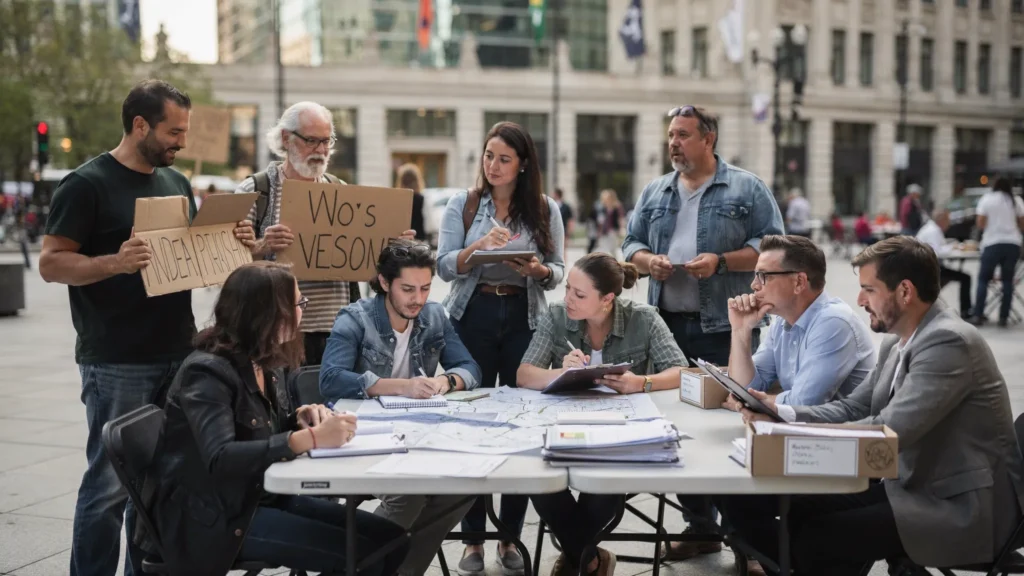
4) Community organizing and coalition building
Individual action scales when you turn it into a small, reliable team. Organizing is a type of civic participation that builds civic capacity, not just civic expression.
Effective organizing tends to be:
- Specific (one issue, one jurisdiction, one decision path)
- Role-based (outreach, research, comms, meeting attendance, follow-up)
- Measurable (members recruited, meetings held, commitments secured)
If you can build a coalition that can repeatedly show up, deliver information, and follow through, you are building the kind of “people power infrastructure” that continuous participation requires.
Connection to the manifesto: the concept of a dedicated “people’s branch” implies a sustained civic function, not sporadic activism. Organizing is one way communities prototype that function even before formal reforms exist.
5) Volunteering for campaigns and civic initiatives
Campaign volunteering is often seen as partisan, but it is also civic participation in the basic sense: helping society choose direction and leadership.
You can contribute ethically by focusing on:
- Voter registration and turnout (where legal)
- Community listening and issue intake (not just persuasion)
- Operational roles that improve trust (clear disclosures, transparent fundraising, respectful outreach)
If you want your volunteering to align with continuous democracy, look for efforts that keep people engaged after election day through ongoing decision participation and oversight.
Connection to the manifesto: JustSocial frames democracy reform as both a political and institutional project. Volunteer energy is valuable, but the manifesto pushes toward building lasting participation infrastructure, not only winning moments.
6) Participatory budgeting and local co-decision processes
Participatory budgeting (PB) lets residents propose projects and vote on spending priorities. It is one of the clearest “decision-connected” participation formats because it typically commits real funds.
If your city offers PB, you can participate by:
- Submitting project ideas that are feasible and equity-aware
- Helping neighbors navigate the process (language access, accessibility, offline support)
- Demanding follow-through: public implementation trackers and clear explanations when projects change
If your city does not offer PB, you can advocate for a pilot. Even a small PB fund can prove the model.
Connection to the manifesto: PB reflects the manifesto’s theme that democratic legitimacy grows when participation is consequential, transparent, and continuous.
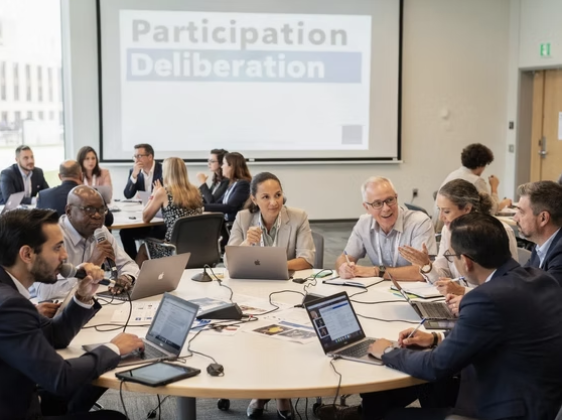
7) Citizens’ assemblies and structured deliberation
Some decisions are too complex for a simple up or down vote. Citizens’ assemblies and other deliberative models help people weigh evidence, hear trade-offs, and produce recommendations with legitimacy.
You can take action by:
- Advocating for an assembly when issues are polarized or technically complex
- Supporting good process design: balanced evidence, facilitation, public documentation, and clear decision linkage
- Participating in public comment phases that complement an assembly’s work
This type of participation aims to improve decision quality, not just participation volume.
Connection to the manifesto: the manifesto emphasizes that democracy needs better civic reasoning, not only more inputs. Structured deliberation is one way to institutionalize public reasoning.
8) Oversight, accountability, and “follow the implementation” work
One of the most neglected types of civic participation is oversight. Many public processes collect feedback, announce a decision, and then disappear into implementation, where the real impacts happen.
Oversight participation can include:
- Tracking whether commitments were delivered (timelines, budgets, milestones)
- Filing public records requests where applicable
- Monitoring procurement, grants, and service outcomes
- Publishing “what we were told vs what happened” summaries
This is where transparency becomes more than a slogan. It becomes an enforceable norm.
Connection to the manifesto: JustSocial’s manifesto argues for transparency and accountability as core democratic infrastructure. Oversight is the citizen-side muscle that makes that infrastructure meaningful.
9) Civic education and building democratic skills (especially for adults)
Democracy depends on skills: understanding institutions, evaluating claims, deliberating respectfully, and reading public data. If people lack these capabilities, participation becomes vulnerable to manipulation, misinformation, and burnout.
Civic education can be civic participation when it is practical and community-based, for example:
- Running a local “how decisions get made here” workshop
- Teaching media literacy and information resilience
- Practicing deliberation formats in community settings
- Translating dense policy into plain language summaries
Connection to the manifesto: “The Face of Democracy” places major emphasis on education reform and civic development. The manifesto’s broader institutional vision (including an academic branch concept) treats learning as part of governance capacity, not an afterthought.
10) Civic tech and democracy infrastructure building
Not everyone wants to speak at meetings, but many people can contribute through technology, design, research, operations, or product thinking.
Civic tech participation can include:
- Helping test civic participation prototypes and providing structured feedback
- Supporting accessibility, language inclusion, and usability reviews
- Contributing to transparency artifacts and public documentation
- Building tools that strengthen integrity (identity and eligibility options, auditability, anti-manipulation safeguards)
This is also where JustSocial’s mission is most explicit: empowering citizens and governments with technology-driven tools for participation and transparency.
Connection to the manifesto: the manifesto frames democratic technology as infrastructure that must be designed for legitimacy, inclusion, and auditability. Civic tech work is not just “building an app,” it is building institutional trust.
Map: which type fits your time, risk, and desired impact?
The table below is a simple way to choose among types of civic participation based on what you can realistically sustain.
| Type of civic participation | Best for | Typical civic stage | Time cost | Key success signal |
| Voting and election participation | Baseline legitimacy | Decision (leadership selection) | Low | Higher turnout and informed choice |
| Contacting decision makers | Concrete policy change | Agenda to decision | Low to medium | Written response, meeting, or agenda placement |
| Public meetings and hearings | Local decisions | Deliberation to decision | Medium | Public record includes your input and next steps |
| Organizing and coalitions | Sustained influence | All stages | Medium to high | Reliable team, repeatable actions, measurable wins |
| Campaign volunteering | Direction-setting | Agenda and leadership | Medium | Voters reached and retained, ethical operations |
| Participatory budgeting | Budget priorities | Decision and implementation | Medium | Funded projects delivered and tracked |
| Citizens’ assemblies | Complex trade-offs | Deliberation | Medium | Published recommendations and decision linkage |
| Oversight and accountability | Real-world outcomes | Oversight | Medium | Implementation tracked, discrepancies documented |
| Civic education | Long-term capacity | All stages | Medium | People gain decision literacy and resilience |
| Civic tech building | Scalable infrastructure | All stages | Medium to high | Tools adopted with transparency and safeguards |
A note on legitimacy: participation should be safe, inclusive, and resistant to manipulation
Not all participation is automatically democratic. Poorly designed processes can amplify the loudest voices, exclude people with less time or access, or be gamed by coordinated manipulation.
JustSocial’s manifesto and related work emphasize that participation must be paired with safeguards: accessibility, transparency, proportional identity and eligibility controls, clear rules, and auditability. If you are joining or designing a participation effort, look for those properties, not just “engagement.”
Frequently Asked Questions
What are the main types of civic participation? The main types of civic participation include voting, contacting officials, attending public meetings, organizing, volunteering, participatory budgeting, citizens’ assemblies, oversight, civic education, and civic tech building.
Which type of civic participation has the biggest impact? The biggest impact usually comes from actions that are decision-connected and repeatable, such as local organizing tied to a specific decision, participatory budgeting, or ongoing oversight that forces follow-through.
Is civic participation only political or partisan? No. Many forms are nonpartisan by design, like oversight, civic education, accessibility work, or improving public transparency. Even when values differ, better process can benefit everyone.
How do I avoid burnout when getting involved? Pick one action you can repeat, join a small team, and focus on measurable outcomes. Continuous democracy depends on sustainable participation, not heroic one-time effort.
How does technology change civic participation? Technology can lower barriers to participation and improve transparency, but it also introduces risks like misinformation and manipulation. Legitimate civic tech needs safeguards like auditability, accessibility, and clear governance.
Take the next step with JustSocial
If you want your civic participation to be more than a comment box, explore JustSocial’s manifesto to see the bigger vision: continuous direct democracy supported by transparent, accountable processes and technology that treats participation as public infrastructure.
You can also visit JustSocial.io to learn about the movement’s direction and ways to engage, including opportunities to support, collaborate, and get involved with emerging prototypes and community efforts.