Definition of the Concept of Utopia
Utopia, as coined by Thomas More in 1516, is not merely an imaginary and unattainable perfection. In fact, it serves as a critical instrument that holds a mirror to society and outlines practical alternatives to reality.
Good utopias do not escape reality but elevate the political imagination. They allow us to ask what welfare, equality, and proper governance are, and then translate the answers into principles, actions, and policies.
From the Greek Polis to the Modern State
Direct democracy began in the polis (city-state) in Greece, through direct participation in people’s assemblies, frequent voting, and civic service as part of citizenship. The Roman Republic developed the system with representative institutions, meaning a transition to less broad assemblies and granting powers to councils and representatives. In early nation-states, there were already expanding parliaments, but they remained a narrow elite.
In 1776, the United States was established as the first modern democratic republic with a written constitution, checks and balances, and elected representatives. This model served as a bridge between classical ideas and the representative democracy of nation-states and prepared the ground for the expansion of rights later on.
During the 19th and 20th centuries, citizens in many countries were granted universal suffrage, mass parties were established, and a system of professional bureaucracies and broad media began. This brings us to the 21st century characterized by large states, huge populations, available but polarized information, and a demand to return the voice to the people.
In representative democracy, citizens can control their destiny only rarely, while the daily arena of policy is conducted without them. This is the failure point that needs to be fixed in the aspiration for utopia.
Limitations of Representative Democracy
In recent years, there has been a consistent decline in public trust in political institutions, alongside erosion in participation (voting).
Data in Israel and around the world indicate low trust rates in governments and a growing trend of dissatisfaction with the functioning of democracy. At the same time, voting rates in many countries are declining over time, even if there are local waves of temporary increases.
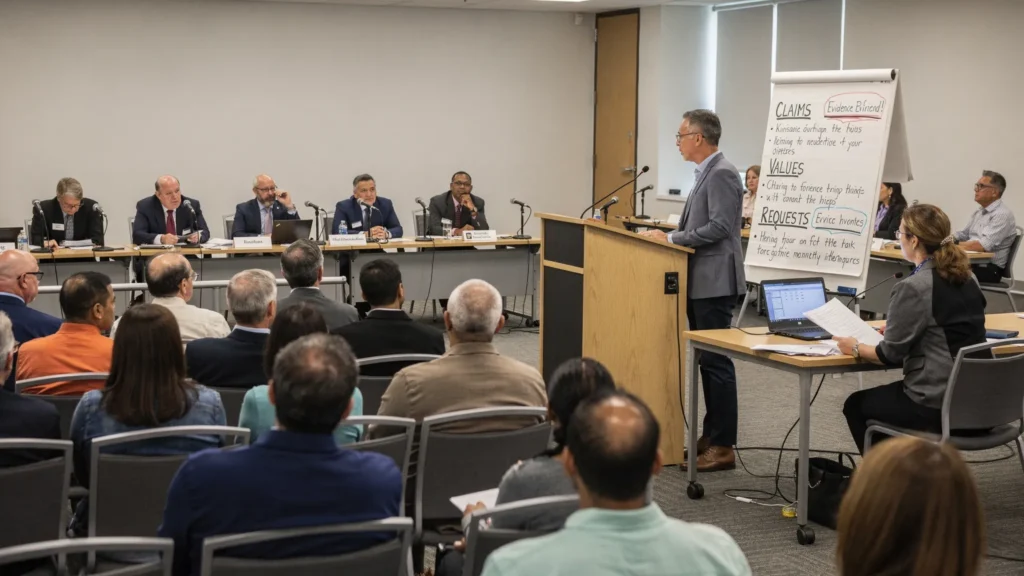
The result is a built-in gap between the public agenda and the institutional agenda. When representation is limited to elections once every few years, a mismatch is created between civic priorities and daily decisions on education, health, infrastructure, and economy. This gap is not fate but a design failure that can be fixed.
Technology as an Enabler of Democratic Change
- Digital participation platforms: arenas for proposals, discussions, document sharing, monitoring of implementation.
- Secure voting systems: remote voting, identity verification, and end-to-end encryption.
- Public analytics tools: continuous public opinion measurement, mapping of priorities by region and topic, identification of service gaps.
- Artificial intelligence: assistance in summarizing complex materials, generating policy alternatives, and assessing impacts.
Technological tools have enormous potential to expand participation, shorten geographic distances, and create transparency and coherence in data. However, they come with risks such as privacy violations, information manipulation, impact of digital divides, dependence on immature tools, and algorithmic bias.
In order to get as close as possible to a utopian reality where technology empowers democracy, principles must be established for secure digital identity, open source where possible, public criticism, and gradual implementation with regulatory oversight.
Innovative Models for Participatory Governance
Participatory Budgeting in European Cities
In cities like Paris and Barcelona, part of the investment budget is directed to residents’ decisions. Residents propose projects, rank them, and decide, and the authority commits to implementing and reporting regularly.
Citizens’ Assemblies in Ireland and France
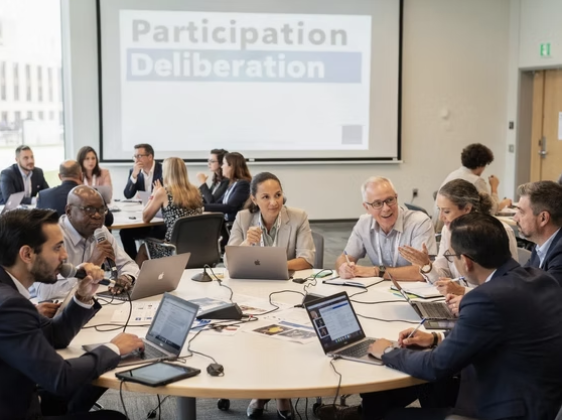
Representative citizens (in a sample model from the population) receive time, knowledge, and professional guidance, and convene to formulate recommendations on core issues. The model reduces polarization and allows reliance on quality citizen knowledge that feeds policy.
Platforms for Digital Participation
Using open source tools, such as Decidim and CONSUL, it is possible to share proposals, hold discussions or open parliament, and plan an inclusive budget. The widespread adoption of these tools proves that technology can serve as shared infrastructure for different authorities.
Shared Principles
- Transparency of processes and decisions.
- Inclusion and accessibility.
- Professional framing supported by data.
- Commitment to continuity, not just a one-time event.
- Binding connection between participation and implementation and oversight.
Active Citizenship in the 21st Century
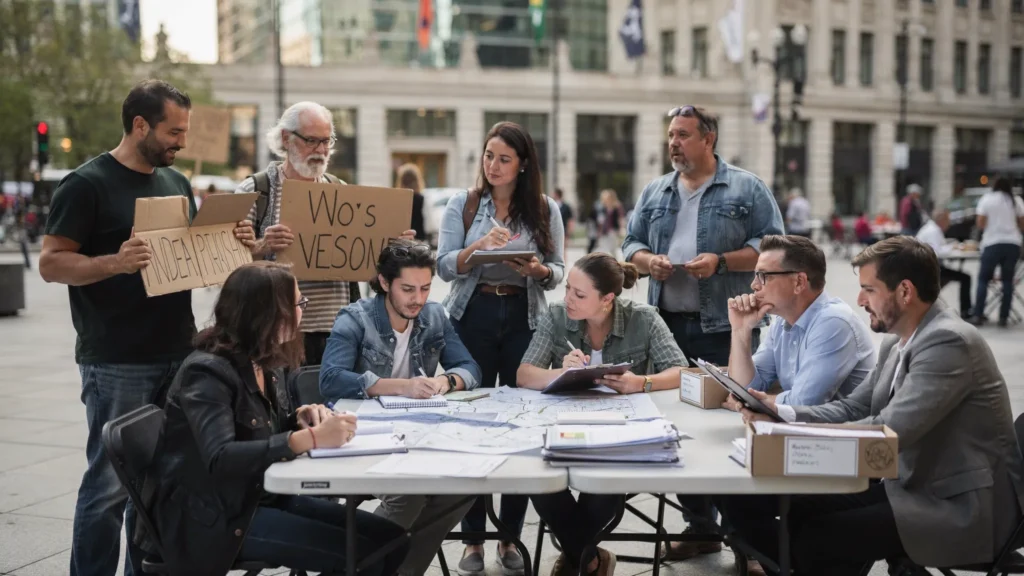
Civic duty does not have to end at the ballot box. The formal system can be complemented through advanced education, critical thinking, and digital literacy. The goal is to shape a generation with a culture of political dialogue and community initiatives, capable of reading data, asking questions, and formulating alternatives.
When the classroom, the community, and the authority speak the same language of data, experimentation, and discussion, active citizenship becomes routine.
Practical Implementation of Democratic Change
Current examples at the local and national level:
- Urban planning with public participation: open project boards, sharing of digital plans, voting on process stages, and publication of implementation status.
- Digital participation rates: citizen box for proposals, tracking of handling.
- Civic initiatives for local decision-making: communities in schools, neighborhoods, and municipalities that hold regular thematic votes and document them accessibly.
Continuous direct democracy should exist alongside the representative system. Representation remains the foundation of stability, and ongoing participation returns legitimacy to people with the help of quality information and adaptive governance.
Summary – From Utopia to Reality
The 21st century allows us to turn imagination into a working system. At JustSocial, we work to encourage civic participation that will improve representative democracy and return the lost voice to the public.
Our mission is to provide accessible tools for continuous direct democracy, and to accompany governments and authorities in implementing technologies that promote transparency, inclusion, and efficiency.
We are developing and demonstrating key components: TakeAction! as a news space that enables immediate action; rParliament for broadcasting and documenting committee discussions; rConsensus for managing secure community votes; an analytics layer that connects participation data to policy; complementary ideas such as an open law database and AI tools for the classroom and authority. Alongside this, we operate in a B2G format to help authorities adopt solutions gradually, controlled, and safely.
We believe in privacy and security standards, integration of open source where possible, active accessibility to reduce digital gaps, and a binding connection between participation processes and decisions. The transition from utopia to a working scheme includes fewer slogans and more real projects, measurement, and transparency.
If you too see democracy as a space for daily partnership, join us. You can support, volunteer, test the prototypes, and suggest ideas. Together we can turn the historical inspiration of the polis and our vision into an Israeli and digital system that works for all of us, day by day.
Responsible digital platforms and sharing models that respect pluralism. This is the direction we are promoting at JustSocial. Those who believe that democracy should always be accessible and not just on election day are invited to join the effort, to influence, and to give all our voices real weight in public policy.