Political movement training for first-time organizers should not begin with slogans, follower counts or a demand to become louder online. It should begin with a harder skill: helping people turn frustration into civic participation that can be heard, tested, recorded and improved.
For JustSocial, that matters because the movement’s manifesto argues that modern political life still carries too many relics of the Industrial Revolution: centralized institutions, slow bureaucracy and a public reduced too often to voters, taxpayers and consumers. The alternative is continuous direct democracy, where citizens have a meaningful role in public life between elections, not only on election day.
Training is where that vision either becomes practical or stays rhetorical. First-time organizers need more than motivation. They need habits, facilitation skills, transparent processes and a disciplined way to help communities deliberate without collapsing into noise.
Political Movement Training for First-Time Organizers: The Core Shift
The first shift is from persuasion to participation. A traditional campaign asks, “How do we get people to support us?” A democratic organizing model asks, “How do we help people think, speak, decide and act together?”
That difference changes the entire training program. New organizers are not only message carriers. They become stewards of public learning. Their job is to help neighbors understand an issue, compare options, record disagreement and create decision-ready civic work.
This is especially important for a movement built around direct democracy. If people are asked to participate more often, the quality of that participation matters. Continuous participation without structure becomes exhaustion. Continuous participation with training becomes civic capacity.
In the JustSocial manifesto, Yuval D. Vered connects this idea to the ancient Polis and the future Cosmopolis: a public culture where citizens feel that the state is not remote from them, but something they help shape. Political movement training for first-time organizers should make that feeling concrete in small, repeatable ways.
Start With a Participation Promise
Before a first-time organizer learns outreach scripts, event planning or digital tools, they should be able to explain the movement’s participation promise in one sentence.
A participation promise tells people what their involvement will produce. It is not a vague invitation to “get involved.” It is a clear civic contract: if you give time, attention or expertise, the movement will turn that contribution into visible public work.
For a JustSocial-style movement, the promise might be: your voice will be collected respectfully, your reasoning will be documented, your community’s preferences will be measured transparently and public representatives will be pressured to respond to the result.
Translate ideals into commitments
Many new organizers can repeat values. Fewer can translate values into operating commitments. Training should help them move from abstract words such as democracy, transparency and empowerment into behaviors people can see.
| Value | Training commitment | What participants experience |
|---|---|---|
| Civic participation | Every meeting has a clear way to contribute | People know how their input is used |
| Deliberative democracy | Arguments are compared by evidence and tradeoffs | People hear more than slogans |
| Discursive democracy | Language, framing and identity are treated seriously | People feel less erased by the process |
| Government transparency | Notes, votes and next steps are published when appropriate | People can verify what happened |
| Citizen empowerment | Volunteers own real responsibilities | People become builders, not spectators |
This table is not theory for its own sake. It is a checklist for trust. First-time organizers should be taught that people do not stay involved because a movement sounds important. They stay involved when the process respects their time.
Teach listening before recruitment
Most new organizers want to recruit immediately. That instinct is understandable, but premature recruitment often creates shallow support. People sign a form, join a chat group and disappear.
Political movement training should teach listening as the first civic act. Organizers can conduct short issue interviews, host small conversations and collect stories from residents affected by a public problem. The point is not to extract quotes for marketing. The point is to understand how people define the problem before the movement asks them to support a solution.
A simple listening practice can ask four questions: what is the issue, who is affected, what has already been tried and what would a fair public response look like? When organizers bring those answers back into group discussion, civic participation starts to feel real.
Train Organizers to Facilitate Deliberation, Not Win Arguments
First-time organizers often enter politics through moral urgency. That urgency matters, but it can make them treat disagreement as betrayal. A movement that wants continuous direct democracy cannot afford that habit.
Deliberative democracy asks people to weigh reasons together before reaching conclusions. It does not require everyone to agree. It does require a process where participants can hear competing claims, test assumptions and understand the cost of each option.
What deliberation looks like in practice
Training should give organizers facilitation tools they can use in rooms, online forums and local working groups. They need to know how to frame an issue, separate facts from values and keep discussion focused on choices.
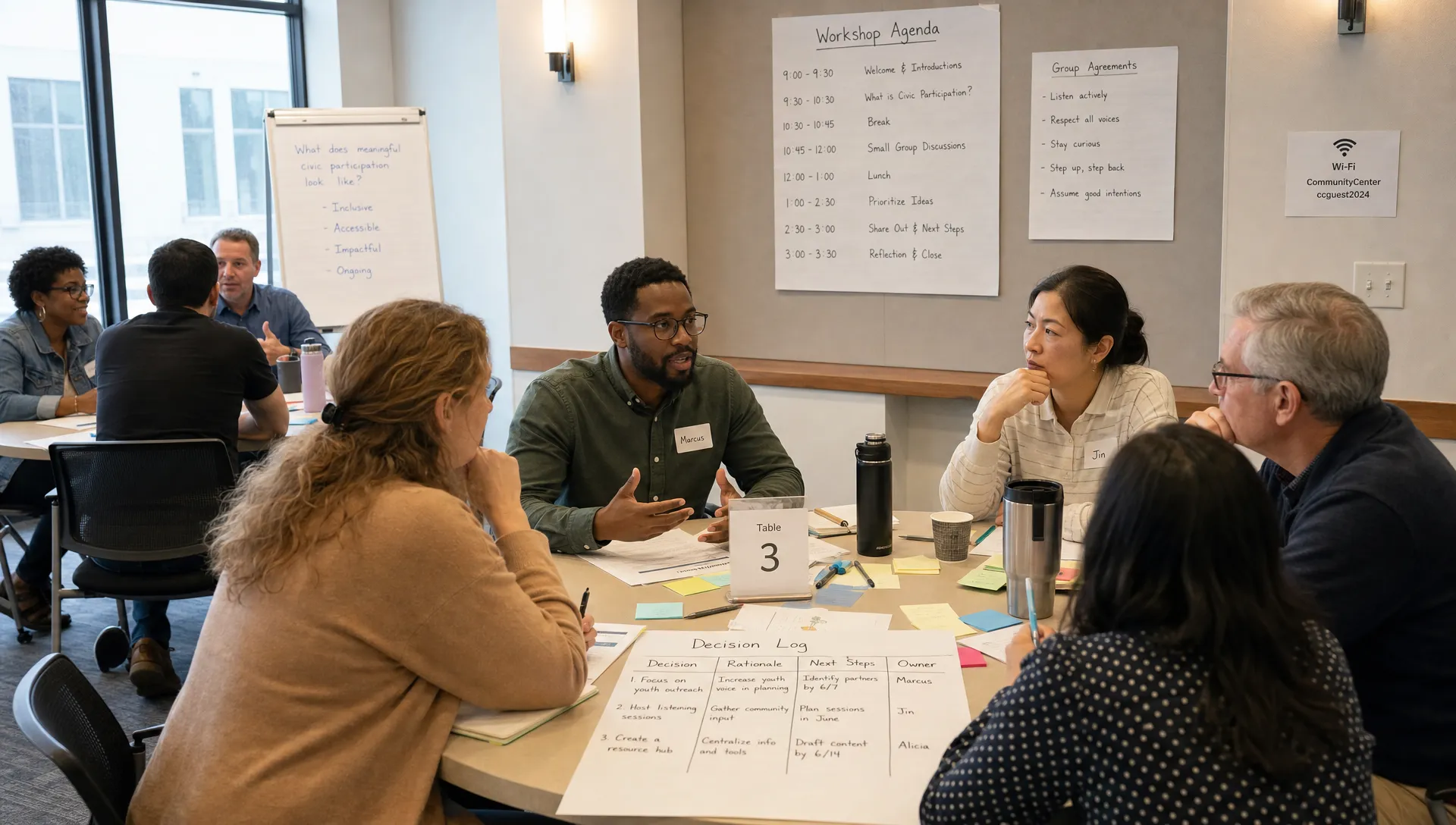
A useful facilitation rhythm is: define the problem, list affected groups, map options, name tradeoffs, test support and record unresolved concerns. This turns a meeting from a series of speeches into a civic production process.
For example, if a community is discussing school reform, the organizer should not begin by asking who supports a specific policy. They should ask what students, parents, teachers and administrators each need from the system. That approach reflects the manifesto’s concern that education should move away from industrialized teaching sprints and toward more holistic public learning.
Why discursive democracy belongs in organizer training
Discursive democracy focuses on the public conversation itself: who gets heard, which words define the debate and how social status affects whose reasoning is taken seriously. This is not cosmetic. Language often decides whether people feel invited into democracy or pushed outside it.
First-time organizers should learn to notice when jargon excludes people, when a loud participant dominates or when a community’s lived experience is treated as less valid than institutional language. They should also learn to summarize disagreement fairly. A participant who feels misrepresented will not trust the process, even if the final vote goes their way.
Build a Training Path, Not a One-Time Orientation
A welcome call is not training. A volunteer handbook is not training. Political movement training for first-time organizers should be a path with practice, feedback and responsibility that grows over time.
An eight-week training structure is enough to give new organizers a foundation without overwhelming them. It should mix political education, practical exercises and real civic output.
| Week | Training focus | Practice assignment | Civic output |
|---|---|---|---|
| 1 | Movement purpose and participation promise | Explain the movement in plain language | One clear organizer statement |
| 2 | Community listening | Interview three residents or stakeholders | Listening notes with recurring themes |
| 3 | Issue mapping | Identify causes, affected groups and decision-makers | Public issue brief |
| 4 | Deliberation facilitation | Run a 45-minute structured discussion | Meeting summary with tradeoffs |
| 5 | Discursive democracy | Rewrite exclusionary language into accessible language | Inclusive discussion guide |
| 6 | Digital tools and transparency | Publish notes, tags or decision records | Transparent public record |
| 7 | Team roles | Assign responsibilities for research, outreach and facilitation | Small civic team charter |
| 8 | Public action | Present a proposal, petition or representative briefing | Decision-ready civic artifact |
The phrase “civic artifact” may sound technical, but the idea is simple. Each training cycle should produce something reusable: a briefing, a public note, a mapped issue, a meeting record or a proposal. This prevents organizing from becoming a loop of meetings about future meetings.
Teach the Tools Without Worshiping the Tools
JustSocial promotes technology-driven tools for participation and transparency, including direct democracy tools, online voting platforms, decision-making software and public transparency initiatives. But the core lesson for organizers is that tools do not create democracy by themselves.
A platform can collect votes, but it cannot guarantee that people understood the question. Analytics can show patterns, but they cannot decide what is just. AI can summarize discussions, but it cannot replace human responsibility for fairness. Blockchain may help with auditability in some contexts, but it does not solve every trust problem.
Political movement training should therefore teach three questions before introducing any tool: what civic problem does this solve, what risk does it create and who is accountable if it fails?
The manifesto’s technology section points to social platforms, cloud storage, analytics, possible blockchain infrastructure and AI language models as existing tools that could be redirected toward public life. First-time organizers should understand that technology is not the movement’s substitute for citizens. It is the scaffolding that can make wider participation possible.
Use growth discipline ethically
Movements can learn from startup and marketing disciplines without treating citizens as targets to be manipulated. Clear positioning, creative testing, KPI reporting and feedback loops can help organizers see what is working and what is not. For example, studying how performance marketing and brand acceleration teams connect audience insight with measurable growth can help a civic organization become more disciplined, as long as the purpose remains public empowerment rather than consumer conversion.
The ethical line is straightforward. A democratic movement should measure participation so it can serve people better, not exploit their attention. If a metric rewards outrage, the training program should teach organizers to reject it.
Practice Public Transparency From Day One
Transparency is not something to add after a movement gains power. It is a habit that must be trained early, when the stakes are still small enough for people to learn.
First-time organizers should be taught how to publish meeting notes, record decisions, name open questions and explain why a choice was made. That does not mean exposing private information or creating security risks. It means building a culture where public work leaves a public trail.
This connects directly to JustSocial’s idea that public committees, except those dealing with sensitive defense or national security issues, should be visible through recordings and documents. A movement asking governments to become transparent must model transparency inside its own organizing.
If your team is still building the basics, JustSocial’s guide to movement infrastructure before scale is a useful companion because it frames infrastructure as the condition for durable participation, not a bureaucratic luxury.
Convert Supporters Into Civic Teams
A first-time organizer should not be trained to do everything alone. That path leads to burnout and hidden hierarchy. The healthier model is a small civic team with clear roles.
A civic team might include a listener who gathers community input, a researcher who checks claims, a facilitator who runs deliberation, a documenter who publishes records and a liaison who communicates with public officials or partner groups. The titles matter less than the principle: responsibility should be visible.
This approach also protects the movement from personality politics. If the work depends on one charismatic person, it will weaken when that person leaves. If the work is held by a team with shared methods, it can reproduce.
For a deeper role-based approach, JustSocial’s article on volunteer roles that actually matter explains how volunteers can produce durable civic value instead of only amplifying posts.
What First-Time Organizers Should Track
Training needs measurement, but the metrics should match the mission. A movement committed to civic participation should not judge success only by crowd size, impressions or donations.
Good metrics ask whether people are becoming more capable democratic actors. Are they learning? Are they returning? Are they producing public work? Are decision-makers being forced to respond?
| Metric | What it reveals | Healthy signal |
|---|---|---|
| Returning participants | Whether people trust the process | People come back after their first meeting |
| Issue briefs produced | Whether discussion becomes usable work | Teams publish clear summaries |
| Diversity of speakers | Whether participation is broad or captured | More voices contribute over time |
| Documented disagreements | Whether dissent is respected | Minority views are recorded accurately |
| Public official responses | Whether civic work reaches power | Representatives acknowledge or answer proposals |
| Organizer retention | Whether training prevents burnout | New organizers stay active for months, not days |
Metrics should be reviewed in training sessions, not hidden in leadership dashboards. If continuous direct democracy means citizens help govern public life, then the movement’s own learning data should become part of its shared reflection.
Common Training Mistakes to Avoid
First-time organizers are often asked to move fast. Speed matters during moments of public urgency, but poor training creates avoidable damage. The most common mistakes are easy to name and hard to unlearn later.
- Teaching talking points before teaching listening
- Confusing online engagement with civic participation
- Allowing meetings to end without notes or next steps
- Treating disagreement as disloyalty
- Giving volunteers tasks without authority
- Measuring attention instead of democratic capacity
- Using technology before defining the civic process
A better training culture slows down enough to build trust, then speeds up because people know what they are doing. This is the operational meaning of citizen empowerment: not flattering people as “the people,” but giving them the methods to act together.
The Deeper Purpose: From Voters to Co-Governors
The manifesto’s social contract section argues that citizens are too often reduced to voters, taxpayers and consumers. Political movement training for first-time organizers should reverse that reduction.
The goal is not to replace representative institutions with constant referendums on every issue. JustSocial’s vision is more nuanced: citizens should be continuously heard, public opinion should be measured responsibly and representatives should be forced to take public reasoning into account.
That requires organizers who can build bridges between street-level experience, digital participation, academic knowledge and public institutions. It also requires humility. No first-time organizer has all the answers. The training should make that explicit: democracy is not the rule of one organizer’s certainty, but the disciplined search for better collective judgment.
When training works, people stop seeing politics as a distant performance by professionals. They begin to experience politics as shared public work. That is the road from a passive republic to a more continuous, participatory democracy.
Frequently Asked Questions
What should political movement training include for first-time organizers? It should include movement purpose, listening skills, issue mapping, deliberation facilitation, transparent documentation, digital tool literacy, team roles and ethical measurement.
How is this different from campaign volunteer training? Campaign training often focuses on persuasion, turnout and message discipline. Movement organizer training should focus on civic participation, public learning, community deliberation and durable democratic infrastructure.
Do first-time organizers need technology skills? They need enough technology literacy to use participation tools responsibly, understand privacy risks and publish transparent records. They do not need to be engineers, but they should know what a tool is meant to solve.
Why are deliberative democracy and discursive democracy part of the training? Deliberative democracy helps people compare reasons and tradeoffs. Discursive democracy helps organizers notice how language, framing and power affect who is heard in public life.
How many people are needed to start training organizers? A small group is enough. One facilitator, a few committed participants and a clear training path can produce useful civic artifacts before the movement has large numbers.
Ready to Train the First Circle?
A political movement does not become democratic because it says the word democracy. It becomes democratic when its first organizers learn to listen, deliberate, document, share power and build tools that make participation easier for the next person.
If JustSocial’s vision of continuous direct democracy speaks to you, start small. Gather a first circle, choose one public issue, run one structured discussion, publish one transparent record and invite others to improve it. That is how training becomes civic infrastructure, and how civic infrastructure becomes a movement.