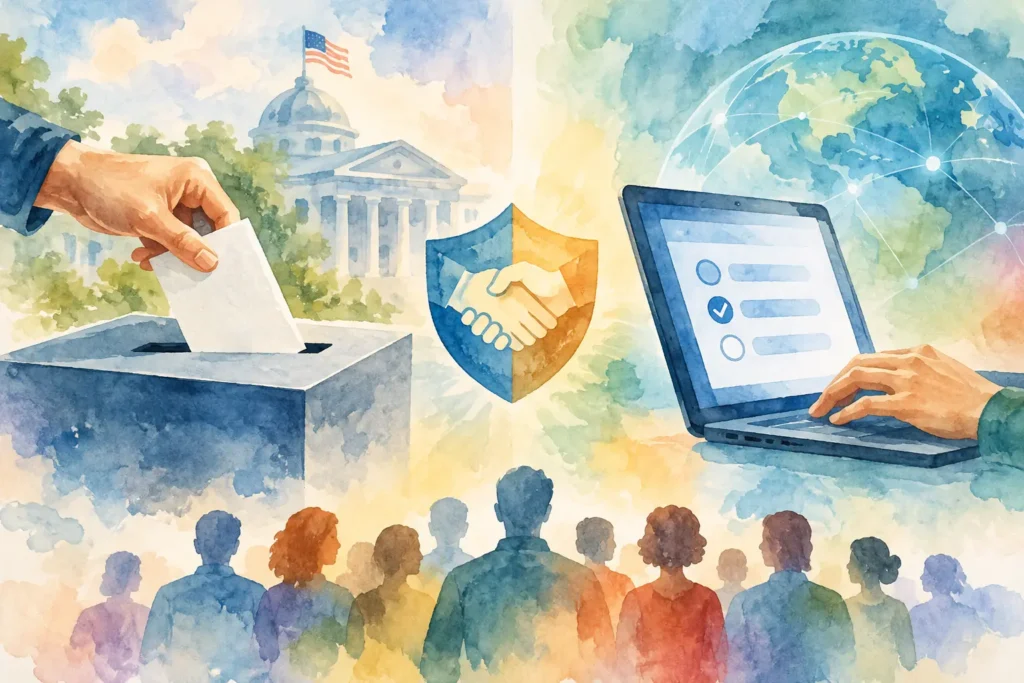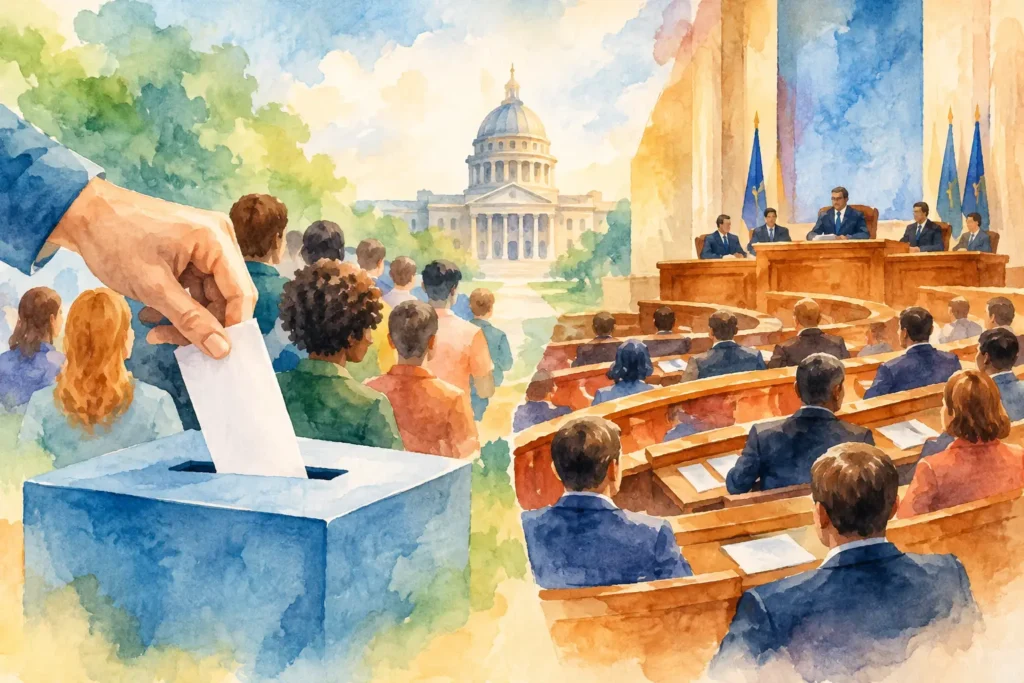
A resident spends an hour at a public meeting, submits thoughtful comments, and never learns whether anyone read them. A nonprofit gathers community input for a local program, but cannot explain how priorities were selected. These are not small communication failures. They teach people that participation is performative.
Learning how to build civic trust begins with changing that experience. Trust grows when people can see that public institutions, community organizations, and decision-makers will listen, explain their choices, and create real opportunities for citizens to shape what happens next. It is not a branding exercise. It is a relationship built through repeated evidence.
For a stronger democracy, that relationship cannot appear only at election time. Citizens need accessible ways to participate in the decisions that affect their schools, streets, housing, health, safety, and public resources throughout the year.
Civic Trust Is Earned Through Experience
Civic trust is often described as confidence in government. That is true, but incomplete. Trust also concerns whether people believe they have standing in public life: that they can understand a process, contribute without insider connections, and receive an honest response.
People do not need every public decision to go their way in order to trust the process. They do need to know the rules were clear, their perspective was treated with dignity, and the final decision was not made behind a closed door. A community can accept difficult trade-offs when leaders explain the constraints, show the evidence, and acknowledge disagreement.
This distinction matters because trust is not the same as approval. A city may need to delay a project because funding fell through. A nonprofit may have to prioritize one neighborhood before another. Trying to make every outcome sound positive can weaken credibility. Plain language about what is possible, what is not, and why is more durable than polished reassurance.
How to Build Civic Trust With Meaningful Participation
The most reliable way to build trust is to give people meaningful influence before decisions are final. Asking for feedback after a plan is effectively complete invites frustration, especially among communities that have repeatedly been excluded from public power.
Meaningful participation starts early. Share the question the community can actually help answer. Is the public helping set priorities, choosing among options, reviewing a proposal, allocating funds, or monitoring implementation? Each role carries a different level of influence. We should name it clearly.
Make the scope honest and specific
Vague invitations such as “share your thoughts” place the burden on residents while hiding the real boundaries of a decision. A better invitation states the decision, the available resources, who holds final authority, and the timeline for action.
For example, rather than asking residents what they want from a neighborhood improvement fund, explain the amount available, eligible uses, geographic boundaries, and how proposals will be selected. Constraints do not make participation less democratic. Hidden constraints do.
When officials or organizers do not yet know the answer, they can say so. Public uncertainty is not a weakness if it is paired with a genuine process for finding direction together.
Close the feedback loop every time
The most trust-building message is often the one that arrives after participation ends: “Here is what we heard. Here is what changed. Here is what did not change, and why.”
Without this step, surveys, listening sessions, and digital comment forms become one-way collection systems. Participants are asked to give time, experience, and often personal stories, yet receive no evidence that their contribution mattered. That pattern produces civic fatigue.
Closing the loop should be understandable without specialized knowledge. Use plain language, publish a clear record of decisions, and make the response available through more than one channel. For communities with limited internet access or language barriers, a digital update alone is not enough. Trust requires outreach that meets people where they are.
Share power, not just information
Public information is essential, but transparency without participation can still leave citizens watching from the sidelines. Communities build deeper trust when they can help set agendas, develop solutions, and evaluate results.
The appropriate level of shared power depends on the decision. Emergency response may require fast action. Legal requirements may limit what can be delegated. Technical questions may need expert analysis. Even then, there is room to explain the rationale, invite public oversight, and create future opportunities for input.
For decisions with broad community impact, participatory budgeting, citizen assemblies, neighborhood voting, advisory groups with real authority, and open proposal processes can move engagement beyond consultation. The point is not to use one model everywhere. The point is to match the method to the stakes and give the public a role that is real.
Build Civic Infrastructure People Can Use
Participation cannot depend on finding the right meeting, knowing the right person, or having time off during business hours. If democracy is to be continuous, civic infrastructure must be as understandable and available as the everyday tools people use to manage their lives.
Digital tools can help by making public decisions visible, collecting ideas, supporting accessible voting, documenting deliberation, and reporting outcomes. But technology does not automatically create inclusion. A confusing platform can add another barrier. A system that collects data without accountability can make distrust worse.
Good civic technology is designed around public purpose. It should tell residents what is being decided, why it matters, how to participate, and what happens after they respond. It should work on mobile devices, support accessibility needs, protect personal information, and avoid requiring unnecessary technical fluency.
Digital participation also needs an offline counterpart. Libraries, community centers, schools, faith communities, local nonprofits, and trusted neighborhood leaders can help connect residents to a process. The strongest approach is not digital-only or in-person-only. It gives people multiple paths into the same public conversation.
Transparency Must Include the Hard Parts
Publishing documents is not the same as being transparent. A budget buried in a difficult-to-search file may technically be public but practically unavailable. Meeting recordings without summaries can preserve a record without creating understanding.
Useful transparency helps people answer practical questions: What is being proposed? Who will be affected? What evidence informed the decision? Where is the money going? Who is accountable for delivery? When will progress be reviewed?
This is especially important when institutions make mistakes. Errors, delays, and changing conditions are unavoidable in public work. Concealing them creates a larger problem than the original failure. A timely explanation, a correction plan, and a public way to track follow-through show that accountability is active rather than ceremonial.
Transparency also requires care. Not every detail should be public, particularly when disclosure could compromise personal safety, protected information, or a fair process. The standard is not total exposure. It is a clear, principled explanation of what is shared, what is protected, and why.
Measure Trust by What People Can Do
Trust surveys can be useful, but they should not be the only measure. Communities should also examine whether residents can successfully participate and whether participation changes decisions.
Look at who is taking part, who is absent, and where barriers persist. Are meetings scheduled at accessible times? Are materials translated? Can residents participate without reliable broadband? Do young people, renters, disabled residents, working parents, and historically marginalized communities see pathways to influence?
Then examine outcomes. How quickly are questions answered? How often are decisions accompanied by public reasoning? What percentage of commitments are completed? How many community proposals advance to action? These measures reveal whether a civic process is building capacity or simply generating activity.
Just as important, publish the results and invite the public to challenge them. Institutions should not be the sole judges of whether they are trustworthy.
Start With One Decision That Matters
Trust rarely returns through a major announcement. It returns when a resident sees a promise kept, a question answered, or a local priority reflected in a decision. That is why the next step should be concrete.
Choose one upcoming decision with visible community impact. Explain the boundaries honestly. Offer more than one way to participate. Make the process accessible. Then show, in public, what the community changed.
Each time we do this, we deepen the connection between citizens and the institutions meant to serve them. Democracy becomes less like an occasional request for a vote and more like a shared practice of making public life work.