Public hearings are supposed to be one of the most direct encounters between citizens and power. A council, school board, agency, or parliamentary committee opens the room, invites the public to speak, and records what people say before a decision is made.
In practice, many hearings feel like civic theater. Citizens wait for hours, speak for two or three minutes, leave without knowing whether their words mattered, and later see a decision explained in language that barely acknowledges public input. Officials can say, truthfully, that they “heard from the public.” Citizens can say, also truthfully, that nobody really listened.
Discursive democracy offers a better way to design public hearings. It does not ask every speaker to become a policy expert. It does not eliminate protest, emotion, or disagreement. Instead, it creates rules that turn public speech into usable civic information: claims, reasons, evidence, values, tradeoffs, affected interests, and questions that decision-makers must address.
That fits closely with JustSocial’s manifesto, The Face of Democracy, which argues that people should not be reduced to voters, taxpayers, and consumers. If democracy is to become continuous, public hearings are one of the first institutions we should upgrade.
Why public hearings often fail
The central problem is not that people speak too emotionally. Public decisions are emotional because they affect schools, homes, taxes, safety, land, work, and dignity. The real problem is that most hearings lack a process for converting speech into public judgment.
A standard hearing often treats participation as a queue. Whoever signs up speaks. Officials listen or appear to listen. A clerk records minutes. Then the institution moves on. This format protects the appearance of openness, but it rarely produces a clear map of what the public actually argued.
Several predictable failures follow.
| Hearing failure | What it looks like | Democratic cost |
|---|---|---|
| Vague scope | Citizens do not know which decision is actually on the table | Input becomes unfocused and easy to ignore |
| First-come speaking order | Organized groups dominate the room | Affected but less organized people are underrepresented |
| No shared evidence | Speakers cite incompatible facts without a common record | Officials can cherry-pick convenient claims |
| No synthesis | Testimony is recorded but not meaningfully summarized | Public reasoning disappears into archives |
| No duty to respond | Decision-makers are not required to answer major arguments | Participation becomes symbolic |
| Hostile atmosphere | Speakers attack people instead of claims | Less powerful participants stay silent |
A better hearing is not just a longer open mic. It is a civic process with public rules, public artifacts, and a visible connection to decisions.
What discursive democracy means in a public hearing
Discursive democracy focuses on the quality of public discourse: who gets to speak, what frames shape the issue, which claims become visible, and how arguments are interpreted. In a hearing, its purpose is to make public talk legible without flattening disagreement.
This is different from deliberative democracy. A deliberative process usually involves structured learning, facilitated discussion, and the production of decision-ready recommendations. A public hearing is broader and more open. It may include testimony from residents, activists, experts, businesses, workers, students, parents, unions, neighborhood groups, and people who simply have lived experience.
The best design uses both models. Discursive democracy makes the public conversation fairer and more intelligible. Deliberative democracy can then take the strongest claims, evidence, and tradeoffs into a smaller, more structured process when a decision requires deeper option-building.
The OECD’s work on public deliberation emphasizes clear remit, transparency, inclusion, information, and impact as core design principles for democratic processes. Those principles are useful here, but public hearings need their own rulebook because they are usually open, time-limited, and institutionally formal.
Rule 1: publish the real decision before the hearing
No hearing should begin with a vague topic like “public safety,” “school policy,” or “zoning update.” Citizens need to know the actual decision surface.
A proper hearing notice should answer five questions:
- What decision will be made?
- Who has authority to make it?
- What options are currently being considered?
- What constraints are real, such as budget, law, timeline, or safety?
- How will public testimony be used before the decision?
This is where many institutions fail. They invite broad public input but do not reveal whether the decision is still open, partially open, or already functionally decided. Discursive democracy requires honesty about influence. If officials are only consulting, say so. If the hearing can change the proposal, state what parts can change.
The IAP2 Spectrum of Public Participation is useful for this distinction because it separates informing, consulting, involving, collaborating, and empowering. Public hearings should not pretend to empower people when the institution is merely collecting comments.
Rule 2: require a participation promise
Every public hearing should include a short participation promise. This is not a slogan. It is a procedural commitment.
A strong promise might say:
Public testimony will be summarized into a Hearing Record within seven days. The Record will identify major claims, evidence, affected groups, tradeoffs, and unresolved questions. Decision-makers will publish a written response explaining which arguments influenced the final decision, which did not, and why.
That one paragraph changes the meaning of the hearing. Citizens are no longer speaking into a void. Officials are no longer free to say “we listened” without showing what they heard.
This is the same logic behind JustSocial’s broader emphasis on public receipts: democracy should leave inspectable traces. For a deeper version of this idea, see JustSocial’s guide to building trust with public receipts.
Rule 3: separate testimony types
Not all testimony does the same civic work. A resident describing unsafe sidewalks, a business owner explaining compliance costs, and a researcher citing crash data are all valuable, but they should not be processed as identical inputs.
Hearings become clearer when speakers identify their testimony type at registration or at the start of their remarks.
| Testimony type | Purpose | Example |
|---|---|---|
| Lived experience | Shows how a policy affects daily life | “This bus change adds 40 minutes to my commute.” |
| Evidence claim | Adds data, research, or documented facts | “The city’s own report shows peak usage after 6 p.m.” |
| Value claim | Names a principle the decision should respect | “Public land should prioritize community benefit.” |
| Tradeoff warning | Identifies a cost or risk | “This rule may improve safety but reduce access for disabled residents.” |
| Alternative proposal | Offers a different option | “Pilot this in two districts before citywide adoption.” |
| Process objection | Challenges fairness or legality of the process | “The notice period was too short for affected tenants.” |
This rule does not restrict speech. It helps the institution understand what kind of civic information each speaker is providing.
Rule 4: use a claim, reason, request format
A public hearing should make room for emotion, but the formal record needs structure. The simplest format is:
- Claim: What do you want decision-makers to understand?
- Reason: Why do you believe it?
- Request: What should the institution do next?
For example: “The proposed school phone ban is too broad. Students need phones for transportation, work, and family responsibilities after school. Please consider a classroom-use restriction rather than a full-day possession ban.”
This format respects the speaker while making testimony easier to synthesize. It also reduces the advantage of professional advocates who already know how to speak in policy language.
Rule 5: equalize the queue, not just the clock
Giving every speaker two minutes is not enough. If the first hour is dominated by one organized faction, the public record will still be distorted.
Better queue rules include rotating between stakeholder categories, reserving time for directly affected groups, allowing remote and written testimony, and publishing the speaker order criteria before the hearing begins. In highly contested hearings, organizers can use a randomized queue within categories rather than a pure first-come system.
This is especially important for working people, parents, disabled residents, students, minorities, and people who cannot wait through a four-hour meeting. A hearing that is technically open but practically inaccessible is not democratic enough.
Rule 6: moderate by process, not viewpoint
Discursive democracy needs boundaries, but those boundaries should protect the process rather than censor political positions. A speaker should not be removed because their view is unpopular, harsh, or inconvenient. A speaker can be interrupted if they threaten people, disclose private information, refuse time limits, impersonate others, or repeatedly speak outside the published scope.
The difference matters. Viewpoint moderation destroys legitimacy. Process moderation protects participation.
A useful rule is: “Any lawful viewpoint may be expressed, but all speakers must follow the same format, time, safety, disclosure, and relevance rules.”
This aligns with JustSocial’s argument in Discursive Democracy vs Free Speech: democratic processes can set procedural boundaries without becoming viewpoint-policing machines.
Rule 7: create an evidence shelf before and during the hearing
Public hearings often collapse because nobody agrees on the factual baseline. A hearing on housing, policing, school closures, climate adaptation, or public procurement can easily become a battle of disconnected statistics.
Before the hearing, the institution should publish an Issue Pack with key documents, relevant laws, budget numbers, prior decisions, and known constraints. During and after the hearing, speakers should be able to submit sources into an evidence shelf.
The evidence shelf should not pretend to settle every dispute. It should make claims traceable. If a speaker says a policy will save money, the record should show whether they cited a budget memo, an outside study, an anecdote, or no source at all.
For complex topics, the hearing record can include an “uncertainty note” that identifies facts still in dispute. This is healthier than forcing fake certainty.
Rule 8: publish a live or rapid synthesis
A transcript is not enough. Transcripts preserve words, but they do not show the shape of the argument.
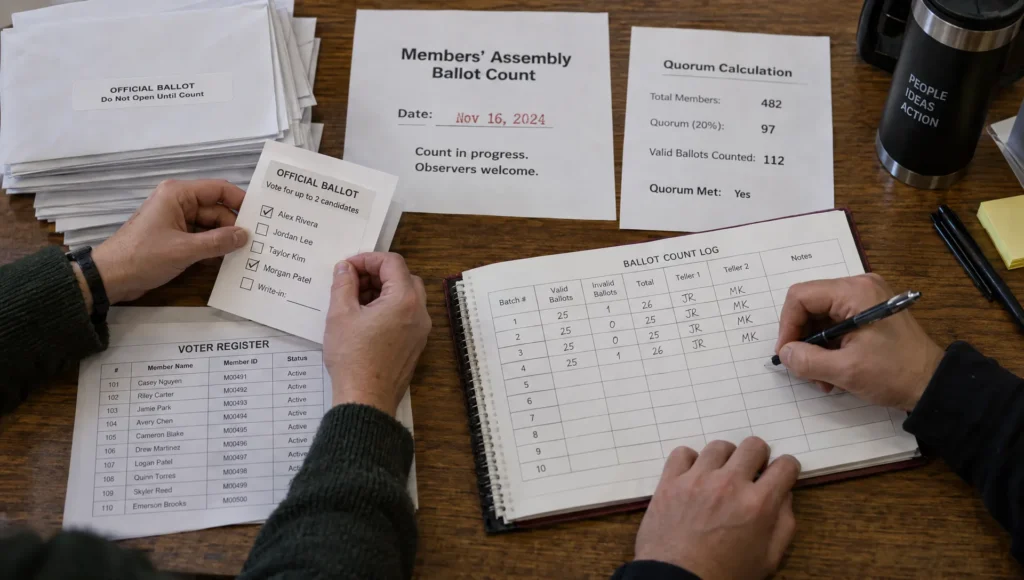
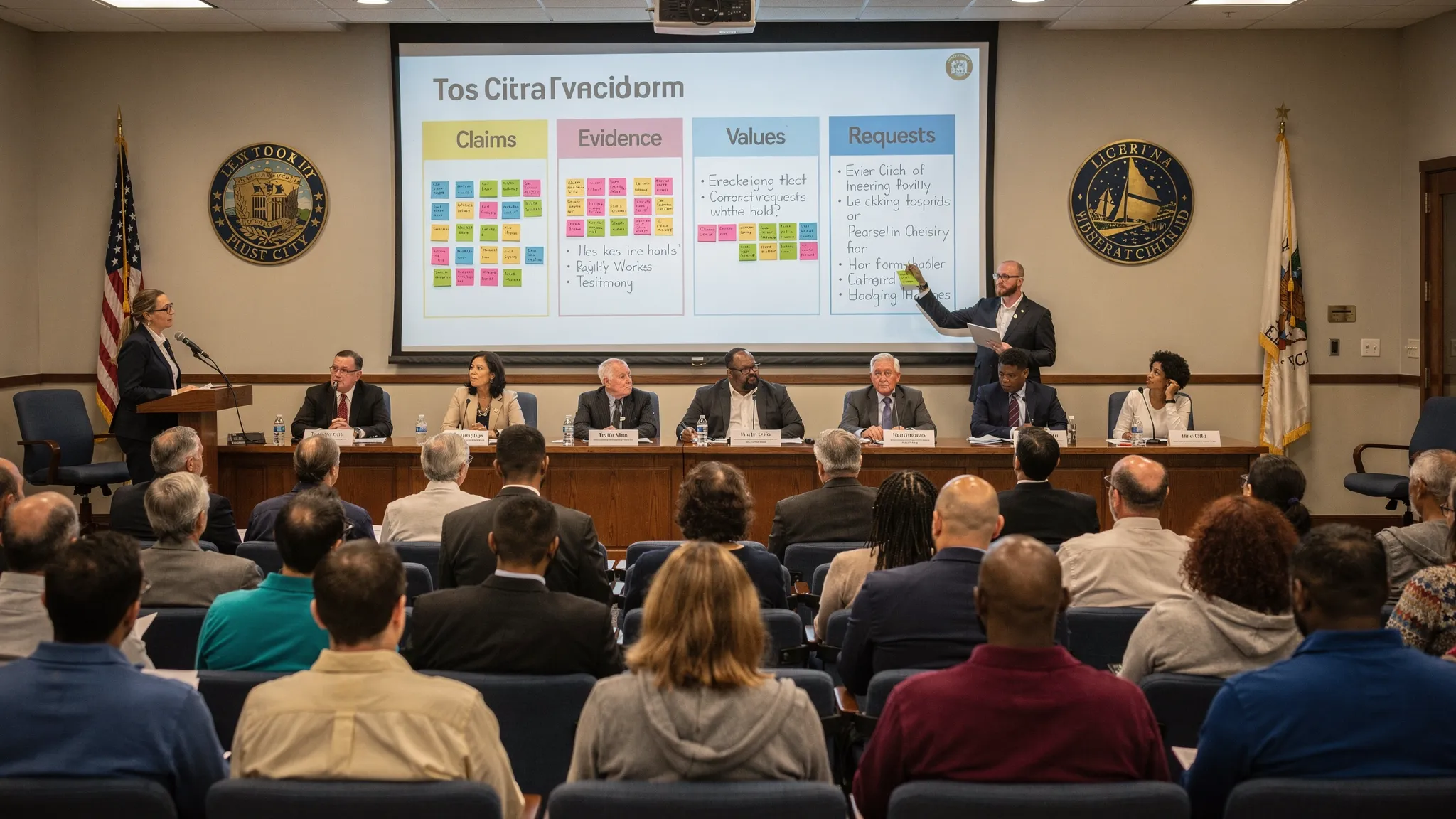
A discursive hearing should produce a synthesis that groups testimony by claims, reasons, values, affected groups, and proposed changes. Ideally, a neutral synthesis team publishes a draft within a few days and allows corrections for a short window.
A good synthesis does not say, “The public supports X.” It says something more precise: “Speakers supporting X emphasized safety and administrative simplicity. Speakers opposing X emphasized unequal burden, lack of evidence, and implementation risks. Several speakers proposed a narrower pilot.”
That level of detail helps decision-makers respond honestly. It also helps citizens see one another more clearly.
Rule 9: require a response memo
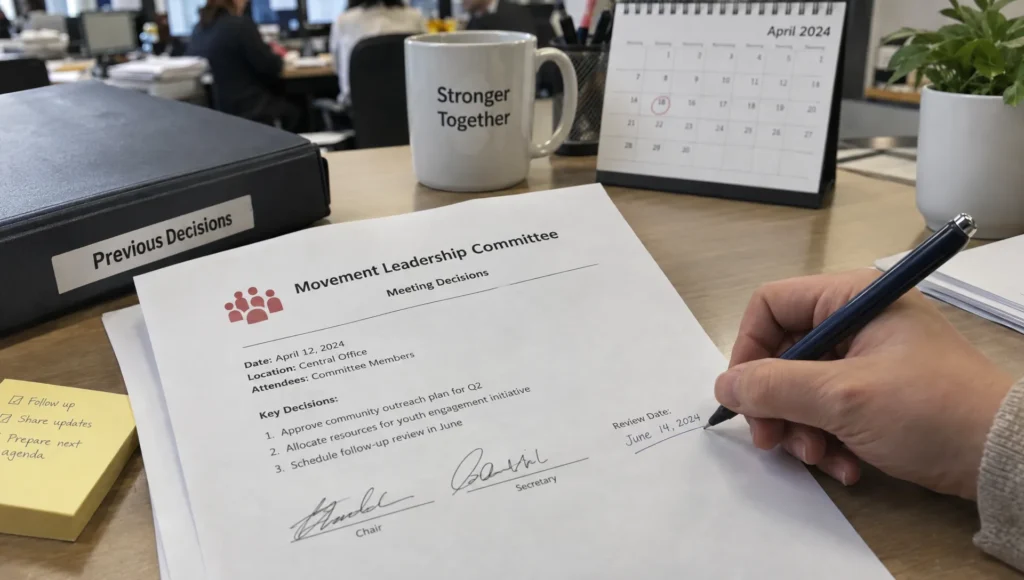
The most important reform comes after the hearing. Decision-makers should publish a response memo before the final vote or administrative action.
The memo should include:
- The final decision or recommended decision
- The major public arguments received
- Which arguments changed the proposal
- Which arguments were rejected and why
- What evidence was relied on
- What will be reviewed after implementation
This is the bridge between speech and power. Without it, citizens cannot tell whether participation mattered. With it, even people who lose can evaluate whether the institution answered them fairly.
For agencies and councils, this should become routine. For political movements, it should become a norm they model internally before demanding it from government.
Rule 10: track implementation after the decision
A hearing should not disappear after the vote. If public testimony produced commitments, those commitments need tracking.
For example, if a city approves a traffic redesign while promising a six-month safety review, the tracker should show whether the review happened, what data was collected, and whether changes followed. If a school board adopts a revised discipline policy after public testimony, the tracker should show implementation steps, complaints, and review dates.
This is where public hearings become part of continuous democracy rather than isolated events. Public input leads to a decision. The decision leads to implementation. Implementation leads to oversight. Oversight leads to the next decision.
JustSocial’s manifesto calls for citizens to have a day-to-day role in the state of the nation. That does not happen only through online voting platforms or future civic technology. It begins with ordinary institutions learning to close the loop.
A better 90-minute public hearing agenda
Not every public hearing needs to be complicated. A city committee, school board, university, or movement can start with a simple structure.
| Time | Segment | Output |
|---|---|---|
| 0 to 10 minutes | Decision statement and rules | Everyone knows the scope and process |
| 10 to 20 minutes | Issue Pack summary | Shared factual baseline |
| 20 to 65 minutes | Structured public testimony | Claims, reasons, requests, and evidence |
| 65 to 75 minutes | Clarifying questions from officials | Publicly visible information gaps |
| 75 to 85 minutes | Neutral synthesis readback | Draft map of major arguments |
| 85 to 90 minutes | Next steps and publication dates | Clear receipt timeline |
The key is not the exact timing. The key is that every hearing produces something more useful than a list of speakers.
Hybrid and online hearings need stronger rules
Digital participation can widen access, but it can also amplify manipulation, harassment, spam, and performative outrage. A hybrid public hearing should not simply add a livestream and call it democracy.
Better online rules include verified eligibility when stakes require it, privacy-protecting participation options, captions and language access, written testimony windows, public moderation logs, and clear separation between official testimony and general comment streams.
AI can help summarize testimony, identify repeated claims, improve accessibility, and translate plain-language materials. But AI should not decide which arguments matter, rank citizens by influence, or replace human judgment. JustSocial’s article on AI in Democracy makes the same point: AI should assist democratic infrastructure, not govern it.
A one-page hearing constitution
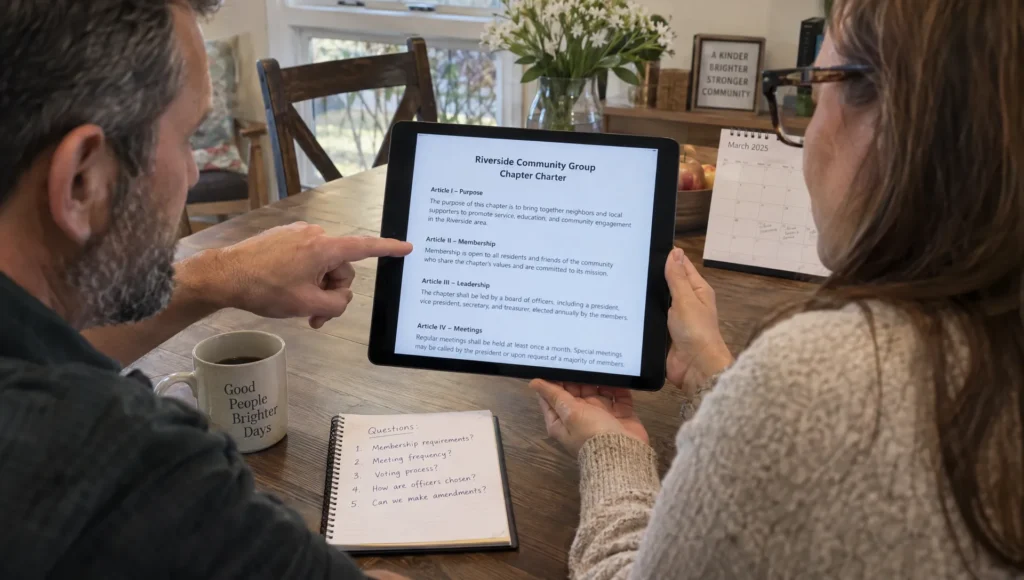
Any institution can adopt a short hearing constitution. It should be published with the agenda and repeated at the start.
Here is a practical template:
This hearing exists to gather public claims, reasons, evidence, values, tradeoffs, and requests related to the published decision. All lawful viewpoints may be expressed. Speakers must follow equal time, relevance, safety, and disclosure rules. The institution will publish a Hearing Record within seven days, including a synthesis of major arguments and submitted evidence. Before the final decision, decision-makers will publish a response memo explaining how public input affected the outcome or why it did not.
This kind of rule does not solve every democratic problem. But it changes the default from “say your piece and hope” to “speak into a process that must answer.”
How political movements can use this now
A political movement does not need to wait for government permission to model better hearings. It can run shadow hearings on major public issues, publish Issue Packs, invite officials to attend, produce Hearing Records, and demand written responses.
This is one way movements can become civic infrastructure rather than just campaign machines. Instead of only mobilizing anger, they can organize public reasoning. Instead of only counting supporters, they can publish decision-ready civic artifacts.
That is directly connected to JustSocial’s vision of a People’s Branch: a standing capacity for citizens to be heard, measured, organized, and answered. The manifesto’s proposed tools, including ideas like rParliament and rConcensus, point toward a future where public discourse, public records, and public decision-making are connected by design.
Public hearing reform is a modest but powerful step in that direction.
Frequently Asked Questions
What is discursive democracy in public hearings? Discursive democracy in public hearings means designing the hearing so public speech becomes clear, inclusive, traceable, and useful for decision-making. It focuses on claims, reasons, evidence, values, and public meaning rather than treating testimony as a disconnected open mic.
Does this limit free speech? It should not limit viewpoints. Better hearing rules should regulate process: time, relevance, safety, disclosure, evidence submission, and response duties. The goal is to protect fair participation, not suppress unpopular opinions.
How is this different from deliberative democracy? Discursive democracy improves the public conversation and surfaces the range of arguments. Deliberative democracy usually involves a more structured group that studies evidence and produces recommendations. A strong civic system uses public hearings for discourse and deliberative processes for deeper option-building.
What is the most important rule to adopt first? Start with a duty to publish a Hearing Record and response memo. Once officials must show what they heard and how they responded, the rest of the process becomes more accountable.
Can small communities use these rules? Yes. A neighborhood association, school board, nonprofit, or local movement can use a simplified version: publish the decision question, use claim-reason-request testimony, summarize arguments, and track follow-up.
Build hearings that actually hear
Public hearings should be more than a ritual before power acts. They should be one of the basic channels through which citizens shape public life between elections.
If you believe democracy needs better civic participation, stronger public transparency, and technology that serves citizens rather than replaces them, read JustSocial’s manifesto, The Face of Democracy, and explore how you can contribute to the movement.
The future of democracy will not be built only by voting every few years. It will be built by upgrading the everyday rules of public power, one hearing, one record, and one accountable decision at a time.