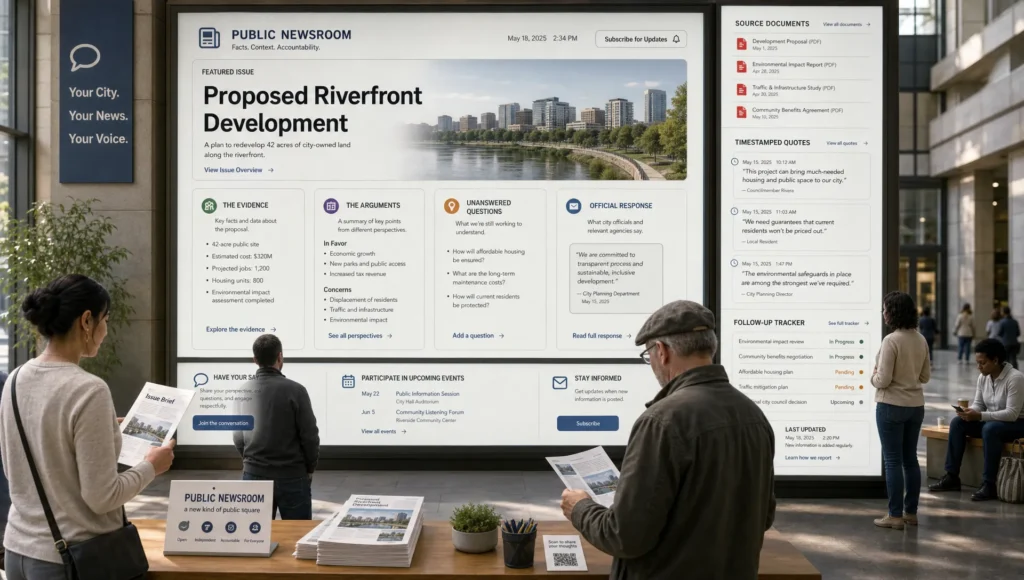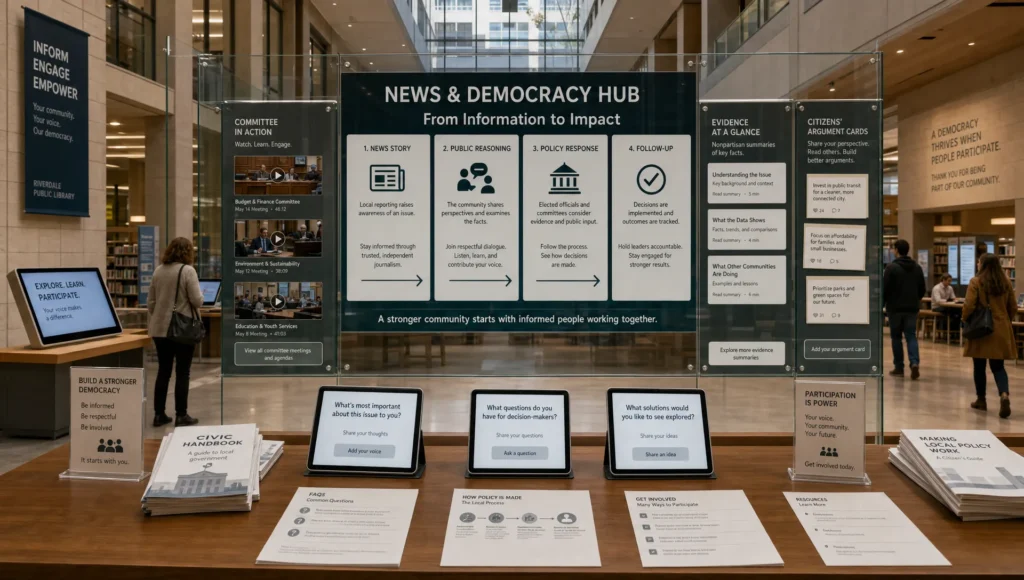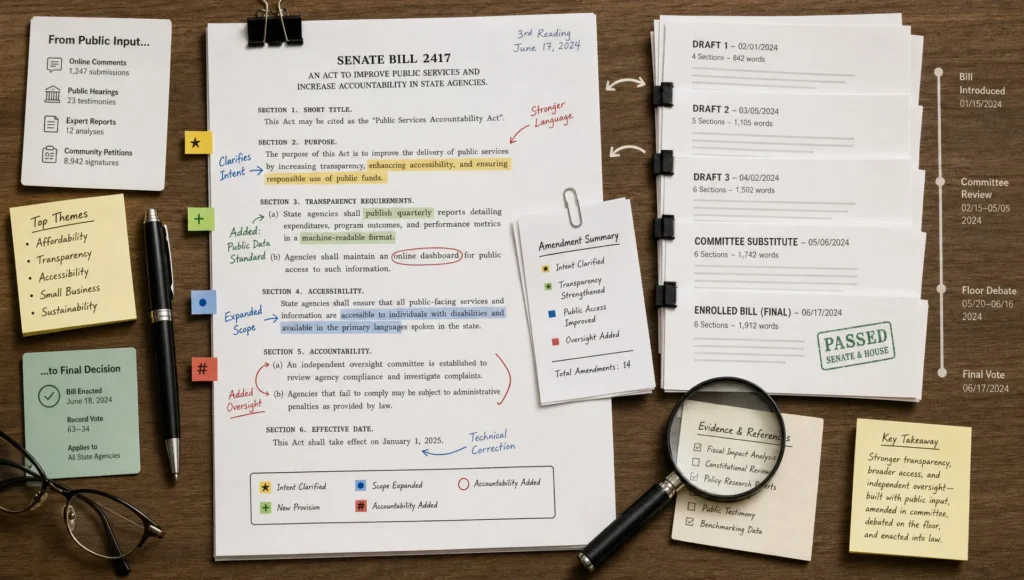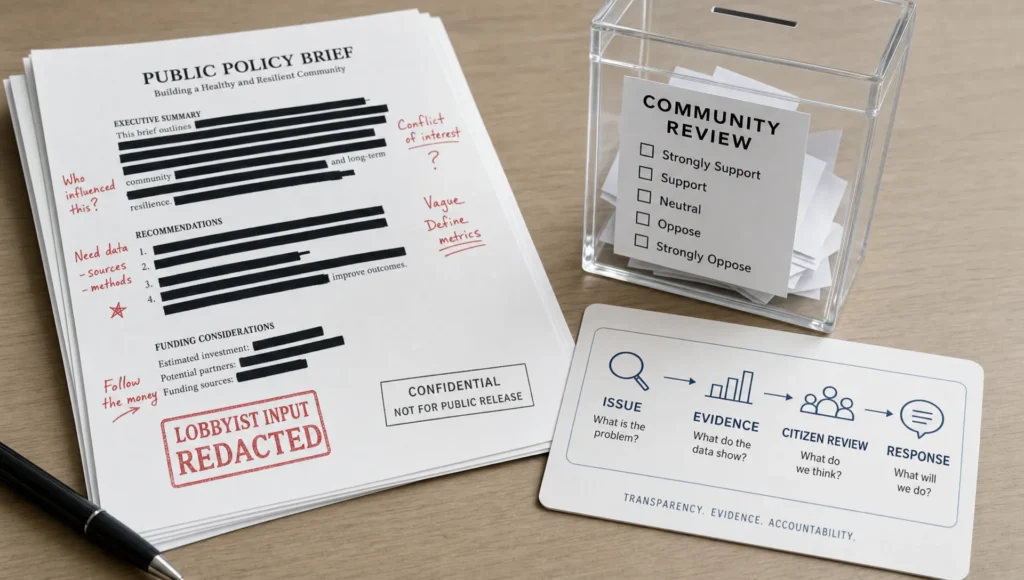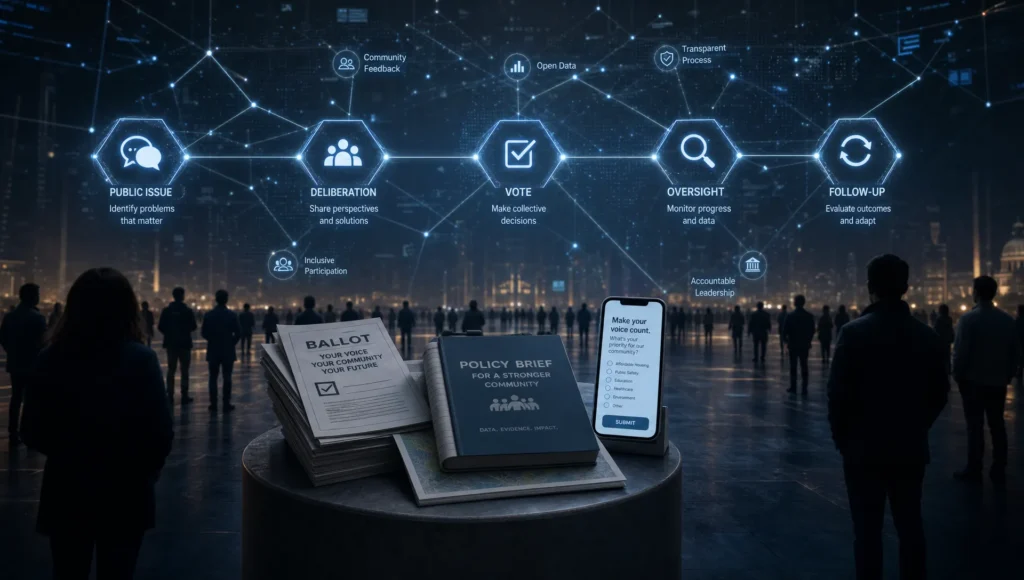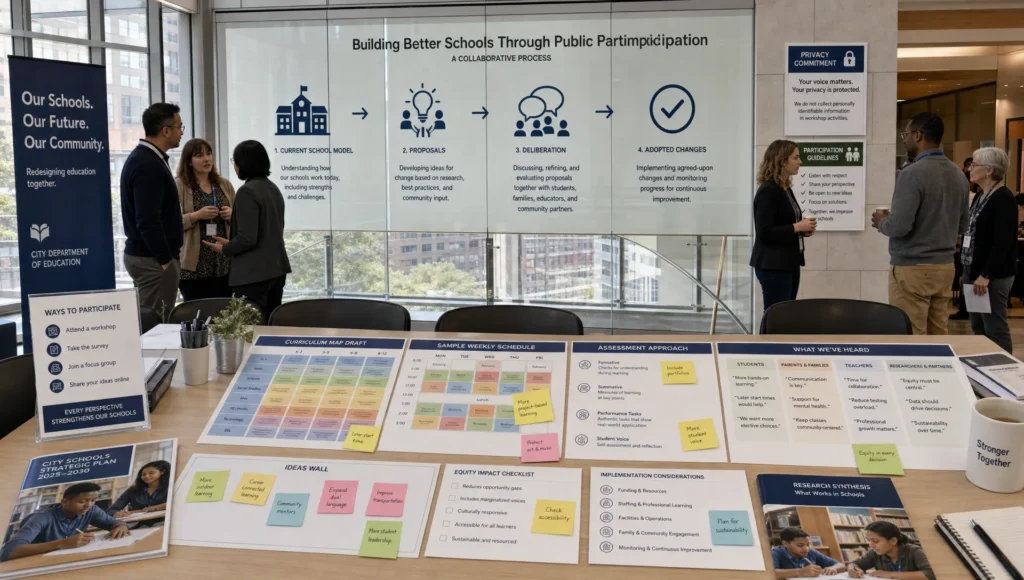
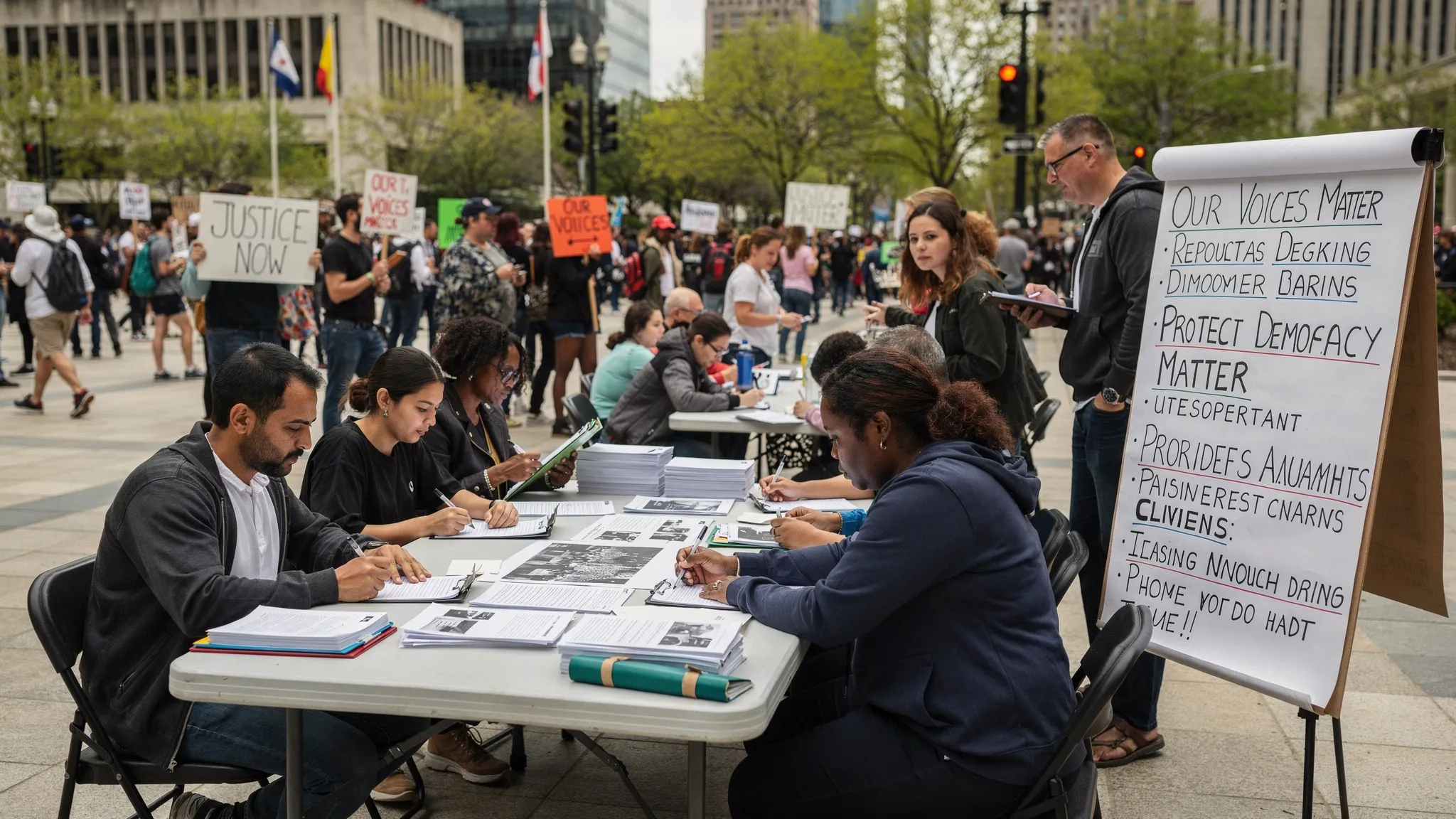
Discursive democracy for protest movements begins with a simple observation: a protest can reveal a crisis of legitimacy, but it does not automatically create a better decision. Marches, slogans, boycotts, sit-ins, online campaigns, and public demonstrations can force attention. Yet attention is only the first civic resource. The next question is whether a movement can turn that attention into public reasoning that is inclusive, traceable, and hard for institutions to ignore.
That is where discursive democracy matters. It gives protest movements a way to move from “people are angry” to “the public has articulated claims, reasons, evidence, values, tradeoffs, and decision demands.” It does not replace street action. It disciplines it. It makes the movement more legible to supporters, harder to misrepresent by opponents, and more useful to citizens who agree with the cause but do not yet know how to participate.
JustSocial’s manifesto, The Face of Democracy, argues that citizens should not be reduced to voters, taxpayers, and consumers. It calls for continuous civic participation, better public technology, and a culture where the people are heard between elections. Protest movements are often the moment when citizens rediscover that democratic instinct. Discursive democracy is how a movement keeps that instinct alive after the crowd goes home.
What Discursive Democracy Adds to Protest
A protest says, “This issue cannot be ignored.” Discursive democracy asks, “How should the public talk about this issue so that real decisions can change?”
In practical terms, discursive democracy is the design of public conversation. It is concerned with who gets to speak, what claims are visible, how disagreement is handled, how evidence is checked, and how public meaning is formed before formal decisions are made.
For protest movements, this is crucial because most movements do not lose power only because of repression or lack of attention. They often lose power because their message becomes too vague, too fragmented, too personality-driven, or too easy to caricature. A movement may start with moral clarity and then get stuck in noise: competing slogans, viral outrage, media simplifications, internal fights, and unclear demands.
Discursive democracy helps by creating a public process around the movement’s claims. It gives organizers a way to say: here are the demands, here are the reasons, here are the disagreements inside the movement, here is the evidence, here are the affected groups, and here is the decision we expect institutions to address.
This is not the same as deliberative democracy, although the two should work together. Discursive democracy improves the public conversation. Deliberative democracy turns that conversation into structured, decision-ready options. A strong political movement needs both.
| Civic layer | Main question | Protest movement output |
|---|---|---|
| Protest action | What must become visible now? | Marches, signs, speeches, petitions, public pressure |
| Discursive democracy | How should the public understand and debate the issue? | Claim maps, evidence summaries, public forums, synthesis notes |
| Deliberative democracy | What options should be seriously considered? | Options memos, tradeoff analysis, citizen panels, recommendations |
| Civic participation | Who must respond, decide, and implement? | Decision requests, response trackers, oversight logs |
When these layers are separated, a movement becomes harder to dismiss. It is no longer only a crowd. It becomes a civic institution in formation.
Why Protest Movements Need More Than Visibility
Visibility is powerful, but it is unstable. The cameras leave. The algorithm moves on. Opponents reframe the story. Officials offer symbolic concessions. Internal factions compete for control of the message.
This is the danger JustSocial’s manifesto describes when it criticizes political systems that hear citizens only during election cycles and leave them shouting into social networks the rest of the time. A protest movement may briefly break through that silence, but without a process, the silence returns.
Common failure points include:
- Slogan compression: A complex public problem is reduced to a phrase that mobilizes supporters but does not guide decision-makers.
- Media capture: Journalists select the most dramatic images or conflicts, while the movement’s actual reasoning disappears.
- Representative capture: A few visible spokespeople become treated as the whole movement without a transparent mandate.
- Purity spirals: Internal disagreement is treated as betrayal rather than a normal part of democratic reasoning.
- Demand ambiguity: Officials can claim they “listened” because the movement never defined a decision, timeline, or response standard.
Discursive democracy does not eliminate these risks. It gives organizers a way to manage them publicly. The movement can publish its process, show how claims were gathered, explain how disagreements were handled, and make clear which demands have broad support and which remain contested.
That matters because legitimacy is not built by pretending everyone agrees. It is built by showing how disagreement is processed.
The Protest-to-Discourse Workflow
A movement that wants influence needs a repeatable workflow. The goal is not to bureaucratize protest until it loses energy. The goal is to convert public energy into democratic infrastructure.
1. Capture the movement’s claims, not just its slogans
Every protest contains many claims. Some are moral claims, some are factual claims, some are personal testimonies, and some are policy demands. Organizers should collect these separately instead of mixing them into one message.
A useful claim format is simple: “We believe X because Y, and we want decision-maker Z to do A by date B.”
This format forces clarity without flattening emotion. It allows a grieving parent, a worker, a student, a veteran, or a local business owner to speak from lived experience while still connecting that experience to a public decision.
2. Build an evidence commons
A protest movement should not rely only on viral posts or expert reports hidden in private folders. It should maintain a shared evidence commons where people can inspect the sources behind public claims.
This can include official documents, budgets, laws, meeting minutes, academic summaries, court filings, photos, testimony, and uncertainty notes. The key is not to pretend that evidence settles every disagreement. The key is to make the disagreement checkable.
This connects directly to the manifesto’s call for public transparency, committee records, accessible civic data, and technology that lets citizens understand what the state is doing. If representatives have documents, recordings, and policy rationales, the people should be able to examine them.
3. Create a public disagreement map
Movements often fear visible disagreement because opponents may exploit it. But hidden disagreement usually becomes more damaging later.
A disagreement map shows where supporters align and where they differ. For example, a housing protest may agree that rent pressure is intolerable but disagree on rent caps, public housing, zoning reform, or tax policy. A school protest may agree that students need more support but disagree on budgets, phone rules, class sizes, or AI tools.
Publishing this map signals maturity. It tells the public that the movement is not a mob. It is a democratic space capable of reasoning.
4. Turn demands into decision questions
A demand becomes stronger when it is attached to a real decision. “Fix public transit” is morally understandable, but institutionally vague. “Will the city council allocate $X to bus frequency in the 2027 budget, and will it publish monthly reliability data?” is harder to evade.
The best decision questions name the decision owner, the decision window, the relevant rule or budget line, and the expected public response. This is how discursive democracy connects to civic participation. The conversation is not just expressive. It points toward action.
5. Hand off to deliberative groups
Once the public discourse is mapped, a smaller deliberative process can evaluate options. This may be a citizens’ panel, a community working group, a representative assembly, or a cross-faction committee.
The discursive phase should remain open and broad. The deliberative phase should be structured and evidence-informed. If the movement confuses the two, it risks either endless debate or shallow voting. If it separates them, it can preserve mass participation while still producing serious proposals.
6. Publish receipts and keep organizing
After public forums, meetings, petitions, or negotiations, the movement should publish short records: what was asked, who was contacted, what evidence was used, what officials promised, what changed, and what remains unresolved.
These records are democratic receipts. They protect the movement from symbolic listening sessions and help supporters understand what to do next.
Discursive Rules That Keep Protest Democratic
Movements often demand accountability from governments while neglecting their own internal process. That is a mistake. If a political movement wants to model a better democracy, it must practice the legitimacy it asks institutions to adopt.
The following rules are simple enough for local groups but strong enough to scale.
| Rule | Why it matters for protest movements |
|---|---|
| Separate people from claims | Critique arguments, actions, and institutions without dehumanizing participants. |
| Require claim plus reason | Make public speech more useful than slogans alone. |
| Mark evidence quality | Distinguish direct experience, official data, expert analysis, rumor, and opinion. |
| Protect minority voices | Prevent the movement majority from recreating the exclusion it opposes. |
| Publish synthesis notes | Show how public input was summarized and what was left unresolved. |
| Disclose roles and interests | Let people know who is organizing, funding, moderating, or negotiating. |
| Create appeal paths | Give participants a way to challenge moderation or representation decisions. |
| Set handoff rules | Define when open discourse moves into deliberative democracy or formal negotiation. |
These rules do not weaken protest. They protect it. A movement with public rules can grow without becoming chaotic. It can welcome new participants without surrendering to manipulation. It can disagree internally without collapsing into factional warfare.
Digital Infrastructure Without Digital Mob Rule
Many protest movements now begin online, but online attention is not the same as democratic power. Platforms reward speed, anger, identity performance, and simplified conflict. Discursive democracy requires a different design: slower contribution formats, transparent moderation, claim tagging, evidence links, public summaries, and clear handoffs to decision processes.
The private sector has trained people to expect comparison, transparency, and quick access to information. For example, a person can now compare plans and buy insurance online in the UAE through platforms that make complex options easier to inspect. Public decision-making should meet an even higher standard. Citizens should be able to compare policy options, see the evidence behind them, understand tradeoffs, and track what institutions did in response.
That does not mean every protest needs a sophisticated platform from day one. A shared folder, public spreadsheet, mailing list, meeting notes page, and basic intake form can already create more legitimacy than a purely viral campaign. The issue is not whether the technology is advanced. The issue is whether the process is inspectable.
JustSocial’s manifesto imagines tools such as civic action platforms, public parliamentary records, community voting systems, analytics, and identity features that let citizens participate continuously while protecting privacy. Protest movements can pilot the culture behind those tools before governments adopt them. They can become living laboratories for a more continuous form of democracy.
From Protest Crowd to People’s Branch
One of the manifesto’s central ideas is that “the people” should become a standing democratic force, not a temporary crowd activated every few years. This is the People’s Branch idea in practical form: citizens continuously voice concerns, shape agendas, inspect institutions, and feed public judgment into decision-making.
A protest movement can act as a prototype of that People’s Branch if it does four things well.
First, it must listen beyond its most active members. The people most affected by a policy are not always the people with time, confidence, safety, or language access to attend meetings or speak online. Discursive democracy requires intentional outreach.
Second, it must preserve public memory. Movements weaken when every meeting restarts the conversation from zero. A public archive of claims, evidence, decisions, promises, and follow-up creates continuity.
Third, it must connect public emotion to public reasoning. Anger can reveal injustice, but it cannot be the only operating system. The movement must create formats where grief, fear, hope, and moral urgency can become claims, questions, proposals, and oversight.
Fourth, it must demand a response standard. Officials should not be allowed to say “we hear you” without publishing what they heard, what they accepted, what they rejected, and why.
This is where protest becomes more than resistance. It becomes civic participation with structure.
A Practical Example: Turning a Housing Protest Into Discursive Power
Imagine a citywide protest over housing costs. Thousands gather outside city hall. The message is clear: people cannot afford to live where they work, study, and raise families. Without discursive infrastructure, the moment may fade into a media story about crowd size and political tension.
With discursive democracy, the movement can do something stronger.
| Protest moment | Discursive action | Public output |
|---|---|---|
| Rally speeches | Collect claims from renters, owners, workers, students, and service providers | Claim library sorted by issue and affected group |
| Viral slogans | Translate slogans into decision questions | Housing decision docket |
| Public anger | Build an evidence commons from rent data, zoning rules, budgets, and testimony | Shared evidence page with uncertainty notes |
| Internal disagreement | Map competing solutions fairly | Disagreement map showing tradeoffs |
| Negotiation with officials | Publish asks and response deadlines | Public response tracker |
| Follow-up protests | Focus pressure on unanswered decisions | Updated action plan |
Now the movement is not simply asking the city to care. It is showing the city what must be answered.
What Organizers Should Avoid
Discursive democracy can be misused if it becomes performative. A movement should avoid processes that look participatory but do not change anything.
Do not collect thousands of comments if no one will synthesize them. Do not invite testimony if there is no safety plan for vulnerable participants. Do not run a vote if the options are unclear. Do not publish evidence without showing uncertainty. Do not claim consensus when there is only majority pressure. Do not let the loudest supporters define the whole public.
Most importantly, do not confuse attention with consent. A viral post is not a mandate. A protest crowd is not the entire people. A disciplined movement respects this distinction. It uses protest to open the door, discursive democracy to structure public meaning, deliberative democracy to build options, and civic participation to demand action.
Frequently Asked Questions
What is discursive democracy in a protest movement? Discursive democracy is the structured public conversation around a protest’s claims, values, evidence, and demands. It helps a movement turn public attention into reasoned, inspectable civic pressure.
How is discursive democracy different from deliberative democracy? Discursive democracy shapes the broader public debate and makes claims visible. Deliberative democracy uses structured forums to weigh evidence and produce decision-ready recommendations. Protest movements need both.
Does this make protest less emotional or less powerful? No. It gives emotion a civic pathway. Anger, grief, and hope remain part of the movement, but they are connected to claims, evidence, decision questions, and accountability.
Can small protest groups use this approach without special technology? Yes. A basic website page, shared documents, public notes, intake forms, and response trackers can support discursive democracy. The important part is process clarity, not expensive software.
How does this connect to JustSocial’s manifesto? The manifesto argues for continuous civic participation, public transparency, and a political culture where citizens are heard between elections. Discursive democracy gives protest movements a practical method for building that culture now.
Build the Democratic Capacity Behind the Protest
A protest can expose a broken system. A political movement must build the alternative.
Discursive democracy helps movements become more than moments of pressure. It helps them become civic engines that gather public judgment, protect disagreement, publish evidence, demand responses, and prepare citizens for continuous participation.
If that vision speaks to you, read JustSocial’s manifesto, share it with others, and consider contributing your skills. The future of democracy will not be built only by representatives, parties, or platforms. It will be built by citizens who learn how to turn public voice into public power, and who insist that democracy must continue after the protest ends.