In 2026, a political movement can grow faster than ever and lose trust just as quickly. A viral post can bring thousands of names to a mailing list, but it cannot prove that people were heard. A crowded rally can show anger, but it cannot show how that anger became a proposal, a decision, or a public result.
Transparent growth asks a different question: can supporters, skeptics, journalists, public officials, and ordinary citizens inspect how the movement turns attention into civic participation?
That question sits close to the heart of JustSocial’s manifesto, The Face of Democracy. The manifesto argues that citizens should not be reduced to voters, taxpayers, and consumers. People need ongoing ways to speak, reason together, influence public priorities, and see whether institutions responded. For a modern political movement, the tools of growth should therefore be more than campaign software. They should be civic infrastructure.
A useful tool is anything that makes a democratic promise repeatable. It can be a platform, a public document, a meeting format, a moderation rule, a volunteer role, or a visible tracker. The goal is not only to expand the movement, but to grow in a way that proves the movement is practicing the democracy it demands.
What transparent growth means for a political movement
Most movements measure growth through visible signals: followers, donors, volunteers, newsletter signups, meeting attendance, petition signatures, and media mentions. Those numbers matter, but they are incomplete. They can measure reach without measuring legitimacy.
Transparent growth adds a second layer: public proof. A political movement grows transparently when anyone can answer four basic questions without needing private access or personal trust in the leadership.
- What is the movement asking people to do?
- Who decides what the movement prioritizes?
- How are public opinions, objections, and minority views processed?
- What happened after people participated?
This is where discursive democracy and deliberative democracy become practical tools, not academic labels. Discursive democracy improves the public conversation by making claims, evidence, values, and disagreements visible. Deliberative democracy creates structured spaces where people can weigh tradeoffs and produce decision-ready options. Civic participation then connects those outputs to real public decisions.
Without these layers, growth becomes a funnel. With them, growth becomes a civic loop.
The transparent movement tool stack
A political movement does not need a massive platform on day one. It needs a transparent stack that can start small, survive scrutiny, and scale without becoming chaotic.
| Tool layer | What it does | Public artifact it should produce | Transparency question it answers |
|---|---|---|---|
| Manifesto map | Turns values into concrete priorities | Public principles page | What does the movement stand for? |
| Participation promise | Defines how people can influence the movement | One-page participation charter | What can supporters actually affect? |
| Decision docket | Lists active issues and decision windows | Public issue tracker | What decisions are open now? |
| Discursive channel | Collects claims, evidence, objections, and lived experience | Claim map or synthesis note | What are people saying and why? |
| Evidence commons | Stores sources, data, testimony, and uncertainty | Evidence index | What information is being used? |
| Deliberative workspace | Turns public input into options and tradeoffs | Options memo | What choices are realistically available? |
| Receipt hub | Shows responses, changes, and follow-through | Response log and implementation tracker | Did participation matter? |
| Volunteer operating system | Assigns roles and routines | Role board and task log | Who is doing the work? |
The stack can be built with simple tools at first: shared documents, public folders, forms, spreadsheets, livestreams, meeting notes, and lightweight community platforms. Software becomes more important as participation grows, but governance comes first. A beautiful platform with vague rules will still produce distrust.
Start with a manifesto map, not a slogan
A slogan attracts attention. A manifesto map builds memory.
JustSocial’s manifesto is unusually broad: it moves from the failures of industrial-era institutions to educational reform, civic technology, public transparency, a people’s branch, and a more active role for academia. A political movement inspired by that vision should not expect every newcomer to absorb the full theory before participating. It needs a translation layer.
A manifesto map turns a long vision into a navigable structure. It should show:
- Core principles, such as continuous civic participation, public transparency, and citizen empowerment
- Active priorities, such as education reform, public committee visibility, or better participation tools
- Current experiments, such as local civic teams or prototype testing
- Open questions where the movement has not yet reached a settled view
That last category matters. Transparent growth does not pretend to have all answers. In fact, one of the strongest lines in the JustSocial vision is the belief that collectively, people do have answers if they are given meaningful ways to participate. A manifesto map should make room for that humility.
Publish a participation promise before asking for participation
Many movements ask people to “join us” before explaining what joining means. That creates disappointment. People volunteer, speak, donate, or attend meetings, then discover that the important decisions are still made by a tiny inner circle.
A participation promise prevents that. It is a short public document that defines what participants can influence and what they cannot.
A strong participation promise should include the movement’s current decision areas, the channels people can use, the timeline for review, the criteria for action, and the type of response participants can expect. It should also say where leadership retains responsibility. Transparency is not the same as pretending every decision is open to everyone at all times.
For example, a movement might say: “Supporters can propose local campaign priorities each month. Proposals that receive enough structured support will enter a deliberative review. The core team will publish a response within 14 days explaining acceptance, revision, delay, or rejection.”
That one paragraph is more democratic than a thousand vague calls for engagement.
Use discursive democracy to turn noise into public reasoning
Growth creates noise. More people means more comments, more anger, more duplication, more misinformation, and more pressure to reward whoever speaks loudest. If a political movement relies only on social media dynamics, it will eventually confuse virality with public judgment.
Discursive democracy offers a better pattern. Instead of treating public conversation as an endless comment thread, it structures conversation so that claims become usable.
A discursive tool should help participants separate five things: claim, reason, evidence, value, and request. For example, “The school day should start later” is a claim. “Teenagers need more sleep and current schedules harm learning” is a reason. Research, parent testimony, student surveys, and transport constraints are evidence. Health, family time, and educational fairness are values. “Ask the district to pilot a later start twice per week” is a request.
This structure does not remove emotion. It gives emotion a civic path. JustSocial’s manifesto speaks directly to frustration, helplessness, and the desire to stop shouting into the void. Discursive tools are how a movement takes that energy seriously without letting it dissolve into chaos.
Transparent growth is a familiar trust problem beyond politics. In ordinary life, people look for visible proof before trusting an organization: past work, contact details, reviews, service areas, and clear promises. Even a local service business such as Maler Nordsjælland understands that public-facing evidence helps people decide whether to engage. A political movement should hold itself to an even higher standard: do not simply ask for trust, publish the proof that trust deserves.
Use deliberative democracy to make growth intelligent
Discursive democracy makes public reasoning visible. Deliberative democracy does something more focused: it helps a smaller, structured group turn public input into better options.
This distinction is vital for transparent growth. A movement can let everyone speak while still asking a prepared group to study tradeoffs, consult evidence, listen to competing values, and produce a usable recommendation. That is not elitism if the process is open, the selection method is fair, the evidence is public, and the final output is inspectable.
A deliberative workspace should produce an options memo, not a press release. The memo should compare realistic choices, explain tradeoffs, name dissenting views, identify uncertainties, and recommend a path forward. For a movement, this is especially useful when issues are emotionally charged or technically complex.
Consider education reform, a major theme in the JustSocial manifesto. People may agree that the industrial model of schooling is outdated, but disagree on AI in classrooms, project-based learning, teacher roles, school hours, student choice, or assessment. A deliberative process can turn that broad frustration into a set of options that parents, teachers, students, and public officials can actually evaluate.
Build a receipt hub so participation has memory
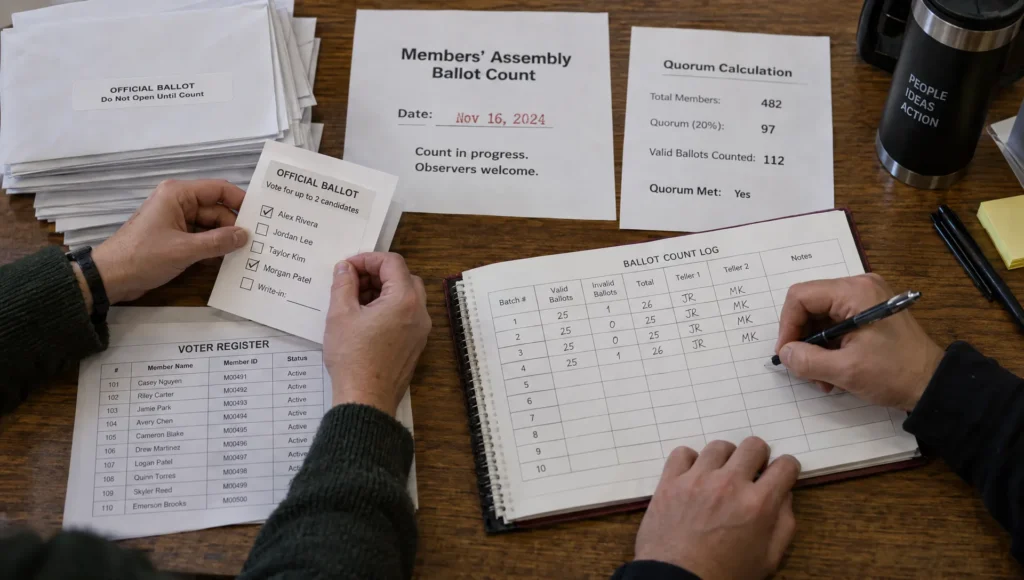
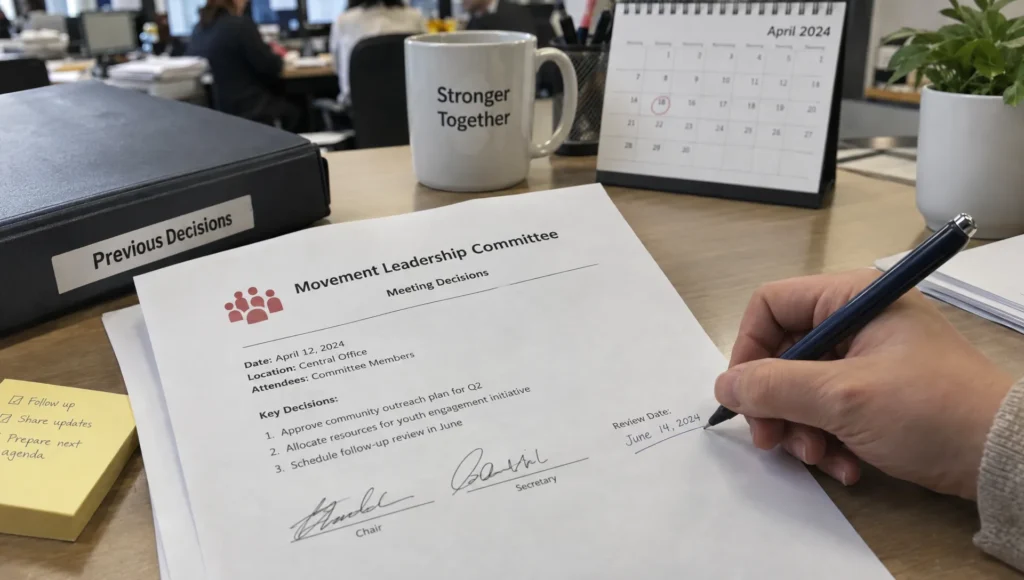
A receipt is a public record that proves a civic action happened and shows what followed. It might be a meeting note, a decision memo, a response from an official, a vote tally, a rationale, a budget update, or an implementation tracker.
A receipt hub is where transparent growth becomes durable. It prevents the movement from relying on memory, charisma, or private chat histories. New supporters can see what has happened. Critics can inspect the process. Volunteers can avoid duplicating work. Journalists can follow the story. Public officials can respond to clear requests instead of vague pressure.
A basic receipt hub might include:
- Participation promises and process rules
- Issue pages and decision dockets
- Evidence indexes and synthesis notes
- Deliberative options memos
- Leadership responses and rationale memos
- Implementation trackers and post-decision reviews
The key is consistency. A movement does not need perfect documentation, but it does need a predictable standard. If people give time, testimony, or money, they deserve to see what happened next.
Match tools to the stage of growth
Different stages require different tools. The mistake is adopting large-scale tools before the movement has learned how to use small-scale transparency.
| Growth stage | Main risk | Best tool focus | Success signal |
|---|---|---|---|
| 5 to 20 people | Informal control by founders | Manifesto map and role clarity | People understand the mission and their responsibilities |
| 20 to 100 people | Confusion and duplicated work | Decision docket and receipt hub | Supporters can find active priorities without asking insiders |
| 100 to 1,000 people | Noise and factionalism | Discursive channels and evidence commons | Claims and objections are synthesized fairly |
| 1,000 to 10,000 people | Legitimacy gaps | Deliberative processes and participation promises | Public input becomes decision-ready options |
| Institutional interface | Co-option or performative consultation | Response logs and implementation trackers | Officials respond to documented civic outputs |
This staged approach also protects the movement from technology theater. A platform cannot create democratic culture by itself. The culture must be practiced in small loops, then supported by better tools.
Protect transparency from becoming surveillance
A transparent political movement must not expose people unnecessarily. This is especially important for civic participation in polarized environments, minority communities, workplaces, schools, and countries where political expression carries real risk.
Transparency should apply first to process, decisions, money, rules, and institutional responses. Privacy should apply to personal data, sensitive testimony, vulnerable participants, and internal safety concerns.
That balance fits JustSocial’s broader thinking about identity and anonymity. The movement’s manifesto imagines citizens being heard continuously, but also points toward anonymous or privacy-protecting ways to register opinions. The principle is simple: the public should be able to inspect the democratic process without turning every participant into a target.
Useful safeguards include data minimization, role-based access, consent for attribution, appeal paths for moderation, anonymized synthesis for sensitive topics, and clear rules for when identity verification is required. Higher-stakes decisions may need stronger eligibility checks. Lower-stakes discussions should not demand unnecessary exposure.
A 30-day rollout for transparent movement tools
Transparent growth can begin in one month if the goal is modest: complete one visible participation loop.
| Week | Focus | Output |
|---|---|---|
| Week 1 | Define the promise | Publish a manifesto map and participation promise |
| Week 2 | Open one decision | Create a decision docket page for a single issue |
| Week 3 | Structure public input | Collect claims, reasons, evidence, and requests through a discursive format |
| Week 4 | Publish the receipt | Release a synthesis note, leadership response, and next-step tracker |
The first loop should be small enough to finish. A movement might choose one local decision, one education issue, one transparency demand, or one prototype feature. The point is not to solve everything. The point is to prove that participation can move from voice to record to response.
Once one loop works, repeat it. Repetition is how a political movement becomes trustworthy.
Metrics that show transparent growth is real
If a movement only tracks audience growth, it will optimize for attention. If it tracks civic participation and follow-through, it will optimize for democratic capacity.
| Metric category | What to track | Red flag |
|---|---|---|
| Participation reach | Number and diversity of contributors | Only insiders participate |
| Discursive quality | Share of claims with reasons or evidence | Comments are mostly slogans or attacks |
| Deliberative quality | Options produced, tradeoffs named, dissent recorded | Recommendations hide disagreement |
| Response discipline | Time from input to public response | People never learn what happened |
| Implementation memory | Updates on accepted proposals | Wins are announced but not tracked |
| Volunteer sustainability | Repeat contributors and role rotation | A few people carry all work |
These metrics do not need to become bureaucratic. They should help the movement notice whether it is becoming more democratic as it becomes larger.
Why these tools matter for JustSocial’s vision
JustSocial’s manifesto calls for a future where citizens have a more continuous role in public life, where public committees and state processes become more visible, where technology supports participation, and where education prepares people to engage rather than merely comply.
The transparent movement tool stack is a practical bridge toward that future. It does not require waiting for a national reform. A local group, school community, professional network, or civic coalition can begin practicing these tools now.
The deeper point is cultural. The manifesto’s idea of a renewed Polis, scaled for modern life, depends on people feeling that public life is close enough to touch. Transparent tools make that possible. They turn abstract democracy into a set of visible habits: name the decision, gather reasons, weigh options, publish responses, and track results.
A political movement that grows this way is not merely recruiting supporters. It is training citizens, building memory, and modeling the public institutions it wants to see.
Frequently Asked Questions
What tools should a political movement build first? Start with a manifesto map, a participation promise, a simple decision docket, and a receipt hub. These can be built with basic documents and spreadsheets before investing in custom technology.
How does discursive democracy help movement growth? Discursive democracy makes public conversation usable by structuring claims, reasons, evidence, values, and requests. It helps a growing movement avoid becoming a loud but unreadable comment section.
How does deliberative democracy fit into a political movement? Deliberative democracy gives the movement a structured way to turn broad public input into realistic options. It is especially useful for complex issues where slogans are not enough.
Can a movement be transparent without exposing private participant data? Yes. Transparent growth should focus on public rules, decisions, evidence, funding, responses, and implementation. Personal data should be minimized, protected, and disclosed only with clear consent or legitimate need.
Why not just use social media for civic participation? Social media is useful for reach, but it is poor at memory, synthesis, decision linkage, and follow-through. A movement can use social platforms for discovery while relying on its own transparent tools for democratic work.
Build the tools before the crowd arrives
A political movement becomes credible when its internal practice reflects its public values. If the goal is a society where citizens are heard continuously, then the movement itself must show how continuous civic participation works.
That begins with small, inspectable tools: a promise, a docket, a discourse format, a deliberative process, and public receipts. From there, technology can scale what the movement has already learned to practice.
If this vision resonates with you, explore JustSocial’s manifesto, follow the movement’s work, and consider contributing your skills as a volunteer, organizer, designer, developer, educator, or civic partner. Transparent growth is not only a communications strategy. It is the beginning of a more democratic public culture.