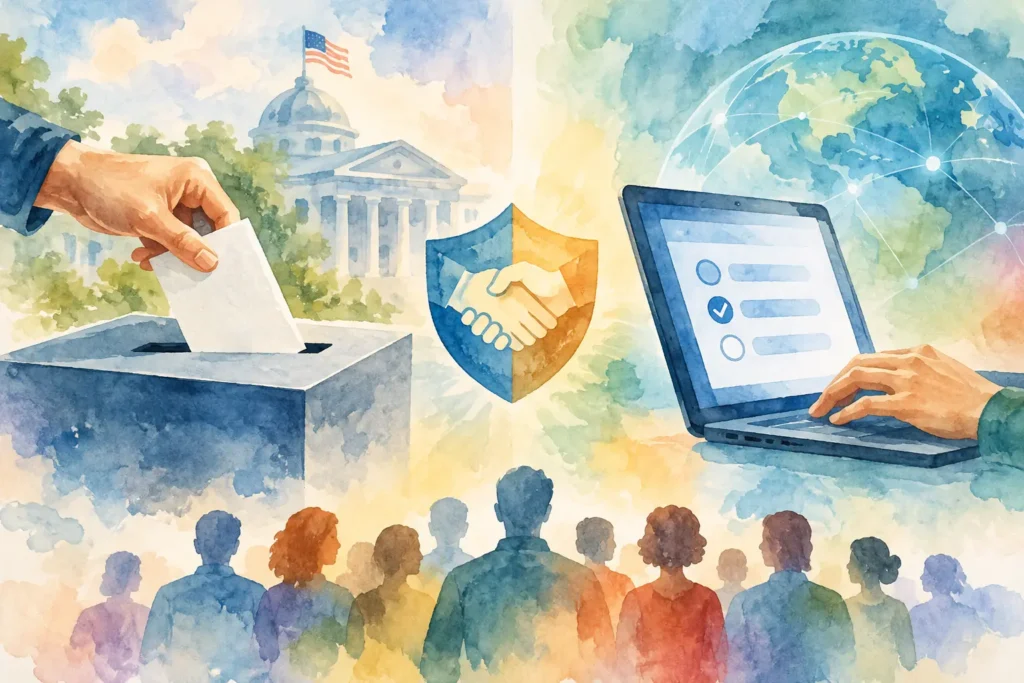
A resident should not have to tell their story three times to get help with rent, find a neighborhood meeting through a broken calendar, or wonder where their donation went. Yet these are often the visible consequences of underfunded nonprofit technology infrastructure. What looks like a minor technical inconvenience can become a barrier to services, participation, and public trust.
For nonprofits working closest to community needs, technology is not merely an administrative expense. It is part of how people experience dignity, access, and accountability. The systems behind an intake form, a public dashboard, a volunteer schedule, or a community vote shape who can participate and who gets left out.
Nonprofit Technology Infrastructure Is Public Infrastructure
A website, database, email platform, payment processor, case-management tool, and video meeting account can seem like separate purchases. In practice, they form an operating environment. When those tools are disconnected, hard to maintain, or inaccessible, staff members become the bridge between systems. They spend time copying information, reconciling spreadsheets, responding to preventable questions, and repairing processes that should support their work.
That burden lands hardest on small organizations and grassroots groups. A large institution may have an IT department, procurement staff, and dedicated data specialists. A neighborhood mutual-aid network may have one part-time coordinator using personal accounts and a collection of free tools. Both may serve the public, but only one has a realistic margin for technical failure.
We should treat this gap as a civic issue. Communities rely on nonprofits to distribute resources, organize residents, advocate for policy, and carry essential local knowledge. If those organizations cannot communicate reliably, protect sensitive information, or make decisions transparently, the community loses capacity to act.
Start With People, Not Platforms
The most common technology mistake is beginning with a product search. A new platform cannot repair an unclear process or replace a relationship with the people an organization serves. Before choosing tools, nonprofit leaders should ask what a person needs to accomplish, where the current experience breaks down, and who may be excluded by a digital-first approach.
For example, an organization may want a new client portal. The better first question is whether clients have reliable internet access, can complete forms on a phone, need materials in multiple languages, or prefer a call-back option. A portal may be useful, but it should extend human access rather than become the only doorway.
The same principle applies to civic participation. An online survey can gather ideas quickly, but it does not automatically create meaningful public input. People need clear information, enough time to respond, and confidence that their contributions will be considered. Technology can widen the circle of participation when it is paired with transparent rules and genuine follow-through.
Define the work the system must support
A practical technology plan begins with a short list of core functions. Most nonprofits need a dependable way to communicate, manage contacts, store and share documents, collect donations or payments, coordinate programs, and report outcomes. Organizations that organize communities may also need tools for public meetings, petitions, participatory budgeting, member voting, or issue tracking.
The goal is not to acquire the most features. It is to reduce friction in the work that matters most. If staff cannot explain a system in plain language, train a new colleague to use it, or recover from a mistake without calling an outside consultant, the tool may be too complex for its value.
Build for Trust, Security, and Continuity
Trust is built in ordinary moments: when a donor receives an accurate receipt, when a client knows who can see their information, when a resident can verify how a community decision was made. These moments depend on infrastructure that is maintained over time.
Security deserves particular care because nonprofits often hold sensitive records related to income, immigration status, health, housing, political activity, or personal safety. The answer is not fear or technical jargon. It is a clear set of responsible habits: use organization-owned accounts instead of personal logins, require multi-factor authentication, limit access to the information each role needs, back up essential records, and establish a simple plan for staff transitions.
Continuity matters just as much. Too many organizations discover, after a director leaves or a volunteer steps back, that no one has access to a domain name, social media account, donor list, or shared drive. Institutional knowledge should not live solely in one person’s inbox. Documenting account ownership, renewal dates, basic workflows, and emergency contacts is unglamorous work, but it protects the organization and the people who depend on it.
There are trade-offs. Centralizing data can make reporting and coordination easier, but it can also create greater privacy risk if access is too broad. A fully integrated system may save time, but it can make an organization dependent on a single vendor. Free tools reduce immediate costs, but they may limit support, accessibility, data portability, or long-term control. Responsible planning means naming those trade-offs before a crisis forces a decision.
Make Accessibility a Core Requirement
Accessibility should not be an afterthought added when a complaint arrives. It is a commitment to the public. If a form cannot be used with a keyboard, a video lacks captions, a PDF cannot be read by assistive technology, or a registration page fails on a mobile phone, the organization has created a barrier for people it may be trying hardest to reach.
Accessible design also improves usability for everyone. Clear headings help a screen-reader user and a rushed parent. Plain language helps a person with a cognitive disability and a resident unfamiliar with bureaucratic terms. Mobile-friendly pages help people without laptops, including many who rely on public Wi-Fi or limited data plans.
Digital access also has limits. Some people will need paper materials, phone support, in-person assistance, translated content, or a trusted community partner to participate. The most inclusive systems are not digital-only. They offer more than one path into the work.
Connect Data to Accountability, Not Just Reporting
Nonprofits are often asked to prove impact through numbers. Metrics matter, but data should serve the community before it serves a report. Counting workshop attendance is useful; understanding whether participants could influence a decision is more meaningful. Tracking the number of applications received may show demand; tracking how many people completed the process, and why others could not, reveals whether access is real.
Public-facing transparency can deepen trust when it is understandable and appropriately scoped. Share how funds are allocated, what goals guide a program, what decisions have been made, and what remains unresolved. Do not publish personal information or create dashboards that suggest false precision. A small data set can identify trends, but it may not represent every voice in a diverse community.
For participatory initiatives, the standard should be higher than collecting feedback. People deserve to know what happened after they spoke. Was an idea adopted, revised, deferred, or declined? Who made that decision? What evidence informed it? This feedback loop turns participation from a one-time request into an ongoing civic relationship.
Fund Maintenance as Mission Work
The strongest infrastructure plans include maintenance from the beginning. Software subscriptions, staff training, accessibility updates, security reviews, technical support, and data cleanup are recurring needs. They should be budgeted as part of program delivery, not treated as optional overhead to be squeezed into the margins.
Funders can help by supporting general operations, multi-year commitments, shared services, and reasonable technology costs. Boards can help by asking whether the organization owns its critical accounts, protects constituent data, and has a recovery plan. Community members can help by valuing the behind-the-scenes systems that allow a local organization to remain responsive when needs change.
JustSocial sees civic technology as a shared foundation for more continuous, accessible democracy. That foundation is built not only through ambitious public platforms, but also through the everyday systems that let local organizations listen, coordinate, explain, and act with their communities.
The next technology decision does not need to be dramatic. Start with one point of friction that keeps someone from receiving help or being heard. Bring the people affected into the conversation, choose a solution the organization can sustain, and make its purpose clear. Each improvement is a chance to make public life more accessible, accountable, and ours to shape together.