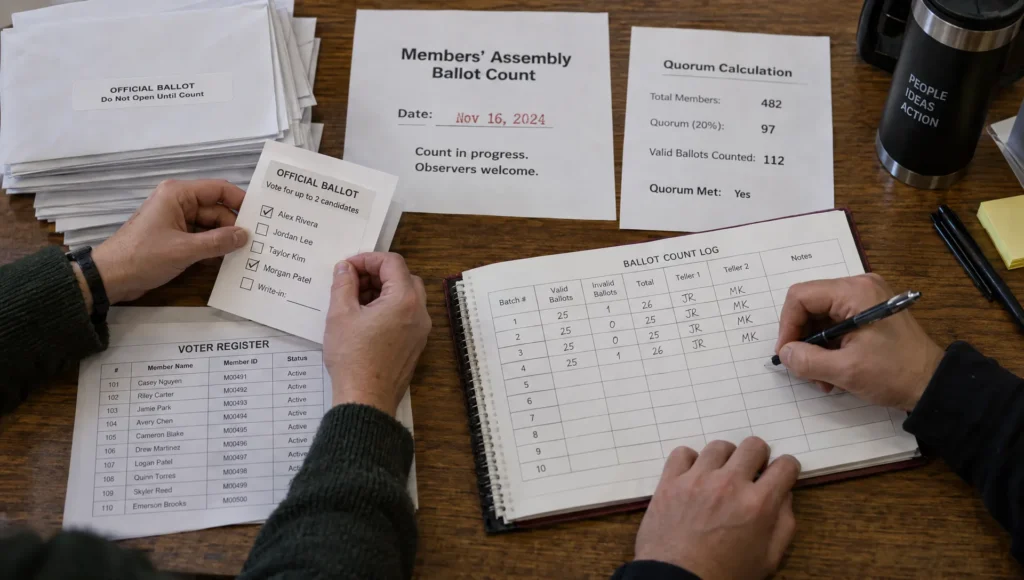
A political movement strategy for continuous democracy begins with a different question from ordinary campaign politics. The question is not simply: How do we win the next election? The deeper question is: How do citizens become visible, competent, and consequential every week between elections?
That distinction matters. Traditional movements often surge around anger, a charismatic leader, or a single election cycle. They may win attention, sometimes even power, then discover that public participation disappears into the same old machinery of committees, bureaucracy, lobbying, and party discipline. Continuous democracy demands something more durable: a movement that can turn public speech into public reasoning, public reasoning into usable options, and usable options into accountable decisions.
This is the strategic heart of JustSocial. In The Face of Democracy, Yuval D. Vered argues that modern societies still carry industrial-era political habits: citizens are treated as voters, taxpayers, and consumers, while the state rarely listens to them in a structured daily way. The manifesto points toward a different model, a Cosmopolis, where civic participation is continuous, technology-supported, transparent, and connected to real public decisions.
A political movement built for that future cannot behave like a normal pressure group. It must become a prototype of the democracy it wants to create.
The strategic premise: build democratic capacity, not just attention
Attention is useful, but it is not power by itself. A viral post, a protest sign, or a trending hashtag can reveal public frustration. Yet continuous democracy requires the next step: making that frustration legible to institutions and useful to citizens.
The strategic premise is simple: a movement wins when it builds democratic capacity that survives beyond any one campaign.
That means the movement must train people to do four things repeatedly: name public decisions, argue with reasons, deliberate across disagreement, and demand visible follow-through. This is where civic participation, discursive democracy, and deliberative democracy become operational tools rather than abstract theories.
| Strategic layer | What it builds | Main output | Why it matters |
|---|---|---|---|
| Civic participation | Citizen action connected to decisions | Requests, testimony, petitions, oversight records | Converts concern into influence |
| Discursive democracy | Better public reasoning | Claim maps, evidence shelves, synthesis notes | Prevents public debate from becoming pure noise |
| Deliberative democracy | Informed judgment across tradeoffs | Options memos, recommendations, dissent reports | Makes conflict usable for decision-makers |
| Transparency | Trust through verification | Public receipts, trackers, response memos | Reduces the need for blind trust |
This is also why continuous democracy is not the same as constant referendum. A referendum asks the public to decide a question at a point in time. Continuous democracy builds a civic system that lets people raise issues, examine evidence, deliberate, vote when appropriate, and monitor implementation over time.
Start with a participation promise
Every serious political movement needs a participation promise. This is a public commitment that explains what supporters can do, what the movement will do with their input, and what proof will be published afterward.
Without a participation promise, people are asked to donate time, trust, data, and emotional energy without knowing whether anything will happen. That is how movements drift into participation theater. People are invited to speak, but their speech is not connected to a decision.
A strong participation promise answers:
- What decision, issue, or institution are we trying to influence?
- Who can participate, and under what rules?
- What public artifact will be produced from participation?
- How will the movement report back on institutional responses?
For continuous democracy, the promise should be modest enough to keep and concrete enough to matter. For example: We will collect public input on one city budget issue, organize the strongest arguments into an evidence-backed brief, convene a small deliberative group to produce options, deliver the result to the relevant decision owner, and publish the response.
That is a better strategic unit than a vague call to wake up, resist, or take back power. It gives citizens a task, a process, and a receipt.
Use discursive democracy to turn noise into public reasoning
The manifesto speaks directly to the emotional failure of today’s public sphere. People pour anger into smartphones, social platforms amplify outrage, and institutions often treat that noise as either a threat or a marketing signal. Continuous democracy requires a better channel.
Discursive democracy is the movement’s first filter. It does not mean everyone agrees. It means public conversation is structured so that disagreement becomes understandable.
A movement can practice discursive democracy by asking participants to express claims in a usable format: What is the problem? What evidence supports it? Who is affected? What decision should change? What tradeoff are you willing to acknowledge?
This structure changes the tone of politics. Instead of rewarding whoever shouts the loudest, the movement rewards clarity, evidence, lived experience, and relevance. It also protects pluralism. People can still bring ideology, identity, anger, and moral conviction, but they must connect those things to reasons that others can inspect.
That is crucial for a political movement that wants to cross left and right. Continuous democracy should not begin by asking citizens to dissolve their identities. It should ask them to translate their concerns into public reasons and decision-ready proposals.
Use deliberative democracy to make disagreement productive
Discursive democracy opens the field of public speech. Deliberative democracy narrows that field into structured judgment.
This is where a movement moves from hearing many voices to building decision-grade options. A deliberative process brings together a balanced group of participants, gives them shared evidence, exposes them to competing arguments, and asks them to produce recommendations that acknowledge tradeoffs.
The OECD has documented the global spread of representative deliberative processes, such as citizens’ assemblies and citizens’ juries, because many governments and civic organizations now recognize a basic truth: raw opinion is not the same as considered judgment.
For JustSocial’s vision, deliberative democracy also connects to the manifesto’s proposal for a stronger role for academia. Experts should not rule over citizens, but they can help clarify evidence, uncertainty, costs, constraints, and consequences. In a healthy continuous democracy, academia becomes a public reasoning service, not a priesthood.
A movement should therefore publish deliberative outputs in a standard format:
| Deliberative artifact | Purpose |
|---|---|
| Issue Pack | Explains the decision, context, constraints, and affected groups |
| Evidence Index | Lists sources, data, expert input, and uncertainty |
| Options Memo | Presents realistic choices with tradeoffs |
| Minority Report | Preserves serious disagreement instead of hiding it |
| Response Request | Asks a named institution to answer publicly |
| Implementation Tracker | Shows what happened after the recommendation |
This turns conflict into civic infrastructure. Citizens do not need to agree on everything. They need a process that lets disagreement become visible, fair, and actionable.
Build a civic action pipeline
A movement for continuous democracy should not treat activities as isolated events. Petitions, town halls, livestreams, public comments, protests, and online votes should all feed into a common pipeline.
The pipeline is the movement’s operating system. It takes civic energy from first signal to institutional response.
| Pipeline stage | Movement question | Public output |
|---|---|---|
| Intake | What are people experiencing or demanding? | Issue submissions and testimony summaries |
| Structuring | What decision does this connect to? | Decision statement and stakeholder map |
| Discursive phase | What claims, evidence, and frames exist? | Claim map and evidence shelf |
| Deliberative phase | What options are realistic and fair? | Options memo and recommendation |
| Decision linkage | Who must respond, when, and under what authority? | Response request or policy proposal |
| Oversight | Was anything implemented? | Public tracker and outcome review |
This is how a political movement becomes more than a crowd. It becomes a civic memory system. Every issue leaves a trace. Every promise can be checked. Every public process can teach the next one.
That matters because one of the deepest failures described in the manifesto is the sense of citizen helplessness. People feel they speak into the void. A pipeline gives them a path from speech to consequence.
Design participation spaces that people can actually use
Continuous democracy cannot be built only online. Digital tools are essential, especially for scale, analytics, accessibility, and continuity. But people also need physical spaces where trust can form, where neighbors can listen to one another, and where civic culture becomes embodied.
The design of these spaces is not cosmetic. If a meeting room is inaccessible, chaotic, unsafe, or impossible to hear in, the process excludes people before the debate even begins. A citizen who cannot hear testimony is not meaningfully participating. A parent who cannot attend because there is no hybrid option is effectively filtered out. A minority participant who fears exposure may stay silent unless privacy rules are clear.
Even practical details such as acoustics matter. Movements that host assemblies, school forums, committee watch sessions, or hybrid town halls should think seriously about audibility and room design, and resources on soundproofing and acoustic solutions can be unexpectedly relevant when building spaces where people can actually hear and be heard.
The same principle applies online. A democracy tool must be understandable, accessible, secure, multilingual where needed, and transparent about identity rules. Technology should expand participation, not create a new expert class that controls the process from behind a dashboard.
Govern the movement as the democracy it demands
A movement that demands transparency from government must practice transparency internally. Otherwise, it reproduces the very political culture it claims to oppose.
This does not mean every private conversation must be public. Movements need safety, strategy, and privacy. But the rules that affect legitimacy should be inspectable: who makes decisions, how funds are handled, how volunteers are selected, how moderation works, how conflicts of interest are disclosed, and how data is protected.
The manifesto argues that the state should become more aligned with the individual, not by shrinking public life into private consumption, but by giving people meaningful influence over public systems. A movement should model that alignment by treating supporters as participants in governance, not just donors, voters, or amplifiers.
Minimum internal governance for a continuous democracy movement should include:
- A public participation promise
- A funding and conflict-of-interest policy
- A moderation and safety policy
- A data minimization policy
- A regular public update on decisions, finances, pilots, and outcomes
This is not bureaucratic decoration. It is strategic armor. Transparent governance makes the movement harder to smear, harder to capture, and easier to join.
Let technology follow governance, not replace it
JustSocial’s manifesto names technologies that can support continuous democracy: social platforms, cloud storage, analytics, AI language models, and potentially blockchain for security and confidentiality. It also imagines tools such as TakeAction!, rParliament, rConcensus, public analytics, and a repository of state laws.
The strategic warning is that technology must follow democratic design. An online voting platform without civic education, deliberation, identity safeguards, privacy rules, and public receipts can easily become a faster version of the same broken politics.
Technology should help the movement do five things better: widen access, organize information, protect participation, summarize large-scale input, and track follow-through. It should not pretend to solve legitimacy by itself.
AI, for example, can help cluster public comments, translate testimony, summarize hearings, and identify repeated concerns. But it should not decide what citizens mean, rank political worth, erase minority reports, or replace human judgment. Continuous democracy is human self-government assisted by tools, not government by tools.
Move from pilot to institutional pressure
A political movement for continuous democracy should not wait for permission. It can begin by running shadow processes around real public decisions: school policies, local budgets, public transit changes, environmental permits, neighborhood safety plans, or public tech procurement.
The first goal is proof. Show that citizens can participate in a structured, fair, evidence-aware way. Publish the artifacts. Deliver them to officials. Ask for a response. Track whether anything changes.
Once the movement has repeated this loop, it gains institutional leverage. It can approach municipalities, agencies, schools, and public committees with a tested model rather than a vague demand.
There are three strategic campaigns happening at once:
| Campaign type | Goal | Example action |
|---|---|---|
| Culture campaign | Normalize continuous civic participation | Teach people to ask for evidence, receipts, and response memos |
| Pilot campaign | Demonstrate the process on real issues | Run a 30-day deliberation sprint on a local decision |
| Institutional campaign | Make participation part of governance | Ask councils or agencies to adopt participation promises and trackers |
This is how a movement becomes scalable without becoming hollow. It does not scale by copying slogans. It scales by copying civic routines.
Measure what proves democratic health
A continuous democracy movement should avoid vanity metrics. Follower counts, petition signatures, and event attendance may be useful signals, but they do not prove democratic power.
Better metrics ask whether people are becoming more capable of influencing decisions in legitimate ways.
| Metric | What it reveals |
|---|---|
| Decision linkage rate | How often participation connects to a named public decision |
| Evidence coverage | Whether claims are supported, sourced, and contestable |
| Deliberation completion rate | Whether public input becomes options or recommendations |
| Diversity gap | Which communities are missing or underrepresented |
| Duty-to-respond coverage | Whether institutions answer publicly |
| Implementation visibility | Whether citizens can see what changed after participation |
| Civic learning effect | Whether participants become better at future participation |
The last metric is especially important. Continuous democracy is not only about influencing today’s decision. It is about educating citizens through participation itself. This echoes the manifesto’s concern with educational reform and its deeper belief that people should not be passive recipients of state-sanctioned systems. Civic learning should not end in school. It should continue through public life.
The main risks, and how strategy should answer them
A movement for continuous democracy will face predictable criticism. Some will say the public is too ignorant, too polarized, too emotional, or too manipulable to be heard continuously. The manifesto responds to this directly: if imperfect people are already allowed to rule through representative institutions, citizens should not be dismissed as unworthy of representing themselves.
Still, the risks are real. A serious strategy does not deny them. It designs against them.
| Risk | Why it matters | Strategic answer |
|---|---|---|
| Populist impulse | Raw majorities can threaten rights | Use constitutional limits, minority reports, and deliberation before votes |
| Manipulation | Coordinated actors can fake public will | Use identity safeguards, audit trails, and transparent moderation |
| Participation inequality | The loudest or freest people dominate | Use outreach, hybrid formats, accessibility, and representative sampling |
| Expert capture | Technical elites can override citizens | Make expertise contestable and publish uncertainty |
| Burnout | Constant politics can exhaust people | Build small routines, rotating roles, and time-boxed participation loops |
| Data abuse | Civic identity can become surveillance | Minimize data, separate public expression from private verification, and publish rules |
The point is not to make democracy risk-free. No political system is risk-free. The point is to make democratic risk visible, governable, and correctable.
What makes this strategy different
Most political strategies try to gather power for a team. A continuous democracy strategy tries to distribute power as a civic capability.
That changes the movement’s posture. It does not ask citizens to hand over their agency to a leader who promises to fix the system. It asks citizens to practice the future system now. It does not treat government as an enemy to be destroyed or a machine to be worshiped. It treats government as a public operating system that must be upgraded, audited, and made more responsive.
That is the bridge between the Greek Polis discussed in the manifesto and the modern Cosmopolis. The Polis gave citizens an intense sense that public life belonged to them, but it was small and exclusionary. The Cosmopolis must recover civic intensity while scaling inclusion through technology, education, safeguards, and institutional design.
A political movement strategy for continuous democracy is therefore not only about messaging, fundraising, or organizing. It is about building the habits, artifacts, and institutions that make self-government practical again.
Frequently Asked Questions
Is continuous democracy the same as direct democracy? Not exactly. Direct democracy usually refers to citizens voting directly on issues. Continuous democracy is broader: it includes agenda-setting, discursive democracy, deliberative democracy, decision linkage, voting where appropriate, and oversight after decisions are made.
Can a political movement practice continuous democracy before winning power? Yes. A movement can run shadow deliberations, publish issue packs, host structured public discussions, track public decisions, and demand responses from institutions. This builds legitimacy before formal authority exists.
How does deliberative democracy prevent mob rule? Deliberative democracy slows down raw opinion by requiring balanced evidence, structured discussion, tradeoff analysis, minority reports, and public reasoning. It does not eliminate disagreement, but it makes decisions more informed and inspectable.
What role should technology play in this strategy? Technology should support participation, transparency, accessibility, identity protection, and follow-through. It should not replace human judgment, constitutional rights, or public deliberation.
How can ordinary citizens start? Start with one real decision near you. Identify the decision owner, gather evidence, invite structured input, produce a short options memo, request a public response, and track what happens. Small loops are the foundation of continuous democracy.
Join the work of building continuous democracy
If this vision resonates with you, the next step is not to wait for a perfect party, perfect platform, or perfect leader. The next step is to help build the civic infrastructure that makes public power continuous, transparent, and usable.
JustSocial is working to advance that shift through direct democracy tools, civic technology, campaign support, public transparency initiatives, educational reform advocacy, and community engagement resources. Read the manifesto, choose a practical contribution lane, and help turn continuous democracy from an idea into a lived public habit.
Explore the movement at JustSocial and consider how your skills, community, or institution can participate in building the next democratic operating system.