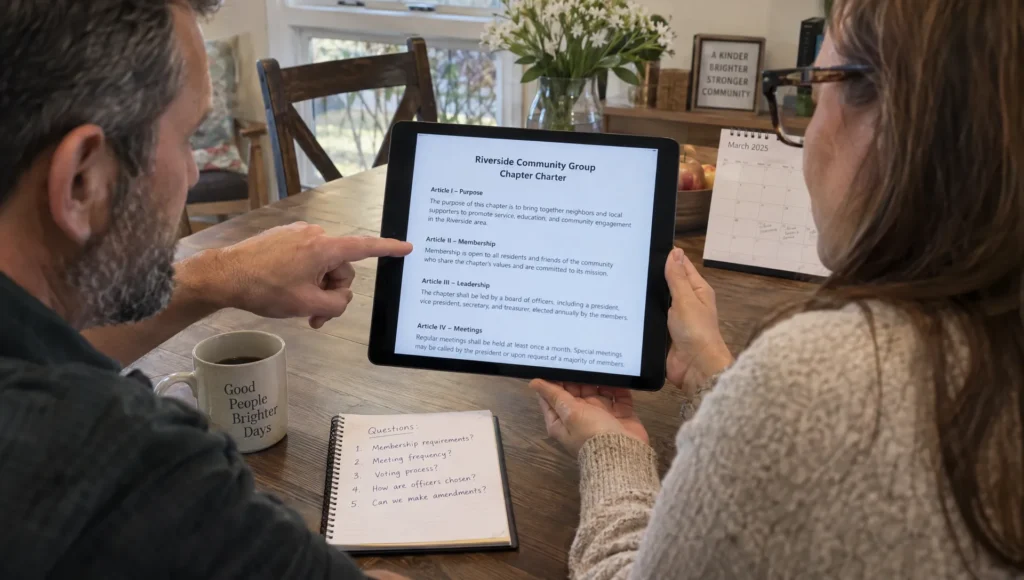
Democratic education is often treated as a civics class, a lesson on constitutions, elections, rights, and institutions. That is necessary, but it is not enough. A person can memorize how a parliament works and still never learn how to challenge a claim, listen across disagreement, weigh tradeoffs, request public records, or turn public frustration into a concrete proposal.
That is where a political movement can help. Not by turning schools into campaign offices, and not by pushing students into a single ideological identity. A democratic movement can support democratic education by building the habits, tools, and public culture that allow people to practice democracy before they are asked to save it.
For JustSocial, this connects directly to the argument in The Face of Democracy: modern societies still rely on industrial-era public structures while citizens live in a digital, networked, fast-moving world. If democracy is supposed to be continuous rather than occasional, education must also become continuous. People should not be trained to wait silently for the next election. They should learn how to participate, deliberate, verify, and hold institutions accountable throughout public life.
Democratic education is not indoctrination
The first responsibility of any movement supporting democratic education is to draw a hard line between civic learning and propaganda.
Propaganda tells people what to think. Democratic education teaches people how to think publicly with others. It builds skills such as asking better questions, checking evidence, identifying decision-makers, respecting minority rights, and understanding the difference between winning an argument and improving a decision.
This distinction matters because many citizens are rightly suspicious when a political movement enters the education conversation. The answer is not for movements to withdraw from civic education entirely. The answer is for them to operate with visible rules, viewpoint diversity, transparent materials, and public accountability.
International frameworks point in the same direction. UNESCO’s work on global citizenship education emphasizes critical thinking, human rights, participation, and responsibility. The Council of Europe’s Reference Framework of Competences for Democratic Culture similarly treats democracy as a set of values, attitudes, skills, knowledge, and critical understanding.
A movement can contribute to that kind of education when it models democratic behavior rather than merely preaching democratic values.
The manifesto’s education challenge
In the JustSocial manifesto, Yuval D. Vered argues that the education system still carries the shape of the Industrial Revolution: age batches, fragmented subjects, standardized testing, and passive movement from one authority figure to another. The manifesto calls for a more holistic model, including project-based learning, more student choice, technology that supports teachers, and a stronger connection between education and civic life.
That argument is not only about schools. It is about the social contract.
If citizens are treated only as voters, taxpayers, and consumers, schools will naturally train them for compliance, career preparation, and private success. If citizens are treated as active participants in public life, education has to prepare them for public judgment.
A political movement can support that shift by helping communities practice three democratic habits:
- Civic participation: learning how to connect public concern to real decisions.
- Discursive democracy: learning how to speak, challenge, listen, and reason in public without collapsing into chaos.
- Deliberative democracy: learning how to weigh evidence and tradeoffs before recommending action.
These habits do not require every student or citizen to become a full-time activist. They require democracy to become learnable, repeatable, and visible.
From civic knowledge to civic practice
Traditional civic education often asks, “Do students understand the system?” Democratic education should also ask, “Can people use the system, improve it, and hold it accountable?”
That is the difference between civic knowledge and civic participation. Knowledge explains what a school board, city council, ministry, or parliament is. Participation teaches how to identify the actual decision, submit a reasoned request, attend a meeting, read a budget line, compare policy options, and ask for a response.
For a democratic political movement, the most useful educational contribution is not another abstract lecture. It is a practice field.
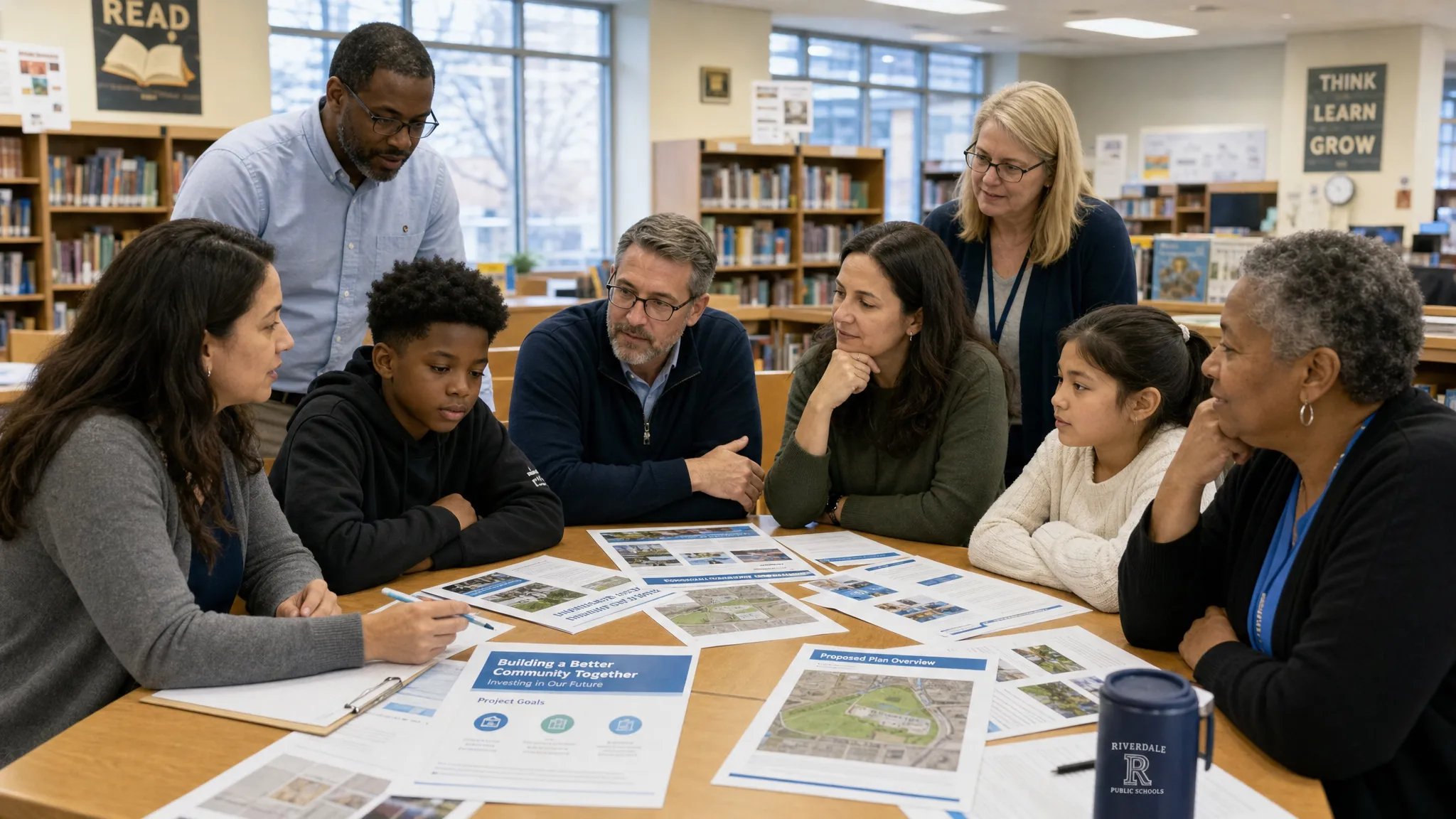
A movement can create workshops, community labs, youth forums, parent circles, and local issue projects where people learn by working on real public questions. These can be small and practical: a school phone policy, a dangerous intersection, a library budget, public transportation access, local mental health support, or transparency in committee meetings.
The educational value comes from the method. Participants learn that democracy is not only expression. It is structured influence.
| Movement contribution | Democratic education value | Public artifact produced |
|---|---|---|
| Decision literacy workshops | Citizens learn how public decisions actually move | Decision map |
| Evidence commons | Participants practice checking claims and sources | Source index or issue pack |
| Discursive democracy rules | Public debate becomes safer and more usable | Discourse charter |
| Deliberative mini-publics | People learn tradeoffs and option-building | Options memo |
| Transparency tracking | Communities learn accountability after decisions | Response log or tracker |
| Civic tech training | Citizens understand tools, data, privacy, and risks | Platform guide or audit notes |
| Student and community projects | Learning connects to lived problems | Project brief and reflection |
This is the educational version of JustSocial’s broader vision: democracy as infrastructure, not as an occasional event.
Discursive democracy: teaching public speech that can be used
Much of public debate today rewards speed, outrage, and identity signaling. That is a terrible classroom for democracy. If young people learn politics mainly through viral conflict, they may conclude that public life is only performance, manipulation, or tribal loyalty.
Discursive democracy offers a different lesson. It focuses on the quality of public reasoning before formal decisions are made. It asks participants to clarify claims, give reasons, disclose uncertainty, separate people from arguments, and make disagreements traceable.
A political movement can support democratic education by teaching simple public reasoning norms:
- Make a claim that can be understood.
- Give a reason or source.
- Name what decision the claim relates to.
- Identify who may be affected.
- State what would change your mind.
These habits are not partisan. They are democratic hygiene. They help students and citizens move from “I feel ignored” to “Here is the decision, here is the evidence, here is the affected group, and here is the request.”
In the JustSocial framework, discursive democracy is especially important because continuous participation produces a lot of public input. Without structure, that input becomes noise. With structure, it becomes civic intelligence.
Deliberative democracy: teaching judgment, not just opinion
Opinion is easy to collect. Judgment is harder to build.
Deliberative democracy gives democratic education its depth. It creates spaces where participants study shared evidence, hear different perspectives, consider tradeoffs, and produce recommendations that decision-makers can actually use.
For education, this is powerful because it trains the muscles that standard political argument often weakens: patience, humility, comparison, compromise, and responsibility for consequences.
A student or citizen who participates in a deliberative process learns that every public choice has constraints. A better school schedule may affect transportation. More security may affect privacy. More technology may improve access while raising concerns about data. Better services may require budget tradeoffs.
Deliberative democracy does not ask people to abandon values. It asks them to test values against reality and explain their reasoning in public.
That fits the manifesto’s call for a stronger role for academia as an independent civic force. Expert knowledge should not replace citizens, but it should help citizens deliberate well. Researchers, teachers, and practitioners can prepare evidence briefs, explain uncertainty, and review whether public materials are balanced. The result is not technocracy. It is better public judgment.
How a political movement can support schools without capturing them
A movement that wants to support democratic education must be disciplined. The goal is to increase civic capacity, not to recruit minors or dominate institutions.
A credible approach should include five safeguards.
Process before position. Educational materials should teach how to reason, participate, and verify, not require agreement with the movement’s preferred policy outcome.
Multiple viewpoints. Issue packs should include competing arguments, affected groups, and credible disagreement. Students should see that democracy is not weakened by disagreement when disagreement is structured well.
Privacy and age protection. Minors need special safeguards. Participation should avoid public shaming, unnecessary personal data collection, and pressure to disclose political identity.
Independent review. Teachers, parents, local officials, academic advisors, and community representatives should be able to inspect materials and challenge bias.
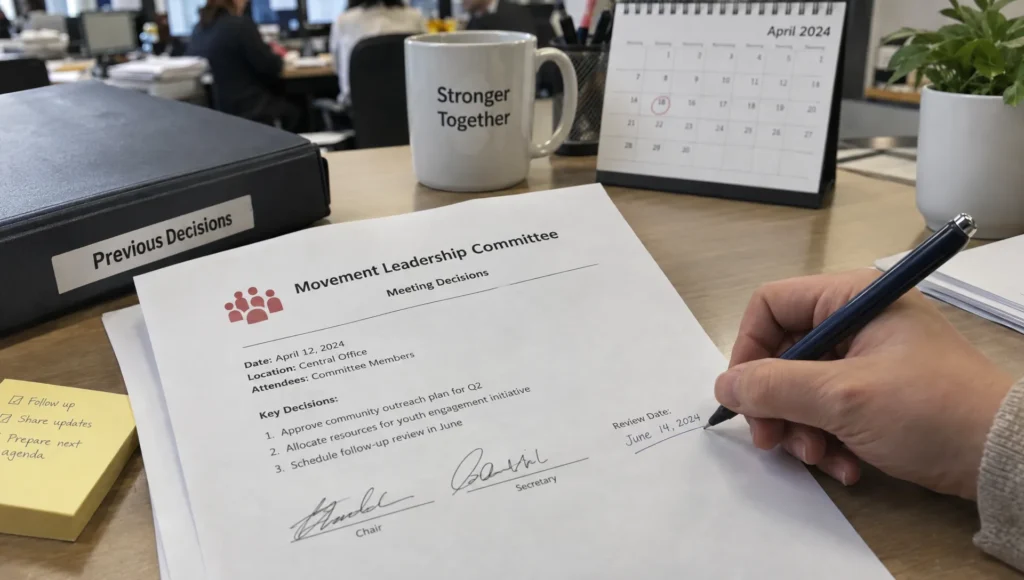
Public receipts. The movement should publish what it did, what materials it used, who participated in what role, what outputs were produced, and how feedback changed the process.
These safeguards are also strategic. They protect legitimacy. A movement that demands transparency from government should practice transparency in its own educational work.
A democratic education support loop
A practical model does not need to begin with national reform. It can begin with one community and one real decision.
- Name the decision: Choose a public issue with a real decision owner, timeline, and scope, such as a school policy, local budget item, or public service change.
- Build the issue pack: Create a plain-language summary with background, evidence, constraints, affected groups, and open questions.
- Teach the discourse rules: Before debate begins, teach participants how to make claims, use evidence, ask fair questions, and disagree without personal attack.
- Run a deliberative session: Bring together a balanced group to compare options, hear testimony, identify tradeoffs, and produce recommendations.
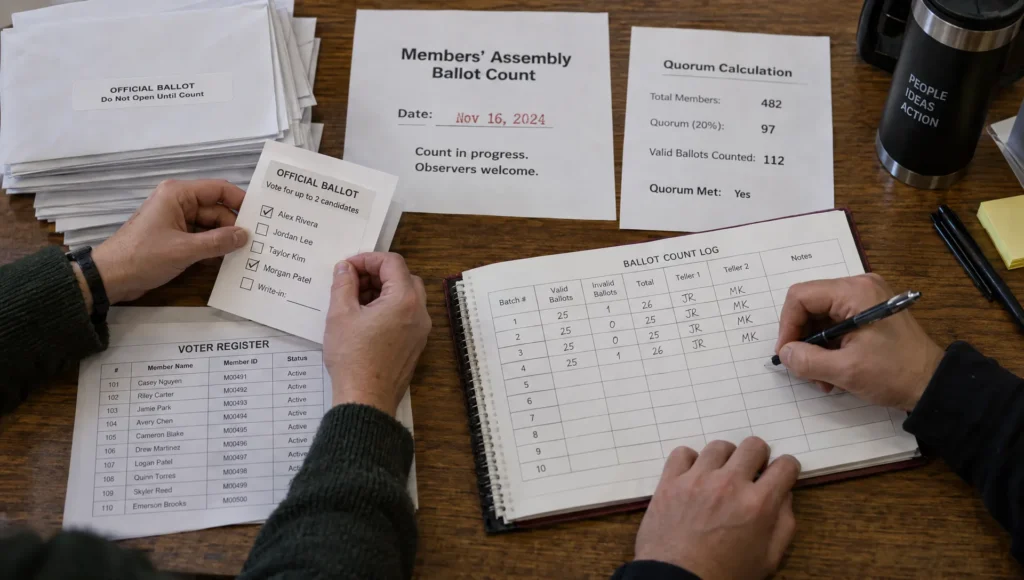
- Publish the outputs: Share an options memo, minority concerns, evidence list, and process notes so outsiders can inspect the work.
- Track the response: Ask the decision-maker for a written response and track whether anything changes after the process.
This loop turns education into lived democracy. It also gives movements a healthier role. Instead of saying, “Trust us, we represent the people,” the movement says, “Here is a process people can inspect, repeat, and improve.”
Civic technology as a learning tool
Technology can help democratic education, but only if it is governed by democratic rules.
The JustSocial manifesto sketches product concepts such as TakeAction!, rParliament, rConcensus, public analytics, and civic identity features. In an educational setting, the principle behind these ideas matters as much as the software itself: citizens should be able to see public decisions, understand the evidence, express reasoned input, and follow what institutions do afterward.
Civic technology can support democratic education by making public life more visible. Livestreams, transcripts, committee records, issue pages, participation dashboards, and implementation trackers can become learning materials. Students can study not only what government says, but how decisions are made.
However, the same technology can also harm education if it rewards popularity over reasoning or surveillance over trust. AI can summarize, translate, and organize input, but it should not replace human judgment. Analytics can reveal patterns, but they should not reduce citizens to manipulable segments. Online voting or participation tools can expand access, but they require privacy, security, accessibility, and clear limits.
The lesson for democratic education is simple: technology should make civic reasoning more visible, not make citizens easier to manage.
What movements should measure
If a political movement wants to support democratic education seriously, it should measure learning and legitimacy, not just reach.
Followers, views, and event attendance can be useful signals, but they do not prove democratic capacity. A more meaningful measurement system asks whether people are becoming better at public reasoning, participation, and accountability.
| Measurement area | Key question | Example evidence |
|---|---|---|
| Inclusion | Who participated, and who was missing? | Participation breakdown with privacy protection |
| Discursive quality | Did people give reasons, evidence, and decision-linked claims? | Claim maps, source indexes, synthesis notes |
| Deliberative quality | Did participants compare tradeoffs and produce usable options? | Options memo, minority report, facilitator notes |
| Civic participation | Did the process connect to a real decision? | Decision owner, timeline, submitted request |
| Accountability | Did an institution respond or act? | Response memo, implementation tracker |
| Learning | Did participants gain civic skills and confidence? | Pre/post reflections, skill self-assessments |
This is where education and movement-building meet. A movement becomes more trustworthy when it can show that people are not only more mobilized, but more capable.
Why this matters for the future of democracy
The manifesto’s idea of a modern Cosmopolis is not only a technological proposal. It is a cultural proposal. It imagines a society where citizens have more meaningful contact with public life, where the state listens continuously, and where education prepares people to participate in that reality.
That cannot be built by software alone. It requires a public learning culture.
A political movement can support that culture by training facilitators, publishing templates, partnering with educators, helping communities run deliberative pilots, making public records easier to understand, and insisting that democratic processes produce receipts. It can also help adults relearn what many were never taught: how to participate without being consumed by politics.
Democratic education should not produce obedient supporters. It should produce citizens who can challenge the movement itself.
That is the test. If a movement teaches people to ask better questions, inspect evidence, protect minorities, demand transparency, and deliberate before deciding, it is strengthening democracy. If it teaches people only to repeat slogans, it is weakening democracy, even if the slogans sound democratic.
Frequently Asked Questions
Can a political movement work with schools without becoming partisan? Yes, but only if it focuses on process, not ideological recruitment. Materials should be transparent, balanced, inspectable, and designed around civic skills such as evidence use, deliberation, public reasoning, and accountability.
What is the difference between civic participation and democratic education? Civic participation is action connected to public decisions. Democratic education prepares people to take that action responsibly by teaching decision literacy, rights, duties, evidence, deliberation, and follow-through.
How does deliberative democracy help students? Deliberative democracy helps students practice informed judgment. They learn to compare options, listen to affected people, understand tradeoffs, and explain recommendations instead of simply expressing opinions.
Why does discursive democracy matter in education? Discursive democracy teaches the rules of healthier public debate. It helps participants make clear claims, give reasons, use evidence, and disagree without turning civic life into personal conflict.
Where does JustSocial fit into democratic education? JustSocial’s manifesto argues for continuous civic participation, educational reform, public transparency, and technology-supported democracy. Its role is to help build the tools, habits, and public processes that make democratic participation learnable and repeatable.
Help build democratic education as civic infrastructure
If democratic education is going to become more than a textbook chapter, it needs movements, educators, technologists, parents, students, and public officials willing to build practical participation loops.
JustSocial is working toward a model of continuous, transparent, technology-supported democracy rooted in civic participation, deliberative democracy, and public accountability. Start by reading The Face of Democracy, explore our writing on civic participation in schools, or learn more about how to join Just Social.
Democracy has to be taught, but more importantly, it has to be practiced. The classroom, the community, and the movement can become places where that practice begins.