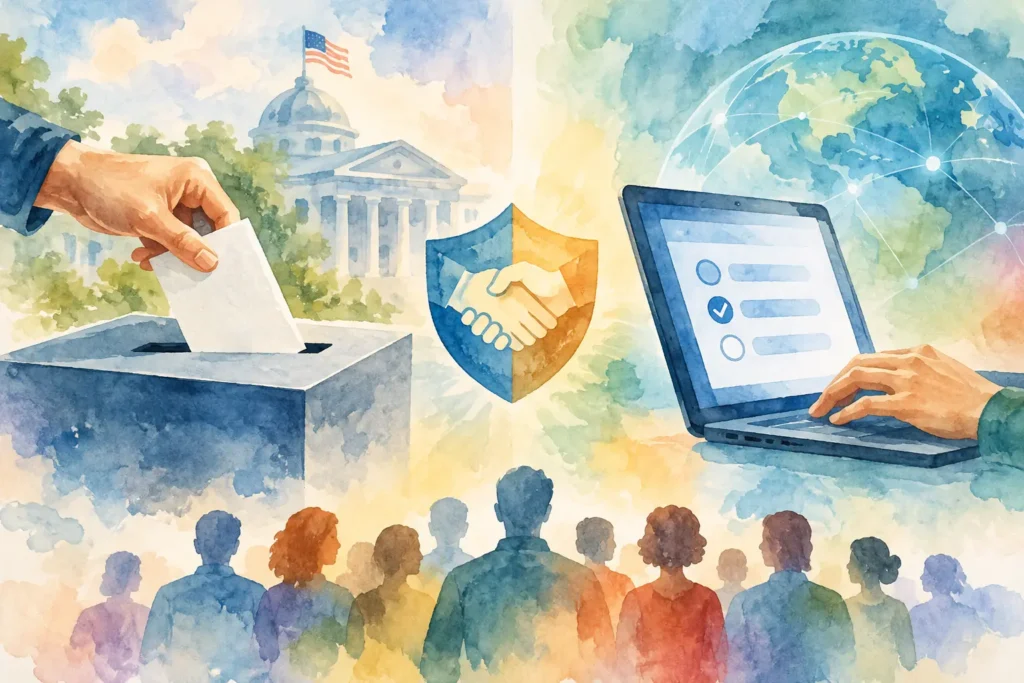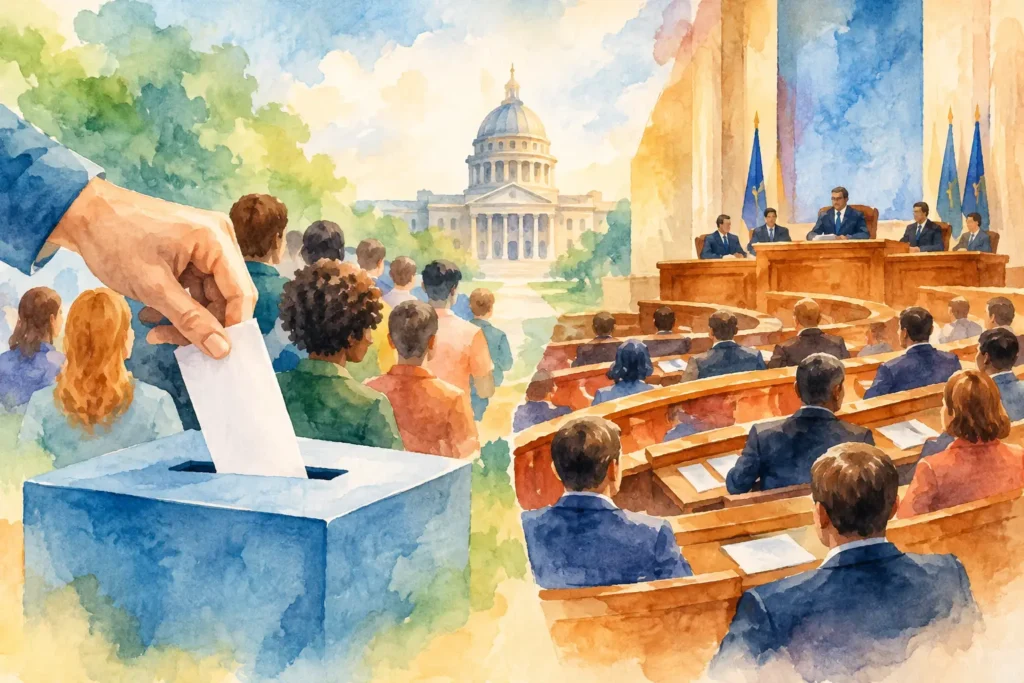
A resident should not have to wait two years, four years, or until a public crisis to be heard. Yet for many people, government becomes visible only at election time, when a confusing notice arrives, or when a decision has already been made. Digital democracy offers a different relationship: one where citizens can follow public choices, contribute their experience, and see how institutions respond throughout the year.
This is not a call to replace every public meeting with an app or reduce civic life to a series of taps. Democracy depends on conversation, organizing, disagreement, and care for people whose voices are too often left out. But thoughtfully built digital infrastructure can make those democratic practices more accessible, more transparent, and more connected to real decisions.
What digital democracy should make possible
At its best, digital democracy gives people practical ways to participate in public life between elections. A parent should be able to weigh in on school transportation before a policy is finalized. A neighborhood organizer should be able to track a proposed zoning change without deciphering a maze of agency websites. A nonprofit serving seniors should have a clear route to share what residents need and understand what happened after they spoke up.
The goal is not simply more engagement. A city can collect thousands of comments and still leave people feeling ignored if there is no visible connection between public input and public action. Meaningful participation requires a clear question, accessible information, a fair process, and a response that explains what decision was made and why.
That is where civic technology becomes public infrastructure. Like a library, a polling place, or a public notice board, it should help people reach the institutions that shape their lives. It should not require insider knowledge, expensive devices, or endless time to use.
Digital democracy is more than online voting
Online voting often dominates conversations about digital democracy because it is easy to understand. Voting matters, and secure, accessible election systems deserve serious investment. But democracy is much larger than casting a ballot on Election Day.
It includes proposing ideas, setting priorities, reviewing budgets, sharing local knowledge, attending deliberations, monitoring implementation, and holding leaders accountable. Digital tools can support each of these moments. They can publish plain-language information before a decision, invite input through multiple channels, show participation data, and preserve a public record of what government heard.
The distinction matters because an online poll alone can create the appearance of power without giving residents any real influence. A strong process identifies whether feedback is advisory, binding, or part of a longer deliberation. It also states who can participate, how competing views will be considered, and when the public can expect a decision.
When these rules are clear, participation becomes less performative. People can decide where to invest their time because they understand the stakes.
Access is a design requirement, not an afterthought
A digital tool that only works for highly connected, English-speaking, tech-confident residents can widen the gap it claims to close. Digital participation must be designed alongside in-person options, phone access, community partners, language support, and accommodations for people with disabilities.
That does not make digital tools less valuable. It makes them more honest. A public process should meet people where they already are: at libraries, schools, faith communities, neighborhood organizations, service providers, and on the devices they can actually use.
Plain language is part of access, too. Residents cannot offer informed input if a proposal is buried under technical terms or presented after key choices have already narrowed. Government and nonprofit leaders have a responsibility to explain the issue, the trade-offs, the available options, and the consequences of doing nothing.
Trust has to be built into the system
Citizens have good reason to ask what happens to the information they share. Public participation systems may collect names, addresses, opinions, demographic data, or records of political activity. Mishandled data can expose people to harassment, discrimination, or surveillance. It can also damage confidence in the entire process.
Digital democracy therefore needs strong privacy practices, limited data collection, clear consent, and public explanations of how information is stored and used. Systems should protect anonymity when it is appropriate while also preventing manipulation, duplicate participation, and coordinated abuse.
There are real trade-offs here. A fully anonymous forum may allow more candid participation but can be easier to disrupt. Strict identity verification can improve confidence in a binding vote but may exclude residents without standard documentation or make participation feel unsafe. There is no universal setting that solves every problem. The level of security should match the consequence of the decision, and communities should understand the choice being made.
Participation needs a path to power
The hardest question is not whether people can submit feedback. It is whether public institutions are prepared to share influence.
A digital participation platform can help a government identify needs, but it cannot substitute for a commitment to act. If officials ask residents to rank budget priorities, they should publish the results, explain how those results shaped the budget, and be transparent about legal or financial limits. If community members propose solutions, they should know who reviews them and what threshold moves an idea forward.
This accountability loop is what turns participation into trust. It recognizes that residents are not customers completing a satisfaction survey. They are co-owners of the public institutions funded in their name.
For public agencies, that may mean redesigning internal workflows so staff can respond to input rather than treating engagement as an extra task. For nonprofits, it may mean creating transparent ways for community members to guide programs, resource allocation, and advocacy priorities. For residents, it means bringing lived experience and local knowledge into a process that can influence outcomes.
Start with a decision people can recognize
Communities do not need to build a perfect national platform before improving democratic participation. The strongest starting point is often a specific public decision people can see and understand: a park improvement, a transit route, a neighborhood safety priority, a grant program, or a portion of a municipal budget.
Begin by defining the decision clearly. State what is open for public influence and what is not. Share information early enough for participation to matter. Offer more than one way to contribute. Then report back in plain language.
Four practices make this work more credible:
- Publish the timeline, decision-makers, and rules before asking for input.
- Use outreach that reaches beyond the usual civic insiders.
- Combine digital participation with trusted local spaces and organizations.
- Show the public what changed, what did not, and why.
These practices are simple, but they challenge a common habit: treating engagement as a final communications step. Participation works best when it begins before a solution is locked in.
Building civic infrastructure together
No single tool can repair political polarization, unequal representation, or public distrust. Technology can also reproduce those problems when it is designed without community oversight. We should be skeptical of systems that promise frictionless democracy while hiding their rules, data practices, or decision-making power.
Still, skepticism is not a reason to accept a democracy that only asks for our attention at the ballot box. We can build better public pathways with open standards, community input, accessible design, and institutions willing to explain themselves. We can test prototypes, learn from participation failures, and keep improving the connection between citizens and the state.
JustSocial believes democracy becomes stronger when participation is continuous, visible, and shared. The work belongs to more than technologists or elected officials. It belongs to organizers who know their communities, nonprofits that serve people every day, public servants who want better systems, and citizens ready to play a more active role.
The next meaningful democratic action may be smaller than a national election. It may be asking your local institution what decisions residents can shape this month, then helping make the answer clear enough for your neighbors to act on.