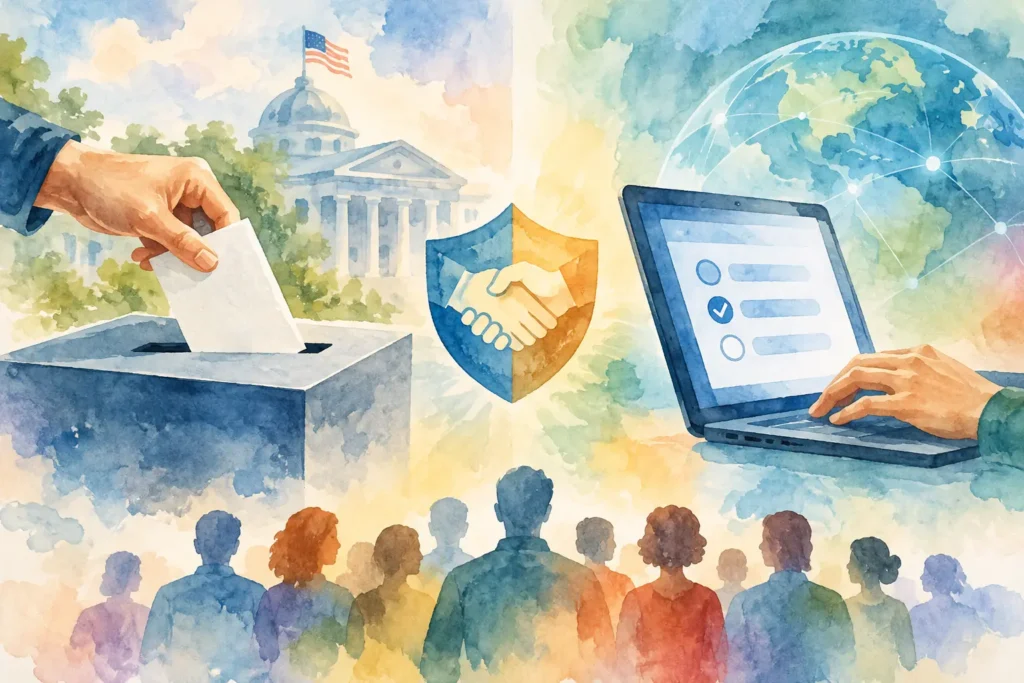
A voter should not need expert knowledge, fast internet, or blind faith to take part in public life. The debate over paper ballots versus online voting is often framed as a choice between the familiar and the future. But the real question is more demanding: what kind of democratic infrastructure lets every eligible person participate while allowing the public to verify that the outcome reflects their collective will?
We can build for access without treating security as an afterthought. We can protect the integrity of high-stakes elections without accepting a democracy that is difficult to enter, slow to respond, or available only once every few years. That requires looking beyond the false promise that one voting method can solve every civic problem.
Why paper ballots still carry public trust
Paper ballots are not merely a tradition. They create a physical record that can be stored, examined, recounted, and audited independently of the software used to mark or count them. If a scanner fails, if a database is corrupted, or if an election result is challenged, the ballot itself remains evidence of voter intent.
That evidence matters because elections ask the public to accept a result even when their preferred candidate or measure loses. Trust does not come from being told that a system is secure. It comes from having procedures that candidates, election officials, observers, journalists, and ordinary citizens can inspect. A voter-marked paper ballot provides a tangible foundation for that shared verification.
Paper voting also limits certain kinds of remote interference. A malicious actor cannot change thousands of paper ballots from another country with one successful intrusion. Physical systems have risks of their own, including lost materials, long lines, inaccessible polling places, and human error. Yet those risks tend to be localized and observable rather than instantly scalable.
For public elections that decide representation, budgets, laws, and constitutional rights, this distinction is significant. A system must withstand not only routine mistakes but determined attacks. It must also produce evidence strong enough to resolve disputes after a close or contested race.
Where paper systems fall short
A paper record is valuable, but paper alone does not guarantee an inclusive election. Voters can face transportation barriers, inflexible work schedules, long distances to polling locations, language gaps, disability-related obstacles, and confusing registration rules. For people serving overseas, living in rural communities, caring for family members, or working multiple jobs, the mechanics of casting a ballot can become a barrier to political voice.
Even when mail voting is available, voters may worry about deadlines, signature requirements, postal delays, or whether their ballot arrived and was counted. A democratic system should not require extraordinary persistence from the people it is meant to represent.
There is another limitation: paper-centered elections are usually episodic. Most Americans are invited to make a small number of high-consequence decisions on a fixed calendar, then asked to wait. That structure can leave communities disconnected from the policies, local priorities, and public services that shape daily life between elections.
The answer is not to discard paper. It is to recognize that election integrity and meaningful civic participation are related, but they are not identical challenges.
Paper ballots versus online voting: the security gap
Online voting is appealing for understandable reasons. It can reduce travel, shorten the time needed to participate, offer language and accessibility features, and make public input possible outside a narrow Election Day window. For a resident who cannot easily reach a polling site, a digital option may feel less like convenience and more like equal access.
But voting from a personal phone or computer introduces hard security problems. A device may be infected with malware. A voter may be pressured by an employer, family member, or campaign worker while voting at home. A fake website may capture credentials. An attacker could target the service provider, the identity-verification process, or the voter’s internet connection.
The central challenge is not simply whether an online platform can encrypt data. Many systems can. The harder issue is whether a voter can verify that their selection was recorded as intended, counted as recorded, and included in the final result without exposing how they voted. This is called end-to-end verifiability, and it remains difficult to deliver in a way that is both highly secure and understandable to the general public.
Security also depends on public confidence. If a statewide election relies on technology that only a small group of specialists can evaluate, many people may be asked to trust claims they cannot independently assess. That is an uncomfortable foundation for democratic legitimacy, especially in a period when misinformation and distrust already weaken civic life.
For that reason, internet voting should not be treated as a simple replacement for paper ballots in major public elections. Convenience is a public good, but it cannot outweigh the need for a reliable, auditable result.
Accessibility is not a side issue
Rejecting broad online voting for high-stakes elections should never mean accepting exclusion. Accessible voting equipment, well-designed mail ballot systems, early voting, ballot tracking, plain-language instructions, transportation support, and properly staffed polling places all expand participation while preserving a paper trail.
Digital tools can also help voters prepare before they cast a ballot. They can provide accessible information about candidates and measures, reminders about deadlines, translation support, and clear explanations of what is at stake. Used well, technology reduces friction around voting without becoming the single point of failure for the vote itself.
The same principle applies to people with disabilities. Every voter deserves privacy and independence. Election systems should offer multiple accessible paths, designed with disabled voters from the beginning rather than added as an afterthought.
A better role for digital participation
Online systems may be better suited to forms of civic participation that benefit from frequency, deliberation, and lower stakes than binding statewide elections. Community surveys, participatory budgeting input, public-comment processes, neighborhood priorities, nonprofit governance, and issue forums can all use digital tools to reach people who would otherwise be absent from the room.
These processes still need clear rules. Participants should know who is eligible, how their input will be used, what data is collected, and whether a vote is advisory or binding. Public agencies and community organizations should publish methods and results in language people can understand. Transparency is not a feature added at launch. It is the condition that makes participation meaningful.
Digital participation can also strengthen the habits that formal elections depend on. When residents have regular opportunities to weigh in on local needs, see how decisions are made, and receive a response from institutions, democracy becomes less abstract. People gain practice in civic judgment. Governments gain a clearer picture of community priorities.
This is where civic technology can serve a larger democratic purpose. Rather than asking software to replace institutions, we can use it to create more entry points into public decision-making. JustSocial is built around that possibility: democracy as an ongoing relationship, supported by accessible tools and shared public responsibility.
Build systems people can question
The healthiest democratic systems are not those that demand unquestioning trust. They are the systems that make questioning productive. A voter should be able to ask how ballots are stored, how audits work, who maintains technology, how accessibility needs are met, and what happens when something goes wrong. Public officials should be prepared to answer clearly.
For binding elections, that means maintaining paper records, conducting meaningful post-election audits, testing equipment publicly, and communicating procedures before conflict arises. It also means resisting the urge to describe every digital upgrade as progress. A new system is only an improvement if it increases both access and accountable verification.
For ongoing participation, it means designing digital spaces that are easy to use, transparent about their limits, and connected to real decisions. Asking for public input without showing what happened to it can deepen cynicism. Inviting people into a process with clear outcomes can deepen their connection with democracy.
We do not have to choose between a secure election and a more participatory society. We can defend paper-backed voting where the stakes require it, while building digital civic infrastructure that gives people more ways to organize, contribute, and be heard. The work begins when we treat every barrier to participation as a shared public problem worth solving.