Most people argue about “more democracy” as if it is one switch you either flip on or off. In practice, democratic systems are built from different mechanisms, and each mechanism shapes incentives, information quality, and legitimacy in a different way.
This matters for civic participation in 2026 because participation is no longer constrained by geography or election cycles. The real question is how to translate everyday public voice into decisions that are actually better, fairer, and harder to capture.
Below is a clear comparison of deliberative democracy vs direct democracy, plus where discursive democracy fits, and why any serious political movement should care.
Definitions (without the academic fog)
What direct democracy is
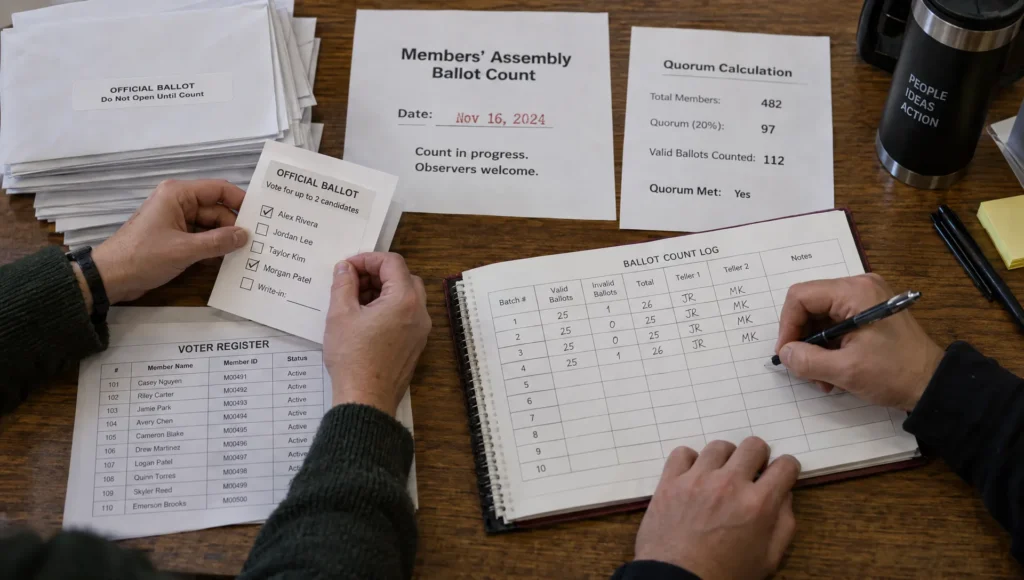
Direct democracy is a model where citizens make decisions themselves rather than delegating final authority to representatives. The core action is usually a vote on a specific question.
In real life, direct democracy appears as referendums, initiatives, recall votes, and binding ballots inside organizations.
What deliberative democracy is
Deliberative democracy is a model where legitimacy depends on citizens (or a representative sample of them) reasoning together under conditions that improve judgment: balanced information, structured discussion, and fair participation.
It is less about “counting preferences fast” and more about “forming public judgment well.” A classic modern approach is James S. Fishkin’s deliberative polling.
What discursive democracy is
Discursive democracy focuses on legitimacy through public justification: decisions should be supported by reasons that can be inspected, challenged, and improved in the open.
If deliberative democracy is about designing high quality “mini publics” or structured forums, discursive democracy is broader: it emphasizes a healthy public sphere where arguments, evidence, and rationales are visible, contestable, and archived.
JustSocial’s manifesto argues that modern states already have the technology to hear people continuously, but lack the institutional commitment to convert that voice into accountable governance. Discursive democracy is one way to name that missing layer: a public reasoning infrastructure, not just occasional voting.
Deliberative democracy vs direct democracy: the key differences
The simplest way to see the difference is this:
- Direct democracy answers: What do we choose?
- Deliberative democracy answers: How do we arrive at a choice worth trusting?
Here is a practical comparison.
| Dimension | Direct democracy | Deliberative democracy | Discursive democracy (where it sits) |
| Core legitimacy claim | The people decide directly | The people form considered judgment through fair reasoning | Decisions are legitimate when reasons and evidence are public and contestable |
| Main citizen action | Voting “yes/no” (or choosing among options) | Learning, discussing, weighing tradeoffs, then recommending or deciding | Contributing claims, counterclaims, sources, and critique in an open record |
| Best at | Clear authorization on specific questions | Complex tradeoffs and long term policy | Continuous accountability and justification across the whole decision lifecycle |
| Biggest risk | Oversimplification, manipulation, majority domination | Process theater if decision makers ignore outcomes, or if selection is biased | Loudness over substance if discourse is unstructured or captured |
| What you must publish to be credible | Rules, eligibility, audit outputs, final results | Evidence set, facilitation rules, participant selection method, final recommendations | Decision rationale, evidence links, and traceable responses to public claims |
If you only remember one thing: direct democracy is a decision mechanism, while deliberative democracy is a decision-quality mechanism.
Where each model shines (and where it breaks)
Direct democracy: strong authorization, weak context
Direct democracy works well when:
- The decision is bounded and understandable.
- The options are stable enough to put on a ballot.
- The system has strong protections for rights and minorities.
- The process is resistant to coercion and manipulation.
It breaks down when decisions require sustained learning, when “winning the vote” becomes more important than understanding consequences, or when public debate is dominated by disinformation.
A useful way to connect this to the JustSocial manifesto is the critique of elections as a “campaign of debauchery” that rewards spectacle. Direct votes can inherit the same pathologies if the surrounding information environment is chaotic.
Deliberative democracy: strong judgment, weak linkage (unless designed)
Deliberative democracy works well when:
- Issues are complex (budget priorities, education reform, climate adaptation).
- Tradeoffs matter and slogans are insufficient.
- You need legitimate compromise and shared understanding.
It breaks down when it becomes a “consultation ornament.” If officials can ignore outcomes without cost, deliberation becomes participation without power.
This is why JustSocial keeps returning to the idea of democracy as infrastructure: legitimacy requires repeatable processes plus a duty to respond with public receipts.
For a deeper background on deliberative practice, OECD’s report on the “deliberative wave” is a useful reference: OECD: Innovative Citizen Participation and New Democratic Institutions.
Discursive democracy: strong transparency, variable quality
Discursive democracy is what many people think they are doing on social media, but most platforms are optimized for attention, not public reasoning.
Discursive democracy works when public discourse has:
- Clear framing of the decision and the decision owner.
- Norms and tooling that reward evidence and clarity.
- A public record of arguments and responses.
It breaks when:
- Discourse is personalized, rage-driven, and ephemeral.
- There is no shared evidence base.
- Citizens never see how discourse affected outcomes.
JustSocial’s manifesto is explicit that modern tech can measure opinion continuously, but it also warns that the state must safeguard these systems. Without safeguards, discourse becomes another arena for manipulation, not empowerment.
A practical way to choose: match the mechanism to the decision
Instead of asking “Which model is best?”, ask “Which part of the decision lifecycle are we trying to improve?”
| Decision need | What to use | Why |
| Rapid, clear authorization on a bounded question | Direct democracy | It delivers a decisive signal and clean legitimacy on that specific choice |
| Producing better options, not just picking among slogans | Deliberative democracy | It creates conditions for learning and tradeoff handling |
| Ongoing accountability and trust rebuilding | Discursive democracy | It forces public reasoning, traceability, and explanation |
This is also the logic behind JustSocial’s broader direction: continuous participation (discursive inputs), structured deliberation, and then decision mechanisms that fit the stakes.
How the models combine in a “continuous” system
A common mistake is to treat deliberation and direct voting as competitors. In practice, they are often complements.
Here is a workable hybrid pattern that aligns with JustSocial’s manifesto (especially its call for a “people’s branch” and an “academic branch” to strengthen governance).
Discursive layer (continuous)
People contribute lived experience, critiques, and proposals in an open record.
What makes it real (not just noise) is discursive discipline:
- Claims have to be attached to a decision docket.
- Evidence is linkable.
- The public can see responses and changes over time.
Deliberative layer (structured)
A diverse group goes deep, stress-tests tradeoffs, and drafts options that are actually implementable.
The manifesto’s emphasis on modernizing institutions applies here: deliberation should be treated like public infrastructure with published rules, facilitation standards, and outputs.
Direct layer (decision)
When a decision should be directly authorized by citizens, direct democracy mechanisms finalize the choice.
Crucially, the direct vote is stronger when it follows genuine deliberation and when the final ballot includes a public rationale and a clear implementation plan.
Why this matters for civic participation beyond politics
Democracy debates can feel abstract until you connect them to everyday life: schools, housing, transportation, public safety, healthcare.
Take housing and development. Whether a city upzones a neighborhood, approves a large project, or changes infrastructure priorities can reshape affordability and opportunity for decades. These are exactly the kinds of high impact decisions that benefit from deliberation (to explore tradeoffs) and discursive transparency (so the public can inspect who argued what and why).
If you want a concrete example of how development choices translate into investment realities, you can look at market-facing analysis from firms like Azimira’s real estate investment team, especially in fast-changing regions where planning decisions move quickly.
The point is not that democracy should serve investors, but that public decisions have real economic consequences. Better civic participation means fewer surprises, less corruption opportunity, and more legitimate outcomes.
What a political movement should take from this
A serious political movement is not just a messaging engine. It is a governance prototype.
If a movement claims it will “return power to the people,” it should be able to demonstrate that internally:
- How are priorities set?
- How are disagreements resolved?
- Where is the evidence?
- Who has final authority, and under what rule?
Using deliberative and discursive practices inside a movement does two things:
First, it produces better policy.
Second, it builds trust through visible process. That matches the manifesto’s argument that citizens should be more than voters and consumers. They should be participants in a continuous civic system.
A simple design checklist (for communities or institutions)
If you are choosing between deliberative democracy vs direct democracy for a real initiative, use this checklist to avoid participation theater.
- Name the decision clearly (what will change, and what will not).
- Name the decision owner (who has authority to implement).
- Publish the decision rule (advisory, binding, threshold, timeline).
- Decide what “good input” looks like (evidence, lived experience, options, cost constraints).
- Choose the right mechanism (direct vote, deliberative forum, or a staged hybrid).
- Require a public rationale (what input mattered, what was rejected, and why).
- Track implementation publicly (otherwise participation becomes a one-time event).
This is the bridge between theory and the manifesto’s core demand: make democracy continuous, measurable, and accountable.

Frequently Asked Questions
Is deliberative democracy anti-voting? No. Deliberative democracy is usually pro-voting, but it treats voting as the end of a reasoning process, not the whole process.
Does direct democracy always mean referendums? Not always. Direct democracy can include initiatives, recalls, and binding votes in organizations. The unifying feature is that citizens decide the outcome directly.
Where does discursive democracy happen in practice? Anywhere public reasoning is visible and contestable, for example in structured public comment processes with published rationales, or in civic forums that require evidence and track responses.
Which model is best for a political movement? Movements often need all three: discursive democracy to stay connected to supporters, deliberative democracy to produce coherent policy, and direct democracy to authorize major decisions internally.
Can these models scale digitally without becoming chaotic? Yes, but only if you design for legitimacy: clear decision linkage, transparent rules, inclusion, and safeguards against manipulation.
Build civic participation that is continuous, not occasional
If you agree that democracy should feel less like a once-every-few-years ritual and more like an accountable operating system, explore JustSocial’s vision of continuous participation and institutional reform.
Read the manifesto, “The Face of Democracy,” and see how the movement connects discursive democracy, deliberative democracy, and direct decision mechanisms into one practical direction: JustSocial’s manifesto. If you want to help build it, visit JustSocial.io and get involved through contributing, volunteering, or supporting the project in the way that fits your skills and capacity.