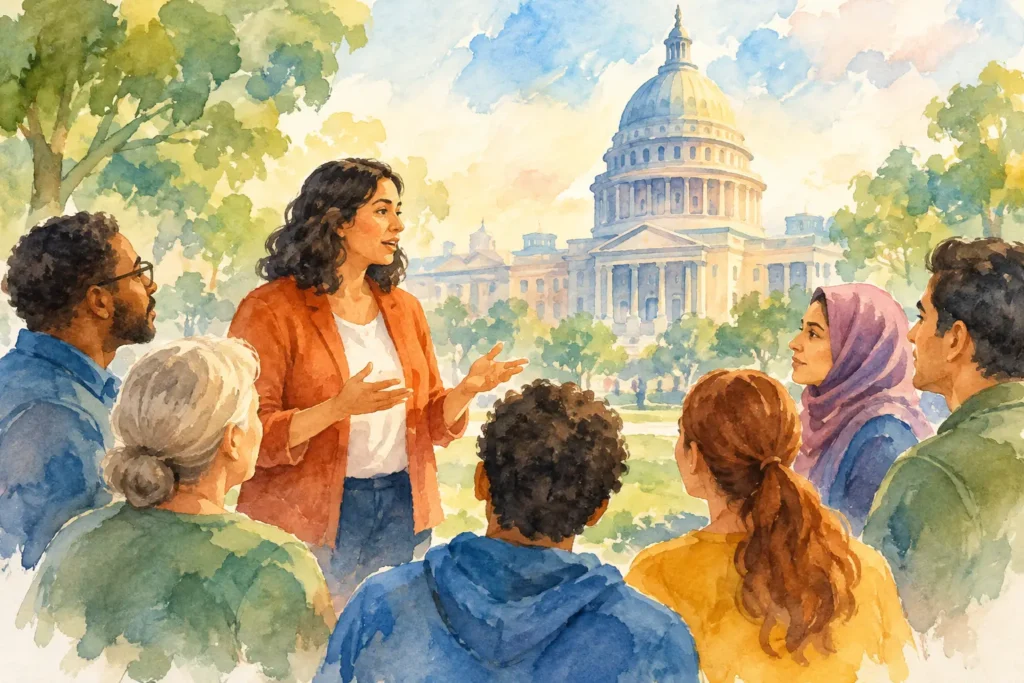
Minority communities often carry a double burden in public life: more at stake, and more risk when speaking up. A school policy can affect language access, a zoning change can reshape a neighborhood, a policing tactic can alter daily safety, and a benefits rule can determine whether families can stay afloat. Yet the act of participating can expose people to retaliation, harassment, doxxing, employment consequences, or targeted misinformation.
So the question is not only “How do we increase civic participation?” It is also “How do we build civic participation that creates real power while reducing harm?”
JustSocial’s manifesto argues that democracy should function more like infrastructure than a once-every-few-years ritual. That idea matters especially for minorities, because infrastructure can be designed with safeguards, oversight, and continuity. When participation is treated as an occasional performance, minorities are often invited to “share stories” but denied durable leverage.
This guide focuses on power with safeguards using two complementary lenses:
- Discursive democracy to make public debate safer and more truth-seeking.
- Deliberative democracy to turn community knowledge into decision-grade input that institutions can act on.
Why civic participation is riskier for minority communities
Many participation systems assume a “low-risk citizen,” someone who can attach their name to a comment, attend a meeting publicly, and tolerate being singled out. For many minority communities, that assumption fails.
Common risk patterns include:
- Visibility risk: Being identifiable can create social or professional retaliation.
- Asymmetric scrutiny: Minorities often get asked to “prove” harms more than others, even when evidence exists.
- Extraction without influence: Institutions gather testimony, then proceed unchanged.
- Manipulation and harassment: Coordinated abuse can drive people out of processes.
- Language and accessibility barriers: Participation is technically “open,” but practically unreachable.
If a process increases voice but does not increase protection, it can become a pipeline for harm.
What “power with safeguards” actually means
Power in civic participation is not “being heard.” Power is shaping a decision and being able to verify what happened next.
Safeguards are the conditions that make participation legitimate and safe enough to sustain, including privacy, rights protections, anti-manipulation defenses, and an auditable connection between input and outcomes.
Here is a practical way to think about it:
| What communities need (power) | What makes it safe and durable (safeguards) |
| Named decision owners and timelines | Clear rules, due process, and appeal paths |
| Decision-grade options, not just testimony | Privacy by design and data minimization |
| A duty-to-respond with reasons | Anti-harassment and anti-doxxing enforcement |
| Implementation tracking after the vote | Audit logs, public artifacts, and oversight |
| Fair access across language, disability, and time | Multi-channel access (online plus offline) |
This aligns with the manifesto’s insistence that we must upgrade institutions, not just add more noise. A modern system should help people participate continuously, but also safely.
Step one: run a community threat model (before you mobilize)
Before choosing tactics, minority communities should do a simple “threat model,” the same way security engineers do. The goal is not paranoia, it is proportional design.
Define:
- Your decision target: What decision, by whom, and by when.
- Stakes: Who benefits, who loses, and how much.
- Likely threats: Retaliation, harassment, surveillance, data exposure, astroturfing.
- Risk tolerance: What risks are unacceptable for your community.
Then match participation methods to risk.
| Risk level | Typical situation | Safer civic participation patterns |
| Low | Service improvements, local budget items | Public comment, meetings, open letters, community surveys with published results |
| Medium | Policies affecting rights, housing stability, school discipline | Facilitated deliberation, anonymized testimony, coalition representation, structured evidence submission |
| High | Immigration-related exposure, contested identity issues, severe retaliation risk | Privacy-preserving participation, trusted intermediaries, closed deliberation with public summaries, legal support, strong anti-harassment controls |
A key idea from JustSocial’s broader approach is that participation must be designed, not merely encouraged. When the stakes rise, “show up and speak” is not a plan.

Discursive democracy: safer public debate is a form of protection
Minority communities are often forced into debate arenas optimized for conflict. Discursive democracy flips the priority from “winning the argument” to improving the quality and safety of the public conversation so that participation becomes less punishing.
In practice, discursive democracy is a safeguard layer. It reduces the probability that participation turns into identity threat, harassment, or misinformation spirals.
Discursive safeguards that change the game
1) Separate people from claims. Require that disagreements target statements and evidence, not identity or group belonging.
2) Mark epistemic status. Normalize “I experienced,” “I believe,” “The data suggests,” and “We do not know yet.” This reduces bad-faith “gotcha” dynamics.
3) Require legible reasons. High-stakes claims should include a source, a concrete example, or a testable proposal.
4) Use bilingual and culturally competent framing. Not as an add-on, but as core legitimacy. If the process only “thinks” in the majority language, it silently filters out minority reality.
5) Publish a code of conduct plus enforcement procedures. Not vague “be nice,” but actual steps: warnings, removals, appeals, transparency reporting.
Discursive democracy also supports coalition-building across minorities and majorities by making disagreement less personal and more actionable.
Deliberative democracy: convert lived experience into decision-grade influence
Discursive democracy improves the public sphere. Deliberative democracy improves decision quality.
For minority communities, deliberative democracy is often the fastest path from “we are harmed” to “here are options the decision owner can adopt, with tradeoffs and evidence.” It is also a way to reduce the burden placed on individuals, because the community produces shared outputs rather than asking the same few people to keep testifying.
The deliberation stack (with minority protections built in)
A deliberative process does not have to be huge. It does need structure and receipts.
- Participation promise: What is being decided, who is eligible, what influence participants will have, what will be published, and when the institution must respond.
- Issue Pack: A shared baseline describing the problem, constraints, and what is already known.
- Evidence Commons: A shared folder or library of sources, local data, and testimony, including dissenting evidence.
- Facilitated deliberation: Small-group discussion with rules that prevent domination and harassment.
- Options memo: 2 to 5 decision-ready options with pros, cons, costs, and equity impacts.
- Public rationale and tracker: A published explanation of what was chosen and why, plus implementation updates.
This matches the manifesto’s “build technology and institutions” thesis. The product is not an app, it is a repeatable civic capability.
A practical privacy pattern for high-risk communities
Deliberative democracy can protect vulnerable participants without hiding the process.
A strong pattern is:
- Collect sensitive testimony through protected channels.
- Deliberate with verified participants under confidentiality rules.
- Publish aggregated findings, reasoning, and options without exposing identities.
- Maintain auditable logs and oversight access so the process is still trustworthy.
This is how you get both safety and legitimacy.
The “public receipts” principle: the safeguard that prevents participation theater
Minority communities are frequently invited into processes that end with “Thank you for sharing.” The remedy is to demand public receipts.
Receipts are short, public artifacts that make it possible to audit whether participation mattered.
Examples:
- The participation promise
- Meeting minutes and evidence indexes
- A decision rationale that cites inputs
- An implementation tracker
This idea is consistent with JustSocial’s vision of continuous, inspectable participation. If you want minorities to participate repeatedly, the system must prove it is not extraction.
For more context on the institutional approach, see JustSocial’s manifesto.
How a political movement can protect minority participation while scaling power
A political movement that centers minority communities should treat protection as part of its operating system, not a moral slogan.
Two strategic mistakes are common:
- Movements optimize for reach and virality, then act surprised when minorities become targets.
- Movements collect data aggressively, then lose trust when data is misused or exposed.
A safer approach is to build what the manifesto calls for in spirit: upgraded civic infrastructure that can scale.
A “movement safeguards charter” you can actually use
| Charter item | What it protects | What to publish |
| Data minimization rules | Doxxing, surveillance, legal exposure | What you collect, why, retention limits |
| Role separation | Abuse of power inside the movement | Who moderates, who decides, who audits |
| Anti-harassment enforcement | Targeted intimidation | Code of conduct and enforcement ladder |
| Decision linkage policy | Empty mobilization | How asks map to decisions and timelines |
| Conflict-of-interest disclosures | Co-option and hidden influence | Funding sources, partnerships, lobby ties |
If a movement cannot publish these basics, it is not ready to safely recruit high-risk communities.
A 30-day plan for minority communities (low drama, high leverage)
This is a realistic month-long approach that prioritizes safeguards.
Week 1: Pick one decision and build the “safety perimeter”
Choose a single, specific decision (policy, budget line, rule change). Identify the decision owner and deadline. Draft a one-page participation promise for your own group, including privacy expectations and acceptable risk.
Week 2: Do discursive democracy repair
Focus on improving the informational environment around the decision. Translate key documents, correct high-impact misinformation, and publish a short framing note that distinguishes claims, evidence, and unknowns.
Week 3: Run a small deliberative session
Hold a facilitated session (even 8 to 15 people works) to produce an options memo. Make sure it includes constraints and tradeoffs, so it reads as credible to outsiders.
Week 4: Deliver the memo and demand receipts
Submit the memo to the decision owner. Ask for a written duty-to-respond, a timeline for a reply, and an implementation tracker if anything is adopted. If the institution refuses, publish that refusal as a receipt.
This is how civic participation becomes durable power.
Where technology helps, and where it can harm
The manifesto argues that the needed technology already exists, but adoption has lagged in the public sector. For minority communities, this is true and incomplete: tech can empower, but it can also increase risk.
Technology helps when it:
- Enables multi-language and accessible participation.
- Publishes auditable artifacts and change logs.
- Adds friction against manipulation and harassment.
- Supports privacy-preserving identity and eligibility checks.
Technology harms when it:
- Exposes identities by default.
- Uses engagement-first ranking that rewards outrage.
- Blurs the line between mobilization and deliberation.
- Collects data that can be subpoenaed, leaked, or repurposed.
If you are designing digital participation, build for safety first. If you are joining a platform, ask what safeguards exist.
Frequently Asked Questions
Is civic participation safe for minority communities? It can be, but safety is not automatic. Start with a threat model, choose proportional tactics, and demand safeguards like privacy, anti-harassment rules, and a duty-to-respond.
How do deliberative democracy processes protect minorities better than open town halls? Deliberative democracy uses structured facilitation, shared evidence, and clear outputs. That reduces domination, improves decision quality, and can include privacy patterns like anonymized testimony with public reasoning.
What is discursive democracy in plain terms? Discursive democracy is the practice of improving public debate so it becomes more truthful, inclusive, and less harmful. It uses rules and norms that prioritize reasons, evidence, and dignity over virality.
How can a political movement avoid exploiting minority stories? By publishing a safeguards charter (data minimization, role separation, enforcement, decision linkage) and by producing public receipts that show how participation changed decisions.
Do we need to show our names to have influence? Not always. High-risk issues often require privacy-preserving participation and trusted intermediaries. You can still publish public reasoning and options without exposing individuals.
Build power that lasts (and does not burn people)
If you agree that democracy should be continuous and infrastructure-like, not a once-in-a-while ritual, then minority participation cannot be treated as a marketing asset. It must be protected by design.
JustSocial is building a political movement around technology-enabled, auditable civic participation with legitimacy safeguards, a vision laid out in The Face of Democracy manifesto. If you want to help shape participation systems that convert voice into accountable outcomes, explore the project, share the manifesto, and consider contributing your skills to the work at JustSocial.io.