If you want civic participation to matter online, you need more than a comment box and a vote. You need a process that helps people learn, reason together, disagree productively, and still produce an output a decision-maker can actually use. That is the promise of deliberative democracy online, and it is also where many pilots fail.
This template is designed to help a city team, agency, university, nonprofit, or political movement run a first online deliberative pilot that is small enough to finish, but serious enough to earn trust. It also connects to the core JustSocial idea in the manifesto, that democracy should become continuous, measurable infrastructure, not a once-every-few-years ritual.
What “deliberative democracy online” means in practice
Online deliberation is not “more engagement.” It is a decision process with specific features:
- A defined decision (or a defined recommendation target) with a real timeline.
- A shared evidence base that participants can inspect.
- Structured dialogue designed to surface reasons, tradeoffs, and uncertainty.
- Public outputs that show how input shaped outcomes.
This is where discursive democracy matters. Discursive democracy focuses on the quality and visibility of public reasoning, who gets heard, what counts as a good argument, how claims are challenged, and whether the final rationale is legible to outsiders. Deliberative democracy is the broader “decision legitimacy through deliberation” model. Discursive democracy is often the practical operating system that makes deliberation auditable and fair.
In the manifesto, JustSocial argues that we already have the technologies to support continuous participation, but our institutions are stuck in industrial-era rhythms. A well-scoped pilot is one way to prove, quickly and safely, that civic participation can be continuous without becoming chaotic.

The Minimum Viable Deliberation (MVD) pilot: design principles
A good first pilot is not “the perfect platform.” It is a complete loop with receipts.
1) Start with one decision, not a general forum
Pick a policy question that is:
- Important enough that people care.
- Bounded enough to finish.
- Safe enough that mistakes are not catastrophic.
Examples: revising a city street design, prioritizing capital maintenance projects, drafting a school district device policy, designing a local small-business support program.
2) Publish a participation promise
If civic participation is not connected to a decision rule, it becomes “engagement theater.” Your promise should answer:
- What will be decided (or recommended)?
- Who will decide?
- By when?
- What will be published?
- What happens if decision-makers disagree with the outcome?
3) Separate mobilization from deliberation
A political movement needs mobilization. A deliberative process needs conditions for learning and reasoning. Treat these as different modes.
Mobilization can bring attention and participants. Deliberation is where you slow down, enforce rules, and make reasoning visible. This separation reduces manipulation risk and supports discursive quality.
4) Make the output usable
Deliberation should end with an “options memo” that a decision-maker could realistically adopt or respond to, including costs, tradeoffs, and implementation considerations.
5) Treat transparency as an artifact pipeline
A trustworthy pilot produces public artifacts at each stage, not just a final PDF. This is aligned with JustSocial’s manifesto emphasis on measurable transparency and continuous participation.
Pilot Charter Template (copy/paste)
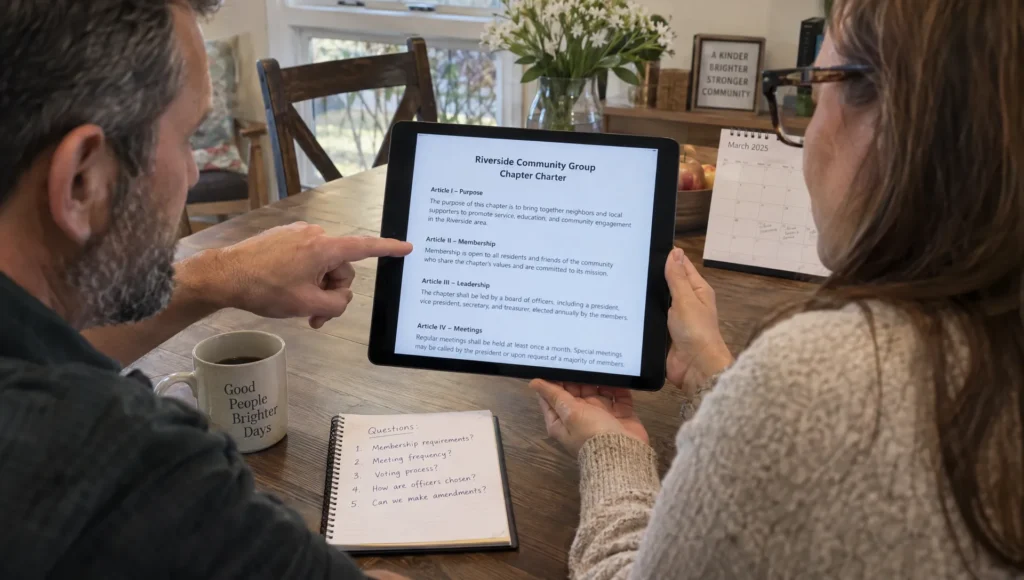
Use this charter as your “lock the rules before you start” document. Keep it short and publish it.
| Charter field | What to write | Why it matters |
| Decision topic | The exact question, in plain language | Prevents scope creep |
| Decision owner | Named office, committee, or sponsor | Clarifies who owes a response |
| Output type | Binding decision, formal recommendation, advisory memo | Sets expectations |
| Timeline | Start date, deliberation window, response date | Creates accountability |
| Eligibility | Who can participate, and how it’s checked | Protects legitimacy |
| Inclusion plan | Language access, accessibility, offline alternatives | Reduces participation inequality |
| Evidence rules | What counts as evidence, how it’s curated | Improves discursive quality |
| Deliberation rules | Code of conduct, facilitation approach, moderation transparency | Prevents capture and abuse |
| Decision link | How outputs will be used, and what “duty to respond” means | Avoids engagement theater |
| Publication commitments | What will be published, when, and in what format | Produces auditable civic participation |
Recruitment and inclusion: legitimacy is engineered
Online deliberation becomes brittle when it is dominated by the loudest or most networked. Your pilot should explicitly choose a legitimacy model.
Common models:
- Open civic participation with guardrails (good for low to medium stakes).
- Stratified invitation (invite a balanced mini-public while still allowing public comments).
- Hybrid (a deliberating cohort plus an open “evidence commons” intake).
Whatever you choose, publish it in the charter.
In 2026, the biggest inclusion mistake is assuming “online” equals “accessible.” Inclusion requires operational work: language, disability access, mobile-first design, and a way for people with low time to contribute meaningfully.
Evidence Commons: build shared reality before disagreement
Deliberation fails when participants argue from different factual baselines. The fix is an Evidence Commons, a curated, inspectable collection of:
- Problem definition and constraints (budget, legal, capacity).
- Stakeholder impact summaries.
- Competing values and goals.
- Sources with provenance.
A practical rule for discursive democracy: require claims to be challengeable. If someone asserts “this will raise costs,” there should be a way to ask “by how much, compared to what, and based on which source?”
A note on “real-world help” links
If the topic touches compliance or business operations, the Evidence Commons can include practical resources. For example, if your deliberation concerns a policy that affects excise-tax reporting (fuel, environmental levies, communications, retail excises), include a neutral how-to resource like an IRS-authorized service to file IRS Form 720 online so small businesses can understand the operational burden being discussed.
That kind of link does not replace deliberation, but it improves it by making the practical implications legible.
Structured deliberation: turn talk into reasons
Discursive democracy is easiest to implement when contributions are structured. Instead of “write anything,” ask for fields.
A simple contribution format:
- Position: support, oppose, or conditional.
- Reasoning: the core argument in 3 to 6 sentences.
- Evidence: link or citation to the commons (or a new source submission).
- Tradeoff acknowledged: what this harms or risks.
- What would change my mind: a falsifiable condition.
This structure does three things:
- Improves the signal-to-noise ratio.
- Makes facilitation fairer.
- Produces a deliberation record that can be audited.
Moderation without censorship (procedural, not political)
A deliberative pilot needs rules, but those rules should be about process integrity, not viewpoint conformity.
Publish:
- A code of conduct focused on harassment, doxxing, threats, spam, and disruption.
- A visible enforcement ladder (warnings, time-outs, removal).
- An appeals pathway.
This keeps civic participation safe while preserving pluralism.
Decision linkage: how online deliberation becomes action
Many pilots die here. They end with “we heard you” and nothing changes.
Your pilot should include a written, public commitment that matches your authority level.
Decision linkage options:
- Binding linkage: the deliberative output triggers a vote, budget allocation, or rule change.
- Constrained discretion: decision-makers must choose an option from the set produced, or publish a justification for rejecting all.
- Duty-to-respond: decision-makers must publish a response that cites which arguments and evidence influenced the final rationale.
Even for a political movement without formal power, linkage is possible:
- Candidates can sign a public commitment to respond to the movement’s options memo.
- The movement can publish a “response tracker” showing who engaged and who ignored.
That turns civic participation into measurable political pressure, not vibes.
The public artifacts (the receipts) your pilot should produce
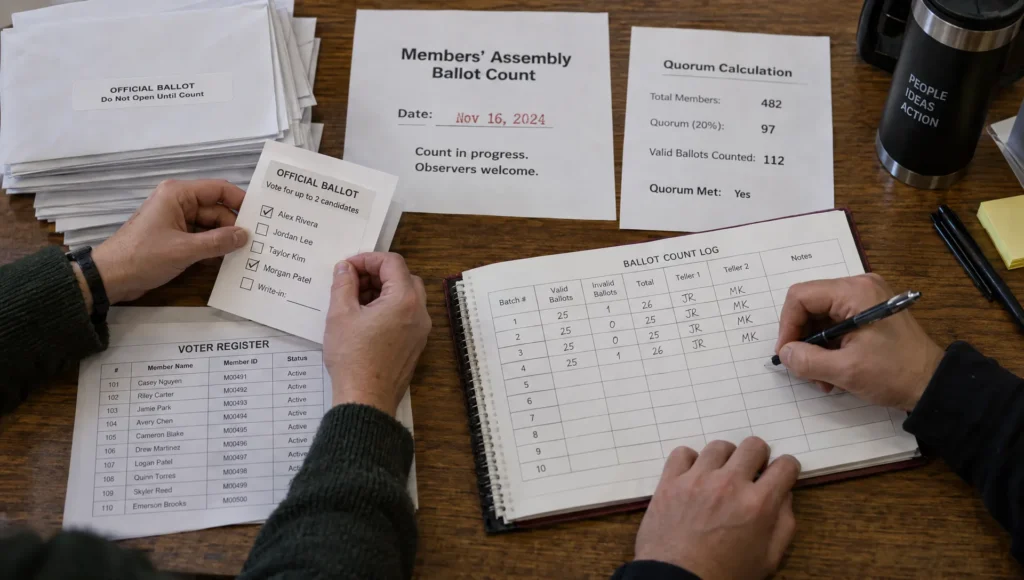
If you publish only a final summary, you will be accused (sometimes fairly) of cherry-picking. Publish a small set of artifacts that show the chain of reasoning.
| Artifact | Publish when | What it contains |
| Pilot Charter | Before recruitment | Scope, rules, eligibility, timeline, decision link |
| Issue Brief | Start of learning phase | Problem statement, constraints, key questions |
| Evidence Commons Index | Early, then updated | Curated sources, data notes, stakeholder inputs |
| Deliberation Record | During and after | The structured contributions, facilitation notes, moderation log summary |
| Options Memo | End of deliberation | 2 to 5 options, pros/cons, tradeoffs, implementation notes |
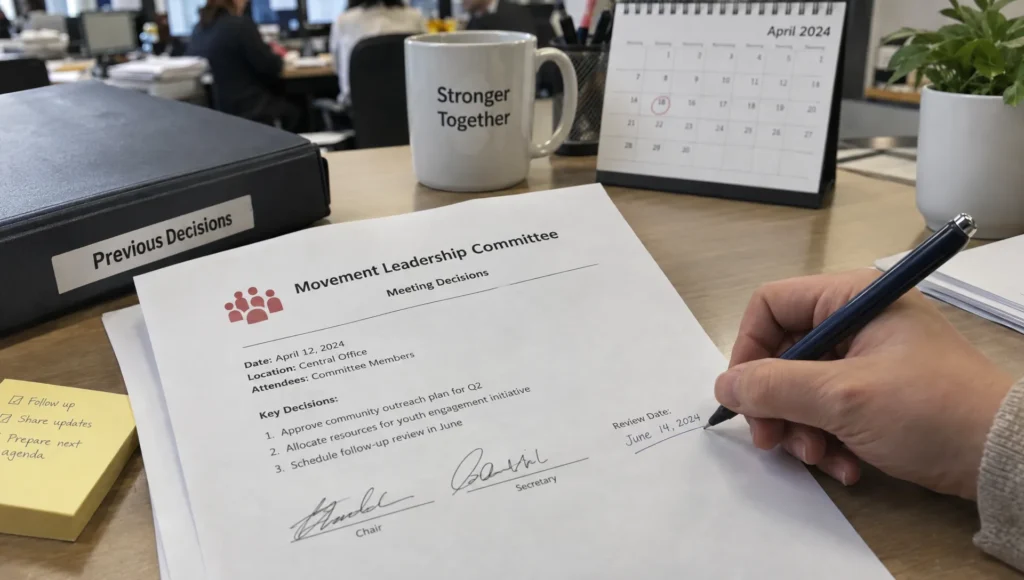
| Decision Response | By the promised date | What was adopted, what was rejected, and why |
| Implementation Tracker | After decision | Milestones, owners, status updates, outcomes |
This is the practical bridge between deliberative democracy and continuous civic participation as infrastructure.
Timeline: a realistic online pilot cadence
A first pilot often works best in 4 to 8 weeks.
- Week 0: Charter, topic framing, publish participation promise.
- Week 1 to 2: Recruitment and onboarding, learning, Evidence Commons.
- Week 3 to 4: Structured deliberation, facilitation, synthesis.
- Week 5: Options Memo, decision response.
- Week 6+: Implementation tracker begins.
Do not stretch a first pilot across many months unless you have strong institutional capacity. Long timelines amplify burnout and open more attack surface for manipulation.
Evaluation: did the pilot improve civic participation, or just digitize noise?
You should evaluate on three layers.
Process integrity
- Did participants understand the rules and timeline?
- Were moderation actions explainable and consistent?
- Was the Evidence Commons used, updated, and contestable?
Discursive quality
- Did people cite evidence and acknowledge tradeoffs?
- Did facilitation reduce dominance by a few voices?
- Did participants report that they learned something?
Decision impact
- Did decision-makers adopt an option, partially adopt, or reject with reasons?
- Was the final response legible and specific?
- Did implementation tracking continue after the spotlight faded?
A useful standard: if an outsider cannot trace how arguments shaped the final rationale, you did not achieve deliberative legitimacy.
Common failure modes (and how to avoid them)
| Failure mode | What it looks like | Practical fix |
| Engagement theater | Lots of comments, no decision link | Publish a duty-to-respond and a response deadline |
| Scope creep | The pilot becomes “everything” | Lock the question and publish “out of scope” items |
| Dominance and pile-ons | A few voices drive outcomes | Structured contributions, facilitation, anti-dogpile friction |
| Competing realities | People argue past each other | Evidence Commons plus claim-challenge norms |
| Trust collapse | Participants suspect hidden handling | Publish artifacts, moderation policy, and a decision rationale |
| Burnout | People disappear mid-process | Shorter timelines and clear time expectations |
Frequently Asked Questions
What is the difference between deliberative democracy and discursive democracy? Deliberative democracy is a legitimacy model where decisions gain authority from fair, informed deliberation. Discursive democracy focuses on the quality and transparency of public reasoning, including how arguments are formed, challenged, and recorded.
Can a political movement run deliberative democracy online without legal authority? Yes. The key is decision linkage. A movement can require candidates, officials, or partner institutions to publicly respond to the options memo, then publish a response tracker so civic participation creates measurable pressure.
How do you stop online deliberation from becoming a shouting match? Use structured contributions, facilitation, and procedural moderation. Require evidence references, tradeoff acknowledgment, and clear rules, then publish a moderation transparency summary.
How big should an online deliberative pilot be? For a first pilot, smaller is better. Aim for a manageable cohort that can complete learning and deliberation in weeks, not months, while still allowing public evidence submissions.
What is the single most important “trust artifact” to publish? The participation promise plus the decision response. If people cannot see how input affected the rationale, trust will not compound.
Build a pilot that can scale into continuous civic participation
If you agree with the manifesto’s premise, that democracy needs to evolve into continuous, auditable infrastructure, then a well-designed online deliberative pilot is a practical starting point.
Read JustSocial’s manifesto to understand the larger institutional vision (including the idea of a standing “people’s branch” and tech-enabled transparency), then decide what you can contribute: running a local pilot, volunteering your skills, or helping test prototypes.
- Explore the vision: The Face of Democracy (Our Manifesto)
- Learn more about the project: JustSocial.io