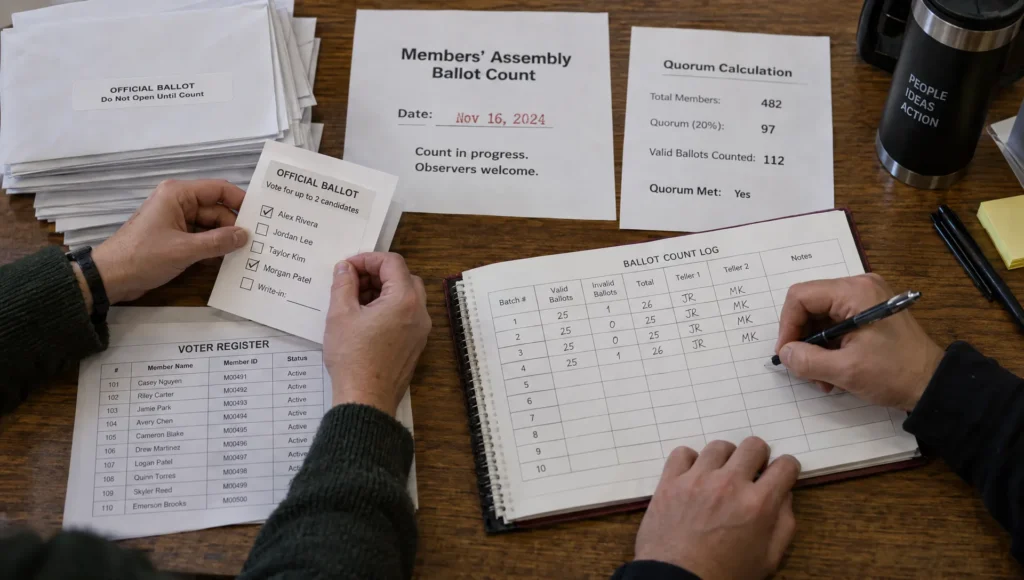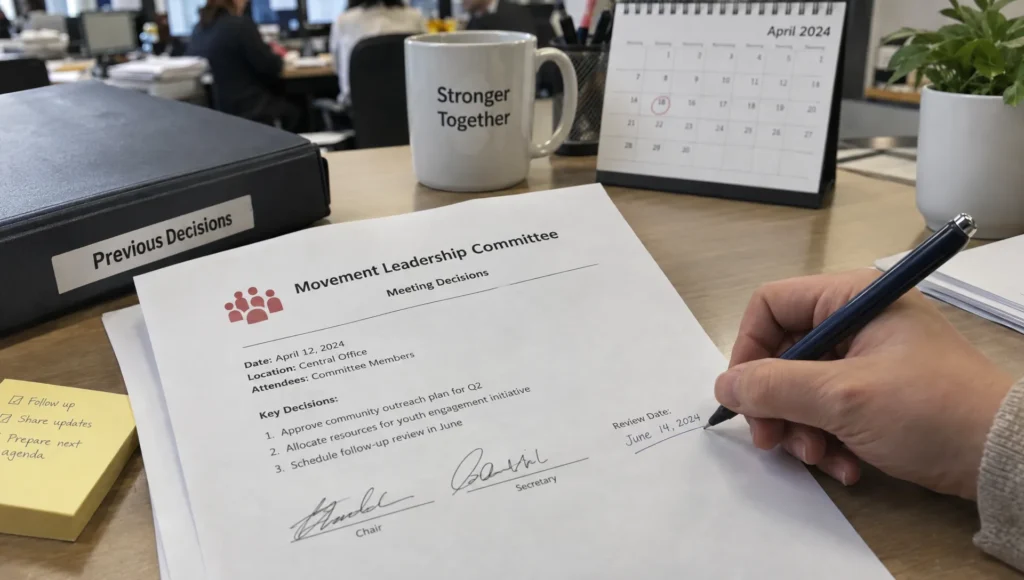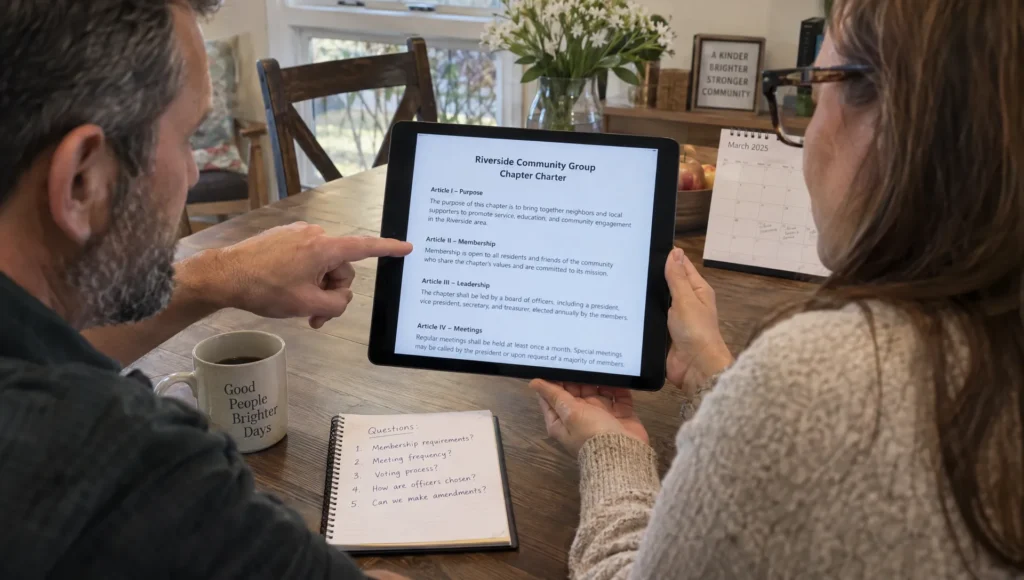
Democratic reform does not win because a manifesto is inspiring, a protest is large, or a platform gets attention for a week. It wins when ordinary people can repeatedly turn concern into public reasoning, public reasoning into decision-ready options, and decision-ready options into visible institutional change.
That is the core task of any serious political movement for democratic reform: build a participation system, not just a message machine.
JustSocial’s manifesto, The Face of Democracy, argues that citizens should no longer be reduced to voters, taxpayers, and consumers. The movement’s larger vision is a civic culture where people can be heard continuously, where technology strengthens transparency, and where public institutions learn to treat civic participation as part of normal governance. This playbook turns that vision into a practical sequence for organizers, civic technologists, volunteers, educators, and local reformers.
The reform problem: movements must become civic infrastructure
Most political movements begin with justified frustration. People see unresponsive institutions, shallow consultation, opaque decisions, and public systems that feel designed for another century. The danger is that frustration can become a cycle: outrage, mobilization, disappointment, burnout, repeat.
Democratic reform requires a different path. A movement must become a civic infrastructure builder. That means creating repeatable ways for citizens to speak, reason, decide, and verify what happened afterward.
In the JustSocial manifesto, this is connected to a broader critique of industrial-era institutions. Schools, parties, bureaucracies, and representative systems still often operate as if citizens should be processed, managed, or consulted only occasionally. A modern reform movement should challenge that assumption. It should prove, in practice, that people can participate more often, more intelligently, and more transparently when the process is designed well.
A useful reform movement therefore has four jobs:
| Movement job | Democratic method | Output people can inspect |
|---|---|---|
| Make public concerns visible | Discursive democracy | Issue maps, claim summaries, evidence shelves |
| Turn disagreement into judgment | Deliberative democracy | Options memos, tradeoff reports, minority views |
| Connect people to decisions | Civic participation | Decision requests, public comments, votes, petitions, oversight logs |
| Make institutions answerable | Transparency and follow-through | Response memos, implementation trackers, change logs |
The point is not to replace elections overnight. The point is to add a continuous layer of public influence between elections, with enough structure that decision-makers cannot pretend they never heard from the people.

Start with a participation promise, not a slogan
A slogan tells people what you believe. A participation promise tells people what they can do with you.
For democratic reform, the participation promise should be concrete enough that a skeptical citizen can understand the movement’s method in one minute. It should answer: What issue are we working on? Who can participate? What will happen with public input? What will we publish? What response are we demanding from decision-makers?
A weak promise sounds like this: “We will give power back to the people.”
A stronger promise sounds like this: “For each public decision we target, we will publish the decision owner, the timeline, a plain-language issue brief, a structured public input form, a summary of public arguments, a deliberative options memo, and a tracker showing whether officials responded.”
That second promise is less poetic, but it builds trust. It also fits the spirit of JustSocial’s political movement: public influence should be measurable, not symbolic.
Your first participation promise should be small. Choose one decision, one community, and one process. If the movement cannot make participation meaningful at a local scale, it will not become legitimate at a national scale.
Build the discursive layer: make public debate usable
Discursive democracy is the layer where public meaning is formed. It is where people name problems, challenge frames, introduce lived experience, contest assumptions, and ask what the real issue is.
Every political movement needs this layer because democratic reform is not only technical. People need language for what they are experiencing. They need to move from “the system is broken” to “this specific decision process excludes affected people,” or from “politicians do not listen” to “there is no duty to respond to structured public input.”
However, discursive democracy should not be confused with endless comment threads. Open expression matters, but movements need formats that make debate legible. A practical discursive process asks participants to separate claims, reasons, evidence, values, and requests.
For example, instead of collecting hundreds of unstructured comments about a school budget, the movement can ask contributors to submit four fields: the claim, the reason, the affected group, and the requested action. Moderators can then cluster similar claims, identify disagreements, and publish a summary that everyone can inspect.
This protects debate from two common failures. The first is domination by the loudest voices. The second is institutional dismissal, where officials claim public input is too messy to use. Structured discourse makes public debate harder to ignore.
A movement’s discursive layer should produce public artifacts such as:
- A decision statement that names the real public decision being influenced.
- An issue map that shows the main claims and disagreements.
- An evidence shelf that links claims to sources, public documents, and lived experience.
- A moderation log that explains process decisions without policing viewpoints.
- A handoff note that explains which questions are ready for deliberation.
This is where a political movement begins to act like a public institution before it has formal authority.
Add deliberative democracy: turn debate into decision-ready options
Discursive democracy opens the question. Deliberative democracy works through it.
Deliberative democracy creates structured conditions for people to consider evidence, hear different perspectives, weigh tradeoffs, and produce usable recommendations. It is especially important for democratic reform because many public issues are complex. Citizens should not be asked only to react. They should be given a fair process for judgment.
A deliberative process does not need to be massive. It can begin with a small working group, a citizens’ panel, a local assembly, or a mixed group of residents, practitioners, and affected stakeholders. What matters is that the process is transparent, balanced, facilitated, and linked to a real decision.
JustSocial’s manifesto proposes a stronger role for academia as an independent democratic branch. In playbook terms, this means expertise should support public judgment without replacing it. Academics, policy professionals, and technical experts can help prepare evidence briefs, uncertainty notes, and tradeoff summaries. Citizens then deliberate with better information, while the final legitimacy still comes from a fair public process.
A basic deliberative stack looks like this:
| Deliberative artifact | What it does | Why it matters |
|---|---|---|
| Issue Pack | Explains the problem, constraints, stakeholders, and timeline | Creates shared context before debate |
| Evidence Index | Lists sources, public data, expert input, and contested facts | Reduces misinformation and selective quoting |
| Facilitation Rules | Sets speaking order, time limits, conflict rules, and disclosure norms | Prevents capture by status, money, or volume |
| Options Memo | Presents 2 to 5 realistic policy options with tradeoffs | Gives decision-makers something usable |
| Dissent Note | Records serious objections and minority concerns | Protects legitimacy without forcing false consensus |
| Response Request | Asks the decision owner to accept, reject, modify, or explain | Connects deliberation to power |
Deliberative democracy is where a reform movement proves that “the people” is not a slogan. It shows that citizens can reason together when the process respects their time, intelligence, and differences.
Make civic participation fit real life
A movement cannot build democratic reform for ideal citizens who have unlimited time, legal confidence, policy knowledge, childcare, transportation, and emotional energy. It must design for real people.
That means participation should be available in multiple levels of effort. Some people can attend a two-hour deliberation. Others can contribute a five-minute claim, review an evidence summary, sign a decision-ready request, translate materials, check accessibility, or help track whether an official response was published.
Good civic participation should feel navigable. People are used to clear search, filters, reminders, plain-language summaries, and practical planning tools in daily life. Public systems should aspire to the same usability people expect when they use ordinary services, from transit apps to curated resources for dog-friendly hotels and destinations. If civic processes are harder to navigate than everyday consumer tools, participation will skew toward insiders.
A reform movement should therefore design a participation ladder:
| Time available | Useful action | Movement output |
|---|---|---|
| 5 minutes | Submit a structured claim or question | Adds to the issue map |
| 20 minutes | Review an Issue Pack and mark missing evidence | Improves shared context |
| 1 hour | Join a moderated discussion or listening session | Adds reasons and lived experience |
| 1 evening | Join a deliberative working group | Helps produce options |
| 1 month | Track implementation and official responses | Builds accountability memory |
This approach also reduces burnout. People should not have to become full-time activists to matter. A healthy political movement lets citizens participate sustainably and see how their contribution connects to a larger reform pipeline.
Choose one reform wedge at a time
Democratic reform is broad, but movements win credibility through specific wedges. A wedge is a concrete institutional practice that can be changed, tested, and repeated.
Instead of trying to “fix democracy” all at once, pick a decision process where the failure is visible and the improvement is understandable. The best first wedge is usually local, documented, and connected to daily life.
| Reform wedge | What the movement demands | Why it is a strong starting point |
|---|---|---|
| Public meeting reform | Clear agendas, structured testimony, response memos | Easy for residents to observe and verify |
| Budget transparency | Plain-language budget packs and implementation trackers | Connects taxes to visible priorities |
| School policy participation | Student, parent, teacher, and community deliberation | Builds civic habits early |
| Committee transparency | Published documents, recordings, votes, and summaries | Matches the manifesto’s call for visible governance |
| Civic tech pilots | Secure, accessible tools for input, deliberation, and tracking | Tests technology without pretending tech alone is reform |
This is where JustSocial’s product concepts, such as TakeAction!, rParliament, and rConcensus, are useful as directional examples. They point toward a public ecosystem where citizens can act on news, inspect representative work, and participate in community decisions. The important principle is not any single app. The principle is that technology should create public memory, structured participation, and accountability.
Publish receipts before asking for trust
Trust is not a mood. It is the result of inspectable behavior over time.
A political movement for democratic reform should publish receipts for its own decisions before demanding transparency from government. If the movement claims to represent the people but hides its funding, moderation rules, internal decisions, or data practices, it becomes a smaller version of the system it criticizes.
Public receipts do not require exposing private information. They require publishing enough process evidence for outsiders to verify that the movement is acting consistently.
At minimum, a movement should publish:
- A governance note explaining who can make decisions for the movement.
- A participation promise for each campaign or pilot.
- A funding summary appropriate to legal and safety constraints.
- A moderation policy for public forums and digital spaces.
- A decision log explaining major strategic choices.
- An implementation tracker showing what was requested, who responded, and what changed.
This is especially important in a polarized environment. Opponents will question motives. Supporters will disagree internally. Institutions will look for reasons to dismiss the movement. Receipts give the movement a disciplined answer: inspect the process.
Move from pressure to institutional reform
Protest and pressure can open doors. They rarely build the whole house.
A democratic reform movement should know how each action moves toward institutionalization. The goal is not only to persuade officials on one issue. The goal is to change the default rules of public decision-making.
This connects directly to JustSocial’s Five Branches idea. The manifesto imagines a stronger role for the people as a standing democratic force, plus an independent academic function that supports public reasoning and oversight. In practical terms, a movement can treat this as a roadmap: first model the People’s Branch locally, then demand that institutions adopt parts of it.
A realistic path looks like this:
| Stage | Movement role | Institutional target |
|---|---|---|
| Community pilot | Run structured discourse, deliberation, and tracking independently | Prove the method works |
| Local partnership | Invite a council, school, agency, or committee to respond publicly | Create a duty-to-respond norm |
| Formal process | Advocate for rules requiring Issue Packs, public summaries, and response memos | Make participation predictable |
| Legal or charter reform | Push for standing participation offices, public data duties, or civic panels | Turn reform into infrastructure |
| Cultural adoption | Train citizens, educators, journalists, and officials in the method | Make participation a civic habit |
This is how a political movement becomes more than a campaign. It becomes a builder of democratic capacity.
Protect legitimacy from the beginning
Democratic reform movements are vulnerable to capture, misinformation, exclusion, and internal personality politics. These risks are not reasons to avoid participation. They are reasons to design participation carefully.
A strong movement names risks early and publishes safeguards.
| Risk | How it appears | Guardrail |
|---|---|---|
| Capture | A faction, donor, celebrity, or insider group dominates the agenda | Publish agenda-setting rules and conflict disclosures |
| Misinformation | False claims spread faster than corrections | Use evidence shelves, uncertainty labels, and correction logs |
| Participation inequality | Only confident, wealthy, or highly available people participate | Offer multiple channels, plain language, translation, and low-time actions |
| Surveillance fear | People avoid participation because identity exposure feels risky | Separate public expression from eligibility where possible and minimize data collection |
| Burnout | Core volunteers become the entire movement | Rotate roles and design small, repeatable work cycles |
| Engagement theater | People are asked for input with no visible consequence | Require decision links, response requests, and implementation trackers |
The manifesto’s social contract argument is useful here. If citizens are expected to participate more continuously, institutions and movements owe them better protections, better education, and better feedback. Participation without safeguards is not empowerment. It is extraction.
Build a 90-day democratic reform sprint
A playbook becomes useful only when it creates action. Here is a practical 90-day sprint for a movement that wants to begin responsibly.
| Timeframe | Focus | Public output |
|---|---|---|
| Days 1 to 15 | Choose one reform wedge and define the real decision owner | Decision Statement and Participation Promise |
| Days 16 to 30 | Open the discursive layer and collect structured claims | Issue Map and Evidence Shelf |
| Days 31 to 50 | Convene a small deliberative group with clear facilitation rules | Deliberation Record and Draft Options Memo |
| Days 51 to 65 | Publish the final options and request an official response | Options Memo and Response Request |
| Days 66 to 80 | Mobilize civic participation around the decision window | Public comments, meetings, petitions, or submissions tied to the memo |
| Days 81 to 90 | Track outcomes and review the process | Response Log, Implementation Tracker, and Lessons Note |
The final lessons note matters. Movements should not pretend every pilot is a triumph. Democratic reform requires learning in public. If participation was too narrow, say so. If the evidence was weak, improve it. If officials ignored the request, document it and escalate. If the process worked, make it easier for another community to copy.
Measure what democratic reform actually changes
Political movements often measure attention: followers, views, event turnout, signatures. Those numbers can help, but they do not prove democratic reform.
A movement should track whether civic participation becomes more inclusive, deliberation becomes more useful, and institutions become more answerable.
Useful metrics include:
| Metric | What it reveals |
|---|---|
| Decision-linked participation rate | Whether public input is tied to real decisions |
| Issue Pack completion | Whether participants receive shared context |
| Deliberation diversity | Whether affected groups and perspectives are present |
| Option adoption or response rate | Whether decision-makers engage with public recommendations |
| Time to publish receipts | Whether transparency is timely enough to matter |
| Implementation follow-through | Whether promises become visible outcomes |
| Repeat participation | Whether people return because the process feels worthwhile |
The most important metric is not whether the movement gets everything it wants. It is whether the public can see how participation moved through the system and where responsibility now lies.
The political movement mindset: from opposition to construction
Democratic reform movements need moral urgency, but they also need construction discipline. It is not enough to oppose corruption, bureaucracy, or unresponsive leadership. The movement must build better defaults.
That means every campaign should ask:
- Did we improve the quality of public discourse?
- Did we create a fair deliberative process?
- Did we connect civic participation to an actual decision?
- Did we publish enough for outsiders to inspect our work?
- Did we leave behind a reusable model?
This is also the emotional core of JustSocial’s manifesto. The aspiration is not merely to complain about representative democracy. It is to recover a sense of civic meaning, closer to the intimacy of the Polis but scaled for modern society through institutions, technology, and education. The proposed future, the Cosmopolis, is not a fantasy city. It is a direction: a public culture where people have more than periodic permission to vote. They have standing civic agency.
Frequently Asked Questions
What makes a political movement different from a political party? A political party is built to win formal offices and exercise state power. A political movement is built to shift public culture, organize people, pressure institutions, and create new civic practices. A movement can later support parties, candidates, or reforms, but it should not reduce its work to elections alone.
Why does democratic reform need discursive democracy? Discursive democracy improves the public conversation before formal decisions are made. It helps people frame problems, surface evidence, include neglected voices, and turn scattered frustration into structured civic input.
Why does democratic reform need deliberative democracy? Deliberative democracy helps citizens move from expression to judgment. It creates a fair process for weighing evidence, hearing tradeoffs, and producing recommendations that officials and communities can actually use.
Can civic participation work if government ignores the movement? Yes, but the movement must publish the record. If officials ignore a well-structured public request, that becomes evidence for the next campaign. Over time, repeated public receipts make institutional silence more costly.
Does technology solve the democratic reform problem? No. Technology can help scale participation, transparency, identity safeguards, and public memory, but it cannot replace legitimacy. The process, rules, education, and accountability structures matter more than any tool.
Help build the next democratic operating system
If you are building a political movement for democratic reform, start small, publish your process, and make every action teach people how democracy could work differently.
JustSocial exists to advance that larger shift: continuous civic participation, transparent public decision-making, and institutions that treat citizens as active partners rather than occasional voters. Read The Face of Democracy, share it with people who are ready to build, and consider how your community could pilot one full loop of discursive democracy, deliberative democracy, civic participation, and public follow-through.