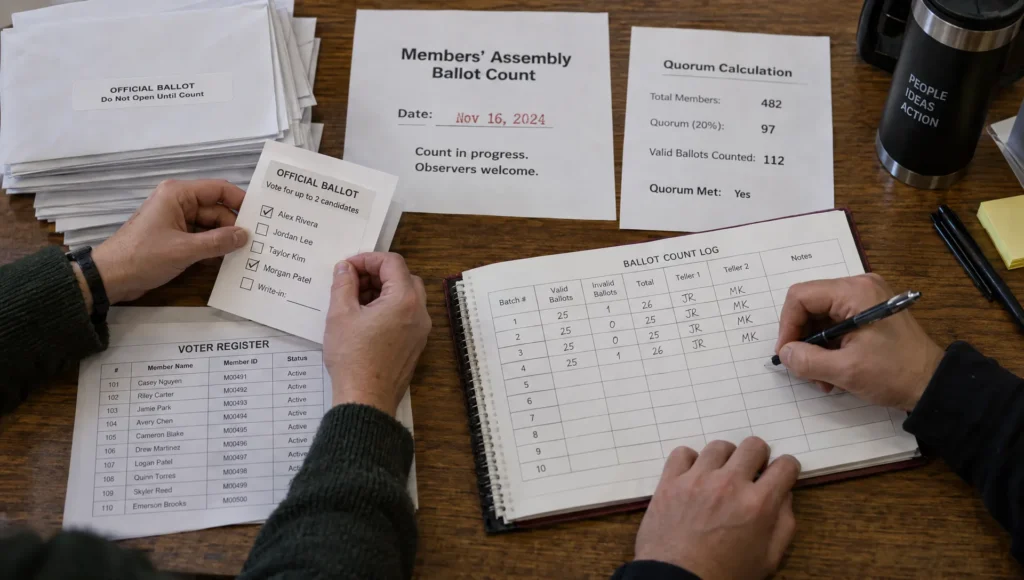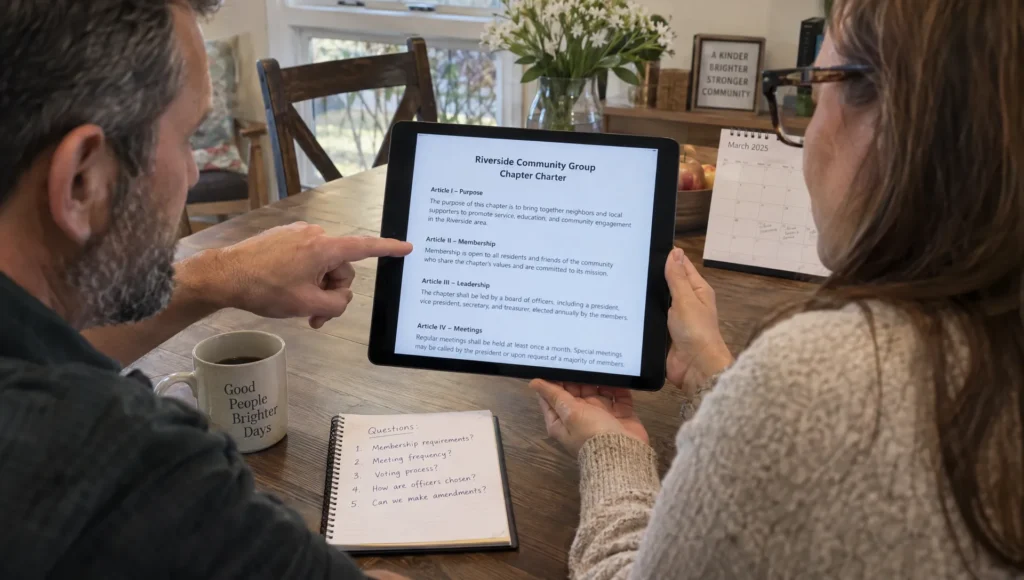
A public budget is democracy translated into money. It decides which schools get repaired, which streets get redesigned, which clinics are staffed, which neighborhoods wait, and which promises become real.
Yet budget transparency is often treated as a technical exercise: publish a PDF, release a spreadsheet, hold one hearing, and call the process open. That is not enough. If citizens cannot see the decision window, the assumptions, the tradeoffs, the procurement trail, and the results, the budget remains a locked room with a spreadsheet taped to the door.
Civic participation changes the standard. It asks government not only to publish numbers, but to make budgets understandable, contestable, and traceable from proposal to outcome. This connects directly to JustSocial’s manifesto, The Face of Democracy, which argues that citizens should not be reduced to voters, taxpayers, and private consumers. Budget transparency is where that reduction becomes most visible, because citizens pay for public systems yet often have little influence over how money is allocated after election day.
Why budget transparency cannot be a spectator sport
Traditional budget transparency usually answers one narrow question: can the public access budget documents? That matters, but it is only the beginning. The deeper democratic question is whether people can understand what is being decided, influence priorities before they are locked in, and verify whether approved spending actually produced public value.
The International Budget Partnership’s Open Budget Survey has consistently shown that public participation is the weakest part of many budget systems. In its 2023 survey, the global average score for public participation was only 15 out of 100. In other words, many governments may publish some budget information, but they still provide very limited opportunities for citizens to shape budget decisions.
That gap is exactly where civic participation belongs. A transparent budget should not be a ceremonial document citizens inspect after the fact. It should be a living public process in which residents can ask: What problem is this allocation trying to solve? What alternatives were considered? Who benefits? Who carries the cost? What evidence supports the decision? What will be measured after the money is spent?
The JustSocial approach adds a further test: can budget participation become continuous? Not one dramatic annual hearing, not one campaign-season promise, but a regular civic practice that lets the public weigh in throughout the budget lifecycle.
What public budget transparency should actually show
A budget line by itself rarely explains much. A city may allocate millions to transportation, education, health, housing, or technology, but the line item does not reveal whether the number is enough, whether it is fair, or whether implementation is on track.
Real public budget transparency needs layers. Each layer should be visible enough for ordinary citizens, journalists, civil society groups, academics, and officials to inspect the same decision from different angles.
| Transparency layer | What the public should see | Why it matters |
|---|---|---|
| Decision clarity | The exact budget decision, owner, timeline, and authority | Citizens need to know where influence is still possible |
| Money flow | Proposed allocation, approved allocation, revisions, payments, and procurement | Transparency must follow money after approval |
| Evidence | Needs assessments, forecasts, cost estimates, and alternative options | Public debate improves when claims are traceable |
| Tradeoffs | What is funded, what is delayed, and what is rejected | Budgets are choices under scarcity, not neutral math |
| Public input | Who participated, what they argued, and how input was summarized | Participation must be visible without exposing private data |
| Official response | Why decision-makers accepted, rejected, or modified public recommendations | A duty to respond prevents participation theater |
| Outcomes | Implementation status, service indicators, audits, and lessons learned | Citizens deserve to know whether spending worked |
This is aligned with the OECD Recommendation on Budgetary Governance, which emphasizes transparency, participation, integrity, and performance in public budgeting. The point is not to flood citizens with raw files. The point is to create a budget record that is complete enough for experts and readable enough for the public.
The budget lifecycle and where citizens can intervene
Civic participation works best when citizens stop reacting to finished decisions and start mapping the process earlier. Every public budget moves through stages. Each stage has a different participation opportunity.
| Budget moment | What citizens can do | Public receipt to request |
|---|---|---|
| Agenda setting | Identify unmet needs and rank priorities | Public issue docket |
| Drafting | Ask for assumptions, cost models, and alternatives | Draft budget notes and evidence index |
| Review | Submit structured comments and questions | Comment log and synthesis memo |
| Deliberation | Weigh tradeoffs in a facilitated process | Options memo with pros, cons, and dissent |
| Approval | Ask decision-makers to explain changes | Vote record and rationale memo |
| Implementation | Track contracts, payments, and milestones | Implementation tracker |
| Audit and learning | Compare promises with outcomes | Evaluation report and change log |
This lifecycle view is important because budget transparency is not only about the annual budget book. It is also about procurement pages, committee packets, grant criteria, capital plans, performance dashboards, audit reports, and meeting minutes.
Discursive democracy belongs at the start of this cycle. It helps the public name problems, challenge frames, and surface lived experience. Deliberative democracy belongs when choices must be narrowed and tradeoffs must be weighed. Civic participation completes the loop by linking public input to formal decisions and follow-through.
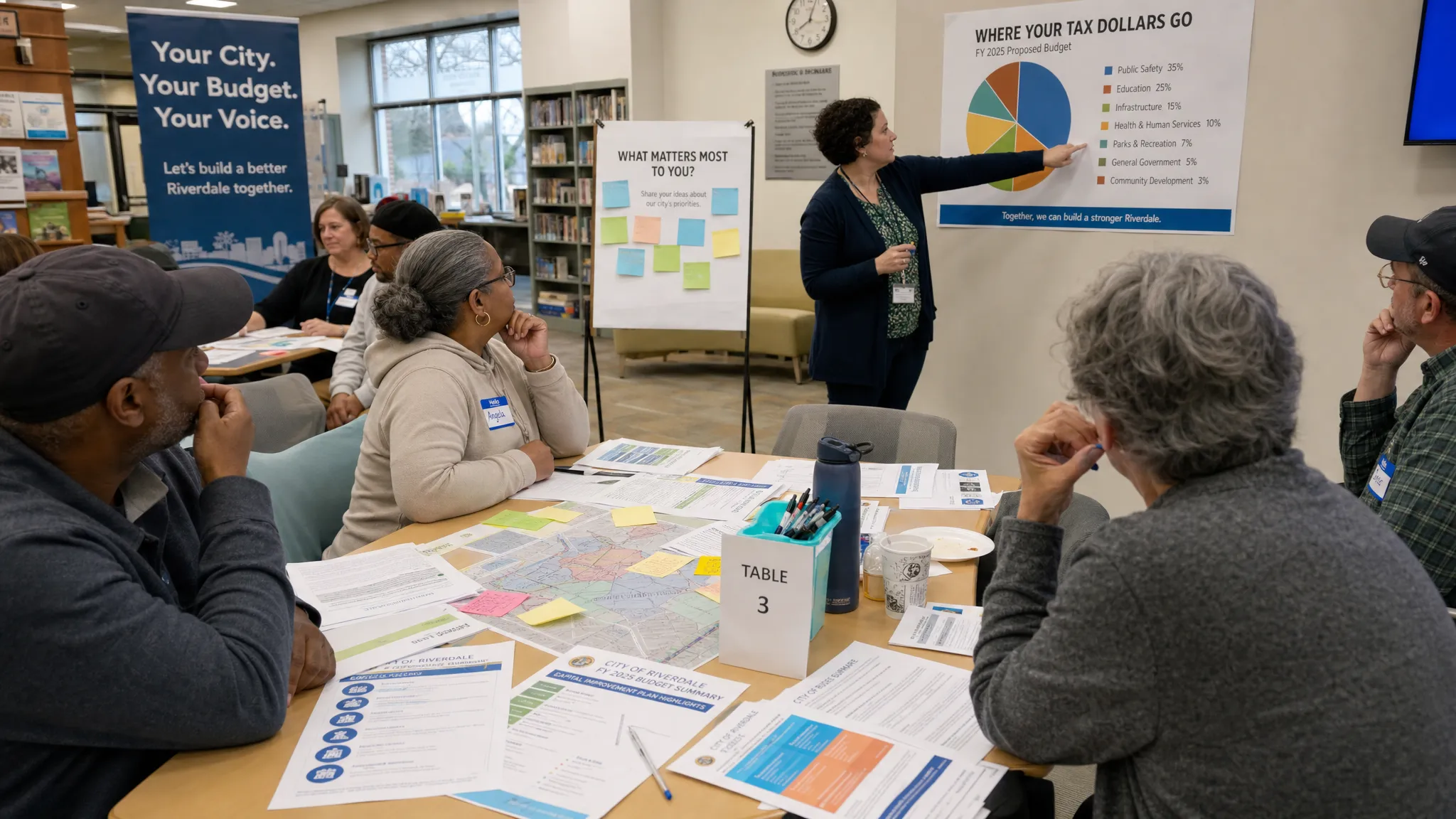
A practical participation stack for budget transparency
To make budget participation credible, every process should produce public artifacts. These are not bureaucratic extras. They are the civic memory of the budget process.
A strong budget transparency process can start with a simple stack: a Budget Decision Page, an Evidence Commons, a structured public input form, an Options Memo, an official Response Memo, and an Implementation Tracker.
The Budget Decision Page names the decision in plain language. For example: Should the city increase funding for after-school programs by reallocating part of the discretionary youth services budget? It should list the decision owner, deadline, legal constraints, and what kind of public input will matter.
The Evidence Commons gathers relevant documents in one place. That may include past spending, demographic data, waiting lists, procurement history, evaluation studies, and citizen testimony. The goal is not to create one official truth, but to make evidence traceable and contestable.
Structured public input prevents the loudest voices from becoming the whole record. A simple format works: claim, reason, evidence, requested action. This gives officials and citizens a way to compare arguments instead of counting comments as if volume equals legitimacy.
The Options Memo is where deliberative democracy becomes useful. It should present two to five realistic options, with costs, benefits, risks, equity impacts, and implementation challenges. Minority reports should be allowed, because disagreement is part of legitimacy.
Finally, the Response Memo and Implementation Tracker close the loop. Decision-makers should explain how public input affected the final budget, then publish progress after approval. Without this, participation becomes a public relations ritual.
How deliberative democracy improves budget choices
Budgets force hard choices. A government cannot fund every good idea at once. That is why budget transparency should not only reveal numbers, but also reveal reasoning.
Deliberative democracy helps because it slows the process down enough for citizens to compare tradeoffs. A representative group of residents can review evidence, question experts, hear affected communities, and produce decision-ready recommendations. This does not replace elected officials, but it improves the quality of public judgment before officials vote.
For example, a community may be divided between funding a new sports facility, expanding mental health services, and improving road safety. A typical public meeting may turn into competing speeches. A deliberative process can ask better questions: Which proposal addresses the most urgent need? Which has the strongest evidence? Which benefits underserved groups? Which can be implemented this year? Which requires long-term capital planning?
Budget debate should also connect line items to lived outcomes. Health, education, transit, housing, and care budgets affect everyday well-being; residents reviewing a health allocation can compare proposed spending with local needs and trusted public resources, from agency reports to independent health, family well-being, and lifestyle information, then ask whether the budget matches actual prevention and care priorities.
The key is to avoid treating citizens as an emotional audience and experts as the only rational actors. Citizens bring lived evidence. Experts bring technical evidence. Officials bring legal and operational constraints. A legitimate budget process needs all three.
The JustSocial lens: from taxpayer to People’s Branch
The JustSocial manifesto argues that the public sector has lagged behind the technological revolution. Private companies use analytics, cloud tools, social platforms, and feedback loops every day, while many public institutions still treat citizen input as a slow, occasional, paper-heavy process.
Budget transparency is an ideal place to change that culture. If citizens are funding the state, the state should give them a clear, continuous way to inspect priorities and contribute judgment. This is the spirit of the People’s Branch idea in the manifesto: not mob rule, not constant referendums on every technical detail, but an institutional channel where public opinion, public reasoning, and public priorities are measured and taken seriously.
The manifesto’s product concepts point toward this direction. An rParliament-style public record could make budget committee documents, livestreams, votes, and transcripts searchable and discussable. An rConcensus-style tool could allow communities, districts, schools, or cities to run structured budget ballots or preference surveys. Public analytics could help officials see which concerns recur across demographic groups, neighborhoods, and political identities, while preserving privacy and avoiding manipulation.
This is where a political movement can matter. Governments rarely build this kind of transparency because someone politely asks once. Movements create pressure, models, and habits. They can publish shadow budget trackers, run independent deliberation circles, recruit volunteer analysts, and show what a People’s Branch might look like before it is formally recognized.
What citizens can do this month
You do not need to understand every accounting code to begin. Start with one decision, one institution, and one public receipt.
| Week | Action | Output |
|---|---|---|
| Week 1 | Pick one budget area, such as school facilities, road safety, public health, or housing | A one-page Budget Decision Note |
| Week 2 | Find the decision owner, timeline, committee, and existing documents | A public link folder or evidence index |
| Week 3 | Ask three process questions in writing | A request for assumptions, alternatives, and response rules |
| Week 4 | Publish a short public summary and invite others to add evidence | A citizen-readable budget brief |
Your process questions can be simple. What alternatives were considered? What data supports this allocation? Which communities are most affected? When will the final decision be made? How will public comments be summarized? Will officials publish a response memo? What outcome measures will be tracked after approval?
If you have more time, form a small civic team. One person tracks meetings. One collects documents. One summarizes evidence. One contacts officials. One translates the issue into plain language for neighbors. This division of labor makes civic participation sustainable instead of exhausting.
How a political movement can make budget transparency real
A political movement focused on budget transparency should not only demand openness from government. It should model openness internally.
That means publishing its own funding principles, meeting notes, decision rules, and budget priorities. If a movement calls for public receipts from government but hides its own process, it weakens its legitimacy. Trust is built through symmetry: demand transparency, practice transparency.
For public budgets, a movement can create a repeatable local kit. The kit should include a template for a Budget Decision Page, a guide for reading budget documents, a structured comment form, a deliberation agenda, and an implementation tracker. The goal is not to win every budget fight immediately. The goal is to build civic capacity that compounds over time.
A movement should also protect budget participation from capture. Wealthier neighborhoods, organized interest groups, contractors, unions, and political factions may all have legitimate views, but none should dominate the process invisibly. Transparency requires disclosure of interests, balanced facilitation, accessibility, and careful privacy rules for vulnerable participants.
The strongest budget transparency movements measure success by follow-through, not attention. Did officials publish the missing document? Did the committee answer public questions? Did the final budget explain rejected alternatives? Did implementation match the promise? Did more residents understand the next decision window?
Common traps to avoid
Budget transparency can fail even when everyone uses the right words. The most common failure is transparency theater, where public documents exist but cannot influence anything.
| Trap | What it looks like | Better practice |
|---|---|---|
| Spreadsheet dumping | Huge files with no explanation | Publish plain-language summaries and machine-readable data |
| One-night participation | A single hearing after priorities are set | Open participation before drafting and during implementation |
| Volume counting | Treating the most comments as the best argument | Use structured input and deliberative synthesis |
| No response duty | Officials say they listened but do not explain decisions | Require public response memos |
| No implementation memory | Approved projects disappear from public view | Maintain trackers for milestones, payments, and outcomes |
| Partisan capture | Budget debate becomes party branding | Keep the process tied to named decisions and evidence |
The deeper problem is not only lack of information. It is lack of democratic infrastructure. In 2026, the technical tools exist. The missing piece is the institutional will to make public budgets continuously inspectable and participatory.
Frequently Asked Questions
What is civic participation in public budgeting? Civic participation in public budgeting means citizens help shape, question, monitor, and evaluate budget decisions. It includes submitting evidence, joining deliberation, attending committee meetings, requesting public records, tracking implementation, and demanding official responses.
Is budget transparency the same as participatory budgeting? No. Participatory budgeting usually lets residents help decide how to spend a defined portion of public money. Budget transparency is broader. It covers the visibility, reasoning, documentation, and follow-through of the entire budget process.
How does deliberative democracy help with budgets? Deliberative democracy creates structured spaces where citizens review evidence, hear different perspectives, weigh tradeoffs, and produce decision-ready recommendations. This is especially useful when budget choices involve scarcity and competing public goods.
What should citizens ask for first? Start by asking for the decision owner, timeline, evidence, alternatives, and response rule. If officials cannot explain who decides, when they decide, and how public input will be used, participation is unlikely to matter.
Can technology solve public budget transparency? Technology can help by organizing documents, tracking decisions, hosting structured input, and visualizing spending. But technology cannot replace governance rules, civic education, privacy safeguards, and a duty to respond.
Build the budget transparency loop
Public budget transparency is not a favor government gives citizens. It is part of the social contract. If citizens fund public institutions, they deserve a continuous, understandable, and auditable way to influence how those institutions spend.
JustSocial exists to help build that kind of democratic infrastructure: civic participation that is not symbolic, deliberation that produces usable judgment, and technology that makes public decisions more transparent rather than more distant.
If this vision speaks to you, start locally. Choose one budget decision. Ask for one receipt. Bring one neighbor into the process. Then repeat. That is how civic participation becomes a habit, how a political movement becomes credible, and how public money becomes public again.