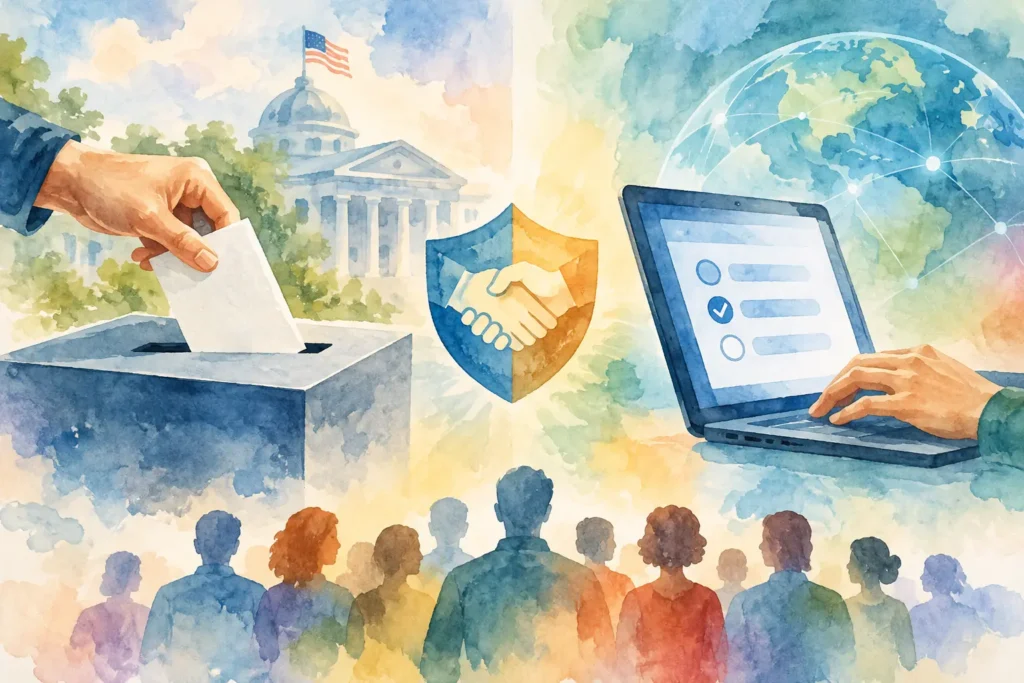
A public meeting can fill a room and still leave most of a community unheard. A comment form can collect thousands of responses and still make it impossible for residents to see what changed because they spoke. Participatory decision making software addresses this gap by giving people a clearer, more continuous way to help shape public choices.
The goal is not to turn every civic question into a quick online poll. Democracy deserves more than a click count. The right digital infrastructure creates an understandable path from public information to community deliberation, collective input, accountable decisions, and visible follow-through. It helps citizens see that participation is not a symbolic gesture. It is part of how government and community institutions work.
What participatory decision making software should do
Participatory decision making software is a digital system that helps a group gather input, deliberate on options, prioritize needs, vote or reach consensus, and document outcomes. In a civic setting, that group might be residents deciding how to spend a portion of a city budget, parents advising a school district, nonprofit members setting priorities, or neighbors shaping a local development plan.
Its value comes from connecting stages that are too often separated. A government may publish information in one place, collect comments in another, hold meetings elsewhere, and announce a decision without explaining how public input mattered. Residents are left to piece together the process themselves. That fragmentation weakens trust even when leaders are acting in good faith.
A well-designed platform gives a decision a public home. People can understand the question, review plain-language background materials, offer ideas, respond to other perspectives, and see the decision rule before they participate. When a choice is made, the record remains available: what was proposed, who was eligible to take part, what input was received, and what happens next.
This is civic infrastructure, not merely a feature set. The design choices determine whose knowledge counts, who can participate, and whether public power becomes easier to understand.
Participation is not the same as polling
A poll asks which option people prefer at a moment in time. Participatory decision making can include voting, but it also makes room for learning, disagreement, revision, and shared problem-solving.
Consider a city allocating funds for neighborhood improvements. A simple survey may reveal that parks, sidewalks, and transit shelters are popular. A participatory process can go further. Residents can propose projects, identify accessibility concerns, compare costs, discuss geographic equity, and help establish the criteria that guide funding. The final vote then rests on a more informed and more transparent process.
That distinction matters because public decisions have real trade-offs. A process that treats every question as a popularity contest can reward the loudest campaign or the most familiar option. A process with clear information, facilitated discussion, and equitable participation can surface needs that are otherwise overlooked.
Software cannot resolve every conflict. Nor should it pretend to. Its role is to make the process more accessible, legible, and accountable while preserving the human judgment that complex public decisions require.
Design for access before engagement metrics
A platform can report high participation numbers and still exclude the people most affected by a decision. Access must be a starting point, not a final checkbox.
Mobile-friendly design is essential, but it is not enough. Residents may have limited data plans, unreliable internet, language barriers, disabilities, or understandable concerns about sharing personal information with public institutions. Participation should be possible through multiple channels, including accessible web forms, translated materials, public kiosks, partner organizations, printed outreach, and staff-supported options where appropriate.
Identity verification also requires care. Some decisions need strong verification to ensure that only eligible residents vote and that each person participates once. Yet a heavy enrollment process can deter people without conventional documentation, stable housing, or confidence navigating government systems. The right approach depends on the stakes of the decision. A neighborhood idea-gathering process may need low barriers, while a binding participatory budget vote may require more rigorous safeguards.
We should be honest about that trade-off. Inclusion and integrity are not opposing values, but they must be designed together. Communities deserve a process that protects against manipulation without treating ordinary residents as suspects.
Plain language is a democratic requirement
Participation cannot be meaningful when the decision itself is difficult to understand. Every process should explain the issue in plain language: what is being decided, what is not open for decision, what constraints exist, who has authority, and how public input will influence the outcome.
Jargon creates an invisible gate. So does a 70-page planning document offered without a clear summary. Participatory tools should make complex information available without requiring every resident to become a policy specialist. Maps, project comparisons, short videos, translated summaries, and accessible cost breakdowns can help people participate with confidence.
Choose software around the decision, not the trend
The first question is not, “Which platform has the most features?” It is, “What decision are we asking people to help make?”
Some processes need idea submission and community feedback. Others need structured deliberation among a representative group. A nonprofit may need member voting with transparent governance records. A city may need participatory budgeting that moves from proposals to feasibility review to public voting to implementation tracking. These are different civic jobs, and they call for different workflows.
Before selecting a tool, institutions should define the decision’s scope, the participants, the decision rule, and the commitment leaders are making. Will the result be binding, advisory, or one input among several? Will participants be able to see why a proposal was ruled ineligible? Who will moderate discussion? How will the institution report progress after the vote?
These questions are more important than a polished interface. A beautiful platform cannot repair a process that has no real authority or no plan for follow-through.
It also helps to establish success measures that go beyond sign-ups. Look at who participated across neighborhoods and demographic groups, whether people completed the process, whether participants understood the decision, and whether selected projects were delivered. Trust is harder to measure, but it leaves evidence: residents return, community partners share the opportunity, and people can point to outcomes shaped by public input.
Transparency must continue after the vote
The fastest way to weaken a participatory process is to invite people in, announce a result, and disappear. Residents need to know what happened after their contribution.
For public agencies, that means publishing the methodology, eligibility rules, participation totals, and decision results in a form people can understand. It also means explaining constraints. If a winning proposal cannot move forward because of legal, safety, or budget realities, the institution should say so plainly and describe the next available path.
For nonprofits and community organizations, the same principle applies. Members and supporters should be able to see how priorities were set and how resources are being used. Transparent decisions strengthen relationships because they replace vague promises with a shared record.
The platform should support this continuity. Project pages can show progress, spending, milestones, delays, and completed work. A public record does not eliminate frustration when implementation takes time. It does give people a reason to believe that their participation was respected.
Build capacity alongside the technology
Participatory decision making software is most effective when it supports a larger civic practice. Staff need training to communicate clearly, facilitate disagreement, protect participant privacy, and respond to feedback. Community partners need time and resources to reach people who have been excluded from formal civic channels. Residents need a real invitation, not a last-minute announcement.
This work can begin with a focused pilot. Choose a decision that has genuine room for public influence, explain the limits honestly, and learn from the experience. A smaller process with visible results can create the confidence needed for more ambitious forms of continuous participation.
We do not need to wait for the next election to practice democracy. When citizens can help set priorities, weigh choices, and see public institutions respond, democratic agency becomes part of everyday life. The work before us is to build tools and processes worthy of that relationship.