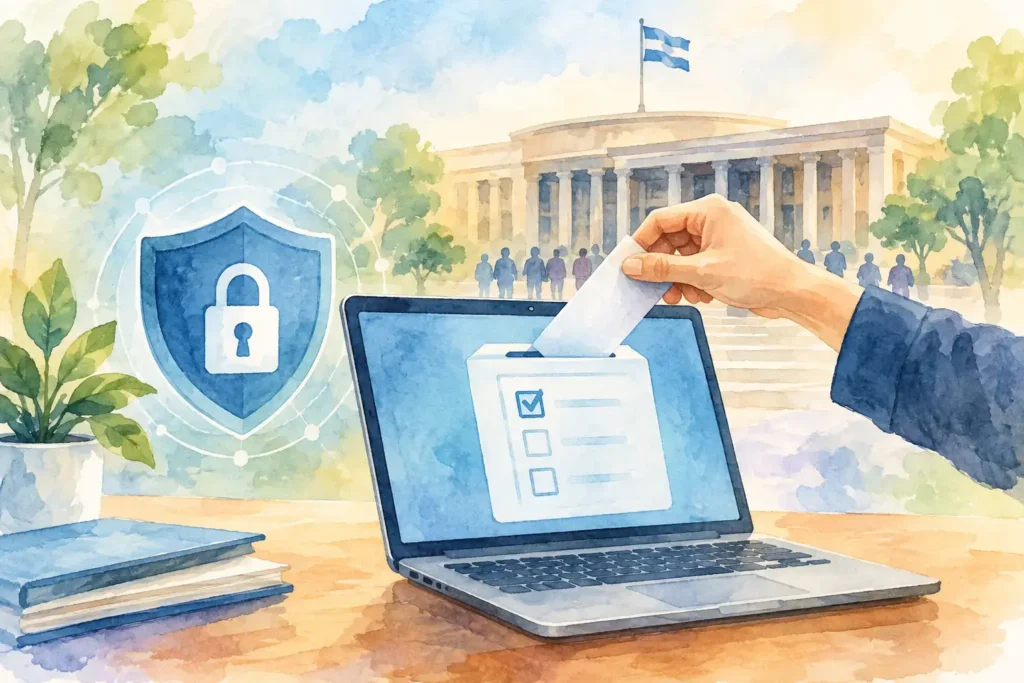
A private ballot is more than a voting procedure. It is the protection that lets a neighbor vote differently from their family, employer, landlord, faith community, or political party without fear of punishment. Learning how to protect ballot privacy helps preserve that freedom – and reminds us that democracy works best when every person can participate on their own terms.
The secret ballot is a foundation of American elections, but privacy is not automatic in every setting. It depends on practical choices by voters, well-trained election workers, accessible polling places, secure vote-by-mail processes, and public systems designed to resist pressure and surveillance. We all have a role in defending it.
Why ballot privacy protects democratic agency
Ballot privacy means no one should know how you voted unless you choose to tell them. Election officials may confirm that you are registered and that your ballot was received or counted. They do not publish a record connecting your name to the candidates or measures you selected.
That separation matters because voting is not meaningful when it is monitored. A supervisor should not be able to demand proof that an employee supported a certain candidate. A partner should not be able to force a spouse to vote a particular way. A campaign should not be able to buy, collect, or inspect marked ballots. Privacy gives citizens room to make independent judgments, including judgments that are unpopular in their own circles.
It also strengthens public trust. When people believe they can vote without retaliation or exposure, they are more likely to participate honestly. When communities understand how election systems separate voter identity from ballot choices, misinformation has less room to grow.
How to protect ballot privacy at a polling place
Most in-person polling locations use a combination of private voting booths, ballot folders or sleeves, and procedures that separate check-in from ballot tabulation. Still, a few simple habits can help you keep your choices private.
Before marking your ballot, take time to review it in a private voting area. Position the ballot so nearby voters cannot read it, and use any privacy sleeve provided by poll workers when walking it to a scanner or ballot box. If a booth does not offer enough privacy because of crowding, layout, disability access, or an equipment problem, ask a poll worker for help. You are entitled to cast your ballot privately.
You can bring written notes or a sample ballot to help remember your choices, subject to your state’s rules. Keep those notes close and avoid displaying a completed ballot. A photograph of your marked ballot, often called a ballot selfie, may be restricted under state law even where it is commonly practiced. The law differs by state, so the safest approach is simple: do not photograph, livestream, or post a completed ballot.
If someone is pressuring you at the polls, step away from that person and speak directly to a poll worker. Election workers are there to maintain an orderly process and can explain available options. If intimidation, threats, or interference continue, document what you can safely remember and report it through the appropriate election-protection or local election channels after voting.
Assistance should support your choice, not replace it
Voters with disabilities, limited English proficiency, or difficulty reading or marking a ballot may be entitled to assistance. Federal law and many state laws allow voters to receive help from a person they choose, with narrow exceptions such as an employer or union representative. Poll workers can also explain accessible voting equipment.
The key principle is consent. A helper may read the ballot, interpret instructions, or mark selections as directed by the voter. They may not choose for the voter, rush the voter, or disclose the voter’s choices. If assistance does not feel respectful or private, ask for another helper or request support from an election official.
Protecting privacy when voting by mail
Voting by mail can make participation more accessible, especially for people with disabilities, caregivers, shift workers, students, and voters far from home. It also requires extra attention because a ballot is completed outside the controlled privacy of a polling place.
Start by filling out your ballot in a place where you can make choices freely. If you live with someone who may pressure you, consider completing your ballot at a trusted friend’s home, a library, an election office, or another safe private setting if your local rules allow. No one should demand to watch you vote or require you to reveal your selections.
Follow every instruction on the return envelope. In many states, the outer envelope contains identifying information or a signature used to verify eligibility, while the ballot itself is enclosed so officials can separate it before counting. A missing signature, misplaced ballot, or improperly sealed envelope can create problems that delay or prevent counting.
Use an official drop box, your local election office, or the mail service recommended by election officials. Do not hand your ballot to a campaign worker, stranger, or anyone you do not trust to handle it lawfully. Some states limit who may return another voter’s ballot, so check local requirements before asking a friend, family member, or caregiver for assistance.
Ballot tracking tools, where offered, can confirm that your ballot was accepted without revealing how you voted. That is a useful distinction: a healthy election system can provide accountability about the process while keeping the contents of each ballot secret.
Keep digital civic participation private, too
As public decision-making moves online, ballot privacy must extend beyond paper. Digital participation can widen access to meetings, consultations, budget choices, petitions, and other civic processes. But participation platforms must not treat citizens’ political preferences as a product to be profiled, sold, or exposed.
For voters and residents, basic digital hygiene helps. Use a strong, unique password for election-related accounts and enable multi-factor authentication when available. Access official election information through verified government channels rather than search ads, forwarded messages, or unsolicited texts. Be cautious about sharing screenshots that show personal registration details, ballot codes, or confirmation numbers.
For governments, nonprofits, and civic-technology builders, the responsibility is larger. Systems should collect only the information needed for participation, clearly explain what is public and what is private, and separate identity verification from the substance of a person’s vote whenever possible. Security matters, but so does governance: communities deserve clear rules about data retention, access, audits, and independent oversight.
A digital system that asks people to choose between privacy and participation has failed its civic purpose. Inclusion requires both access and protection.
Recognize coercion and protect one another
Ballot privacy is not only about curtains, envelopes, and encryption. It is also about power. Coercion can be obvious, such as a threat to fire someone who votes a certain way. It can also be subtle: a family member insisting on standing beside someone as they vote, a community leader demanding proof of loyalty, or a campaign offering a reward for evidence of a completed ballot.
If you see someone being pressured, do not escalate the situation unless it is safe to do so. A calm offer to find a poll worker, locate an accessible voting option, or connect the person with a trusted local resource can create space for an independent choice. Community organizations can help by sharing plain-language voting information, training volunteers on nonpartisan assistance, and making clear that no one owes another person proof of their vote.
We should be equally careful not to confuse enthusiasm with obligation. Sharing why you voted, encouraging neighbors to participate, and organizing around public issues are all valuable forms of civic life. Demanding that people disclose their choices is not. Democracy grows stronger when persuasion ends where private decision-making begins.
Build systems worthy of public trust
Protecting ballot privacy is an ongoing public responsibility. Election officials need adequate funding, trained staff, accessible equipment, and transparent procedures. Civic organizations need to teach voters what privacy protections exist and where to seek help. Technology teams need to design participation tools that serve people before platforms.
At JustSocial, we believe democratic infrastructure should deepen the connection between citizens and public decisions, not turn civic participation into another channel for extraction or surveillance. That means building with communities, inviting scrutiny, and treating privacy as a condition of real agency.
The next time you vote, take the privacy of your ballot seriously. Give others the same room to decide freely. A democracy becomes more participatory not when everyone votes the same way, but when every person can make their voice count without having to ask permission.