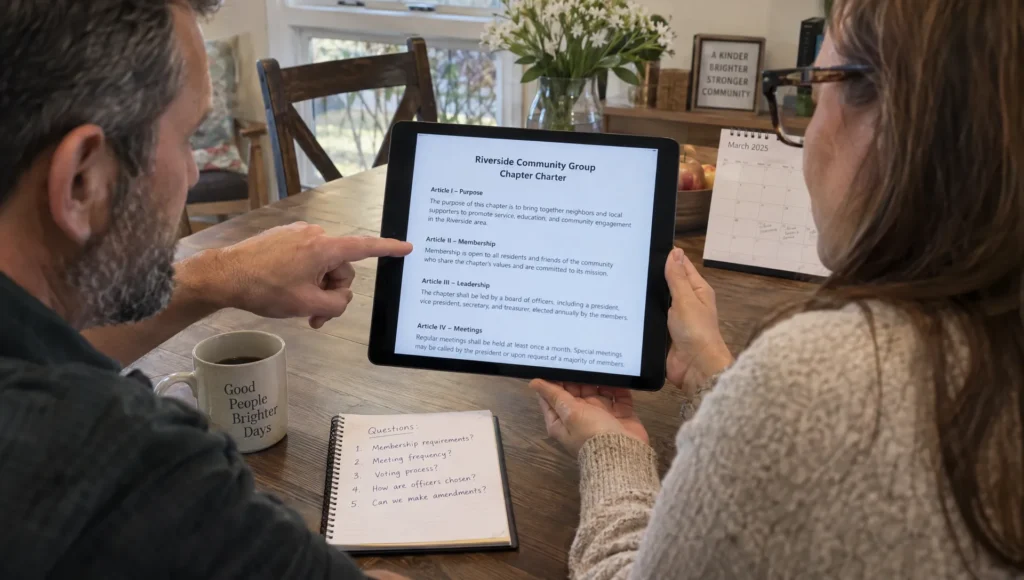
Local schools are often the first public institution a family truly experiences. They are where children learn, where parents meet one another, where teachers carry the weight of social change, and where local governments make choices that shape daily life. If democracy should be close to the people, schools are one of the most natural places to begin.
Yet many school communities only become politically active after trust has already broken down. A policy is announced, parents react, students protest, teachers feel unheard, and administrators defend decisions that might have been stronger if the community had been involved earlier. Civic participation offers a better path: not louder meetings, but better systems for listening, reasoning, deciding, and following through.
For JustSocial, this connects directly to the manifesto’s critique of industrial-era institutions. The traditional school model often treats students as passengers moving through a production line. A stronger local school treats students, families, educators, and neighbors as active members of a living civic community.
Why Schools Need Civic Participation Before Conflict Starts
Civic participation in schools means giving the school community structured ways to influence decisions that affect learning, safety, belonging, budgets, and culture. It is not the same as turning every classroom issue into a public referendum. It is also not a demand that school leaders surrender professional judgment. Instead, it creates a steady civic channel between lived experience and institutional decision-making.
Decades of research on family and community involvement show that when schools build authentic partnerships with families, students tend to benefit academically and socially. Henderson and Mapp’s widely cited review, A New Wave of Evidence, found a consistent connection between family engagement and student achievement across income and background. A Learning Policy Institute review of community schools also highlights how integrated school-community models can support attendance, learning, and student well-being.
The key word is authentic. A survey that disappears into an inbox does not build trust. A town hall where people speak for two minutes and never hear back does not build shared responsibility. Civic participation strengthens local schools when it is connected to real decisions, visible evidence, fair discussion, and public follow-through.
The School as a Small Civic Community
In the JustSocial manifesto, Yuval D. Vered returns to the idea of the Polis: a political community where people experience public life as immediate, meaningful, and connected to identity. A local school can never be the Greek Polis, and it should not romanticize the past. But it can recover one essential lesson: people care more deeply for institutions when they are treated as members, not as passive users.
A school is already a civic community. It has rules, budgets, rituals, conflicts, leaders, public spaces, shared resources, and future citizens. The question is whether those civic realities are handled behind closed doors or transformed into a learning environment for democratic life.
When a school invites students to help shape a phone policy, parents to help evaluate communication practices, teachers to identify implementation barriers, and community partners to support after-school projects, it does more than solve isolated problems. It teaches that public life is not only protest, complaint, or election day. It is a continuous practice.
Three Ways Civic Participation Strengthens Local Schools
The strongest school participation systems do three things at once: they surface knowledge, improve decisions, and build trust. Each function matters because schools are complex institutions where a policy that looks simple from the outside can affect classrooms, families, transportation, staff time, privacy, and student dignity.
| School challenge | Civic participation practice | How it strengthens the school |
|---|---|---|
| Families feel decisions are imposed on them | Publish the decision being considered before it is finalized | Reduces surprise, rumor, and defensive conflict |
| Students experience rules differently than adults expect | Collect structured student input with privacy safeguards | Reveals practical harms, blind spots, and better implementation ideas |
| Teachers are asked to execute policies they did not shape | Include staff in evidence review and option design | Improves feasibility and reduces burnout |
| Public meetings reward the loudest voices | Use discursive democracy rules for claims, reasons, and evidence | Makes participation more respectful, legible, and inclusive |
| Trust fades after input is collected | Publish response memos and implementation trackers | Shows what changed, what did not, and why |
The first benefit is better problem discovery. Families know where communication fails. Students know which rules feel unfair or unsafe in practice. Teachers know what can realistically work inside a classroom. Administrators know the legal, financial, and operational constraints. Civic participation brings these forms of knowledge into one public process.
The second benefit is better judgment. This is where deliberative democracy matters. Instead of counting raw opinions, deliberation gives a representative or balanced group time to examine evidence, hear competing needs, compare tradeoffs, and produce decision-ready options.
The third benefit is trust through memory. Communities do not only ask, “Did we get our way?” They ask, “Were we heard honestly?” A school that publishes clear public receipts, such as issue summaries, options memos, board responses, and implementation updates, creates institutional memory. Even disagreement becomes easier to live with when the reasoning is visible.
A Practical Participation Loop for Local Schools
Schools do not need to begin with a complex platform or a large reform campaign. They can begin with one decision and one repeatable loop. The goal is to make participation predictable enough that people know when to enter, how to contribute, and how their input will be handled.
- Name the decision: State the actual decision in plain language. For example, “The school board will decide whether to change middle school phone rules for the 2026 school year.” Avoid vague prompts like “Tell us what you think about phones.”
- Publish a short Issue Pack: Share the current policy, the reason change is being considered, relevant data, legal constraints, budget limits, and questions that are still open. Keep it readable for parents and students, not only administrators.
- Run a discursive democracy intake: Invite the community to submit claims, reasons, evidence, and requests. This improves public conversation by slowing down rumor and asking people to explain what they believe and why.
- Convene a deliberative working group: Bring together students, parents, teachers, administrators, and where appropriate, community partners. Their job is not to perform outrage or defend a fixed position. Their job is to compare options.
- Publish an Options Memo: Present two to four realistic options with benefits, risks, costs, equity concerns, and implementation needs. Include minority views when consensus is not possible.
- Require a decision response: The principal, superintendent, or board should explain what they decided, which option they chose, what public input influenced the decision, and why other options were rejected.
- Track implementation: Return after 30, 60, or 90 days to ask whether the policy worked as intended. Participation should not end when the vote is over.
This loop reflects the manifesto’s broader call for continuous civic participation. A school community should not wait years for a board election to express its needs, and it should not rely on crisis meetings to be heard. Participation becomes stronger when it is routine.
What Should Schools Work On First?
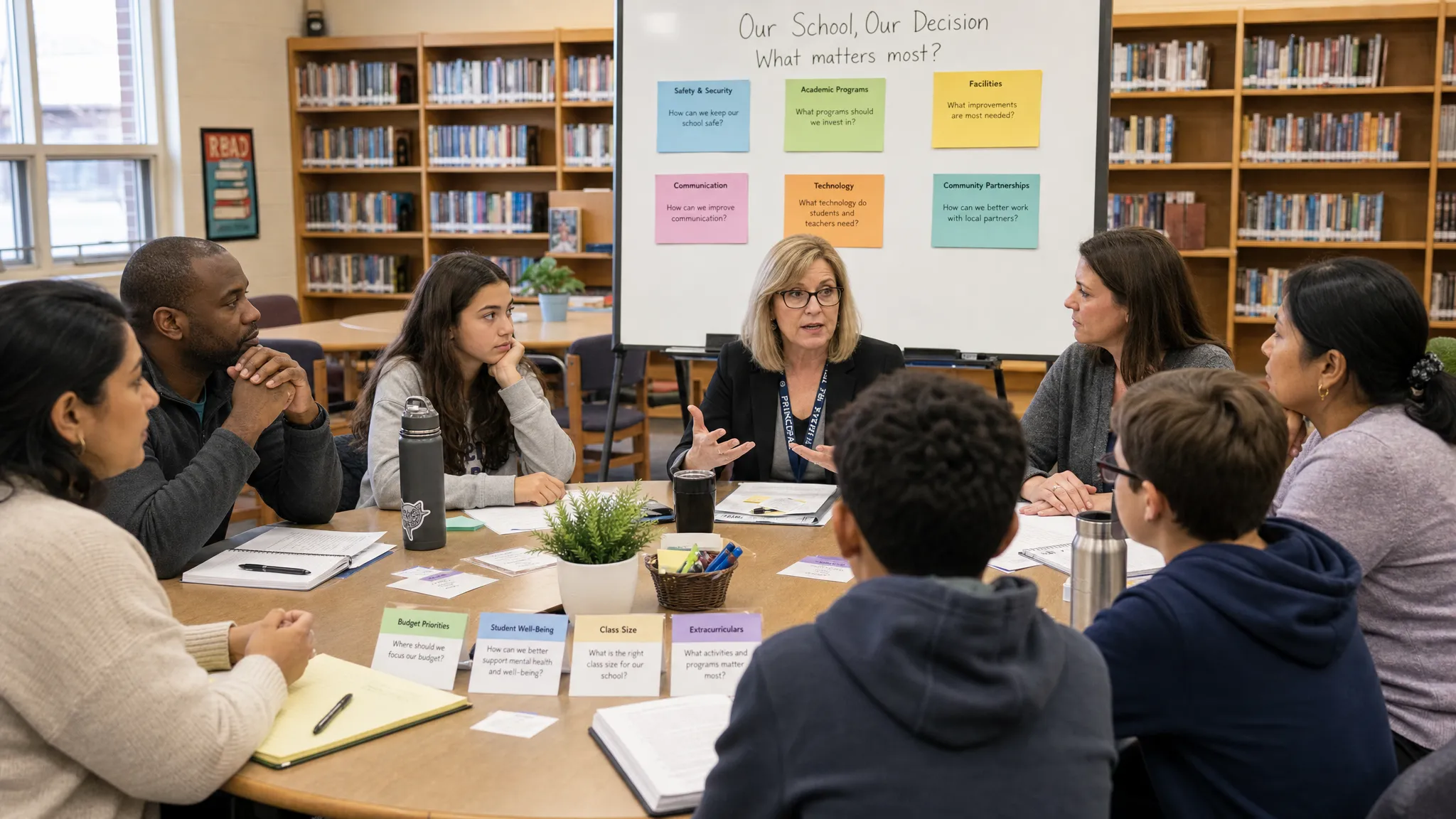
The best first topic is visible, bounded, and important enough that people care. Avoid beginning with the most polarizing issue in the district. Start with a decision that can be completed in weeks, not years, so the community experiences a full participation cycle.
Good first topics include school arrival and dismissal routines, communication between teachers and parents, homework expectations, student club funding, cafeteria improvements, after-school programming, school safety practices, or student well-being supports. These issues affect daily life, but they are usually concrete enough for practical deliberation.
Participation also has a symbolic dimension. A student-led committee designing volunteer badges, club patches, graduation ribbons, or uniform labels can turn belonging into something visible; if the school chooses to produce those materials, suppliers of custom woven labels and patches can help translate a democratic design process into durable objects students actually use.
| First project area | Participation question | Useful public output |
|---|---|---|
| Student well-being | What support is missing during the school day? | Needs map and options memo |
| Phone or AI rules | What rule protects learning without ignoring reality? | Policy options with tradeoffs |
| School safety | Which routines increase safety without creating fear? | Risk review and implementation plan |
| Budget priorities | Which small investments would improve daily school life most? | Ranked project list and response memo |
| School identity | What symbols, events, or traditions build belonging? | Student-designed proposal and cost note |
Small wins matter. A community that sees one issue move from concern to evidence to decision to follow-up is more likely to participate again. That is how civic capacity grows.
Protecting Students, Teachers, and Minority Voices
School participation must be designed with special care because students are minors, teachers may fear retaliation, and minority families may have good reasons to distrust public processes. Participation that exposes vulnerable people without safeguards can damage the very community it claims to strengthen.
Strong school participation should include a few non-negotiable protections:
- Privacy by default: Student testimony should be anonymized when possible, especially on sensitive topics like bullying, mental health, discrimination, or family circumstances.
- Non-retaliation rules: Schools should clearly state that students, parents, and staff will not be punished for good-faith participation.
- Accessible formats: Input should be possible in multiple languages, in writing, in person, online, and through trusted intermediaries when needed.
- Balanced facilitation: Meetings should not reward the most confident or aggressive speakers. Time, turn-taking, and evidence rules matter.
- Minority reports: If a group cannot agree, dissenting views should be published fairly rather than erased in the name of unity.
This is where discursive democracy is especially useful. It does not ask everyone to agree. It asks the community to make claims clearly, give reasons, mark evidence, and respect the dignity of others. In a school, that is not only a governance practice. It is an educational practice.
Civic Participation as Real Civic Education
Many schools teach civics as a subject, but students often experience school itself as a place where rules simply arrive. That contradiction is hard to ignore. If students are told democracy matters but never see a decision process where their evidence and reasoning count, civic education becomes abstract.
The JustSocial manifesto argues for moving beyond the industrial model of education toward more holistic, participatory, and project-based learning. Local school participation can make that real. Students can learn how to frame a problem, gather evidence, interview stakeholders, compare tradeoffs, write recommendations, and evaluate implementation.
Imagine a class studying school lunch waste. Instead of only writing essays, students measure waste, interview cafeteria staff, survey peers, review cost constraints, and present options to the administration. The school might not adopt every recommendation, but it can publish a response explaining what will be tried. That is civic education with consequences.
This also supports teachers. Participation does not need to become another burden if it is designed as project-based learning, student leadership, and community partnership. A well-run process can turn existing concerns into curriculum, service learning, and school improvement.
How a Political Movement Can Help Without Capturing Schools
A political movement that cares about democratic reform should treat schools with humility. Local schools are not campaign stages. They are public communities with children at the center. The role of a movement should be to provide methods, templates, facilitation support, technology ideas, and transparency norms, not to force predetermined answers.
For a movement like JustSocial, the most legitimate contribution is process infrastructure. That means helping schools publish clear decision statements, run fair dialogue, create deliberative working groups, protect privacy, and track implementation. The movement should model the same transparency it asks from public institutions.
A good rule is simple: advocate strongly for participation, but do not manipulate the outcome. If the community deliberates honestly and chooses a policy different from what organizers expected, the process still has democratic value. The deeper goal is to create citizens who know how to reason together and institutions that know how to listen.
A 30-Day Starter Plan for a Stronger School Community
Schools, parent groups, student councils, and local civic teams can test this approach in one month. The plan below is intentionally modest because legitimacy grows through completed loops, not oversized promises.
| Timeframe | Action | Output |
|---|---|---|
| Days 1 to 5 | Choose one bounded school decision and identify the decision owner | One-page Decision Statement |
| Days 6 to 10 | Gather current policy, constraints, student experiences, and basic data | Short Issue Pack |
| Days 11 to 17 | Collect structured input from students, families, teachers, and staff | Public synthesis of claims and concerns |
| Days 18 to 24 | Convene a balanced working group to compare options | Options Memo with tradeoffs |
| Days 25 to 30 | Deliver the memo to the decision owner and request a written response | Response request and follow-up date |
The most important part is the final step. Without a response, participation becomes symbolic. With a response, even an imperfect one, the school begins building a public record of reasoning and accountability.
Frequently Asked Questions
Is civic participation in schools the same as parent involvement? Not exactly. Parent involvement often means volunteering, attending events, or supporting homework. Civic participation includes those actions but goes further by connecting students, families, teachers, and community members to school decisions and follow-through.
Should students participate in school decisions? Yes, with safeguards. Students are directly affected by school rules and often understand practical consequences adults miss. Their participation should be age-appropriate, privacy-protective, and connected to learning.
Can deliberative democracy work in a busy school? It can if the process is small and focused. A school does not need a months-long assembly for every issue. A two-meeting working group with a clear Issue Pack and Options Memo can improve many decisions.
How do schools avoid participation being dominated by loud voices? Use structured formats. Ask participants to state claims, reasons, evidence, and requests. Limit speaking time, provide written options, translate materials, and publish synthesis notes so quieter voices are still counted.
What if the school leadership ignores the process? Start by asking for a written response and a follow-up date. If leaders still ignore the community, the public record becomes useful for board meetings, elections, journalism, and future organizing.
Make Local Schools Laboratories of Continuous Participation
Local schools can become the place where democracy is practiced, not merely described. When students, parents, educators, and neighbors participate in structured, respectful, decision-linked ways, schools gain better information, stronger legitimacy, and deeper belonging.
That is the spirit behind JustSocial’s vision of continuous direct democracy: public institutions should hear people consistently, not only during crisis or election season. To explore the broader argument, read The Face of Democracy and consider how your school community could pilot one transparent participation loop this month.