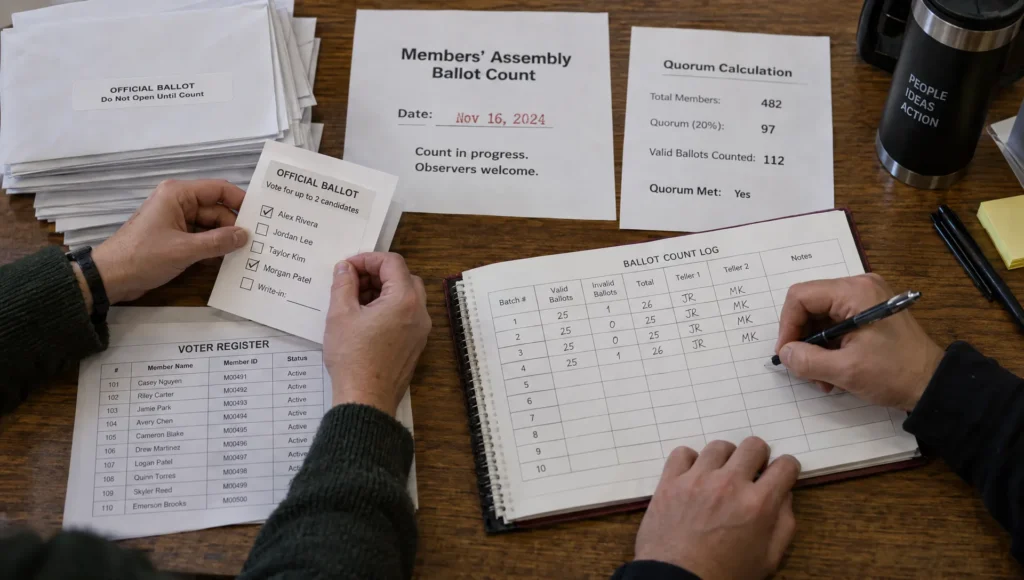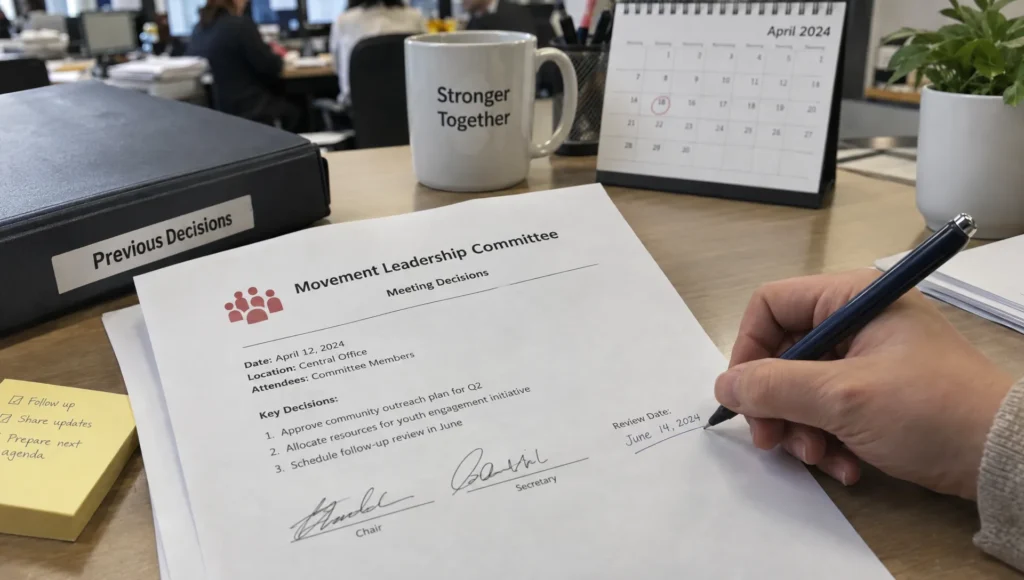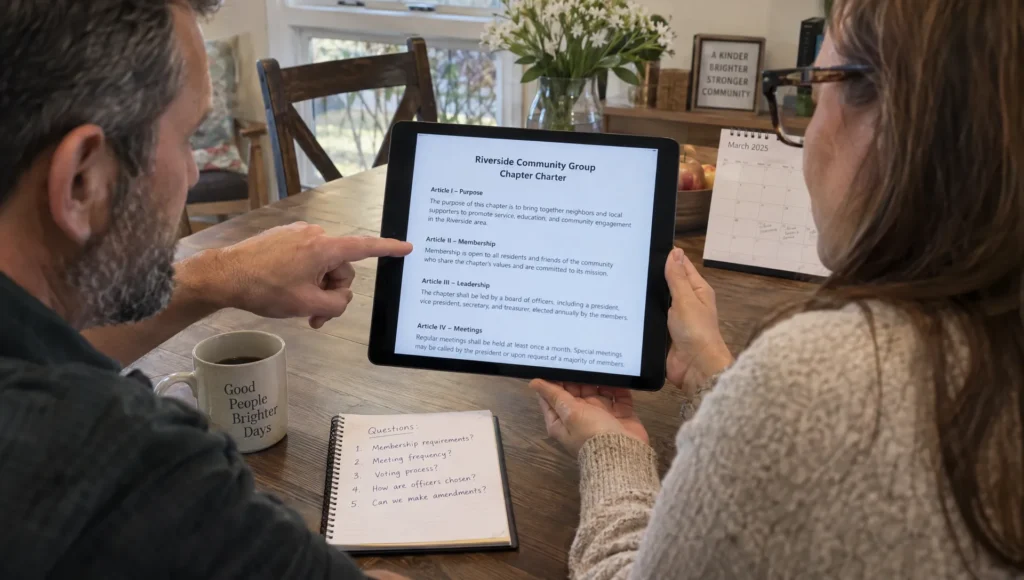
Local democracy is built (or broken) in everyday places: city council meetings, school boards, neighborhood associations, mutual aid groups, parent groups, tenant unions, and local issue coalitions. When people say “politics doesn’t listen,” they are often reacting to a simple pattern: input gets collected, but decisions feel disconnected, and follow-through is hard to see.
This playbook is designed for local communities that want repeatable civic engagement, not one-off activism. It aligns with the vision in JustSocial’s manifesto, which argues that industrial-era institutions are no longer fit for today’s complexity and that democracy must become continuous, auditable, and education-linked, not occasional and opaque. You can read the full manifesto here: The Face of Democracy.
1) Define the decision you are trying to influence (and who can actually decide)
Many community efforts stall because they start with passion but not a clear decision target. Before you recruit volunteers or pick tools, write a one-paragraph “decision brief” that answers:
- What is the decision? (Policy change, budget allocation, zoning variance, service-level standard, school curriculum, public safety practice.)
- Who has authority? (Council vote, agency director, school board, mayor, committee chair, landlord, NGO board.)
- What is the timeline? (Hearing date, budget cycle, contract renewal, election calendar.)
- What constraints exist? (Legal, financial, union agreements, procurement rules, privacy.)
This step echoes a core manifesto theme: participation only matters when it is connected to real power and accountable institutions, not just “engagement theater.”
2) Establish legitimacy: who is “the public” for this issue?
Continuous participation only works if the community agrees on a fair boundary around “who gets a say.” For local issues, this is usually geographic (residents of a district) but can be functional (parents of a school, users of a service, workers in a sector).
Write a simple eligibility statement that you publish everywhere you ask for input. For example:
- “Residents of Ward 3 aged 16+ can vote on priorities. Non-residents can submit ideas and comments.”
- “Families enrolled in the district can participate in deliberation. Final approval remains with the elected board.”
This is not about exclusion, it is about clarity, which is a prerequisite for trust.
3) Build a small “people’s branch” team (even if you are not the government)
JustSocial’s manifesto proposes a reimagined structure that includes a people’s branch and an academia branch, ideas that map surprisingly well to local organizing. Even without formal authority, you can mirror the functions these branches provide: representation, evidence, oversight, and learning.
Start with a core team of 5 to 12 people and define roles that prevent burnout and reduce accusations of bias.
| Role | What they do | Why it matters for trust |
| Facilitator lead | Runs meetings, protects speaking balance | Reduces domination and keeps sessions productive |
| Community outreach lead | Recruits participants, partners with local orgs | Improves inclusion beyond the “usual suspects” |
| Evidence lead | Collects data, brings expert input, summarizes tradeoffs | Prevents misinformation and improves decision quality |
| Transparency lead | Publishes notes, decision logs, and status updates | Makes participation auditable and reduces suspicion |
| Safety and moderation lead | Handles conduct issues and escalation | Protects psychological safety and prevents capture |
If you can add one more function, add “learning.” That can be as simple as a short civic literacy primer at the start of each meeting, reflecting the manifesto’s insistence that democratic renewal and educational reform are linked.
4) Choose the right participation promise (do not overpromise)
A common failure mode is promising “the community will decide” when the process is actually advisory. People will tolerate limits, but they will not tolerate ambiguity.
A useful reference point is the public participation spectrum from the International Association for Public Participation (IAP2), which distinguishes between informing, consulting, involving, collaborating, and empowering.
Use the table below to match your promise to a real mechanism.
| Your promise | What participants should expect | What you must publish |
| Inform | Updates, timelines, constraints | Plain-language brief, meeting notes, changelog |
| Consult | Feedback is collected and summarized | Public input summary and “what changed because of it” |
| Involve | Community helps shape options | Draft alternatives, tradeoff notes, revision history |
| Collaborate | Shared design with decision-makers | Joint working group roster, rules, decision log |
| Empower (binding) | Community vote or binding decision | Eligibility rules, audit method, implementation tracker |
In JustSocial terms, this is the difference between occasional consultation and continuous democracy infrastructure where authority, process, and evidence are explicit.
5) Run civic engagement as a loop, not an event
Local communities often hold a town hall, collect comments, and then lose momentum. Continuous direct democracy (a central theme across JustSocial writing) is built from repeatable loops that connect input to action and action back to the public.
A practical loop you can run with lightweight tools:
Intake (capture issues and proposals)
Collect input in at least two channels, one digital and one offline, to reduce the digital divide.
Good intake questions are specific:
- “What is the problem, in one sentence?”
- “Who is affected, and how?”
- “What would success look like in 6 months?”
Sensemaking (turn many voices into a few clear options)
Sensemaking is where trust is gained or lost. Publish:
- A short list of themes (5 to 10, not 50)
- Representative quotes (anonymized if needed)
- The criteria you used to group ideas (cost, legality, impact, time)
This is where the manifesto’s emphasis on transparency and civic technology matters: people accept disagreement more readily when they can see the logic.
Decision linkage (connect options to an actual decision point)
You must answer publicly:
- “What will be decided, by whom, and when?”
- “What inputs were considered mandatory vs optional?”
If a vote is involved, start with low-stakes decisions first (prioritization, not constitutional redesign). For security and trust considerations, see JustSocial’s checklist: Online Voting Platforms: Security, Privacy, Trust.
Implementation tracking (make follow-through visible)
This is the most underestimated step. Create a public tracker with:
- Milestones
- Owner (person or department)
- Status (planned, in progress, blocked, done)
- Evidence (links, photos, documents)
If you want a deeper model for this, JustSocial’s approach to auditable participation is outlined in Policy Feedback Loops.
Outcomes and iteration (what changed, what did not, and why)
Close every cycle with a “results memo” in plain language:
- “Here is what happened.”
- “Here is what we learned.”
- “Here is the next decision this feeds into.”
That final sentence is how you move from sporadic engagement to continuous engagement.

6) Design for inclusion, not just participation
More participation is not automatically better if it is skewed, easily manipulated, or unsafe. JustSocial’s manifesto repeatedly argues that modern democracy must be redesigned with safeguards, because the old model did not have to contend with today’s scale, speed, and information warfare.
At the local level, inclusion means addressing three practical barriers:
Time and convenience
Rotate meeting times, provide childcare when possible, and offer asynchronous input windows (72 hours is often the minimum for working families).
Language and accessibility
Use plain language, translate the core brief, and ensure digital artifacts meet basic accessibility expectations. In the US, public bodies often align with ADA obligations, but community groups can still adopt the spirit even when not legally required.
Safety and integrity
Publish a code of conduct and a moderation policy. The policy should include:
- What gets removed (harassment, doxxing, hate speech)
- How warnings work
- How appeals work
- How you handle repeat offenders
If your process affects real resources (budget, permits, benefits), raise your identity and eligibility rigor accordingly.
7) Start with one high-visibility use case: participatory budgeting or a service redesign
Local communities often ask, “Where do we start?” Start where the public can see results.
Two proven starting points:
Participatory budgeting (PB)
PB is effective because it links participation to visible outcomes, and it creates a natural annual loop. If you want an end-to-end guide for running PB with strong safeguards, see: Participatory Budgeting Online: A Practical Guide.
Service redesign (the “311 problem”)
Pick one service with chronic dissatisfaction (trash pickup, permitting, street safety, park maintenance). Run a cycle where residents:
- Define the failure modes
- Propose and rank fixes
- Track implementation publicly
This approach also aligns with the manifesto’s critique of bureaucratic opacity and its call to rebuild institutions around human needs.
8) Use transparency as a participation multiplier
Transparency is not just a moral good, it is a scaling mechanism. When people can see budgets, procurement, service performance, and decision records, they do not have to rely on rumors.
If your community works with a municipality, advocate for publishing “first datasets” that matter for accountability. JustSocial’s practical priorities are laid out in Open Government Data: What to Publish First.
Even if you are not a government, you can publish your own transparency artifacts:
- Decision brief
- Meeting notes and recordings (when appropriate)
- Donation and spending summaries
- Conflict-of-interest disclosures for core team members
This is how civic engagement becomes resilient rather than personality-driven.
9) A 30-60-90 day civic engagement plan (that avoids burnout)
The fastest path to momentum is one complete loop, end to end, with visible closure.
| Timeframe | What you do | Deliverable that builds trust |
| Days 1 to 30 | Pick one decision target, recruit core roles, publish rules | Decision brief + eligibility statement + code of conduct |
| Days 31 to 60 | Run intake and sensemaking, publish themes and options | Public input summary + draft options with tradeoffs |
| Days 61 to 90 | Link to decision, run vote or recommendation, start tracker | Decision log + implementation tracker + results memo |
If you cannot publish these artifacts, reduce scope until you can.
10) Measure civic engagement like infrastructure (not vibes)
If you want continuous democracy, you need continuous measurement. The point is not to gamify participation, it is to detect failure modes early (capture, exclusion, stagnation).
Here are metrics that are meaningful at the local level and are hard to fake.
| Metric | What it tells you | How to collect it |
| Participation rate by neighborhood or demographic proxy | Inclusion and reach | Voluntary survey + geographic counts |
| Repeat participation (returning contributors) | Whether trust is compounding | Compare participant lists across cycles |
| Time-to-response (from intake to published summary) | Operational credibility | Timestamp inputs and outputs |
| Decision linkage rate | Whether input touches real decisions | Track how many cycles reach a formal decision point |
| Implementation follow-through | Whether wins become reality | Public tracker with milestones |
This “auditability mindset” is central to JustSocial’s manifesto and to the broader claim that democracy needs new operating systems, not just better speeches.
Where JustSocial fits (and how to plug in)
JustSocial is building technology-driven tools for continuous direct democracy, including participation and decision-support concepts referenced across its work (for example TakeAction!, rParliament, and rConsensus). At the community level, the most valuable takeaway is not any single tool, it is the design philosophy:
- Participation should be continuous, not episodic
- Deliberation should be structured, not chaotic
- Decisions should be linked and traceable, not vague
- Oversight should be public, not internal
- Civic learning should be embedded, not optional
If you want the full institutional vision behind these ideas, start with The Face of Democracy. If you want to explore practical implementations in cities, see Digital Democracy Tools: What Cities Actually Use.

The core idea: make civic engagement boring in the best way
Healthy communities do not rely on rare moments of outrage. They rely on routines that convert attention into decisions, and decisions into visible outcomes. That is the practical interpretation of the manifesto’s call for continuous direct democracy: democracy that functions like infrastructure.
If your community adopts just one habit from this playbook, make it this: never collect public input without publishing the decision linkage and the implementation tracker. That single change turns engagement from a performance into a system.