A political movement becomes durable when it stops asking only, “How do we win attention?” and starts asking, “What public capacity are we building?”
Campaigns can gather crowds, slogans can travel fast, and outrage can briefly unite strangers. But civic infrastructure is what remains after the rally, the election cycle, or the viral post. It is the shared system of habits, spaces, records, tools, and responsibilities that allows people to participate in public life continuously, not only when a crisis becomes impossible to ignore.
For a movement committed to democratic reform, this distinction matters. If citizens are treated as spectators between elections, civic participation becomes episodic and emotional. If citizens are given structured ways to learn, deliberate, propose, vote, monitor, and revise, participation becomes part of ordinary life. That is the deeper promise behind JustSocial’s vision of continuous direct democracy, which is developed in the JustSocial manifesto: people should not be reduced to voters, taxpayers, and consumers. They should be able to function as ongoing participants in the state and their communities.
What civic infrastructure actually means
Civic infrastructure is not just technology. It is also not just “community.” It is the operating system that helps a society make public decisions more openly, intelligently, and legitimately.
A political movement builds civic infrastructure when it creates repeatable ways for people to:
- Understand public issues without relying only on campaign messaging.
- Speak in ways that can be heard, organized, and answered.
- Deliberate with others across disagreement.
- Convert public input into proposals, priorities, and institutional pressure.
- Track whether leaders, agencies, and movement organizers acted on what was promised.
In other words, civic infrastructure turns civic participation from a mood into a method.
This is especially important for movements that care about deliberative democracy and discursive democracy. Discursive democracy emphasizes public reasoning, open argument, and the circulation of ideas. Deliberative democracy goes further by creating structured conditions where people can weigh evidence, hear competing views, revise opinions, and form considered judgments.
A movement needs both. Without discourse, deliberation becomes controlled by a few organizers. Without deliberation, discourse can collapse into noise, performance, and polarization.
Why political movements fail without infrastructure
Many political movements begin with a legitimate grievance. People recognize that something is broken: representation feels distant, public institutions feel slow, money distorts political priorities, or citizens feel unheard. But grievance alone cannot carry a movement for long.
Without civic infrastructure, movements often face predictable problems:
- They depend too heavily on charismatic leaders.
- Their supporters do not know what to do between major events.
- Internal decisions become opaque or personality-driven.
- New participants are welcomed emotionally but not given meaningful roles.
- Public energy is captured by elections, media cycles, or factional conflict.
This is why infrastructure must be built early. A movement that only scales attention may become large before it becomes capable. A movement that builds civic capacity first can absorb growth without losing its democratic character. JustSocial has explored this principle in its argument that a political movement should build before it scales, but the deeper point is cultural: the movement must become a place where citizens practice the democracy they want the state to adopt.
The manifesto’s image of the Polis is helpful here. In the Greek Polis, political life was not an occasional transaction. It was part of belonging. Modern nation-states cannot copy the ancient city-state, and they should not romanticize its exclusions. But they can learn from the intensity of civic membership. Technology, if designed responsibly, gives modern societies a chance to recover some of that immediacy at scale.
The five layers of civic infrastructure
A political movement can build civic infrastructure by developing five connected layers. These layers can start small, even locally, and mature over time.
| Layer | Purpose | What it produces |
|---|---|---|
| Participation layer | Gives people clear ways to contribute | Roles, meetings, surveys, petitions, volunteer pathways |
| Discursive layer | Makes public reasoning visible | Issue briefs, argument maps, public comments, debate records |
| Deliberative layer | Helps people form considered judgment | Citizens’ panels, assemblies, moderated forums, consensus reports |
| Decision layer | Connects input to action | Proposals, votes, priorities, mandates, campaign demands |
| Accountability layer | Shows what happened afterward | Public dashboards, minutes, response logs, promise trackers |
A movement does not need to perfect all five at once. But it should understand that each layer solves a different democratic problem. Participation without discourse can become shallow. Discourse without deliberation can become chaotic. Deliberation without decisions can become symbolic. Decisions without accountability can become manipulation.
Start with a participation promise
Every political movement should make a participation promise before it asks people to join.
A participation promise answers a simple question: “If I give this movement my time, voice, or trust, what can I actually influence?”
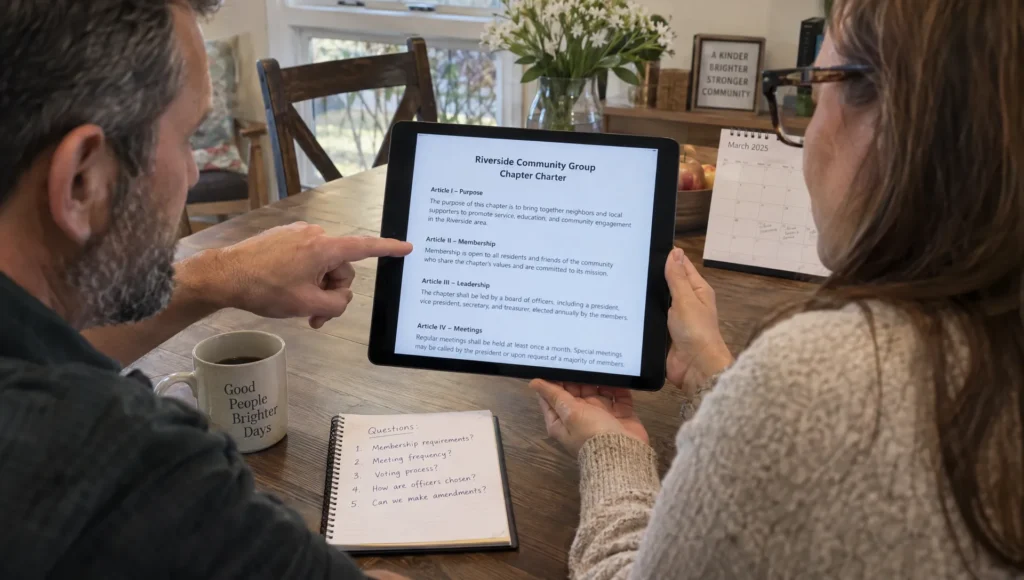
This promise should be specific. It is not enough to say, “We listen to the people.” Movements should explain how listening works. Can members propose agenda items? Can local chapters vote on priorities? Can supporters review draft policy positions? Are minority views recorded? Are leaders required to respond publicly to recurring concerns?
The promise should also be honest. Not every participant can decide everything. A democratic movement still needs coordination, expertise, legal responsibility, and strategic discipline. But it can clearly distinguish between consultation, deliberation, voting, delegation, and execution.
For example, a movement might define three kinds of participation:
- Open input, where anyone can submit concerns, ideas, or evidence.
- Structured deliberation, where selected or self-organized groups examine tradeoffs and produce recommendations.
- Binding internal decisions, where members vote on defined movement priorities or governance rules.
This clarity prevents disappointment. It also protects the movement from the common habit of using participation as decoration.
Build a discursive commons
A discursive commons is a shared public space where the movement’s reasoning is visible. It is where people can see not only what the movement believes, but why it believes it, what objections exist, and what evidence is being considered.
Most political communication is optimized for persuasion. Civic infrastructure requires communication optimized for understanding.
That means publishing issue pages, summaries, public meeting notes, recorded debates when appropriate, and accessible explanations of competing positions. It also means treating disagreement as civic material rather than as a branding problem.
This is where discursive democracy becomes practical. A movement should not only collect opinions. It should organize public reasoning so that citizens can build on one another’s contributions. A serious discursive layer might include argument maps, frequently updated issue briefs, and public records showing how an idea moved from comment to proposal.
The manifesto’s proposed tools, such as public records of parliamentary committees, social participation around public issues, and repositories of laws, point in this direction. The common thread is visibility. Citizens cannot participate meaningfully in systems they cannot inspect.
Create deliberative spaces, not just debate spaces
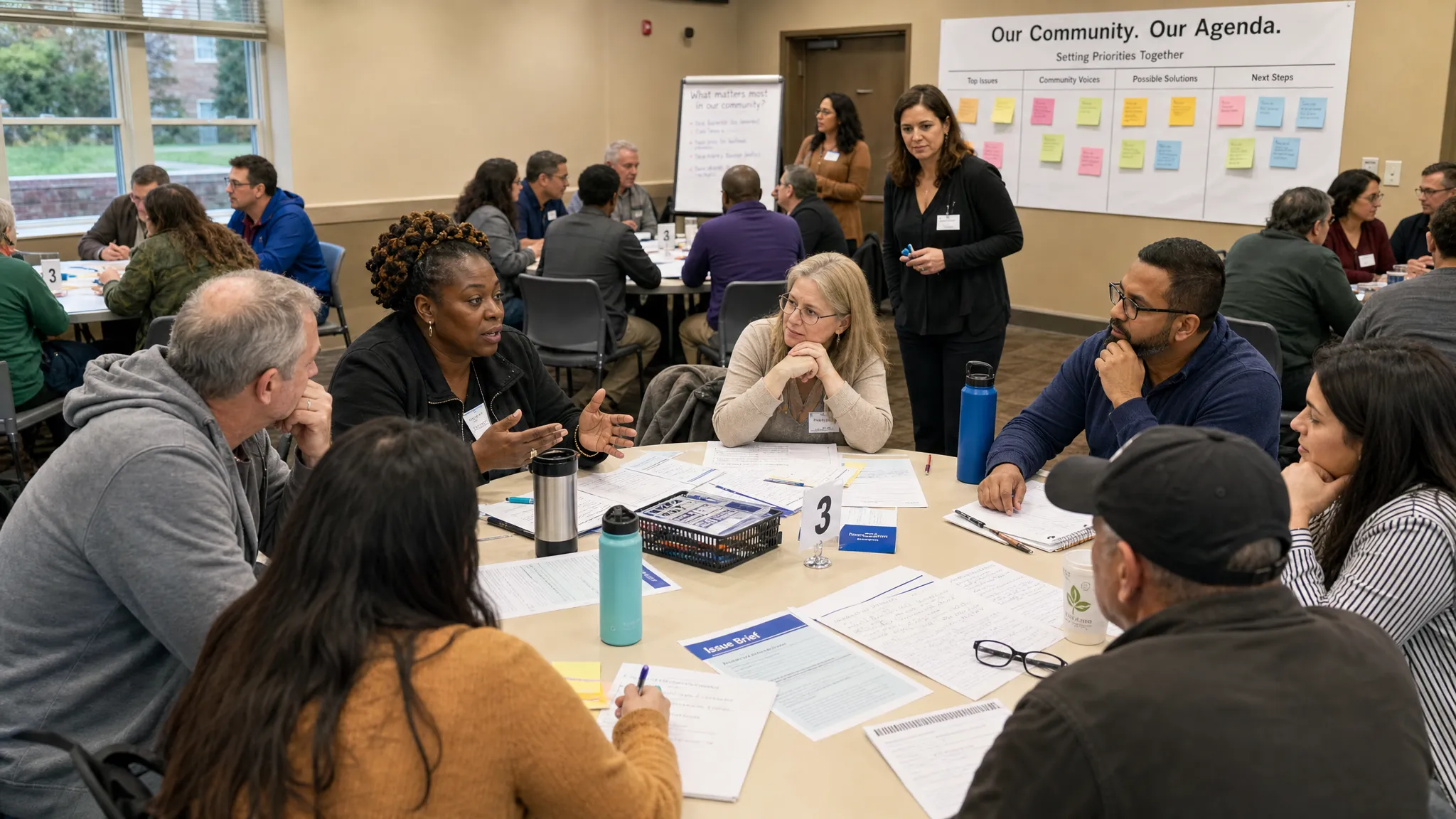
Debate rewards quickness, confidence, and rhetorical skill. Deliberation rewards listening, evidence, reflection, and revision. A political movement that wants to build civic infrastructure must know the difference.
Deliberative democracy has gained serious institutional attention in recent years. The OECD’s work on innovative citizen participation and deliberative processes documents how citizens’ assemblies, panels, and juries have been used across public institutions to address complex policy questions. The lesson is not that every movement must copy a formal citizens’ assembly. The lesson is that better participation requires better conditions.
A deliberative space should give participants:
- A clear question to answer.
- Balanced briefing materials.
- Time to hear from different perspectives.
- Facilitation that protects minority voices.
- A method for recording areas of agreement and disagreement.
- A public explanation of how recommendations will be used.
This matters because raw opinion is not the same as considered judgment. People often change their minds when they hear evidence, encounter lived experience, and face real tradeoffs. A movement that respects citizens should not flatter every first reaction. It should create conditions where citizens can think together.
Connect civic participation to real decisions
Many participation projects fail because people speak into systems that do not respond. The result is worse than silence. It teaches citizens that engagement is a performance staged by institutions that have already decided.
A political movement can avoid this by defining decision pathways. Every major participation process should answer:
- Who receives the input?
- What decision can it affect?
- When will a response be published?
- What happens if leaders reject the recommendation?
- How can participants challenge or revise the process?
This is where civic infrastructure becomes power infrastructure. A movement is not only hosting conversations. It is creating pressure, legitimacy, and public memory.
For example, a local housing group might gather resident testimony, produce an issue brief, run a deliberative forum, vote on three policy demands, present them to city officials, and track every official response. Even if the city refuses, the movement now has a public record, a trained participant base, and a clearer mandate for future action.
That is very different from simply posting “housing is broken” online.
Treat technology as a civic tool, not a substitute for politics
Digital tools can make civic participation easier to access, but they cannot replace trust, judgment, and public responsibility.
The JustSocial manifesto is explicitly technological in its imagination. It discusses social platforms, analytics, cloud storage, AI language models, blockchain possibilities, public records, and voting tools. But its strongest argument is not “use more technology.” It is that modern technology should help citizens become more meaningfully connected to public policy, public institutions, and one another.
That distinction is essential.
A political movement should use technology to reduce friction, widen access, preserve records, and make participation easier to understand. But it should not pretend that an online voting platform automatically creates democracy. A vote without deliberation can be impulsive. A platform without transparency can be captured. Analytics without rights can become surveillance. AI without public standards can amplify bias or obscure responsibility.
The right question is not, “Can this tool collect input?” The right question is, “Does this tool strengthen public agency while protecting dignity, privacy, and accountability?”
Movements interested in experimenting responsibly can begin with small, bounded projects. JustSocial has written separately about how a movement can build civic tech pilots before claiming large-scale transformation. That approach is important because democratic tools must earn trust through use, correction, and public scrutiny.
Build roles, not just audiences
A movement audience watches. A movement membership works. Civic infrastructure depends on roles because people need to know how they can contribute beyond agreement.
Some roles will be visible, such as facilitators, local organizers, spokespeople, and policy writers. Others are quieter but equally important: note-takers, translators, accessibility reviewers, community researchers, volunteer coordinators, data stewards, and conflict mediators.
The goal is to make participation ordinary. A person should be able to enter the movement with one free hour per month and still do something useful. Another person with ten hours per week should be able to take on deeper responsibility without needing personal access to leadership.
This is also how movements resist leader dependency. Charisma can inspire people to enter. Infrastructure gives them a way to stay.
Make public accountability part of the culture
Civic infrastructure fails if it cannot remember.
Movements often make promises in moments of urgency, then lose track of them. Leaders change. Volunteers burn out. Documents disappear into private folders. Decisions are remembered differently by different factions. Over time, mistrust grows.
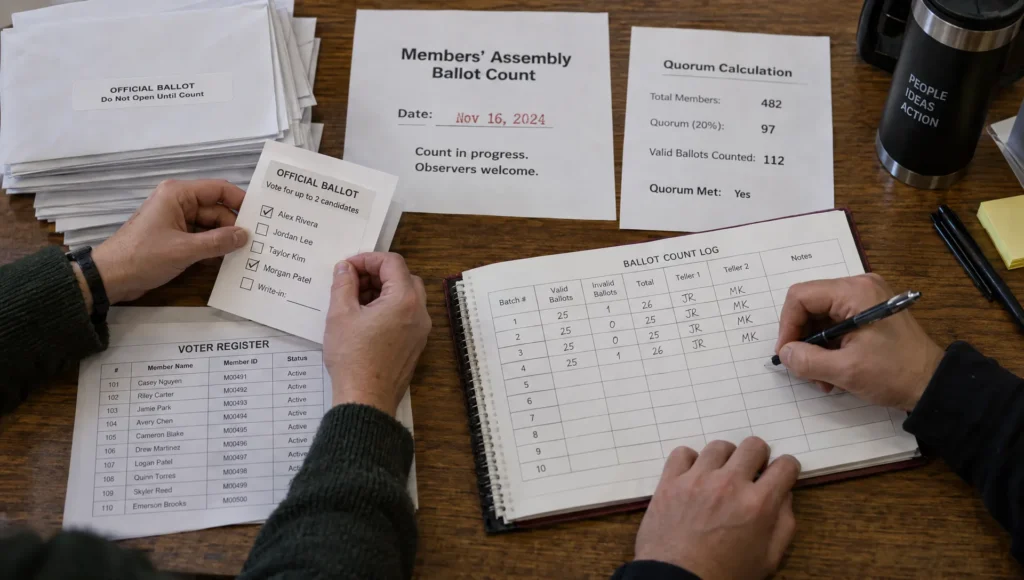
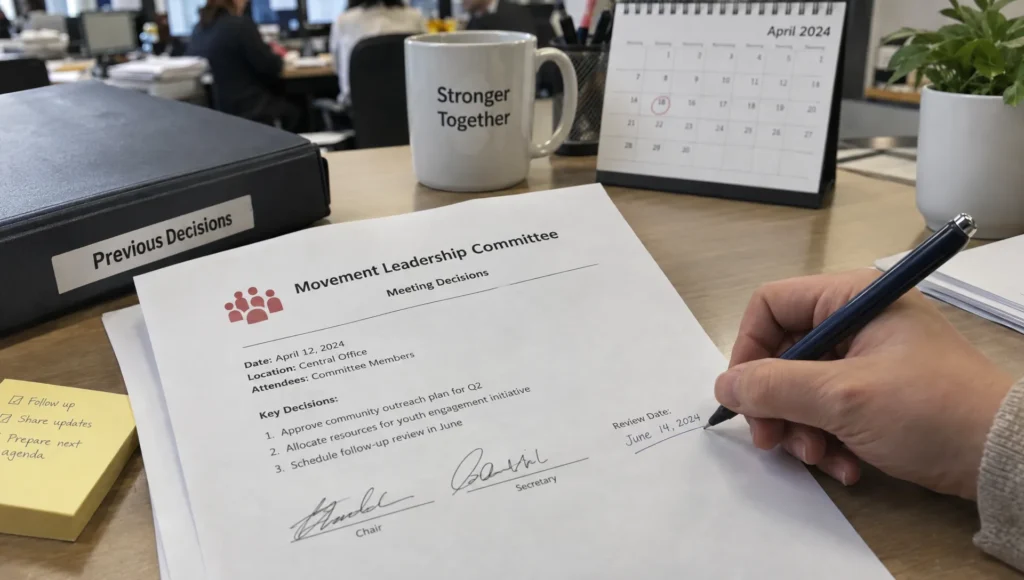
A movement that wants to model democratic reform should maintain a public accountability layer. This does not require a complicated system at first. It can begin with a public record of decisions, meeting summaries, open questions, commitments, deadlines, and responsible teams.
The key is consistency. Citizens should be able to see the life cycle of an issue:
| Stage | Public question | Accountability record |
|---|---|---|
| Input | What are people saying? | Submissions, themes, testimony summaries |
| Deliberation | What tradeoffs were considered? | Briefings, notes, minority reports |
| Decision | What did the movement choose? | Vote results, rationale, decision memo |
| Action | What was done? | Task owners, timelines, public updates |
| Review | Did it work? | Outcomes, participant feedback, revisions |
This kind of recordkeeping may seem administrative, but it is profoundly political. It tells people that their participation enters public memory. It also makes manipulation harder.
Educate for participation
The manifesto links democratic reform with educational reform for a reason. A society cannot expect citizens to participate wisely if it trains them for passivity. Civic participation is not only a right. It is a learned capacity.
A political movement can contribute to civic education without waiting for national curriculum reform. It can teach people how budgets work, how local government decisions are made, how to read a bill, how to evaluate evidence, how to deliberate across disagreement, and how to organize a public meeting.
This educational function should not be condescending. The point is not that “the people are ignorant” and must be managed by experts. The point is that public systems are often made unnecessarily difficult to understand. Civic education gives people the tools to enter those systems with confidence.
Academia, civil society, technologists, teachers, and local practitioners can all help. In JustSocial’s broader vision, academia becomes a more formal democratic branch that helps hold public life to higher standards of knowledge. Even before such institutional reforms exist, movements can practice the principle by grounding their claims in research, inviting expert review, and making learning materials public.
Protect against capture
Every civic infrastructure project creates power. If a movement builds forums, databases, voting systems, public records, and leadership pathways, those systems can be captured by insiders, donors, factions, or loud minorities.
So safeguards must be designed early.
A movement should define conflict-of-interest rules, data protection standards, moderation principles, transparent funding practices, and appeal mechanisms. It should also protect pluralism inside the movement. Civic infrastructure should not become a machine for manufacturing false consensus.
This is particularly important in digital democracy. If participation data is collected, citizens must know what is collected, why it is collected, who can access it, and how it can be deleted or challenged. If identity is used to verify participation, privacy and security cannot be afterthoughts. If anonymity is allowed, the movement must still protect against manipulation, harassment, and artificial amplification.
Democracy requires trust, but trust is not a slogan. It is the result of inspectable systems.
Start small enough to be real
The most practical way for a political movement to build civic infrastructure is to start with one community, one issue, and one repeatable process.
Choose an issue people already care about. Create a public briefing. Invite testimony. Host a moderated deliberation. Produce recommendations. Let participants vote on priorities. Deliver the result to the relevant institution. Publish the response. Review what worked. Repeat.
That cycle is simple, but it contains the DNA of a larger democratic culture.
Over time, the movement can add better tools, more communities, stronger facilitation, formal partnerships, and deeper policy capacity. But the first goal is not scale. The first goal is proof that participation can become structured, respectful, visible, and consequential.
That is how a movement begins to build the road toward what the manifesto calls the Cosmopolis: a public culture where people are not merely governed, but continuously involved in shaping the systems that govern them.
Frequently Asked Questions
What is civic infrastructure in a political movement? Civic infrastructure is the set of processes, roles, records, tools, and public habits that allow people to participate in collective decision-making over time. It includes meetings, deliberative forums, voting processes, public archives, accountability systems, and civic education.
How is civic infrastructure different from campaign infrastructure? Campaign infrastructure is usually built to win attention, votes, donations, or elections within a limited time frame. Civic infrastructure is built to sustain public participation, deliberation, transparency, and accountability beyond any single campaign.
Why does deliberative democracy matter for a political movement? Deliberative democracy helps people move beyond instant opinion by giving them time, information, facilitation, and exposure to different perspectives. This makes movement decisions more legitimate and often more thoughtful.
What role does discursive democracy play? Discursive democracy makes public reasoning visible. It allows citizens to see arguments, evidence, disagreements, and evolving ideas rather than only final slogans or leadership decisions.
Can technology build civic infrastructure by itself? No. Technology can support civic infrastructure by widening access, organizing input, and preserving transparency, but it cannot replace trust, facilitation, education, privacy protections, or political judgment.
Help build the next layer of democracy
A political movement can protest what is broken, but it must also prototype what comes next. Civic infrastructure is how democratic reform becomes practical: people learn together, deliberate together, decide together, and hold power accountable together.
JustSocial exists to advance that shift toward continuous direct democracy, civic participation, and transparent public life. If this vision speaks to you, explore JustSocial.io, read the manifesto, share the ideas, volunteer your skills, or help build local initiatives that make participation part of everyday democracy.