Public hearings are supposed to be one of the most direct meeting points between government and the people. A council proposes a zoning change, an agency presents a transit plan, a school board debates a curriculum shift, and citizens are invited to speak. In theory, this is civic participation at work.
In practice, many hearings feel like a ritual. Residents wait for hours, get two minutes at a microphone, watch officials nod politely, then leave without knowing whether anything they said mattered. The record may be technically public, but it is not always usable. The decision may be technically lawful, but not always explainable.
Discursive democracy offers a way to repair that gap. It does not simply ask whether people were allowed to speak. It asks whether public speech became part of a visible chain of reasoning, evidence, disagreement, official response, and final decision.
That shift can turn public hearings from symbolic comment sessions into real democratic infrastructure.
What discursive democracy means in a public hearing
Discursive democracy is the idea that democratic legitimacy depends on the quality, openness, and accountability of public discourse. A decision is not democratic merely because officials held a meeting. It becomes more democratic when the affected public can see the reasons behind a proposal, challenge those reasons, introduce lived experience and evidence, and receive a meaningful response.
This overlaps with deliberative democracy, but the emphasis is slightly different. Deliberative democracy often focuses on structured discussion that helps a group weigh options and reach a considered judgment. Discursive democracy focuses on the broader public conversation around power, including how claims are recorded, categorized, answered, remembered, and connected to institutional action.
In a public hearing, that distinction matters. A hearing does not always have enough time to become a full deliberative process. But it can become discursive if it creates a public record that is intelligible, fair, and consequential.
| Model | What usually happens | What discursive democracy adds |
|---|---|---|
| Traditional hearing | Citizens speak, officials listen, comments enter the record | Testimony is organized into claims, evidence, affected groups, and response obligations |
| Deliberative process | Participants discuss tradeoffs and may produce recommendations | Useful for deeper policy design, especially with smaller representative groups |
| Discursive hearing | Public speech becomes part of a transparent reasoning system | Every major concern can be traced from statement to synthesis to official answer |
For JustSocial, this connects directly to the movement’s larger argument that citizens should not be reduced to voters, taxpayers, and consumers. The JustSocial manifesto imagines a more continuous form of democracy in which people can weigh in throughout the life of public policy, not only every few years at the ballot box.
Public hearings are a natural place to begin building that culture.
Why many public hearings fail the people who attend them
Most public hearings were designed for a slower political age. They assume that participation means physical attendance, a microphone, a written comment, and a transcript. Those tools still matter, but they are no longer enough.
A hearing can fail even when every legal box is checked. It fails when the decision was effectively made before the public was invited. It fails when the documents are too technical for ordinary residents to understand. It fails when officials hear fifty versions of the same concern but never explain how that concern was weighed. It fails when powerful organizations submit polished reports while working people have to compress their experience into a rushed statement after a long day.
The result is a familiar civic frustration: people speak, but the system does not appear to listen.
This is not only a communication problem. It is a legitimacy problem. When citizens cannot see how their input travels through the decision-making process, public hearings begin to look like theater. Over time, that perception feeds distrust, apathy, and anger.
Discursive democracy improves public hearings by making the path of influence visible. It does not guarantee that every speaker gets the outcome they want. It does require institutions to show how public reasoning affected, challenged, or failed to change the final decision.
Before the hearing: publish the real decision frame
The most important part of a public hearing often happens before anyone speaks. If the public does not know what is actually open for debate, testimony becomes scattered and frustrating.
A discursive hearing starts with a clear decision frame. Officials should publish, in plain language, the decision being considered, the options still available, the constraints that cannot be changed, the evidence already being used, and the timeline for action.
That frame should answer basic questions:
- What decision will be made, and by whom?
- Which parts of the proposal are still open to change?
- What evidence is the institution already relying on?
- What kinds of public input are most useful at this stage?
- How will the public receive a response after the hearing?
This makes participation more honest. If a city has already secured funding for a road project but has not finalized the route, the hearing should say so. If a school board must comply with state law but can choose implementation details, that should be clear. If an agency is genuinely choosing between alternatives, the alternatives should be easy to compare.
Without a decision frame, hearings reward insiders who already understand the process. With a decision frame, more people can participate effectively.
During the hearing: turn speech into public reasoning
A public hearing should not be treated as an open mic where comments disappear into a transcript. It should be treated as a civic reasoning session.
That does not mean officials should interrupt every speaker or over-moderate emotion out of the room. Anger, grief, fear, and frustration are often legitimate democratic signals. But discursive democracy asks the institution to translate public speech into a usable record without stripping away its meaning.
For example, a resident might say: “This transit change will hurt elderly people in my neighborhood because the new stop is too far from the clinic.” In a traditional hearing, that becomes one comment among many. In a discursive hearing, it becomes a claim that can be categorized and answered:
| Testimony element | Example from the speaker | How it should be recorded |
|---|---|---|
| Affected group | Elderly residents | Equity and accessibility impact |
| Policy concern | New stop location | Route design and service access |
| Evidence type | Local lived experience | Needs verification with mobility and clinic access data |
| Required response | Explain whether the stop can be moved or supplemented | Agency response before final approval |
This kind of structure does not make the hearing less human. It makes the human testimony harder to ignore.
There is also a practical lesson here: public hearings are events, and events need design. Room layout, timing, queue management, translation, childcare, audio quality, and visual clarity all shape who can participate. Civic institutions can learn from the discipline of large-scale event production, where the success of a gathering depends on planning the audience experience, not merely opening the doors.
The same principle applies to democracy. If the format excludes people, the outcome cannot fully represent them.
After the hearing: create public receipts
The weakest part of most public hearings is what happens afterward. Citizens leave, officials deliberate, and the final decision appears days or weeks later. The missing piece is a public explanation of how the testimony was processed.
Discursive democracy requires a response layer. After the hearing, the institution should publish a synthesis that groups major public claims, identifies areas of agreement and disagreement, links claims to evidence, and explains what changed or did not change.
This is where the idea of public receipts becomes essential. A public receipt is a short, traceable record showing how civic speech moved through the system. It can show that a concern was heard, where it was categorized, what evidence was used to evaluate it, and how officials responded.
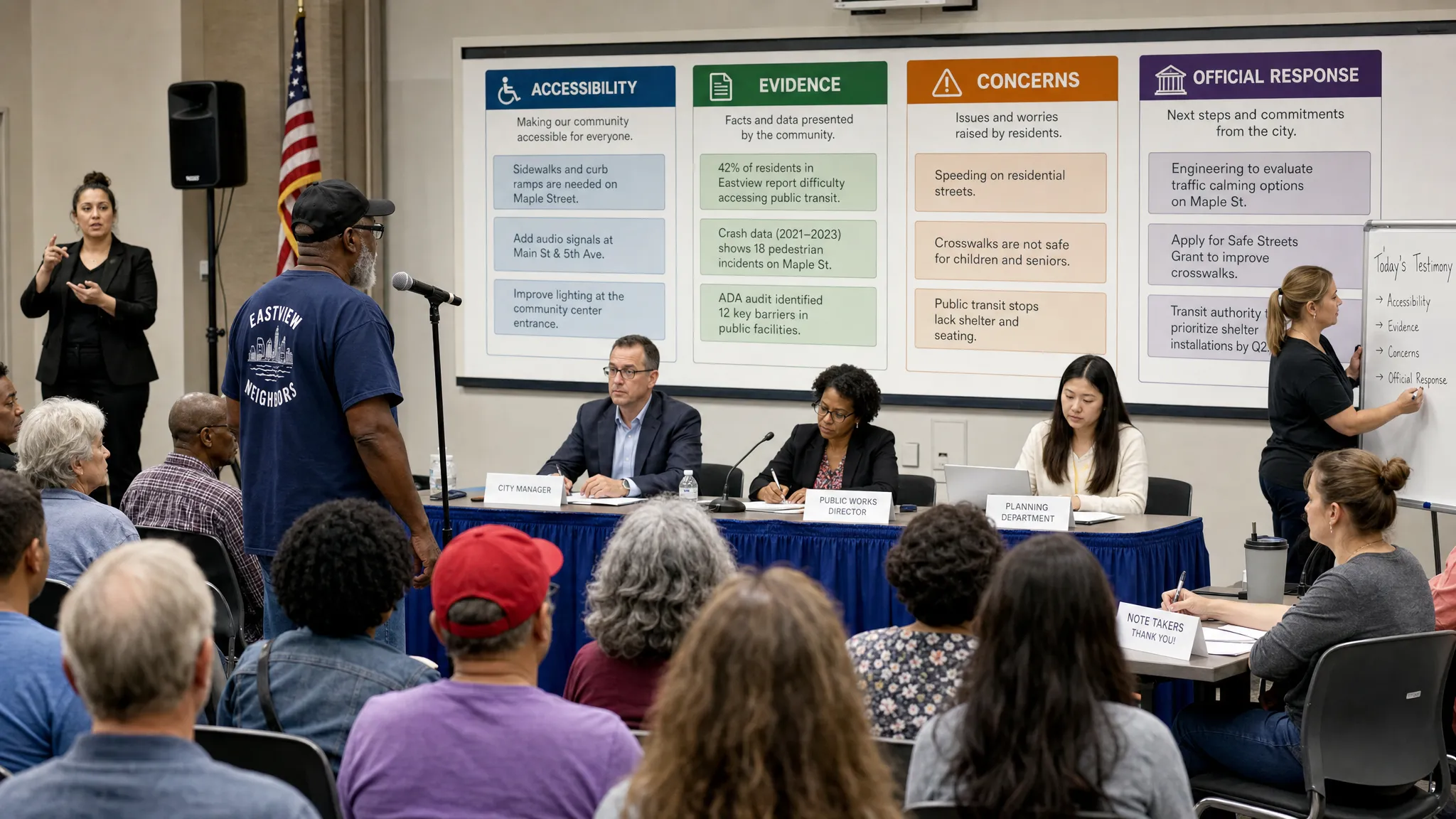
A good post-hearing record should include more than a transcript. It should include a public reasoning map.
| Hearing output | Why it matters |
|---|---|
| Summary of major claims | Prevents repeated testimony from being treated as isolated comments |
| Evidence cited by the public | Allows officials and residents to distinguish data, experience, expert opinion, and speculation |
| Points of consensus | Shows where the community broadly agrees |
| Points of disagreement | Makes tradeoffs visible rather than hidden inside final votes |
| Official response | Forces decision-makers to explain acceptance, rejection, or partial adoption |
| Implementation follow-up | Lets the public track whether promises became action |
This is not bureaucracy for its own sake. It is how trust is built when people disagree.
How discursive democracy protects minority voices
One risk in any participation process is that the loudest or largest group dominates. A hearing packed by one faction can create the impression of consensus even when quieter communities are more affected.
Discursive democracy helps by separating volume from substance. Instead of counting only how many people said something, institutions should also examine who is affected, what evidence supports the claim, and whether absent groups were meaningfully represented.
For example, if a proposed redevelopment receives majority support from citywide residents but strong opposition from tenants facing displacement, the hearing record should not flatten those positions into a simple popularity contest. It should identify the affected group, the specific harm alleged, and the mitigation options available.
This fits the deeper JustSocial view of citizen empowerment. A continuous democracy should not become mob rule. It should create better channels for public intelligence, including minority experience, expert knowledge, and local context.
Discursive democracy is not anti-representative. It asks representatives to become better listeners and more accountable explainers. In the language of the manifesto, elected officials should act less like distant rulers and more like pipelines for gathering consensus and implementing public policy.
The role of technology in better public hearings
Digital democracy can make public hearings more inclusive, but only if technology is used carefully. A livestream alone is not transformation. A comment box alone is not participation. The question is whether digital tools help the public understand, contribute, and verify the process.
Useful technology for discursive hearings might include searchable transcripts, multilingual summaries, accessible evidence libraries, identity-protected participation, online comment periods, public dashboards, and response ledgers. These tools can extend the hearing beyond the room while preserving transparency.
This is closely aligned with JustSocial’s broader vision of continuous direct democracy, where public platforms, analytics, and civic engagement tools help governments measure public opinion more precisely and respond more consistently. The point is not to replace judgment with a poll. The point is to give public judgment more structure, memory, and institutional weight.
Communities exploring this path can also benefit from broader rules for healthier public debate, especially when hearings involve conflict, misinformation, or emotionally charged issues.
Still, safeguards are essential. Any digital layer should protect privacy, explain how identity is verified, prevent manipulation, support people without reliable internet access, and make public records easy to audit. If technology becomes a black box, it will reproduce the same distrust it was meant to solve.
A practical model for a discursive public hearing
A city council, school board, agency, or community organization does not need to rebuild democracy overnight. It can start with a minimum viable discursive hearing.
The model is simple:
- Publish a plain-language decision frame before the hearing.
- Provide the evidence, options, constraints, and timeline in one accessible place.
- Let people submit comments before, during, and after the live session.
- Categorize testimony by claim, affected group, evidence type, and requested action.
- Publish a post-hearing synthesis within a fixed deadline.
- Require officials to answer major claims before the final vote.
- Track implementation promises after the decision is made.
This approach improves both sides of the hearing. Citizens arrive better prepared, and officials receive more usable input. Disagreement does not disappear, but it becomes clearer. Public anger does not vanish, but it becomes harder to dismiss as noise. Technical expertise does not dominate, but it is placed in conversation with lived experience.
That is the democratic value of discourse: it transforms isolated statements into shared civic knowledge.
What better public hearings can change
Better public hearings will not solve every democratic crisis. They will not eliminate corruption, polarization, apathy, or bad faith. But they can change the daily experience of government.
A resident who disagrees with the final decision may still feel respected if the institution clearly answered the concern. A policymaker may make a better decision after seeing patterns in public testimony that were not visible in staff reports. A journalist may report more accurately when the hearing record separates evidence from rumor. A community group may organize more effectively when it can point to official responses and unmet commitments.
Over time, this creates public memory. The next hearing does not begin from zero. Citizens can ask what happened to the last promise. Officials can show what changed. Communities can learn which arguments persuaded, which failed, and which require more evidence.
That is how public hearings become part of continuous civic participation rather than isolated moments of frustration.
Frequently Asked Questions
What is discursive democracy? Discursive democracy is a model of democracy that emphasizes open, structured, and accountable public discourse. It focuses on how claims, evidence, disagreement, and official responses shape legitimate decision-making.
How is discursive democracy different from deliberative democracy? Deliberative democracy usually focuses on discussion that helps participants weigh options and reach a recommendation or decision. Discursive democracy focuses more broadly on the public reasoning system, including how debate is recorded, answered, and remembered.
Can discursive democracy work in large public hearings? Yes, but it requires structure. Large hearings need clear decision frames, categorized testimony, accessible records, post-hearing summaries, and official response obligations so participation does not become a chaotic list of comments.
Does discursive democracy mean officials must follow public opinion? No. Officials may still make independent decisions, especially when law, rights, budgets, or expert evidence require it. But they should explain how public input was considered and why major concerns were accepted, rejected, or modified.
Build public hearings that actually listen
Public hearings should be more than a legal requirement. They should be a living bridge between citizens and the institutions that govern them.
Discursive democracy gives that bridge a stronger design: clearer questions, better records, fairer participation, visible reasoning, and public accountability after the microphones turn off.
JustSocial exists to advance that kind of political movement, one built around continuous direct democracy, citizen empowerment, digital tools, and transparent public decision-making. If we want a democracy that truly hears people, public hearings are one of the first places to begin.