Democracy does not only weaken when citizens stop voting. It also weakens when public institutions forget.
A community raises the same safety concern for ten years. A minister promises reform during a campaign, then the promise disappears into press releases and budget language. A committee hears testimony from parents, teachers, workers, and local leaders, but the reasoning behind the final decision is never made understandable to the people who spoke. The result is not simply frustration. It is civic amnesia.
Discursive democracy offers a way out. It treats public speech as more than noise, content, or sentiment. It treats civic conversation as a raw democratic resource that should be organized, preserved, answered, and learned from over time. When done well, discursive democracy can create stronger civic memory, meaning a society can remember what was argued, what evidence mattered, what disagreements remained, what officials promised, and what happened next.
For a political movement like JustSocial, this is not a side issue. The JustSocial manifesto argues that modern citizens have been reduced too often to voters, taxpayers, and consumers. Stronger civic memory is one practical way to reverse that reduction. It helps turn civic participation into a continuous relationship between people and state, rather than a brief transaction every election cycle.
What civic memory means in a democracy
Civic memory is the public capacity to remember political life in a usable way.
It is not nostalgia. It is not a museum of old speeches. It is not a folder of meeting minutes that no one can search, understand, or connect to present decisions. Civic memory is the living record of how a society thinks, argues, chooses, corrects itself, and teaches the next generation what happened.
A strong civic memory answers questions like these: Who raised an issue first? What evidence was offered? Which communities were affected? Which alternatives were rejected, and why? What did representatives say in response? What was promised? What changed after implementation? What should future citizens know before reopening the same debate?
Without that memory, democracy becomes repetitive and performative. Citizens are asked to speak again and again, but the system behaves as if it is hearing them for the first time. Public debate becomes a cycle of outrage, reaction, forgetfulness, and renewed outrage.
This is one reason social media alone cannot carry democratic life. It remembers everything technically, yet almost nothing civically. Posts remain searchable, but their relationship to evidence, institutional response, and public consequence is often weak. A feed can preserve fragments while destroying continuity.
Discursive democracy and deliberative democracy are allies
Discursive democracy is closely related to deliberative democracy, but the two are not identical.
Deliberative democracy usually refers to structured processes where citizens reason together under conditions designed for fairness, inclusion, evidence, and reflection. Citizens assemblies, deliberative polls, and participatory panels are common examples. The OECD has documented the growth of representative deliberative processes, showing that ordinary people can engage complex policy questions when given time, balanced information, and a serious process.
Discursive democracy is broader. It asks how democratic conversation happens across society, including public meetings, online forums, journalism, protests, classrooms, committees, neighborhoods, and political movements. It is concerned not only with whether people deliberate well in a formal setting, but whether public reasoning becomes visible and consequential across everyday political life.
| Democratic model | Primary focus | Best contribution to civic memory |
|---|---|---|
| Deliberative democracy | Structured citizen reasoning | Creates high-quality snapshots of public judgment on specific issues |
| Discursive democracy | Ongoing public communication | Builds a continuous record of claims, evidence, disagreement, and response |
| Representative democracy | Elections and delegated authority | Creates institutional responsibility for decisions and implementation |
| Participatory democracy | Broad citizen involvement | Expands who contributes knowledge, pressure, and lived experience |
The point is not to replace one model with another. A healthier democracy needs all of them. Deliberative democracy can create careful moments of public judgment. Discursive democracy can connect those moments to the wider civic conversation before and after they happen.
This is especially important in a world where democratic decline has become a recurring warning. Organizations such as V-Dem have tracked global autocratization trends in recent years. One lesson is clear: institutions weaken when public accountability is episodic, fragmented, or easy to manipulate. Stronger civic memory makes manipulation harder because it gives citizens and journalists a shared record to examine.
How democracies forget
Democracies forget in predictable ways.
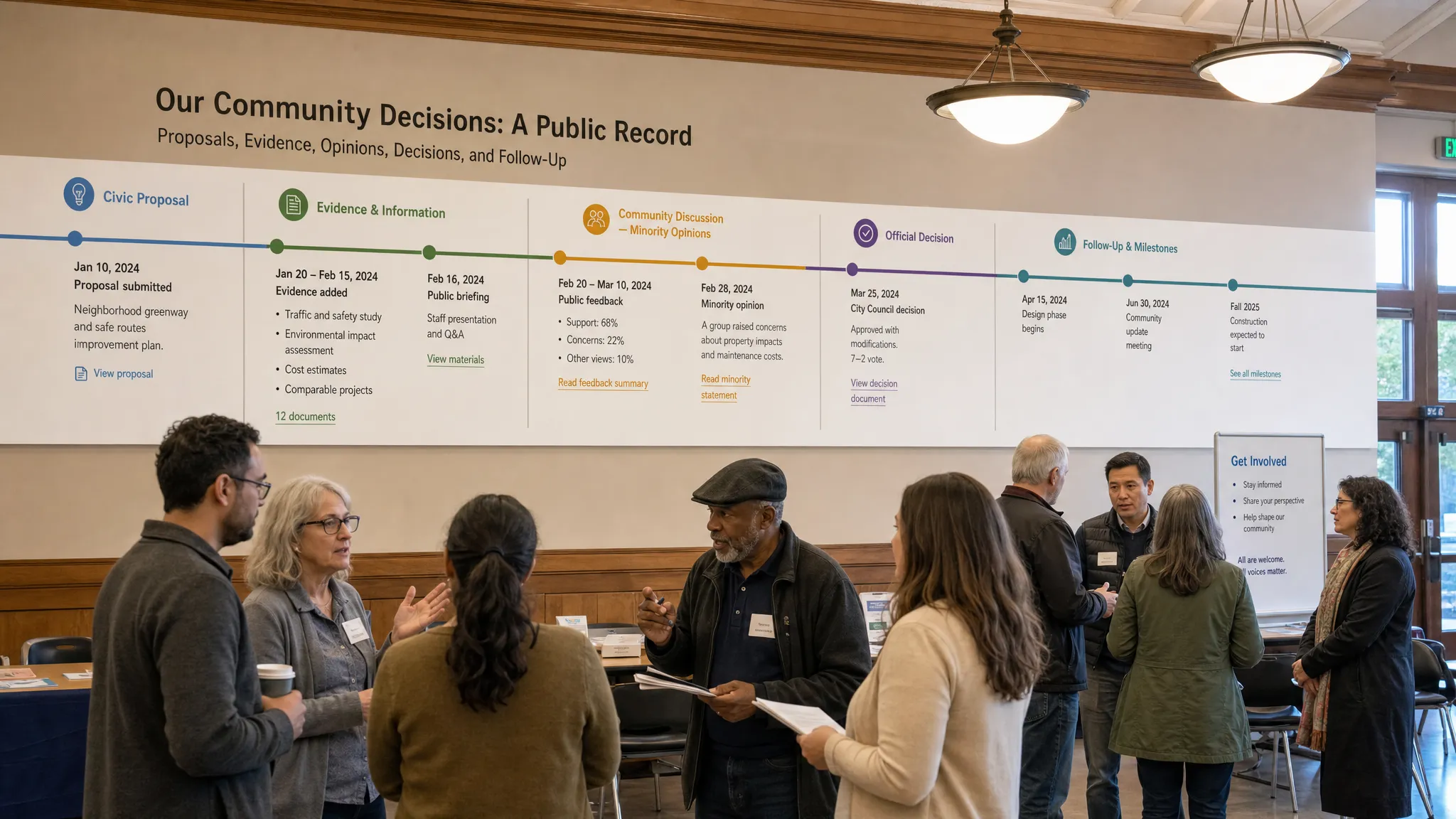
They forget when campaign promises are separated from legislative votes. They forget when public testimony is recorded but never summarized in a way ordinary citizens can use. They forget when minority concerns are treated as obstacles instead of early warnings. They forget when data is published without context, when officials answer vaguely, and when media cycles move on before institutions respond.
They also forget when each political generation is forced to rediscover old failures. A city may spend years debating housing, transportation, education, or policing without a clear public map of previous proposals, objections, studies, compromises, and outcomes. The lack of memory makes every debate easier to distort. Anyone can pretend that no alternative was offered, no evidence was available, or no promise was made.
This is why discursive democracy must do more than encourage people to speak. It must create a public structure in which speech leaves democratic traces. JustSocial has explored this idea through the concept of public receipts, which are records that connect civic input to evidence, synthesis, decisions, and follow-up.
A receipt is not the same as agreement. Citizens do not need government to obey every opinion instantly. They need institutions to show that public reasoning was heard, understood, weighed, and answered.
What stronger civic memory should preserve
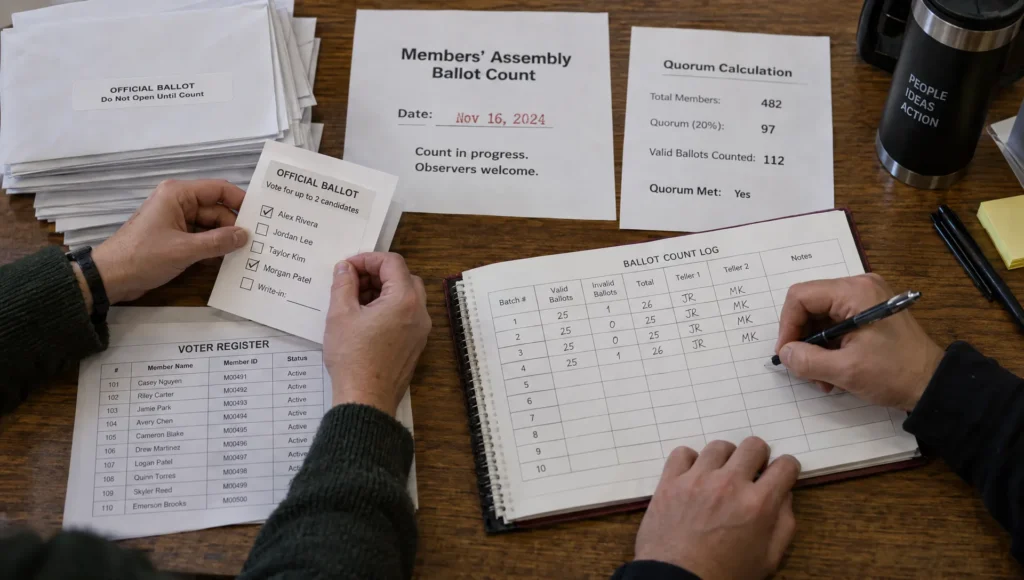
A democracy that remembers should not preserve only the final vote. Final votes matter, but they are too thin to carry the full meaning of public life. Stronger civic memory preserves the reasoning environment around a decision.
| Memory layer | What it records | Why it matters |
|---|---|---|
| Concern | The problem citizens raised | Prevents institutions from pretending an issue appeared suddenly |
| Evidence | Data, testimony, research, and lived experience | Helps separate verified claims from rumors or slogans |
| Disagreement | Major objections and minority reports | Protects pluralism and prevents false consensus |
| Response | What officials, experts, or institutions said back | Makes listening visible and accountable |
| Decision | The policy choice, vote, or administrative action | Connects public reasoning to authority |
| Implementation | What happened after the decision | Keeps democracy focused on outcomes, not announcements |
| Revision | What changed when new facts emerged | Allows society to learn without treating correction as weakness |
This kind of memory changes the emotional texture of civic participation. Citizens are more likely to participate when they believe their words will not vanish. Officials are more likely to act responsibly when their reasoning will remain connected to future evaluation. Journalists and educators can do their work better when public records are organized around questions, evidence, and consequences rather than scattered documents.
It also changes how political debate works. As JustSocial has argued in its work on smarter political debate, the goal is not to make everyone polite while nothing changes. The goal is to make disagreement productive enough that it can be remembered, tested, and carried forward.
Why this connects to the JustSocial manifesto
The JustSocial manifesto returns again and again to one central frustration: public systems still operate with industrial-era assumptions while society has entered a technological era. Schools, parliaments, bureaucracies, and party systems often move as if citizens can only be engaged occasionally, in narrow formats, and from a distance.
Civic memory challenges that assumption.
If citizens can communicate continuously, then institutions need ways to remember continuously. If public opinion can be expressed daily, then democratic systems need more than polling and election results. They need civic archives that are structured, transparent, privacy-conscious, and institutionally meaningful.
The manifesto’s vision of the Polis and the Cosmopolis is useful here. The ancient Polis felt immediate because citizens could experience political life as part of communal life. Modern nation-states cannot simply recreate that scale, but technology can help restore some of its intimacy if it is designed for public reasoning rather than manipulation.
The manifesto also proposes that the people themselves should become a distinct democratic force, with technology helping public institutions hear citizens more consistently. That idea depends on memory. Without civic memory, continuous participation becomes a flood. With civic memory, it becomes a learning system.
The same is true for the manifesto’s argument that academia should have a stronger public role. Academic institutions can help evaluate evidence, preserve standards, and produce advisories, but their contribution becomes far more powerful when connected to a public record of what citizens are actually asking, fearing, proposing, and experiencing.
Technology must support memory without becoming surveillance
A serious discursive democracy needs digital infrastructure, but not every digital tool strengthens democracy. Some tools amplify attention without accountability. Some collect data without consent. Some reward anger because anger produces engagement.
The challenge is to build democratic technology that supports civic memory while protecting citizens.
The manifesto imagines tools such as public records of parliamentary committees, community voting systems, civic action platforms, analytics for public officials and journalists, and organized repositories of law. These are not merely technical ideas. They are memory ideas. They ask whether the public can see what government is doing, connect debate to institutional action, and understand the legal and political record over time.
To serve democracy, such tools need clear principles. Identity should be handled with care. Anonymity and privacy may be essential in many contexts, especially where public speech carries social or political risk. Evidence should be traceable without exposing people unnecessarily. Algorithms should help citizens navigate public reasoning, not trap them in outrage loops. Public officials should not receive vague sentiment dashboards that flatten people into moods. They should receive structured civic knowledge that preserves context and disagreement.
This is where discursive democracy differs from simple data collection. The goal is not to harvest citizens. The goal is to empower them by making their participation durable, interpretable, and answerable.
What a political movement can do now
A political movement does not need to wait for full institutional power before building civic memory. In fact, building memory early is one way a movement proves it is serious about democratic reform.
Movements often excel at mobilizing attention. They gather people, frame demands, create symbols, organize campaigns, and pressure institutions. But attention fades quickly if it is not converted into memory. A movement that wants long-term civic participation must remember its own debates, promises, disagreements, mistakes, and lessons.
That means publishing clear records of what supporters are asking for. It means distinguishing official positions from open questions. It means preserving minority concerns inside the movement rather than hiding them for the sake of unity. It means showing how public input changed strategy. It means creating continuity between protest, policy, education, and institutional reform.
For JustSocial, this fits the deeper claim that elected officials should become better pipelines for gathering consensus and implementing public policy. A pipeline cannot work if it leaks memory. If the people are to take a more continuous role in shaping public life, the movement must model the behavior it demands from the state: listen, record, synthesize, answer, and revise.
Here are practical civic memory habits any reform movement, local community, or public institution can begin using:
| Practice | Democratic benefit |
|---|---|
| Publish issue timelines | Shows how long a concern has existed and what changed over time |
| Keep public reasoning summaries | Helps newcomers understand debates without reading every document |
| Record unresolved disagreements | Prevents unity from becoming erasure |
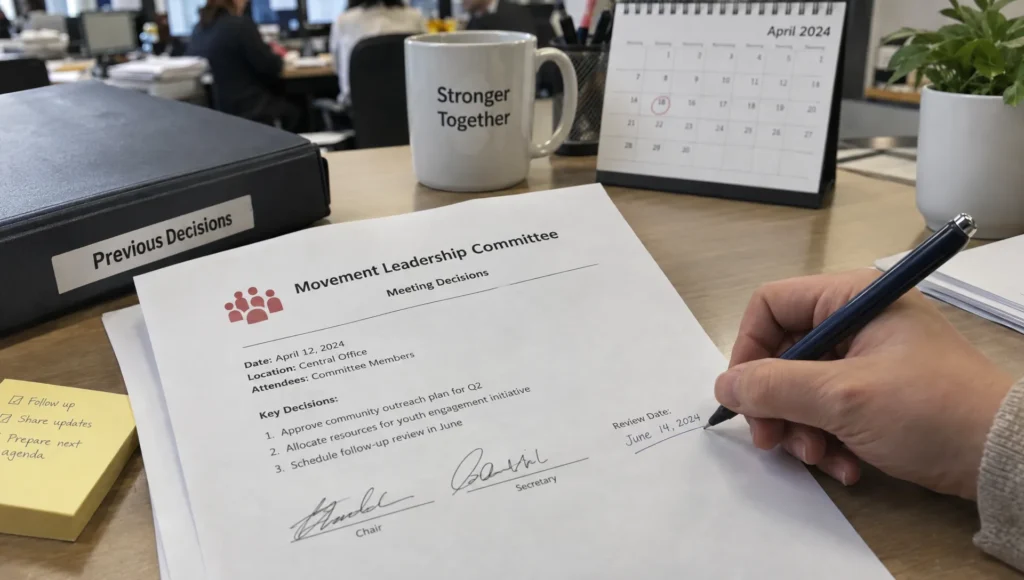
| Track promises and follow-up | Makes accountability specific rather than symbolic |
| Connect decisions to evidence | Raises the quality of future debate |
| Invite corrections publicly | Turns learning into a democratic norm |
These habits may sound simple, but they are culturally radical. They shift politics from performance to continuity. They tell citizens that participation is not a momentary shout into the void. It is part of a shared public record.
Civic memory as democratic education
Civic memory also belongs in education.
The JustSocial manifesto criticizes industrial schooling for treating students as passive recipients of state-sanctioned material rather than as developing citizens with interests, questions, and voices. A democracy with strong civic memory can help schools teach politics differently.
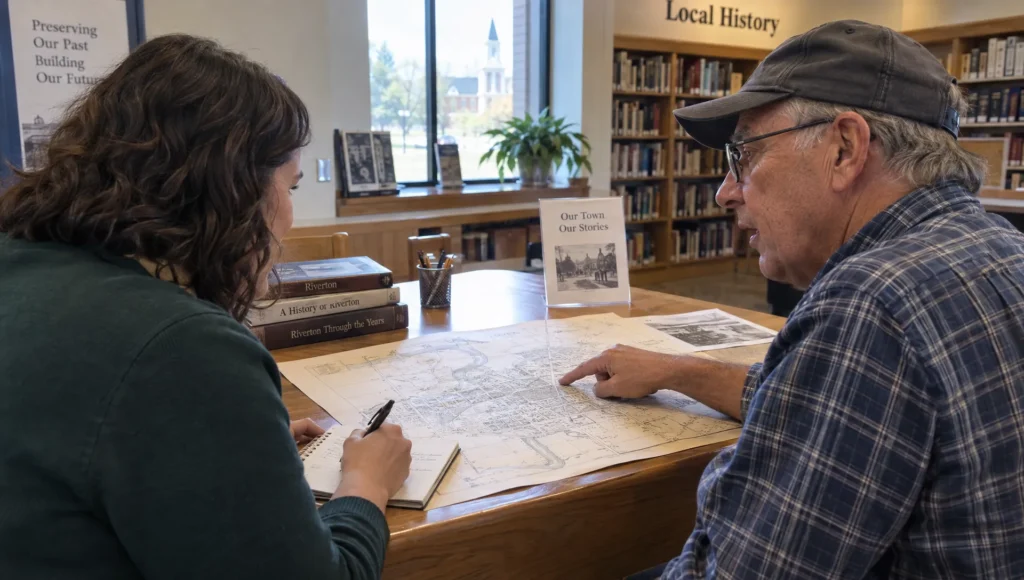
Instead of teaching democracy only as institutions and dates, schools could examine living public records: how a local issue emerged, how evidence was gathered, how different groups argued, how officials responded, and what happened afterward. Students would learn that politics is not only ideology or election drama. It is the practice of collective memory, judgment, and responsibility.
This matters because civic participation is learned by doing. If young people see that public speech can be organized and answered, they are more likely to believe that participation is worth the effort. If they see only shouting, manipulation, and forgetfulness, apathy becomes rational.
A society that remembers well educates citizens continuously. Every public issue becomes a case study in how the community reasons about itself.
Frequently Asked Questions
What is discursive democracy? Discursive democracy is a democratic approach that focuses on the quality, structure, and consequences of public conversation. It asks how civic speech can become part of public reasoning, institutional response, and long-term accountability.
How is civic memory different from an archive? An archive stores records. Civic memory makes records usable for democratic life by connecting claims, evidence, disagreements, decisions, implementation, and later corrections.
Does stronger civic memory replace elections or representatives? No. It strengthens accountability around elections and representation. Representatives still make decisions, but citizens can better see how public input was considered and whether promises were kept.
How does this relate to deliberative democracy? Deliberative democracy creates structured spaces for citizens to reason together. Discursive democracy expands that logic across everyday public life and helps preserve the reasoning before, during, and after formal deliberation.
Can digital tools build civic memory safely? They can, but only if designed with privacy, transparency, security, and public accountability in mind. Democratic technology should help citizens understand and influence institutions, not turn them into surveillance subjects.
Help build a democracy that remembers
Stronger civic memory will not appear by accident. It has to be demanded, designed, funded, protected, and practiced.
JustSocial is a political movement working toward a future where civic participation is continuous, public reasoning is taken seriously, and technology helps citizens shape society rather than merely react to it. If that vision resonates with you, explore JustSocial.io, read the manifesto, share the ideas, and consider how your own community could begin building democratic memory now.
A democracy that forgets its citizens teaches them to disappear. A democracy that remembers them teaches them to participate.