A fragmented media age does not simply mean more channels. It means different citizens can inhabit different civic worlds while living under the same laws. One person sees a policy debate as an emergency, another sees it as propaganda, and a third never sees it at all. Democracy still asks them to make collective decisions together.
Discursive democracy is a response to that break in shared reality. It treats public conversation not as background noise around politics, but as one of politics' core institutions. Citizens need spaces where claims can be tested, values can be named, trade-offs can be made visible, and public officials can be held to what people actually said, not only to what polls, protests, or party strategists claim they meant.
This is why the JustSocial manifesto argues that modern citizens should no longer be reduced to voters, taxpayers, and consumers. In a society shaped by networks, cloud platforms, and AI, civic participation can become continuous rather than episodic. The challenge is not only to let more people speak. The challenge is to make public speech legible, fair, and consequential.
What fragmentation does to the democratic mind
Media fragmentation has obvious benefits. More communities can publish, more citizens can challenge elites, and more perspectives can find an audience. The old broadcast era excluded many voices and often treated public opinion as something to be managed from above.
But fragmentation also changes the psychological conditions of democracy. When every citizen receives a different stream of facts, symbols, influencers, and emotional cues, public debate becomes harder to anchor. The problem is not disagreement. Disagreement is healthy. The problem is disagreement without shared context.
The Reuters Institute Digital News Report 2024 found that 39% of people across surveyed markets sometimes or often avoid the news, while overall trust in news remained at 40%. That combination matters. Citizens are overwhelmed by information, but often unsure which information deserves confidence.
At the same time, the Pew Research Center's social media and news fact sheet shows how social platforms have become a regular news source for many Americans. This does not mean social media is inherently anti-democratic. It means political understanding is increasingly formed in environments optimized for attention, identity, and speed.
Fragmentation weakens democracy in three ways. It fragments attention, so citizens do not know which public questions require shared focus. It fragments trust, so evidence is accepted or rejected based on group belonging. It fragments accountability, so officials can speak differently to different audiences and avoid a common record of what the public demanded.
Discursive democracy, not just louder debate
Discursive democracy asks a deeper question than who gets to vote or who wins a debate. It asks how public meaning is formed before decisions are made. It shares ground with deliberative democracy, which values reasoned discussion before collective choice, but it expands the lens.
Deliberation often imagines a structured room: citizens gather, review evidence, speak respectfully, and make a recommendation. Discourse includes the wider public sphere: news, comments, group chats, school boards, parliamentary hearings, petitions, protests, cultural narratives, and everyday speech. In a fragmented media age, both are necessary.
| Democratic model | Core question | What it contributes | What it misses if isolated |
|---|---|---|---|
| Participatory democracy | Who gets to take part? | Expands access and strengthens civic participation | Can become raw preference aggregation without reasoning |
| Deliberative democracy | How do we reason together before deciding? | Improves judgment through structured discussion | Can remain too formal, limited, or disconnected from daily life |
| Discursive democracy | How does public meaning form across society and reach institutions? | Connects everyday speech, evidence, identity, and public action | Can be captured by noise or manipulation without safeguards |
| Representative democracy | Who governs after elections? | Creates stability and legal authority | Can drift away from citizens between election cycles |
Discursive democracy matters because a citizen's position is rarely formed in one formal meeting. People change their minds through stories, arguments, evidence, trusted relationships, emotional experience, and repeated exposure to public problems. A democratic system that ignores this process will always misunderstand the people it claims to represent.
Why fragmented media requires civic architecture
Older media systems had gatekeepers, and those gatekeepers often failed. But they did provide some common reference points. Fragmented media gives society pluralism without enough common processing. Citizens can speak, but their speech often disappears into separate feeds.
Public life now needs civic architecture: shared issue pages, reason maps, transparent evidence trails, representative summaries, and official response loops. As JustSocial has argued in Discursive Democracy in the Age of Political Algorithms, recommendation systems already shape what citizens see. A democratic society should decide how these systems serve civic life instead of pretending they are neutral.
Civic architecture is not censorship. It does not mean one official truth handed down from the state. It means creating public spaces where disagreement can be organized rather than merely amplified. A good democratic space should make it easier to understand the strongest arguments on each side, the evidence behind them, the communities affected, and the decision-makers responsible.
Principles for discursive democracy in a fragmented media age
A discursive democracy suited to today's media environment needs practical principles, not only ideals.
- Shared civic context: Major public questions should begin with a common brief that explains the issue, decision timeline, legal limits, budget implications, and affected communities.
- Reason trails: Citizens should be able to attach reasons, evidence, assumptions, and lived experience to their positions, not only likes or votes.
- Plural forums with comparable outputs: Different communities should be able to discuss in their own language and style, while producing summaries that can be compared across groups.
- Protected civic identity: People should be able to identify relevant perspectives voluntarily, such as parent, student, worker, local resident, or business owner, while maintaining strong privacy protections.
- Institutional response: Public bodies should answer the strongest arguments and most common concerns, not just publish final decisions.
- Public memory: Debates should be archived so society does not restart the same argument from zero every month.
These principles turn fragmented speech into civic knowledge. They also connect to a central idea in the JustSocial vision: technology should not only help people express frustration. It should help citizens convert frustration into influence.
A political movement must do more than win the feed
In fragmented media, a political movement is often tempted to focus only on distribution. Gain followers. Trigger emotion. Win attention. Dominate the narrative. These tactics may build visibility, but they do not necessarily build democracy.
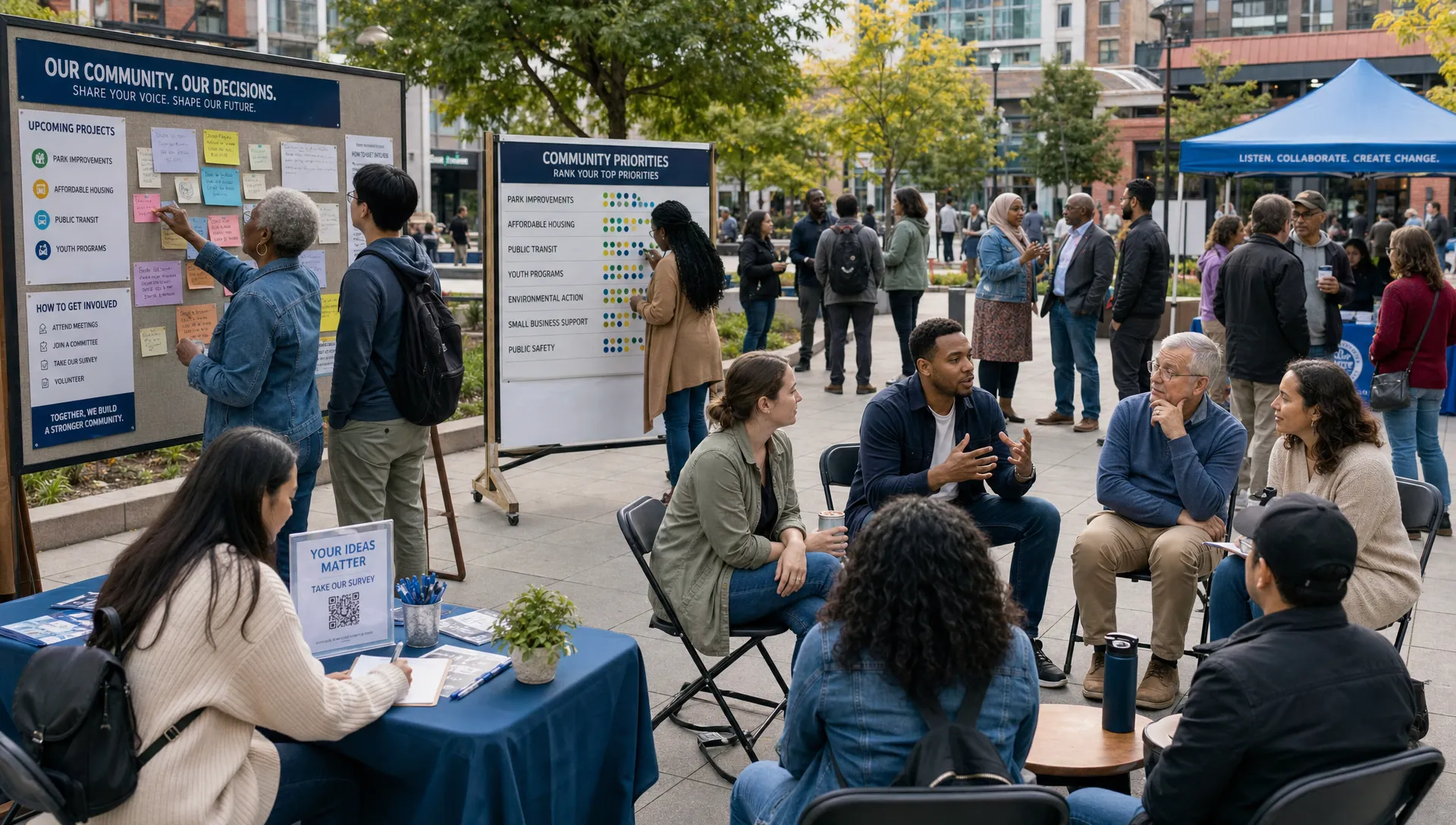
A discursive political movement has a different task. It must model the public square it wants to create. That means inviting disagreement without letting abuse take over, valuing evidence without silencing lived experience, and turning supporters into participants rather than spectators.
This is especially important for a movement like JustSocial, which is built around continuous civic participation and the idea that citizens should have more meaningful influence between elections. The movement's role is not simply to campaign for a new system. It is to demonstrate the habits such a system would require: listening, structuring disagreement, protecting minority voices, and making public reasoning visible.
A movement can begin before the state changes. It can build prototypes, publish civic briefs, host structured discussions, train volunteers, pressure parties, and ask institutions to answer public arguments in writing. Even without formal authority, it can raise the standard for what democratic engagement should look like.
Civic participation without pretending everyone has the same time
One common mistake in democratic reform is assuming every citizen will participate with the same intensity. They will not. People have families, jobs, disabilities, stress, language barriers, and different levels of political interest. A serious model of civic participation must respect unequal time and energy.
Discursive democracy can support many levels of participation. The observer follows an issue and learns the basics. The witness contributes lived experience. The challenger tests weak claims. The builder proposes alternatives. The voter weighs in when a decision point arrives. The organizer helps others participate.
All of these roles matter. A democracy that recognizes only the final vote wastes most of the public's intelligence. A democracy that recognizes only the loudest activists misreads the public. A discursive system should allow citizens to move between low-effort and high-effort participation as their lives and interests change.
This is also where moderation becomes a democratic function, not just a platform policy. People will not participate if civic spaces are humiliating, chaotic, or dominated by bad faith actors. Good rules protect the possibility of participation. They should be transparent, appealable, and focused on keeping public reasoning possible.
From scattered opinion to a public decision cycle
Discursive democracy becomes powerful when public conversation is connected to a repeatable decision cycle. The point is not endless talk. The point is better public judgment and more accountable action.
| Stage | What happens | Why it matters |
|---|---|---|
| Question framing | The public issue is stated clearly, with scope and constraints | Prevents debate from dissolving into unrelated arguments |
| Experience collection | Citizens share how the issue affects them | Brings invisible costs and needs into view |
| Argument mapping | Main claims, counterclaims, values, and evidence are organized | Makes disagreement understandable rather than chaotic |
| Expert review | Relevant professionals and academics evaluate facts and trade-offs | Adds rigor without replacing public judgment |
| Public revision | Citizens respond to the mapped arguments and update positions | Allows learning instead of one-time opinion capture |
| Institutional response | Officials explain what they accepted, rejected, and why | Turns civic participation into accountability |
| Memory and follow-up | The debate, decision, and outcomes remain accessible | Helps future citizens learn from past decisions |
This cycle reflects a core insight of discursive democracy: public opinion is not a static object waiting to be measured. It is a living process. If institutions measure only the end result, they miss how citizens reason, what they fear, what they value, and what compromises they might accept.
What must be protected
A fragmented media age makes discursive democracy necessary, but it also makes it risky. If designed badly, civic platforms could become surveillance tools, propaganda channels, or popularity contests. The answer is not to abandon the project. The answer is to build safeguards into the democratic architecture from the start.
| Risk | How it appears in fragmented media | Democratic safeguard |
|---|---|---|
| Surveillance | Citizens fear that political expression will be used against them | Privacy by design, data minimization, independent oversight |
| Manipulation | Coordinated groups flood debate with false or repetitive claims | Transparency rules, authenticity checks, visible evidence standards |
| Majority domination | Large groups silence minorities through volume or hostility | Minority reports, protected participation channels, anti-harassment rules |
| Exclusion | People without time, access, or confidence are left out | Offline access, plain-language briefs, multilingual support, flexible participation |
| Fatigue | Citizens disengage because every issue feels urgent | Prioritization, summaries, delegation options, clear decision calendars |
These safeguards are not technical details. They are democratic commitments. A system that asks citizens to participate continuously must also protect them continuously.
The deeper promise: a modern Polis at scale
The JustSocial manifesto returns to the idea of the Polis because it captures something modern states often lack: the feeling that public life is close enough to matter. The ancient Polis was limited and unequal by modern standards, but its democratic lesson remains powerful. Citizens experienced political life as part of ordinary life, not as a distant ritual every few years.
The modern challenge is scale. Millions of people cannot gather in one square. But they can participate in structured public discourse if the tools, norms, and institutions are built for it. Discursive democracy can give large societies some of the intimacy of civic life without forcing sameness.
Fragmentation itself is not the enemy. A free society will always contain many identities, media habits, communities, and worldviews. The enemy is unconnected fragmentation, where groups no longer share enough civic reality to govern together.
Discursive democracy offers a way forward. It does not promise harmony. It promises a better form of conflict: visible, reasoned, accountable, and connected to action. In a fragmented media age, that may be the difference between citizens shouting past one another and citizens building a public world together.
Frequently Asked Questions
What is discursive democracy? Discursive democracy is a model of democracy that treats public conversation, reasoning, identity, evidence, and disagreement as essential parts of political decision-making. It focuses on how public meaning is formed and how institutions respond to it.
How is discursive democracy different from deliberative democracy? Deliberative democracy usually emphasizes structured discussion before decisions. Discursive democracy includes that, but also looks at the wider public sphere where opinions form, including media, communities, civic platforms, protests, and everyday conversation.
Why does media fragmentation make discursive democracy more important? Fragmented media separates citizens into different information environments. Discursive democracy helps rebuild shared context by organizing claims, evidence, values, and official responses in ways that different communities can understand and challenge.
Does discursive democracy replace elections? No. Elections remain important for legal authority and peaceful transfer of power. Discursive democracy strengthens what happens between elections by making civic participation more continuous, visible, and accountable.
How can a political movement support discursive democracy? A political movement can support it by building civic tools, hosting structured public discussions, training participants, demanding institutional transparency, and modeling healthier forms of disagreement.
Help build a democracy that can hear itself
Fragmented media does not have to mean fragmented democracy. If citizens can be organized only as audiences, democracy will keep weakening. If citizens can be organized as participants, public life can become more intelligent, more accountable, and more humane.
Explore JustSocial.io to learn more about the political movement working toward continuous civic participation, public transparency, and a democracy built to listen between elections.