
A political movement cannot offer meaningful civic participation if members must accept harassment as the price of speaking. Threats, stalking, doxxing and repeated intimidation can push people out of public life, leaving decisions to those who can afford the exposure. Protecting members is therefore part of democratic participation, not an administrative extra.
A workable security plan combines prevention, confidential reporting, proportionate intervention and ongoing care. It also protects legitimate dissent. The goal is not to shield leaders from criticism, but to ensure that people can disagree, organize and contribute without being threatened or exposed.
What political movement security should protect
Start with behavior, not political alignment. A harsh disagreement about policy is different from publishing someone’s home address, threatening their family or repeatedly contacting them after they have asked someone to stop.
Context matters. An apparently ordinary message can become intimidating when paired with a history of stalking or knowledge of someone’s location. Members should not have to prove an aggressor’s intentions before receiving support.
| Situation | Initial response | Important boundary |
|---|---|---|
| Strong criticism of a policy or leader | Allow debate under clear discussion rules | Criticism alone is not harassment |
| Repeated unwanted contact or targeted abuse | Document the pattern and assess protective measures | Do not require the affected person to keep engaging |
| Exposure of private identifying information | Restrict further circulation and seek removal where possible | Never republish the information to condemn it |
| Threats, stalking or an immediate safety concern | Prioritize safety and consider emergency or specialist assistance | Do not wait for a committee meeting |
A political movement should apply these distinctions regardless of the person’s status. Founders, donors and popular volunteers must follow the same conduct rules as everyone else.
This matters for deliberative democracy: participants need room to weigh evidence and challenge proposals. Discursive democracy likewise depends on people being able to exchange reasons without intimidation deciding whose voice survives.
Build a reporting route before an incident happens
People often stay silent because they do not know who will receive a report, whether a leader will be told or whether reporting will expose them further. Publish a short reporting policy in the places members already use.
At minimum, explain:
- Where to report: Provide a designated contact and an alternative if that person is unavailable or involved in the complaint.
- What to include: Ask for relevant messages, dates and immediate safety concerns, without demanding a complete account at first contact.
- Who can see the report: Name the roles with access and explain the limits of confidentiality.
- What happens next: Describe acknowledgment, initial safety assessment, possible temporary protections and follow-up.
- How retaliation is handled: Explicitly prohibit threats, exclusion or pressure directed at someone for making a good-faith report.
Promise only response times your team can meet. A volunteer inbox is not an emergency service, and its published hours should make that clear.
Separate emergency action from final decisions
One designated responder should be able to take temporary protective action, such as pausing access to an event or restricting a shared channel. That authority should have limits, a recorded reason and prompt review.
Final findings and appeals need a separate process. Where possible, avoid having the same person receive the complaint, investigate it and decide the appeal.
JustSocial’s discussion of who has authority to make movement decisions provides a useful foundation. For safety decisions, the additional requirement is speed without unchecked power: immediate protection first, accountable review afterward.
Reduce exposure without making participation secretive
Transparency should reveal how decisions are made, not expose everyone who helped make them. A political movement can publish its rules, spending decisions and policy reasoning while protecting membership lists, private contact details and individual reports.
Protect accounts and sensitive information
JustSocial’s manifesto on continuous participation and institutional safeguards calls for citizens to be heard throughout a representative’s term. It also proposes voluntary identity disclosure and emphasizes safeguarding participation platforms. Those ambitions make privacy a design requirement, not a feature to add later.
Use separate organizational accounts rather than sharing personal logins. Give each person only the access their role requires, remove access when roles end and keep recovery details under organizational control. The CISA Secure Our World guidance offers practical advice on strong passwords, multifactor authentication, phishing and software updates.
Collect less information. If a task does not require a home address, date of birth or identity document, do not request it. Keep incident records separate from general volunteer databases, with restricted access and a defined retention policy.
Pseudonyms can reduce public exposure, but they do not guarantee anonymity. Administrators, service providers or attackers may still connect an account to a person. Explain those limits before members share sensitive information.
Make events safer by design
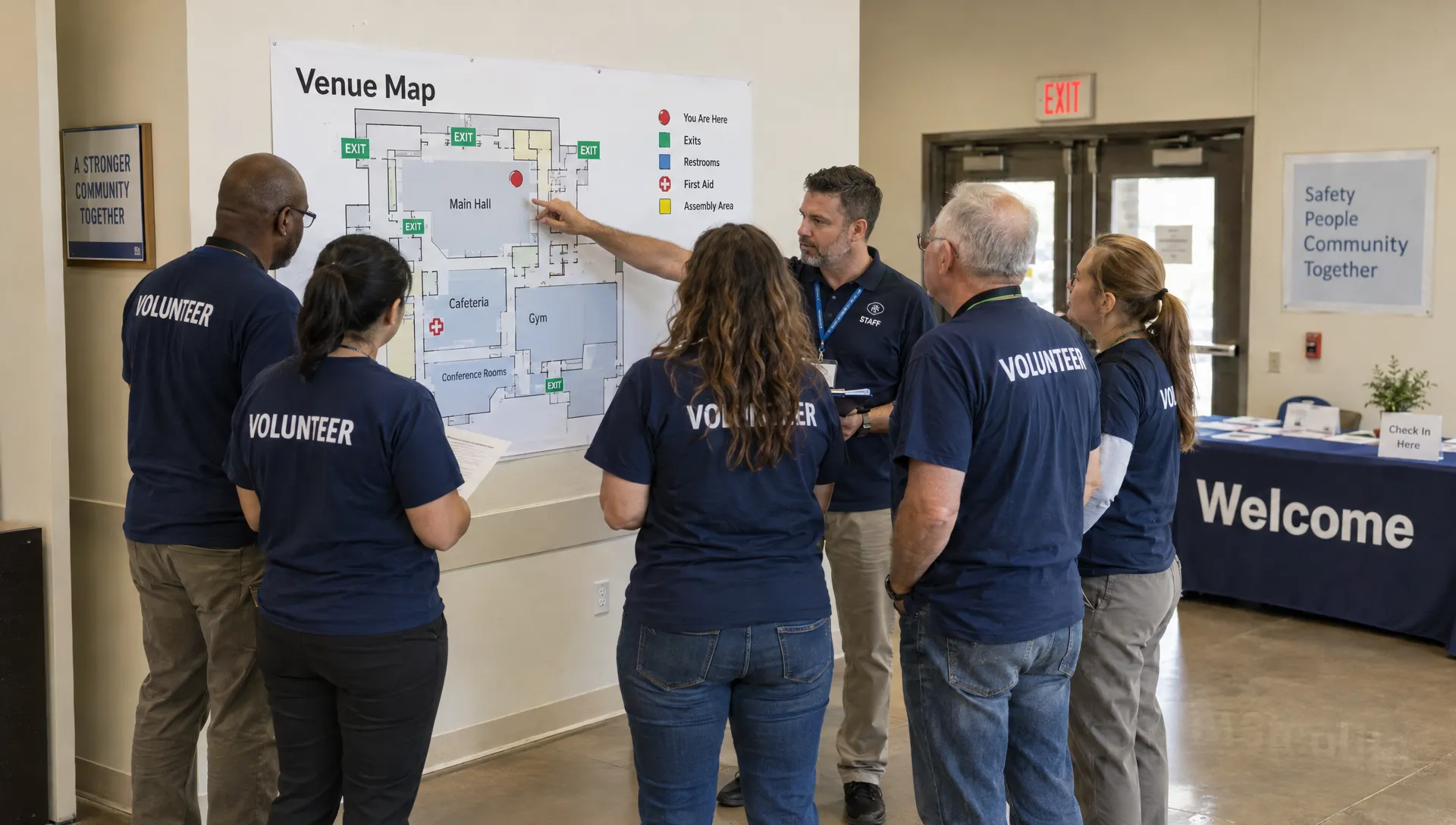
For meetings and public events, identify a safety contact, check exits and establish how staff will handle unwanted contact. Decide who can pause proceedings and where an affected person can speak privately.
Ask before publishing identifiable photographs or tagging attendees. Avoid automatically publishing volunteer schedules, travel arrangements or the live locations of people facing harassment. Public attendance should not imply consent to every later use of someone’s image.
Agree on how attendees can leave safely if needed. A trusted companion or an alternative departure arrangement may help, but choices should follow the person’s circumstances rather than a blanket rule.
Safety staff should de-escalate and seek appropriate assistance, not confront suspected harassers or turn an event into a contest of force.
Respond to harassment in a clear sequence
When an incident occurs, confusion can cause additional harm. A political movement needs a response sequence that a small team can follow under pressure, including when a senior organizer is unavailable.
First, establish immediate safety
Ask whether the person is currently safe, whether their location has been exposed and whether the behavior is escalating. Do not begin by demanding a detailed narrative.
If there is immediate danger, contact appropriate local emergency services and follow their guidance. For stalking, domestic abuse or persistent threats, specialist services can help assess risks that a volunteer organizer is not qualified to judge.
Offer practical options: stepping out of a discussion, changing an event assignment, restricting contact or arranging a trusted companion. Do not make withdrawal from public participation the default solution.
Explain what you propose to do and seek the affected person’s agreement where possible. When urgent safety obligations or legal duties require action without consent, share only what is necessary and explain the decision as soon as it is safe to do so.
Preserve evidence without spreading the harm
Record relevant account names, dates, links and the surrounding context. Preserve original messages where possible. Screenshots can be useful, but they may omit information needed to establish a pattern or authenticate a message.
Store evidence in a restricted location rather than a general group chat. If private information has been exposed, avoid copying it into public rebuttals or asking supporters to circulate screenshots.
The PEN America Online Harassment Field Manual provides practical guidance on documenting abuse and responding to online harassment. Use resources like this to support a consistent process, not to make the affected person responsible for investigating everything alone.
Ask what information the person is comfortable sharing with platforms, advisers or authorities. Evidence requirements and privacy obligations vary by jurisdiction, so seek qualified local advice when needed.
Contain the incident and choose proportionate escalation
Possible actions include platform reports, removal of exposed information, contact restrictions, temporary access limits and referrals to specialist support. Some incidents may also warrant legal advice or police reporting.
Do not assume every abusive message requires a public statement. Public attention can sometimes intensify harassment or reveal details that were previously obscure.
If a statement is necessary, describe the prohibited behavior and the action being taken without repeating threats or identifying the affected person without permission. Tell supporters not to retaliate, contact the alleged harasser or conduct their own investigation.
Record who owns each next step and when the affected person will hear back. A report should not disappear into an inbox once the immediate disruption ends.
Address harassment from inside the movement
External abuse is not the only risk. Members may face sexual harassment, discriminatory intimidation, unwanted contact or threats from colleagues who control assignments, introductions or access to leadership.
A political movement should never require someone to report misconduct directly to the person they fear. Provide an alternative route and bring in an independent reviewer when internal relationships make impartial handling unrealistic.
Keep protective measures separate from final findings. Temporary restrictions can reduce exposure while a complaint is assessed, but they should have a defined scope and review point. A fair process gives the person accused a meaningful opportunity to respond while avoiding unnecessary disclosure of private information.
Ordinary disagreements may benefit from a structured conflict-resolution process. Harassment involving coercion or a significant power imbalance should not automatically be routed into mediation. Nobody should have to negotiate continued contact with someone they fear as a condition of receiving protection.
Watch for retaliation after a report. Removal from useful roles, coordinated hostility or pressure to withdraw a complaint can undermine the process even when nobody makes an explicit threat.
Support recovery without treating distress as weakness
Harassment can affect sleep, concentration, relationships and willingness to participate. A political movement should offer support without implying that the member’s reaction, rather than the abusive behavior, is the problem.
Let the person choose a support contact where possible. Offer temporary workload changes and agree on a follow-up date. Avoid pressuring them to explain their experience publicly, resume campaigning quickly or become the movement’s spokesperson on harassment.
For someone wondering whether ongoing stress warrants professional attention, free online physical and mental health screening quizzes can provide an initial indication. These are not diagnoses or emergency assessments. Members should review the site’s privacy information before sharing health details and seek qualified care when symptoms persist or interfere with daily life.
Immediate danger or a mental health crisis calls for local emergency or crisis support, not an online quiz. Keep health information out of membership records and do not ask members to submit screening results to organizers.
Support also includes reducing the workload that harassment creates. With permission, a trusted colleague can help organize evidence or handle platform reports. Assistance should restore the person’s choices, not transfer control over their participation to someone else.
Test the plan and publish the right information
A written policy is useful only if people can apply it. Run a short exercise using a fictional incident: an organizer receives repeated messages, their address appears online and an event is scheduled for the following day.
Check whether the team can identify the responder, protect records, adjust the event and communicate without exposing the person further. Include the possibility that the accused person is a leader or that the usual safety contact is unavailable.
For a political movement, useful measures include response times, completion of agreed protective actions and member awareness of reporting routes. Do not treat a low report count as proof of safety. It may indicate that people do not trust the process.
Publish conduct rules, reporting routes and appropriately anonymized summaries of process improvements. Avoid small-group breakdowns that make individuals identifiable. Private case records should not become public accountability material.
This follows an important implication of JustSocial’s manifesto: continuous civic participation needs institutions that listen and protect. Collecting more opinions is not progress if people cannot safely express them.
Frequently asked questions
How can organizers distinguish harassment from political criticism? Assess conduct and context. Challenging a policy, leader or decision is not inherently harassment. Threats, stalking, exposure of private information and repeated unwanted contact require a safety response, even when presented as political disagreement.
Should a movement allow anonymous reports? Anonymous reports can reveal risks that would otherwise stay hidden. Explain that limited information may constrain an investigation. Consider proportionate protective measures, but do not treat an anonymous allegation alone as a completed finding of misconduct.
Can members participate without using their real names publicly? Often they can, depending on the activity and applicable rules. Separate public visibility from any necessary eligibility checks, collect minimal information and explain who can access it. Never promise complete anonymity unless the system genuinely supports it.
What should a small volunteer team put in place first? Establish a reporting contact with a backup, secure administrator accounts, restrict access to sensitive records and agree on an immediate-danger procedure. Test these basics before adopting complex tools.
Make safe participation a practical commitment
Choose a safety lead and backup, publish the reporting route and review what member information your team currently exposes. Then test one realistic incident scenario.
JustSocial’s vision asks people to become ongoing participants in public life. Protecting that participation means making room for disagreement while refusing threats and coercion. Members should know how to seek help, what protection is available and how decisions about their safety will be reviewed.





