
A political movement can demand accountability from government while leaving its own members unable to challenge a leader, inspect spending or propose a decision. Bylaws close that gap. They turn democratic intentions into enforceable rights, procedures and limits on power.
Good bylaws answer practical questions before conflict starts: Who can join? Who sets the agenda? What makes a vote valid? Can members remove an officer? What happens when someone disputes a result? The aim is not to regulate every conversation. It is to make consequential decisions predictable, contestable and accountable.
Connect democratic principles to enforceable rules
JustSocial’s manifesto argues that people should have meaningful influence between elections, rather than being reduced to periodic voters and consumers. Its proposed People’s Branch would continuously register public opinion while preserving the independence of government institutions. That distinction matters internally too: gathering views is not the same as authorizing action.
A movement’s bylaws should therefore distinguish discussion, consultation and binding decisions. Members need to know whether they are expressing a preference, advising an elected committee or approving something the organization must implement.
The manifesto also proposes an independent role for academia. An internal counterpart could be evidence review by qualified advisers, but advisers should not acquire governing authority merely because they possess expertise. Their mandate, appointment process and conflicts of interest need explicit rules.
These are proposed governance choices, not claims about rules JustSocial has already adopted.
What political movement bylaws should cover
Bylaws establish the organization’s constitutional rules. Policies handle operational details, such as reimbursement forms or moderation workflows. A chapter charter defines a local group’s relationship with the wider organization.
Keeping those documents separate makes updates manageable without allowing a committee to quietly rewrite member rights through an ordinary policy change.
| Area | What belongs in the bylaws | What can usually sit in a policy |
|---|---|---|
| Membership | Eligibility, rights and grounds for termination | Application workflow |
| Decisions | Authority, notice, quorum and voting thresholds | Meeting templates |
| Leadership | Election, term, removal and vacancy rules | Role handover checklist |
| Finance | Spending authority and oversight rights | Expense claim forms |
| Conduct | Disciplinary powers and appeal rights | Complaint submission process |
| Amendments | Who may propose changes and how they pass | Version formatting |
State which document prevails when rules conflict, subject to applicable law and the organization’s legal form. If local chapters exist, use chapter charters that define local authority rather than repeating every central rule in each chapter’s documents.
No internal document can override mandatory legal duties. Obtain jurisdiction-specific advice before adoption, particularly if the organization is incorporated, registered as a party or subject to campaign-finance rules.
Establish membership rights before leadership powers
Membership should not depend on a founder’s continuing approval. Define eligibility, admission criteria and a review route when an application is refused. Any qualifying period before voting should be published in advance, not introduced after leaders see who has joined.
Core rights should include receiving decision notices, submitting proposals, voting when eligible, standing for office and accessing appropriate organizational records. Members also need protection against retaliation for lawful disagreement.
A political movement that charges dues should explain how nonpayment affects membership and whether hardship waivers are available. Otherwise, financial requirements can become an unintended filter on civic participation.
Define membership categories carefully. Supporters, minors and full voting members may have different rights, but those differences should be visible. The manifesto’s proposal to hear younger people without granting them adult electoral rights offers a useful distinction between participation and formal authority. Any youth arrangements also need appropriate safeguarding.
Avoid giving donors extra votes simply because they contribute more. Where investment or corporate ownership exists, distinguish those legal rights from movement membership and explain any overlapping control honestly.
Give members a route onto the agenda
Democracy weakens when leaders allow discussion but control every question that reaches a vote. Bylaws should create a realistic member-initiated proposal process, with a published support threshold, submission deadline and obligation to respond.
Specify what happens next: who checks whether a proposal falls within the organization’s powers, when it receives a hearing and how members can appeal a refusal. “The committee may consider it” is not an enforceable participation right.
Discursive democracy concerns the exchange of reasons and perspectives. Deliberative democracy adds structured consideration before a decision. Both require more than an open comment box.
For consequential proposals, a political movement can require a discussion period, an accessible explanation of costs and opportunities to submit amendments. Facilitators should apply speaking rules consistently rather than favoring supporters of the leadership.
Members should be able to submit a minority statement alongside the majority recommendation. That protects disagreement without giving a minority an unlimited veto. The final record should explain the decision, identify the responsible implementer and state when progress will be reported.
Make voting rules mathematically clear
Separate decision types and authority
Do not treat every poll as binding. Label consultations clearly and identify the body authorized to make the final decision.
Routine administration may belong to officers within an approved budget. Elections, major commitments and amendments may require member approval. The right allocation depends on the organization, but it must be written down. JustSocial’s guide to who decides what within movement governance provides a useful starting point for mapping those responsibilities.
Define who may open a ballot, certify the result and resolve a challenge. Candidates and proposal sponsors should not have sole control over counting their own contests.
Define quorum, denominators and thresholds
“Majority approval” is incomplete. Does it mean a majority of all eligible members, participants or valid votes cast? Do abstentions count toward participation but not toward approval?
The following is an illustrative model, not a universal recommendation or legal standard:
| Decision | Notice | Participation requirement | Approval rule |
|---|---|---|---|
| Ordinary member motion | 7 days | 25% of eligible members participate | More than half of valid yes/no votes |
| Bylaw amendment | 21 days, with exact text | 40% of eligible members participate | At least two-thirds of valid yes/no votes |
| Officer election | 14 days after nominations close | 25% of eligible members cast valid ballots | Published electoral method, including tie procedure |
For a political movement using this model, the bylaws would also need to define eligibility, valid ballots and rounding. With 100 eligible members, an ordinary motion needs at least 25 participants. If there are 12 yes votes, 10 no votes and three abstentions, it passes under the stated rule.
Freeze the eligible membership register at a published cutoff. Do not remove inactive members during a controversial ballot to lower its quorum.
Support continuous participation without permanent voting
The manifesto’s emphasis on ongoing involvement does not require members to monitor ballots every day. Predictable voting windows, grouped proposals and accessible summaries can preserve influence without rewarding only those with abundant free time.
Specify what happens when quorum fails. A repeated ballot with a lower threshold can invite manipulation, so any fallback rule should be agreed beforehand and retain meaningful participation requirements.
Limit leadership powers and provide lawful removal
List each office’s authority, term length, eligibility conditions and reporting duties. Define vacancies and interim appointments, including when an appointed replacement must face election.
Term limits are one option, not a guarantee of democracy. Whatever arrangement members choose, leadership should remain removable through a fair, usable procedure. Set a petition threshold, notice period and opportunity for the officer to respond before a removal vote.
A political movement should also distinguish the founder’s contribution from permanent constitutional authority. A founder may hold an elected role or an advisory position, but any special power should be disclosed rather than hidden inside informal custom.
The same applies to emergency authority. Name the decisions officers may take urgently, set an expiry and require prompt reporting and review. An emergency clause should not authorize indefinite suspension of elections, appeals or financial oversight.
Where legal duties reserve decisions to directors or trustees, the bylaws must acknowledge those duties. Member control should be designed within the legal structure, not promised where it cannot be delivered.
Put financial accountability beyond personal discretion
Financial rules should identify who approves budgets, spending limits, payment controls and the records members can inspect. Establish independent review proportionate to the organization’s size and obligations.
A receipt proves that money was spent, not that it served the organization. Personal purchases remain personal expenses. For example, a member may consult a guide to engagement ring retailers in New Zealand to compare quality and warranties, but careful shopping does not make that purchase reimbursable from movement funds. The relevant question is organizational purpose and authorization, not simply value for money.
For legitimate purchases, require disclosure when an officer, relative or associated business could benefit. The interested person should withdraw from approval, with the conflict and decision recorded.
JustSocial’s manifesto discusses donations, investment and publicly supported ventures. Those ambitions make boundaries especially important: financial backing should not silently become control over political positions, appointments or access to member data.
Publish useful financial summaries while protecting sensitive personal information. Transparency does not require exposing members’ home addresses or private banking details.
Make discipline fair and appeals independent
Conduct rules should address identifiable behavior, such as threats, harassment, fraud or deliberate disruption. Vague prohibitions on “damaging the movement” can turn criticism into a disciplinary offense.
A political movement needs a process that separates complaints from conclusions. Give the respondent a clear description of the allegation, access to relevant evidence where lawful and safe, reasonable time to respond and a reasoned decision.
Temporary restrictions may be necessary to protect people or records. Define their purpose, duration and review process so that an interim measure does not become an indefinite punishment.
Appeals should go to people who did not make the original decision and have no relevant conflict. Specify available sanctions and use proportionate measures. Suspension, removal from office and termination of membership are different actions and should not be interchangeable.
Protect complainants and witnesses from retaliation. Protect respondents from public accusations presented as findings before the process concludes. Neither protection requires suppressing legitimate dissent.
Govern digital participation, not just the platform
The manifesto proposes technology-supported participation and anonymous recording of community votes. Internally, that aspiration requires a distinction between verifying eligibility and exposing how someone voted.
Bylaws should authorize the permitted meeting and voting methods, subject to applicable law. Supporting policies can then define authentication, ballot secrecy, access controls, retention periods and independent verification.
For a political movement using online ballots, publish the rules for outages, disputed access and recounts before voting starts. Changing platforms midway through a contested election should require a documented procedure, not an administrator’s improvisation.
Offer accessible participation routes for members with disabilities, limited connectivity or low digital confidence. A platform should not become the only practical route to membership rights without addressing those barriers.
If adopting Robert’s Rules of Order or another parliamentary authority, name the edition and its subordinate status to law and bylaws. Adopting meeting rules does not, by itself, resolve every digital voting question.
Protect amendment rights with usable clauses
Members need a way to improve the rules without allowing a temporary majority to rewrite them overnight. Specify proposal rights, advance circulation of exact wording, amendment thresholds and the effective date of approved changes.
For a political movement, changes affecting a live election deserve particular caution. State whether they apply only to future contests, except where applicable law requires otherwise.
The following clauses illustrate the level of specificity to aim for. They require adaptation and legal review:
Members may submit a proposed bylaw amendment supported by at least 5% of eligible voting members. The full text and an explanation of its effect must be circulated at least 21 days before voting opens. Approval requires the amendment quorum and voting threshold stated in these bylaws.
An officer with a material personal or financial interest in a decision must disclose that interest and withdraw from approval of the matter. The disclosure and withdrawal must be recorded. A conflicted officer may provide requested factual information but may not control the decision.
No officer or committee may alter membership voting rights through an operational policy. Any such alteration requires a bylaw amendment, subject to applicable law.
Adopt the rules through a credible process
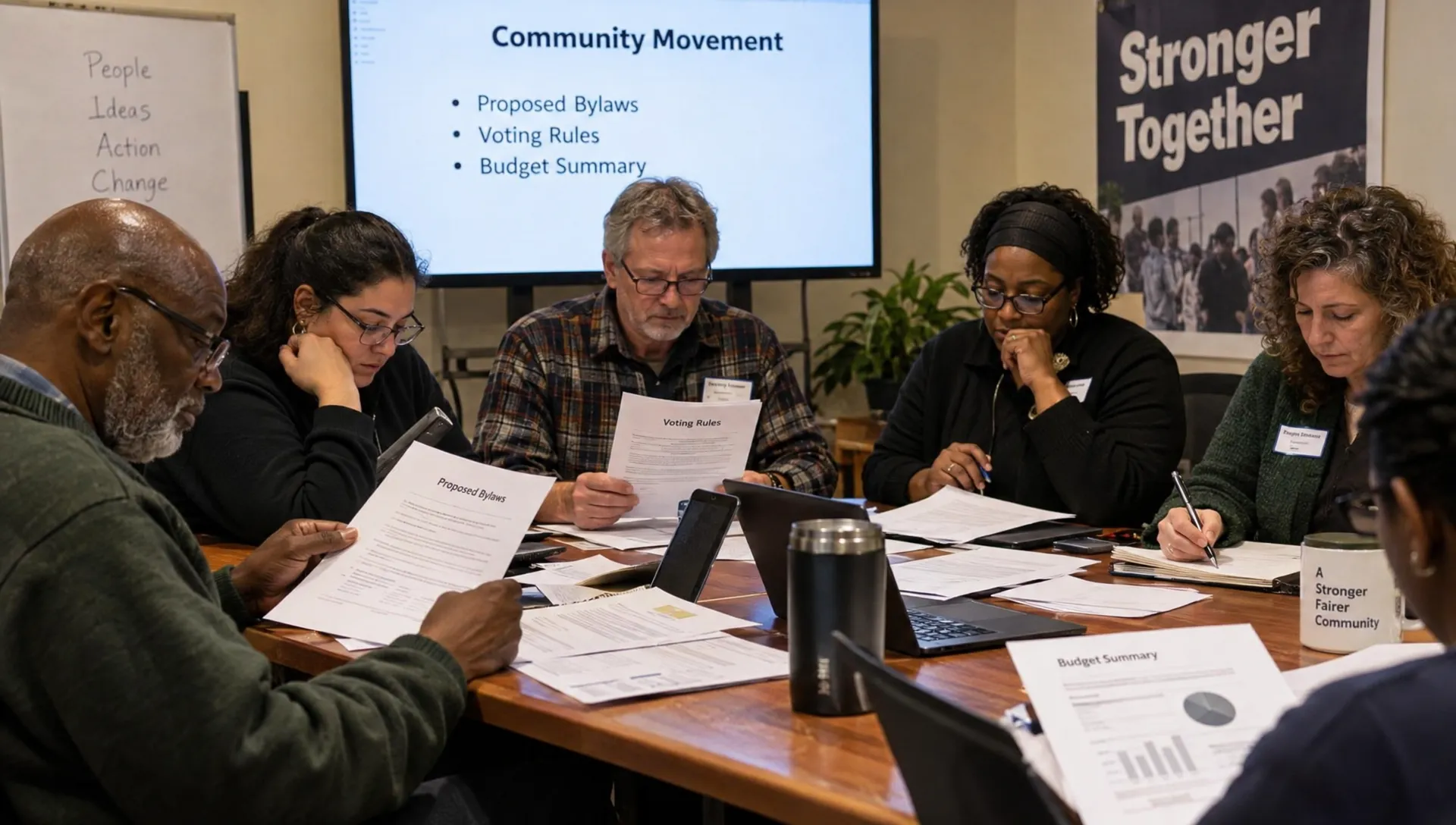
Circulate a draft with a plain-language explanation of each member right and leadership power. Invite amendments, record unresolved concerns and allow enough time for review before adoption.
Test the draft against realistic disputes: a tied election, a failed quorum, a founder seeking reimbursement, a complaint against the chair and a platform outage. If nobody can identify the next authorized step, revise the relevant clause.
After adoption, publish the approved version and amendment history. Train officers and facilitators, assign responsibility for maintaining records and schedule a review after the first full operating cycle.
A political movement should assess whether members can actually use its rules. Track timely responses to proposals, publication of required reports and completion of appeals, rather than treating the existence of a bylaws document as proof of democratic practice.
Frequently asked questions
Are bylaws the same as a manifesto? No. A manifesto explains principles and political ambitions. Bylaws determine internal rights, powers and procedures. They should align, but inspirational language cannot replace a voting rule or appeal process.
Should every decision require a member vote? No. Members can authorize officers to handle routine work within defined limits. Reserve broader approval for consequential decisions and require reporting so delegated authority remains accountable.
Can bylaws guarantee democratic leadership? No. They can make abuse harder to conceal and easier to challenge, but members still need access to records, independent review and practical routes to enforce their rights.
How often should bylaws be reviewed? Set a review schedule suited to the organization and revisit rules after significant disputes or structural changes. A review should invite proposals, not automatically reopen every settled provision.
Turn participation promises into member rights
Start with the rights members need when they disagree with leadership, then draft the procedures that make those rights usable. For groups building on JustSocial’s manifesto, the practical test is straightforward: can people influence decisions between elections, understand what happened and challenge power without losing their place in the movement?





