A street redesign, a school budget, a zoning decision, or the location of a new shelter can change daily life more quickly than most national policies. Yet too often, residents learn about these decisions after the plans are nearly complete. Public participation creates a different possibility: people affected by local decisions can help shape them.
So, what is public participation in local government? It is the set of ways residents, community groups, businesses, and other stakeholders take part in public decisions before those decisions are finalized. It includes voting, but it reaches far beyond election day. A healthy local democracy gives people clear, usable opportunities to share knowledge, set priorities, question proposals, and influence outcomes throughout the year.
For communities that want more accountable institutions, participation is not a ceremonial comment period. It is civic infrastructure. When it is designed well, it brings lived experience into government and makes public power easier to see, understand, and help direct.
What public participation in local government looks like
Local governments make decisions through city councils, county boards, school boards, planning commissions, transit agencies, park districts, and many other public bodies. Public participation can happen at each stage of their work: identifying a problem, developing options, choosing a course of action, implementing it, and reviewing the results.
At the most basic level, participation may mean attending a public meeting, submitting written testimony, calling an elected representative, or voting in a local election. These routes matter, particularly when residents have a direct concern or need to put an issue on the public record.
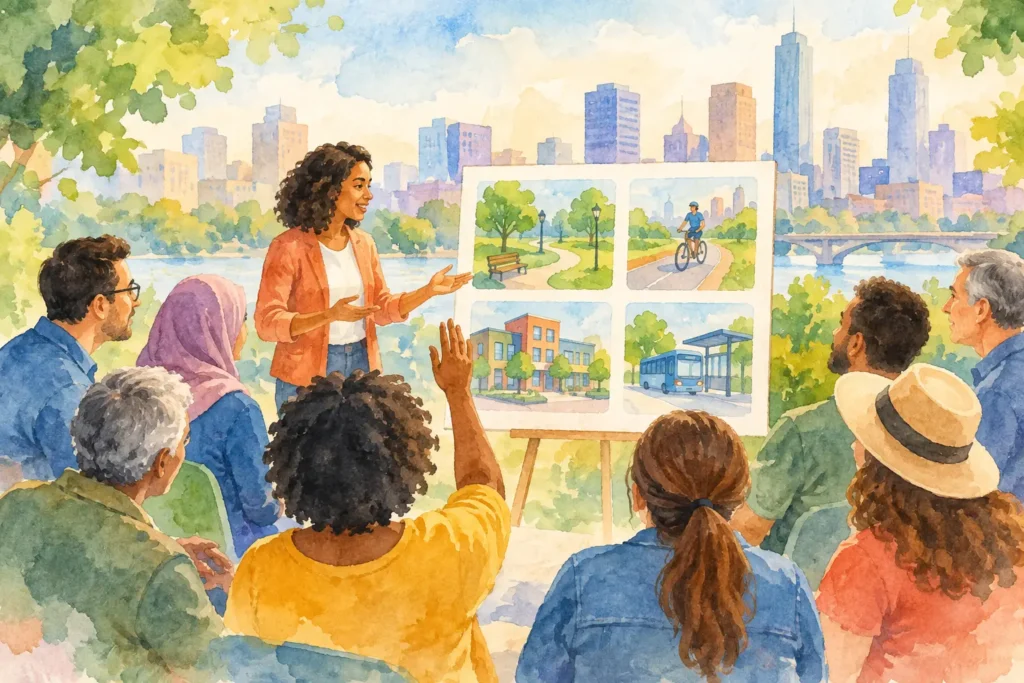
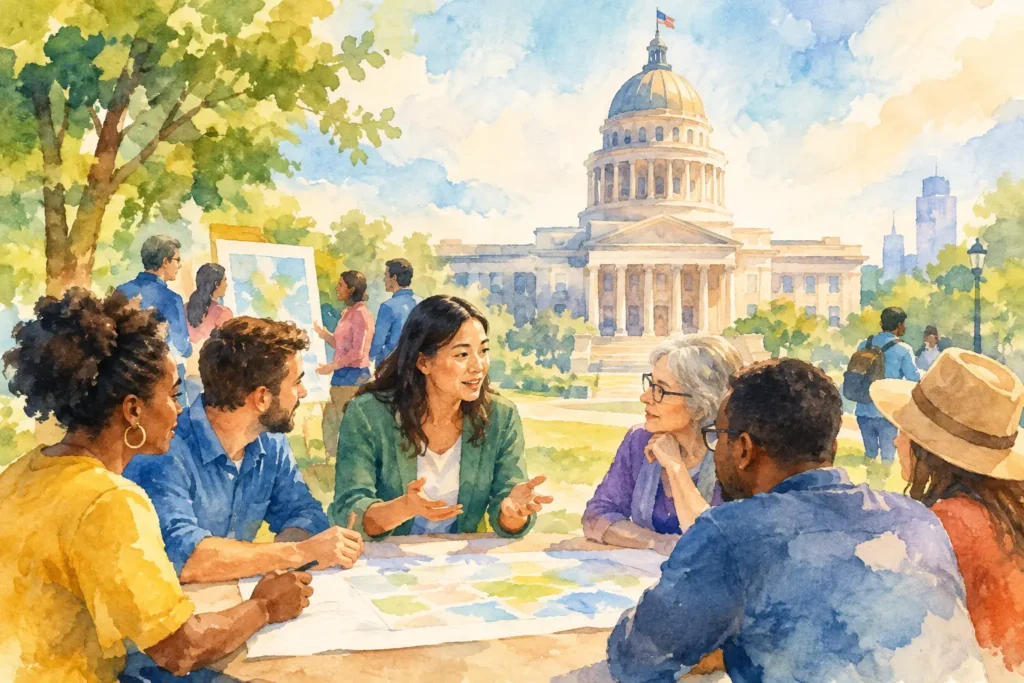
More meaningful participation goes further. A city might ask residents to rank neighborhood investments through participatory budgeting. A school district might form a parent and student advisory group before changing attendance boundaries. A county may hold workshops where community members review data, identify gaps in a proposed plan, and help develop alternatives.
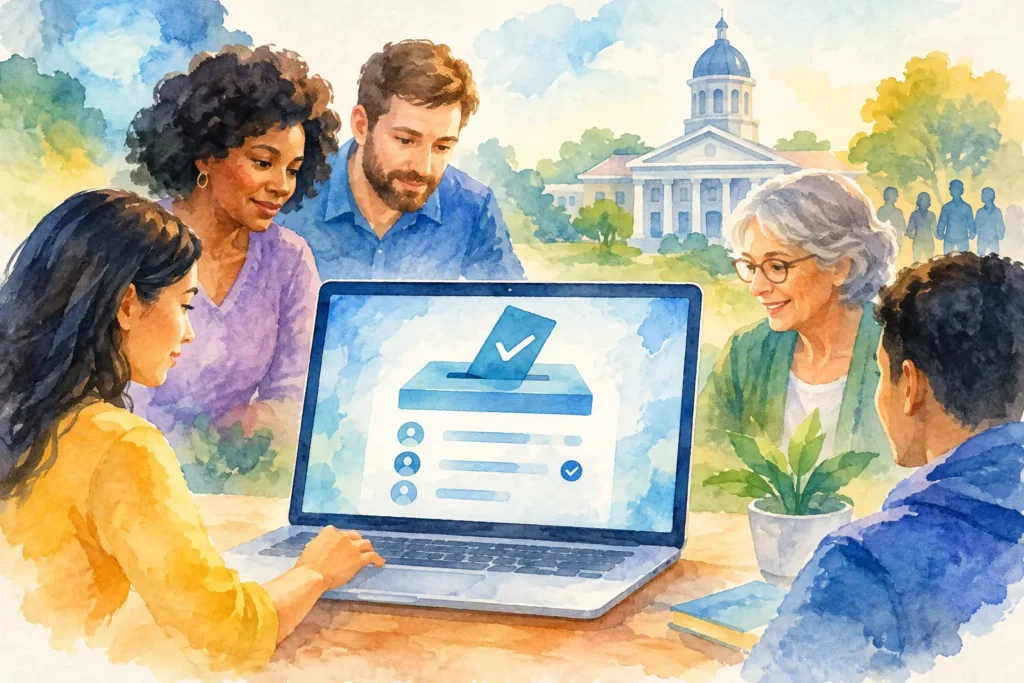
Digital tools can expand this work when they are accessible and transparent. Online surveys, public feedback portals, interactive maps, virtual meetings, plain-language budget explainers, and secure community voting systems can make it easier for people to participate outside weekday meeting hours. But technology is not participation by itself. A digital form that disappears into a closed process can create frustration rather than trust.
The key question is simple: can the public see how its input changed the decision, or understand why it did not?
Participation is more than public comment
A public hearing is often treated as proof that a process was participatory. Sometimes it is. Often, it comes too late.
When residents are invited to speak only after a proposal has been drafted, budgets have been allocated, and political commitments have been made, their choices may be limited to approval or objection. That is consultation, not shared problem-solving. It can still reveal harm, improve details, and hold officials accountable, but it does not give the public much room to shape the direction of the work.
Public participation exists on a spectrum. Informing people is the starting point: government shares timely, accurate information in language people can understand. Consulting people gathers reactions through surveys, hearings, and comments. Involving people brings them into the development of options. Collaborating means residents and public institutions work together on recommendations or decisions. Delegating authority, in limited cases, gives community members direct control over a defined public choice.
No single level is right for every decision. Emergency management may require officials to act quickly. Technical safety standards may demand specialized expertise. But when choices involve community priorities, public spending, neighborhood change, or competing values, deeper participation is usually warranted.
The honest approach is to state the level of influence clearly. If a survey is advisory, say so. If residents will choose how a portion of a budget is spent, explain the rules, amount, and timeline. Clear expectations protect trust better than vague promises of “engagement.”
Why local participation matters
Local government is where democracy becomes concrete. It determines whether a bus route reaches a job center, whether a park is safe and welcoming, whether housing rules allow neighbors to remain in their community, and whether public services reflect the needs of people who use them.
Residents bring forms of expertise that official reports cannot fully capture. A parent may know why a crossing feels unsafe at school pickup. A tenant organizer may recognize patterns of displacement before they appear in citywide data. A disability advocate may identify barriers in a proposed public space that others miss. Listening to these experiences can lead to better decisions, not merely more popular ones.
Participation also improves legitimacy. People are more likely to accept a difficult decision when they had a fair chance to understand it, raise concerns, and receive a meaningful response. Agreement is not the only measure of success. A community can disagree sharply and still believe the process was open, respectful, and accountable.
There is a broader democratic benefit as well. Regular opportunities to participate help people build civic confidence. Residents learn how decisions are made, meet others with different priorities, and discover that government is not an unreachable institution. It is a shared system that can be improved through sustained public involvement.
What meaningful participation requires
Inviting people to participate is not enough. Local governments and civic organizations need to remove the barriers that determine who can actually take part.
First, people need information early enough to use it. Meeting notices posted shortly before a hearing, agenda packets written in dense legal language, or budget documents that require expert interpretation exclude many residents before the conversation begins. Plain-language explanations, translated materials, accessible formats, and clear timelines make participation possible.
Second, participation must meet people where they are. Evening meetings may work for some residents but not for shift workers, caregivers, people with disabilities, or those without reliable transportation. Combining in-person gatherings with phone, mail, and online options can broaden access. It also requires attention to the digital divide. Online participation should supplement, not replace, trusted community-based channels.
Third, people need to know their contribution matters. Governments should publicly report what they heard, what they changed, what they could not change, and why. This feedback loop is one of the most practical ways to prevent civic fatigue. If residents repeatedly give time and receive silence, they learn that participation is performative.
Finally, processes need safeguards against unequal influence. The loudest voices at a meeting do not automatically represent the community. Outreach should include renters, young people, immigrants, low-income residents, rural communities, people with limited English proficiency, and others who have historically been left out of public decision-making. Equity is not achieved by opening the door once. It requires ongoing relationship-building and shared accountability.
How citizens can participate with greater impact
Individual action still matters, especially when it connects to collective action. Start by following the public bodies that make decisions affecting your daily life. City councils are visible, but planning commissions, school boards, utility districts, and county agencies may have just as much influence over the issues you care about.
When a proposal is open for public input, learn what decision is actually being made and when. A specific comment tied to the agenda, local evidence, and a practical request is more useful than a general statement of frustration. If you want a safer intersection, explain the problem, identify who is affected, and ask for a defined action such as a traffic study, crosswalk design review, or protected bike connection.
Working with neighbors can multiply that impact. Community organizations, tenant associations, parent groups, faith communities, and nonprofits often have trusted relationships and a clearer view of who is missing from the conversation. Collective participation can turn isolated concerns into durable public priorities.
Citizens can also ask for better participation itself. Request published decision timelines, accessible meeting materials, response reports, neighborhood outreach, and digital tools that allow people to follow and contribute to public work over time. These are not extras. They are the conditions that let more people exercise democratic agency.
Building participation into everyday democracy
The strongest systems do not depend on a crisis to bring people together. They create recurring ways for residents to propose ideas, review trade-offs, deliberate with one another, and see results. That can include participatory budgeting, standing community assemblies, resident advisory panels, youth councils, neighborhood decision funds, and transparent digital platforms for public input.
Each model has trade-offs. Broad online participation can reach more people but may produce shallow feedback without thoughtful facilitation. Small advisory groups can support deeper deliberation but may not reflect the whole community. Participatory budgeting gives people direct power over money, though it is often limited to a small share of the total budget. The answer is not to find one perfect method. It is to build a connected participation system that matches the decision and remains open to improvement.
This is the democratic future worth organizing for: public institutions that do not merely ask residents to react, but equip them to help govern. When we create clear paths from community voice to public action, we deepen our connection with democracy and give positive change somewhere real to begin.