Deliberative democracy is most valuable when society needs more than a yes-or-no reaction. It works best when citizens are asked to understand a problem, weigh trade-offs, hear from people outside their usual circles, and form a judgment that public institutions can actually use.
That may sound obvious, but it is not how most political systems currently operate. Too often, citizens are invited to vote every few years, argue in public between elections, and hope representatives somehow interpret the noise. JustSocial's manifesto describes this failure sharply: the modern citizen is too often reduced to a voter, taxpayer, and private consumer rather than treated as a continuous participant in public life. The promise of deliberative democracy is to rebuild the missing layer between public frustration and public decision.
But deliberation is not magic. It does not work equally well for every issue, every community, or every political moment. It works best under specific conditions.
Deliberative democracy works best when the decision is still open
The first condition is simple: people must be invited before the real decision has already been made.
Deliberation fails when it becomes political decoration. If officials have already chosen the policy, a citizen panel or public forum becomes a performance of listening, not listening itself. People sense this quickly. Once they feel used, trust collapses and future civic participation becomes harder.
Deliberative democracy works best when decision-makers can say, honestly and publicly, "We have a real question, we have constraints, and we need public judgment before we choose." That does not mean citizens must control every final decision directly. It means the process must have a defined path into power.
A serious deliberative process should clarify:
- What question citizens are being asked to consider.
- Which options are realistically available.
- What evidence and expert input will be provided.
- Who will receive the recommendation.
- How officials must respond after the process ends.
Without that link to action, deliberation becomes another meeting. With it, deliberation can become a democratic instrument.
It works best for complex trade-offs, not simple preferences
Some public questions are straightforward. If a community is choosing between two park names, a simple vote may be enough. If a city wants to know whether residents prefer Saturday or Sunday for a street closure, basic polling can work.
Deliberative democracy becomes more useful when the issue includes uncertainty, competing values, long-term consequences, or unequal burdens. These are the decisions where slogans are least helpful and public reasoning matters most.
Good examples include education reform, climate adaptation, public budgets, housing density, transportation planning, health priorities, digital privacy, and institutional reform. In each case, people may begin with strong opinions, but those opinions can change when they hear evidence, confront costs, and listen to affected groups.
This is why the model fits naturally with the JustSocial vision of continuous public involvement. The JustSocial manifesto argues that modern technology should help citizens weigh in consistently on education, taxpayer funding, and state affairs. Deliberation adds an essential discipline to that vision: citizens should not only be counted, they should be informed, challenged, and heard in structured ways.
It works best when participation is representative, not just loud
Open public meetings often reward time, confidence, anger, and organization. Those who show up are not always those most affected. Parents working two jobs, young people, minorities, caregivers, and politically exhausted citizens may be absent, even when the decision affects them deeply.
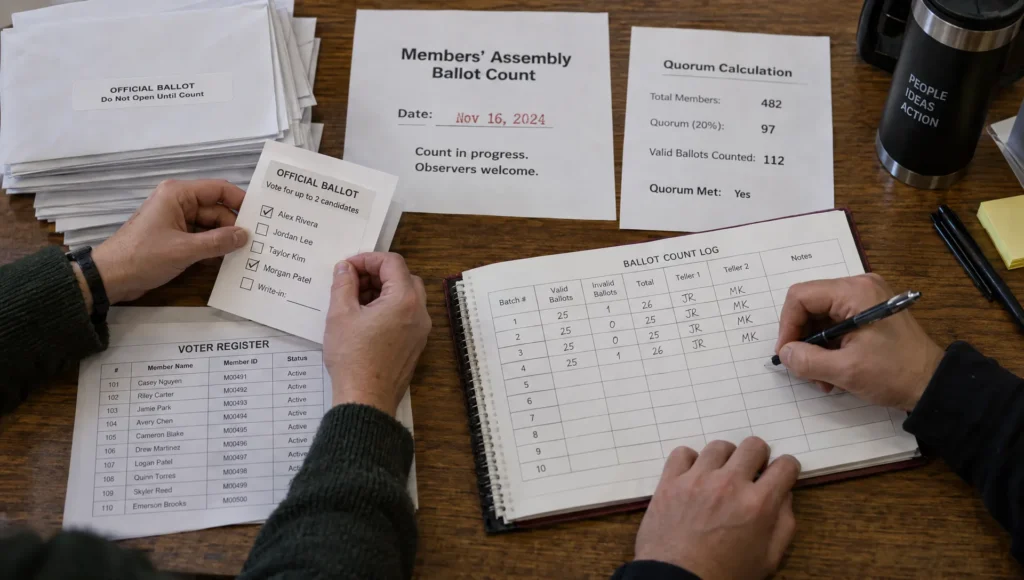
Deliberative democracy works best when it corrects for that imbalance. Many strong deliberative processes use sortition, meaning random selection, to form a mini-public that reflects the wider population. The goal is not to gather political insiders. The goal is to bring ordinary citizens into a setting where they have time, information, and equal standing.
The OECD has documented a growing international use of representative deliberative processes, including citizens' assemblies, juries, and panels. The common thread is not that everyone participates in every conversation. It is that the group is designed to be broadly representative, balanced, and capable of producing considered judgment.
This distinction matters. A democracy that only listens to the loudest voices becomes distorted. A democracy that deliberately includes people who are usually missing becomes more legitimate.
It works best when discourse comes before conclusion
Deliberation is not just a nicer form of debate. It is a different sequence of political thinking.
In ordinary political conflict, people often start with a conclusion and then search for arguments to defend it. In a deliberative setting, the process should slow that instinct down. Participants receive evidence, ask questions, hear testimony, discuss trade-offs, revise their views, and only then reach recommendations.
This is where deliberative democracy and discursive democracy support each other. Discursive democracy is the broader public conversation: journalism, community debate, online discussion, public testimony, civil society organizing, and everyday political speech. Deliberative democracy is the structured moment where a representative group turns that wider discourse into usable public judgment.
A healthy system needs both. Without discursive democracy, deliberation becomes too narrow and insulated. Without deliberative democracy, public discourse can become too chaotic, emotional, and easy to manipulate.
JustSocial's manifesto points toward this combination when it imagines public platforms where citizens can express political identity and opinion continuously while institutions measure and take that opinion seriously. The challenge is not only collecting views. The challenge is building public processes that turn expression into understanding.
It works best when citizens can question experts, not be lectured by them
Evidence is central to deliberative democracy, but expertise must be handled carefully. If experts dominate, citizens may feel managed. If experts are excluded, the process may become uninformed.
The best deliberative settings give citizens access to multiple forms of knowledge. Academic experts can explain data. Practitioners can describe implementation. Public officials can clarify legal and budget limits. Affected residents can explain lived consequences that do not appear in spreadsheets.
The role of the citizen is not to become a technical specialist overnight. The role is to make a public judgment after hearing enough to understand the real choice.
Ireland's Citizens' Assembly is often cited because it helped create a public process around difficult constitutional and social questions, including abortion and marriage equality. Its importance was not only that citizens met. It was that they heard evidence, asked questions, considered different perspectives, and produced recommendations that moved into the political system. The official Citizens' Assembly record shows how structured public reasoning can support decisions on sensitive issues.
| Deliberation works best when… | Why it matters | What to avoid |
|---|---|---|
| The decision is still open | Citizens can influence the outcome | Using deliberation after leaders already decided |
| The issue involves trade-offs | People can weigh costs, benefits, and values | Reducing complex questions to slogans |
| Participants are representative | Quiet or excluded groups are included | Letting only activists or insiders dominate |
| Evidence is balanced | Citizens can reason from shared facts | One-sided briefings or expert lectures |
| Institutions must respond | Recommendations enter the public process | Reports that disappear without explanation |

It works best when it is protected from manipulation
Deliberation requires a safe civic container. People must be able to speak honestly without harassment, coercion, humiliation, or organized intimidation. This is especially important in polarized societies, where public disagreement can easily become identity conflict.
Protection does not mean removing disagreement. It means designing disagreement so it becomes productive. Skilled facilitation, clear ground rules, transparency, balanced materials, and protections for minority voices all matter.
This is one reason technology must be used carefully. Digital tools can widen access, document proceedings, publish evidence, and help citizens participate over time. But digital spaces can also amplify outrage, misinformation, and social pressure. The strongest democratic design does not ask technology to replace judgment. It uses technology to support structured civic participation, transparency, and continuity.
For readers exploring how deliberation fits alongside more direct forms of public input, JustSocial's comparison of deliberative democracy and direct democracy explains why different democratic tools are useful for different kinds of decisions.
It works best when citizens see the full feedback loop
People do not need to win every argument to trust a process. They do need to know what happened to their contribution.
A deliberative process should end with a public response. If officials accept a recommendation, they should explain how it will be implemented. If they reject it, they should explain why. If they modify it, they should identify what changed and what constraints shaped the final decision.
This feedback loop is the difference between symbolic consultation and democratic accountability.
It also connects to one of the deepest ideas in JustSocial's political movement: the state should not be remote from the individual. In the manifesto's language, the goal is to move from a detached republic toward a more continuous democratic culture, one where public institutions listen, measure, educate, and respond. Deliberative democracy is one practical mechanism for that shift.
When deliberative democracy is not the right tool
Knowing when deliberation works best also means knowing its limits.
It is not ideal for urgent emergency decisions where delay would cause harm. It should not be used to put the basic rights of vulnerable groups up for public negotiation. It should not be used when institutions have no intention of responding. And it should not be used as a substitute for courts, journalism, protest, elections, or direct civic action.
Deliberative democracy is strongest when it complements other democratic practices. It can improve representative decision-making, deepen civic participation, strengthen discursive democracy, and prepare citizens for more meaningful public judgment. But it cannot carry the entire democratic system alone.
The more ambitious goal is a layered democracy: broad public discourse, continuous participation, representative deliberation, transparent institutions, and accountable decision-making. That is where deliberation becomes more than a meeting format. It becomes part of a new civic architecture.
A practical test for any deliberative process
Before launching a citizen assembly, panel, forum, or digital deliberation process, organizers should ask one central question: will this process help citizens make a better public judgment than they could make alone?
If the answer is yes, the design should make that possible. The issue should be clear. The evidence should be balanced. The participants should be representative. The discussion should be facilitated. The recommendations should be public. The institutional response should be mandatory.
If the answer is no, another democratic method may be better. Sometimes the public needs a vote. Sometimes it needs protest. Sometimes it needs investigative journalism. Sometimes it needs a court ruling. Sometimes it needs a movement.
Deliberative democracy works best when it gives ordinary citizens the time, structure, and respect required to become temporary stewards of the public good. In that setting, people are not treated as a crowd to be managed. They are treated as members of a political community capable of reason, responsibility, and collective judgment.
That is the point. Not more meetings. Not better public relations. A better democracy.
Frequently Asked Questions
When does deliberative democracy work best? Deliberative democracy works best when a public decision is complex, still open, connected to real authority, and improved by informed citizen judgment. It is especially useful for issues involving trade-offs, competing values, and long-term consequences.
Is deliberative democracy the same as civic participation? No. Civic participation is broader and includes voting, volunteering, protesting, organizing, commenting, and community action. Deliberative democracy is a structured form of civic participation where citizens learn, discuss, and form considered recommendations.
How is discursive democracy different from deliberative democracy? Discursive democracy refers to the wider public conversation across media, communities, institutions, and everyday life. Deliberative democracy is a more structured process that turns discussion into informed public judgment.
Can deliberative democracy work online? Yes, but only if the digital process is carefully designed. Online tools can improve access and transparency, but they need strong facilitation, identity safeguards, balanced information, and protection against manipulation.
What makes a deliberative process legitimate? Legitimacy comes from fair participant selection, balanced evidence, respectful discussion, transparency, institutional response, and a clear connection between citizen recommendations and public decision-making.
Help build the next democratic layer
JustSocial is a political movement working toward continuous citizen empowerment, public transparency, and technology-supported democracy. If you believe citizens should be heard between elections, not only during them, start by reading the manifesto, sharing the ideas, and joining the conversation at JustSocial.io.