Political debate is supposed to help a society think. Too often, it does the opposite. It rewards the fastest insult, the cleanest slogan, the most viral outrage, and the person most willing to treat uncertainty as weakness.
Discursive democracy starts from a different premise: democracy is not only what happens when people vote. It is also what happens when people speak, listen, argue, challenge evidence, change their minds, and force institutions to notice what the public is actually thinking. Smarter political debate is not a luxury for calm times. It is one of the core conditions for civic participation in an era of distrust, polarization, and democratic decline.
For a political movement like JustSocial, this matters because the deeper goal is not simply to add more noise to politics. It is to help build a public culture where citizens are no longer treated as passive voters every few years, but as active participants in the ongoing life of the state.
What discursive democracy really means
Discursive democracy is the practice of organizing public conversation so that claims, reasons, values, identities, experiences, and disagreements can be expressed, tested, remembered, and carried into public decision-making.
It is often confused with “being civil.” Civility helps, but it is not enough. A society can be polite and still ignore the poor, the young, the rural, the dissident, the immigrant, the parent, the worker, or the citizen who cannot translate lived experience into policy language. Discursive democracy asks a more demanding question: can public speech become a usable democratic signal?
A smarter political debate does at least four things:
- It clarifies what people are actually claiming.
- It distinguishes evidence, opinion, emotion, and identity.
- It makes disagreement visible without turning opponents into enemies.
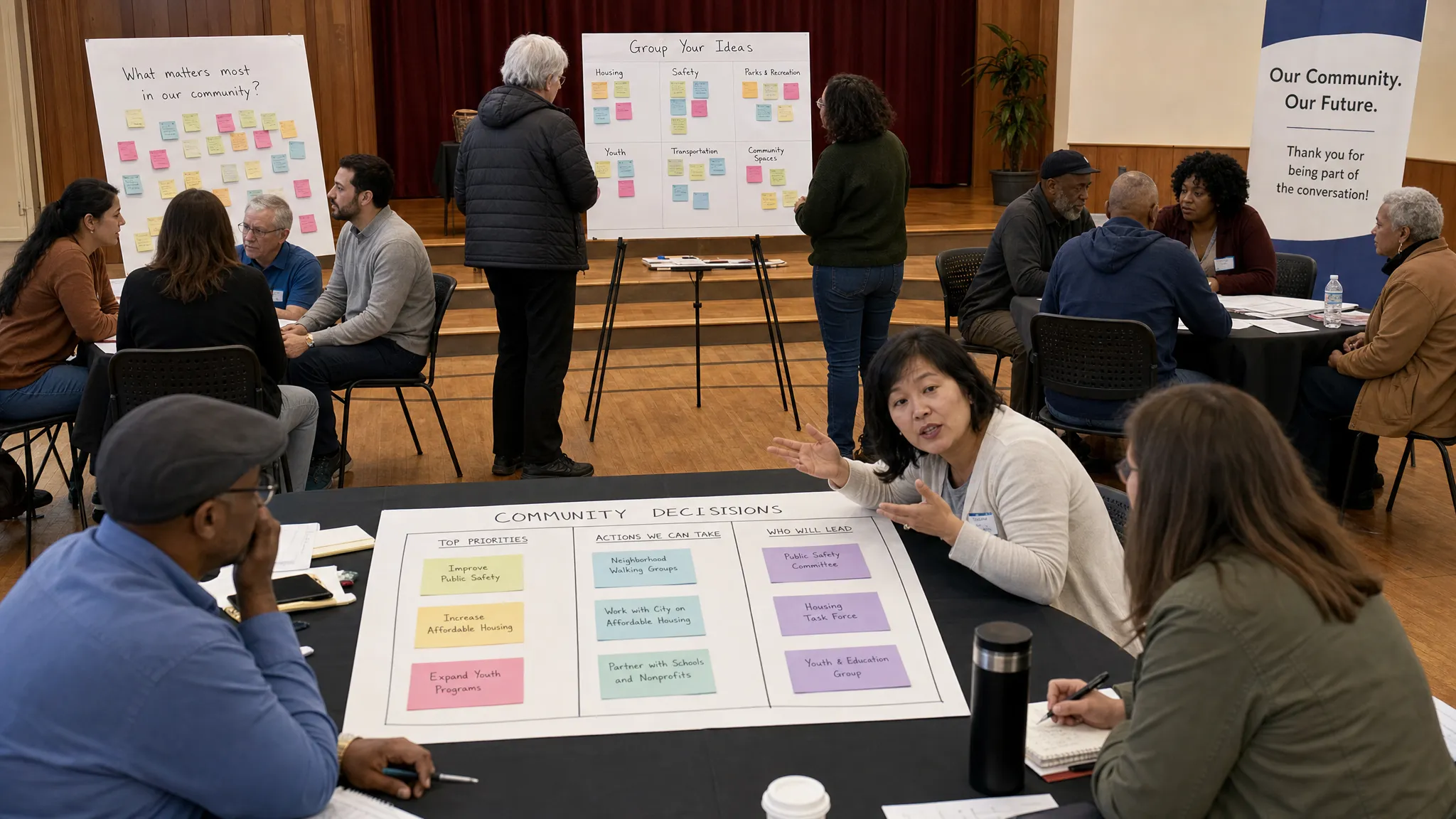
- It creates a path from public conversation to institutional response.
This is where discursive democracy becomes more than a communication style. It becomes civic infrastructure.
The political philosopher Jürgen Habermas is often associated with the idea that democratic legitimacy depends on public reasoning, not only voting procedures. The Stanford Encyclopedia of Philosophy’s overview of deliberative democracy explains this broader tradition: legitimate decisions are strengthened when citizens can participate in reason-giving processes. Discursive democracy extends that instinct beyond formal forums and into the wider public sphere, including media, communities, schools, social platforms, and civic technology.
Why ordinary political debate fails so often
Modern political debate usually looks active. There are panels, posts, comments, speeches, campaigns, marches, polls, interviews, and debates. Yet much of this activity never becomes genuine civic participation because it is not structured to learn.
The failure is not only moral. It is architectural. Most political media systems are designed for attention. Most party systems are designed for victory. Most social platforms are designed for engagement. Very few public systems are designed to convert disagreement into better shared understanding.
That creates predictable problems. Citizens repeat claims without knowing where they came from. Politicians answer the easiest version of a criticism. Journalists compress complex public frustration into spectacle. Online communities reward certainty over curiosity. People who are already alienated become even more convinced that politics is something done to them, not by them.
This matters because democratic habits are not self-sustaining. In its 2024 report, Freedom House found that global freedom declined for the 18th consecutive year. Elections alone do not protect democratic culture when public reasoning collapses, institutions become deaf, and citizens lose faith that participation matters.
Discursive democracy responds by treating debate as a public good. It does not ask everyone to agree. It asks society to build better ways of disagreeing.
Discursive democracy and deliberative democracy are partners, not rivals
Discursive democracy and deliberative democracy are closely related, but they work at different levels.
Deliberative democracy is usually more structured. It includes citizens’ assemblies, panels, juries, consultations, and other settings where people receive information, discuss trade-offs, and reach recommendations. The OECD has documented the rise of these representative deliberative processes, especially for complex policy problems.
Discursive democracy is broader. It includes the conversations that shape what a society considers important before formal deliberation begins. It includes the framing battles, moral language, identity claims, public emotions, and media narratives that determine which issues become visible and which are ignored.
| Democratic practice | Main setting | Main purpose | What it needs to work |
|---|---|---|---|
| Discursive democracy | Public sphere, communities, media, civic platforms | Make claims, values, grievances, and disagreements visible | Open participation, transparency, memory, and fair process |
| Deliberative democracy | Structured forums, citizens’ assemblies, policy panels | Weigh options and produce informed recommendations | Balanced information, facilitation, time, and institutional response |
| Electoral democracy | Elections and party competition | Choose representatives or decide ballot questions | Fair voting rights, trust, accountability, and peaceful transfer of power |
The three should reinforce each other. Discursive democracy broadens the agenda. Deliberative democracy deepens the reasoning. Elections provide formal authority. When one of these dominates while the others weaken, democracy becomes distorted.
For a deeper comparison, JustSocial’s guide to discursive democracy vs deliberative democracy explores how these models differ and why both matter.
The JustSocial connection: from Polis to Cosmopolis
The JustSocial manifesto argues that many of today’s political and educational structures are relics of the Industrial Revolution. Citizens move through standardized institutions, enter the workforce, pay taxes, and then are invited to express political power only occasionally through elections. In that model, the citizen becomes, in the manifesto’s words, too often reduced to a voter, taxpayer, and consumer.
Discursive democracy challenges that reduction. If citizens can speak continuously, identify concerns, test claims, and help shape public priorities, then politics becomes part of everyday civic life again.
This connects directly to the manifesto’s reflection on the Greek Polis. The Polis was not merely an administrative unit. It was a lived community where political participation gave meaning to citizenship. The manifesto’s larger ambition, moving toward a “Cosmopolis,” is not nostalgia for ancient city-states. It is an argument that modern technology may finally make large-scale civic participation possible in ways that older societies could not sustain.
That is the essential bridge: the Polis gave people immediacy, but it could not scale. Modern states scaled, but they lost immediacy. Discursive democracy asks whether we can recover immediacy at scale.
You can see this broader vision in JustSocial’s manifesto, especially where it argues for continuous participation, public transparency, civic technology, and a more educated democratic public.
What makes political debate smarter?
Smarter political debate is not debate with more experts, more data, or more moderation alone. Those can help, but the deeper issue is whether the conversation improves the public’s ability to act.
A smart debate has memory. If the same claim appears repeatedly, the public should be able to see whether it has been answered, disproven, refined, or ignored. Without memory, every argument starts from zero, and bad-faith actors can exhaust the public by repeating settled claims.
A smart debate has traceability. People should be able to see how a grievance moved from a citizen’s statement to a media discussion, a committee agenda, a policy proposal, or an official response. If no institution is responsible for answering, debate becomes therapy without power.
A smart debate has translation. Citizens do not always speak in policy language, and they should not have to. “My rent is impossible,” “my child’s school is failing,” or “my neighborhood feels abandoned” are not technical policy proposals, but they are democratic signals. A healthy discursive system helps translate lived experience into public problems that can be investigated and acted on.
A smart debate has humility. It allows people to say, “I do not know,” “I changed my mind,” or “my side has a weak point here,” without being punished as traitors. Democracy becomes more intelligent when uncertainty is not treated as surrender.
From performative debate to public intelligence
The biggest shift is to stop treating debate as a fight for symbolic victory and start treating it as a method for producing public intelligence.
| Performative political debate | Smarter discursive debate |
|---|---|
| Rewards the most shareable attack | Rewards the clearest claim and strongest reasoning |
| Treats opponents as enemies | Separates people from arguments |
| Repeats the same controversies endlessly | Builds public memory around claims and responses |
| Converts attention into outrage | Converts attention into civic participation |
| Leaves institutions free to ignore public input | Creates visible pathways to official response |
This does not mean politics should become emotionless. The JustSocial manifesto is full of moral urgency, frustration, grief, hope, and anger at systems that fail to hear people. Those emotions are not the enemy of democracy. The danger comes when emotion is harvested for attention but never organized into action.
Discursive democracy should make public emotion legible. It should ask: what pain is being expressed, what claim is being made, what evidence is available, who is affected, who has authority to respond, and what would count as progress?
That is how smarter political debate becomes a bridge between speech and power.
The role of technology in discursive democracy
Technology will not automatically improve democracy. In many cases, it has made political debate faster, angrier, and easier to manipulate. But the answer is not to abandon technology. The answer is to govern it, design it, and aim it toward democratic purpose.
The JustSocial manifesto imagines public platforms where citizens can weigh in more continuously on public affairs, where parliamentary committees and public documents are easier to access, where community votes can be organized, and where analytics can help institutions understand public opinion more precisely. These are not just product ideas. They are pieces of a different democratic architecture.
For discursive democracy, the key question is not “Can we build another platform?” The key question is “Can we build systems that make civic participation more meaningful, transparent, and consequential?”
That requires safeguards. Participation systems must protect privacy, reduce manipulation, distinguish verified civic input from bot activity, and make moderation rules visible. They must also be accessible to people who are not politically fluent, highly educated, or constantly online.
If debate becomes only a game for the loudest and most digitally skilled, it will reproduce the same exclusions it claims to solve.
Education is part of smarter political debate
A society cannot sustain discursive democracy if it educates people only to memorize, compete, and comply. The manifesto’s education section is relevant here because democratic debate is a learned skill. People need practice asking better questions, evaluating sources, listening across difference, and connecting personal experience to public reasoning.
This is where civic participation begins long before adulthood. Students who help choose class topics, discuss shared problems, and learn through projects are not just receiving information. They are rehearsing democratic life.
Smarter political debate should therefore be treated as a civic skill, like literacy. Citizens need to know how to read a budget claim, challenge a statistic, identify a conflict of interest, summarize an opposing argument fairly, and ask what institution has the authority to act.
The goal is not to make everyone a policy expert. The goal is to make democratic participation less alienating and less dependent on professional political language.
A political movement for better disagreement
Every political movement faces a temptation: simplify the world into allies and enemies, then mobilize anger until it wins. That may produce short-term energy, but it rarely produces a healthier democracy.
A movement built around discursive democracy has a harder task. It must model the kind of public culture it wants to create. It must welcome disagreement without becoming directionless. It must criticize institutions without teaching citizens to abandon public life. It must push for structural change while resisting the cheap satisfaction of permanent outrage.
This is especially important for JustSocial because its mission is not merely to win a policy argument. It is to help reimagine the relationship between citizens and the state. If the people are to become a more continuous democratic force, then the quality of public debate matters as much as the quantity of participation.
More voices alone will not save democracy. More organized, visible, accountable, and intelligent civic participation might.
Frequently Asked Questions
What is discursive democracy? Discursive democracy is an approach to democracy that focuses on the quality, openness, and public impact of political conversation. It asks how claims, values, disagreements, and lived experiences can shape public understanding and influence institutions.
How does discursive democracy improve political debate? It makes debate smarter by clarifying claims, testing evidence, preserving public memory, including more voices, and creating pathways from public speech to institutional response.
Is discursive democracy the same as deliberative democracy? No. Deliberative democracy usually refers to structured forums where citizens weigh options and make recommendations. Discursive democracy is broader and includes the public conversations that shape agendas, identities, values, and political meaning.
Why does civic participation need better debate? Civic participation becomes weak when people speak but are not heard, or when debate produces outrage without action. Better debate helps citizens understand one another, pressure institutions more effectively, and participate with greater confidence.
Can technology support discursive democracy? Yes, but only if it is designed with democratic safeguards. Civic technology should protect privacy, increase transparency, reduce manipulation, preserve public memory, and connect participation to real decision-making processes.
Help build a smarter democratic culture
Discursive democracy is not about making politics quieter. It is about making politics more intelligent, more accountable, and more worthy of the people it claims to represent.
If this vision resonates with you, start by reading the JustSocial manifesto and considering how your community, school, workplace, city, or movement could practice better public debate. A healthier democracy will not be built by spectators. It will be built by citizens who insist that public speech should lead somewhere.