A political movement can become visible very quickly and still lack legitimacy where it matters most: in neighborhoods, schools, local councils, workplaces, and community groups. Local legitimacy is not the same as name recognition. It is the earned belief that a movement belongs in the public conversation because it listens, acts transparently, and helps residents gain real influence over shared decisions.
That distinction matters because many people no longer distrust only one party or one leader. They distrust the political process itself. JustSocial's manifesto names the deeper problem clearly: modern citizens are too often reduced to voters, taxpayers, and private consumers. A legitimate movement reverses that reduction. It treats residents as daily participants in public life, not as an audience to mobilize every few years.
For a political movement built around civic participation, local legitimacy grows from repeated proof. People need to see that participation is not theater, deliberation is not manipulation, and technology is not just another tool for collecting attention. They need to experience a different democratic habit in real life.
What local legitimacy really means
Local legitimacy is the public permission a movement earns to organize, propose, convene, and challenge authority in a specific place. It cannot be imported from national media, donor networks, or ideological branding. A movement may have the right ideas and still fail locally if residents feel spoken over, studied, or used.
A useful way to define local legitimacy is through four tests:
| Test | The question residents ask | What legitimacy looks like |
|---|---|---|
| Presence | Are you here only when you need something? | The movement shows up consistently, including between campaigns and crises. |
| Fair process | Can people shape the agenda, or only react to it? | Residents can raise issues, challenge assumptions, and see how input is used. |
| Public proof | Can we inspect what happened? | Meetings, decisions, evidence, commitments, and follow-up are recorded clearly. |
| Shared ownership | Is this movement local, or just local-looking? | Local residents facilitate, lead, disagree, and adapt the work to their reality. |
These tests are simple, but they are demanding. They shift the movement's task from persuasion to public reliability.
Start with the local reality, not the national slogan
Every locality has its own civic memory. A neighborhood may remember a broken development promise, a school closure, an ignored public hearing, a police controversy, a failed transit plan, or years of budget neglect. If a political movement arrives with a fully formed national message before understanding that memory, it will be treated as another outside force.
The first task is not to explain the manifesto. It is to listen for the local wound.
This is where discursive democracy becomes practical. Discursive democracy is not simply free speech or an open comment box. It is the creation of public spaces where people can name problems, hear one another, contest meanings, and form a shared civic vocabulary. Before residents can deliberate on solutions, they often need a place to describe what has been broken.
A movement can begin by asking concrete questions: Which public decision felt most distant from you? Where do you already participate, and where have you given up? What local issue produces the most anger but the least useful action? Which people are always invited into public discussion, and which people are treated as background noise?
The JustSocial manifesto looks back to the Greek Polis as a form of political life where people were members of the public world, not spectators of it. A modern city or state cannot simply recreate the ancient Polis, but the emotional lesson is still relevant: legitimacy grows when public life feels immediate, not remote. A local movement should therefore translate large democratic ideas into nearby experiences, such as a school budget, a zoning decision, a public safety policy, or a neighborhood services plan.
Make civic participation routine enough to trust
Most political organizations ask people to participate in bursts: sign the petition, attend the rally, donate, vote, share the post. Those actions can matter, but they rarely create durable legitimacy by themselves. They are episodic. Residents participate, then the process disappears.
A movement that wants local legitimacy needs a repeatable participation rhythm. It should be clear how an issue enters the movement's agenda, how residents respond, how evidence is gathered, how disagreement is handled, who makes decisions, and when follow-up is published.
That is why JustSocial's idea of building a local People’s Branch is important. The point is not to replace official government overnight. It is to build a civic workflow that makes public participation visible and repeatable at the local level.
A simple local participation cycle might include public issue intake, an open discussion period, a deliberation session, a published decision note, a follow-up deadline, and a later review of what happened. The power is not in the complexity of the system. The power is in the fact that residents can learn the system, use it, and verify that it was followed.
This routine matters because legitimacy is cumulative. One transparent meeting may be appreciated. Ten transparent meetings, with records and follow-through, begin to change expectations.
Use deliberative democracy to turn opinion into judgment
A local movement should not confuse participation with constant polling. Asking people what they think is valuable, but raw opinion often reflects incomplete information, emotional fatigue, or the loudest voices in the room. Deliberative democracy adds a second layer: people examine evidence, hear competing arguments, weigh tradeoffs, and then form a more considered public judgment.
This is essential for local legitimacy because real decisions are difficult. Housing affordability may collide with neighborhood character. Public safety may collide with civil liberties. Climate adaptation may collide with short-term costs. Education reform may collide with staffing realities. A movement that pretends every problem has an easy answer will eventually lose trust.
A legitimate deliberative process should include:
- A clear public question that residents can understand before the meeting begins.
- Balanced background material written in plain language.
- Space for affected residents to speak from lived experience.
- Expert input that informs the room without dominating it.
- Moderation rules that protect disagreement without rewarding abuse.
- A written summary of tradeoffs, minority views, and next steps.
Deliberation also connects directly to the manifesto's criticism of industrial-age public systems. If the old model treats people as passive recipients of policy, deliberative democracy treats them as capable co-authors. It does not assume that every citizen is already informed on every issue. It assumes that citizens deserve processes that help them become informed together.

Publish proof before asking for more trust
Trust is often discussed as an emotional problem, but in politics it is also an information problem. People distrust movements when decisions vanish into private chats, vague summaries, personal loyalties, or charismatic assurances. Local legitimacy requires a public record.
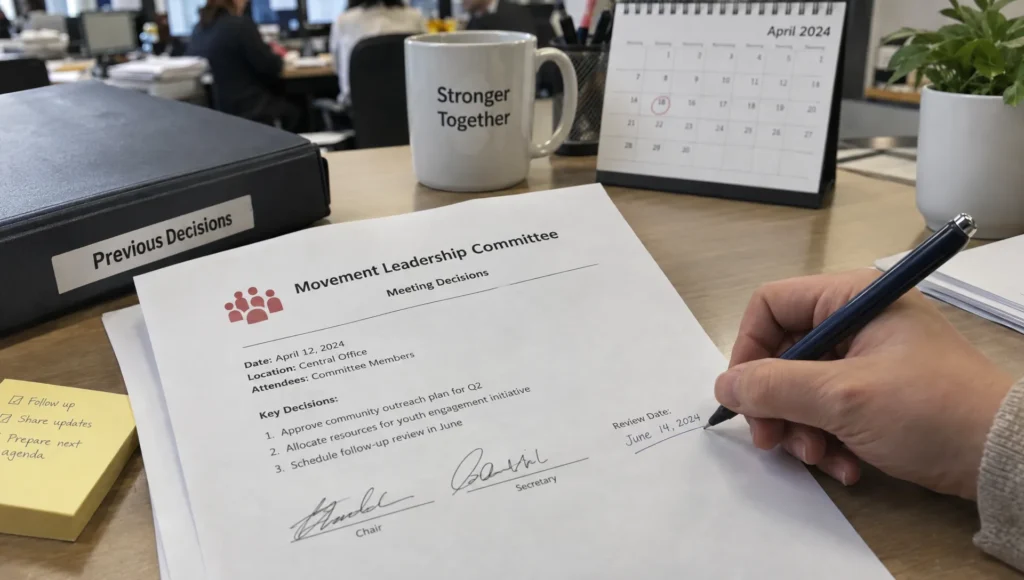
This is where the practice of public receipts becomes central. A receipt does not need to be bureaucratic or defensive. It simply answers the questions residents will eventually ask: What was proposed? Who was consulted? What evidence was used? What objections were raised? What decision was made? Who is responsible for follow-up? What changed after public input?
Receipts protect the movement as well as the public. They reduce rumor, make leadership accountable, and allow new participants to join without depending on insider memory. They also make disagreement healthier. When dissent is recorded fairly, people are less likely to feel erased even if they lose a vote or fail to persuade the room.
For a political movement, publishing proof is not a public relations tactic. It is a democratic ethic.
Use technology to protect participation, not replace it
JustSocial's manifesto argues that the technology needed for more continuous civic participation already exists: social platforms, analytics, cloud storage, AI systems, and possibly blockchain for security and confidentiality. The challenge is not merely technical. It is institutional and moral.
Local legitimacy depends on how technology is used. A participation platform can empower citizens, but it can also become surveillance, manipulation, or shallow engagement if the rules are unclear. Residents will ask practical questions: Who owns the data? Can participation be anonymous where appropriate? How are identities verified when votes matter? Can people participate offline? Are algorithms shaping what people see? Can public officials inspect aggregate opinion without exposing personal identity?
A locally legitimate technology strategy should follow a few principles: collect the least data necessary, separate identity verification from public expression when possible, publish moderation rules, allow offline participation, and make digital records easy for ordinary residents to inspect.
For residents who live abroad or follow civic debates across borders, digital access also touches media access and connection security. Tools that help people securely access francophone TV while abroad illustrate a broader civic reality: public participation increasingly depends on resilient access across devices, networks, and national boundaries. Still, a democratic movement should never make civic belonging depend entirely on private tools. Technology should widen the door, not become the doorkeeper.
Let local leaders emerge before national figures arrive
A movement that depends on one founder, one spokesperson, or one national brand will struggle to build local legitimacy. Residents need to see people they know taking responsibility. They need local facilitators, record keepers, organizers, educators, critics, and bridge-builders.
This does not mean abandoning shared principles. It means separating values from control. The manifesto argues that elected officials should become more like pipelines for gathering consensus and implementing public policy. A local political movement can model that principle internally by making leadership facilitative rather than possessive.
Rotating facilitation, open leadership criteria, transparent meeting notes, and term-limited local roles can all help. So can welcoming people who are not natural activists: parents, shop owners, teachers, students, retirees, public workers, immigrants, and people who have never joined a political meeting before.
The question is not only who agrees with the movement. The deeper question is who feels permitted to help shape it.
Partner locally without being captured
Local legitimacy often requires cooperation with existing institutions: schools, neighborhood associations, unions, religious communities, nonprofits, businesses, professional groups, and municipal offices. A movement that refuses all partnership can become isolated. A movement that accepts every partnership uncritically can become captured.
The balance is transparency. Partnerships should be public, the terms should be clear, and no partner should receive hidden agenda-setting power. If a business sponsors a civic forum, disclose it. If a nonprofit helps recruit participants, disclose it. If local officials attend, make clear whether they are listening, answering questions, or asking for endorsement.
This is especially important in education. The JustSocial manifesto treats educational reform as inseparable from democratic reform because citizens are not born knowing how to participate well. A local movement can support youth civic participation without pretending minors have the same legal role as adult voters. Students can help identify issues, practice deliberation, question public officials, and learn how public decisions are made. That is not partisan recruitment when done transparently. It is civic formation.
Measure legitimacy before measuring scale
Movements often measure growth through followers, donations, media mentions, event turnout, or election results. Those metrics can be useful, but they do not prove local legitimacy. A movement can grow quickly while becoming brittle, shallow, or distrusted.
Better legitimacy metrics focus on participation quality, public proof, and follow-through.
| Legitimacy dimension | What to track | Why it matters |
|---|---|---|
| Participation breadth | Neighborhoods, age groups, professions, and communities represented | Prevents the movement from becoming a narrow activist circle. |
| Deliberation quality | Evidence reviewed, tradeoffs documented, dissent included | Shows that participation is more than opinion collection. |
| Follow-through | Commitments completed, delayed, or abandoned with explanations | Converts promises into inspectable accountability. |
| Transparency | Public notes, decision logs, budgets, and partnership disclosures | Makes the movement easier to trust and harder to capture. |
| Local leadership | Number of trained facilitators and organizers from the community | Reduces dependence on outside personalities or central control. |
| Return participation | People who come back after disagreement or disappointment | Indicates whether the process feels fair even when outcomes vary. |
The most important signal may be this: do people who disagree with the movement still believe the process is worth engaging? If yes, legitimacy is beginning to form.
Avoid the common legitimacy traps
Some movements lose local trust not because their values are wrong, but because their habits are careless. The most common traps are predictable.
- Parachute activism happens when organizers arrive during crisis moments, extract stories and energy, then disappear.
- Survey theater happens when residents are asked for input after the real decision has already been made.
- Tech theater happens when a platform is presented as democracy without clear rules, safeguards, or follow-up.
- Purity politics happens when disagreement is treated as betrayal instead of a democratic resource.
- Leader worship happens when the movement's identity becomes inseparable from one public figure.
Each trap has the same root: the movement asks for trust faster than it builds structures worthy of trust.
From local legitimacy to a modern democracy
A political movement becomes locally legitimate when residents can say: I know how to enter the process, I know how decisions are made, I can inspect the record, and even when I disagree, I am not erased.
That is the bridge between civic participation, discursive democracy, and deliberative democracy. Discursive spaces let people name what they experience. Deliberative spaces help them weigh what should be done. Participation systems make the work repeatable. Public receipts make it trustworthy.
This is also how the large vision of continuous democracy becomes real. It does not begin as an abstract national platform. It begins when a local community learns to hear itself, reason together, document its choices, and demand that representatives treat public opinion as a living civic force rather than a periodic election result.
Frequently Asked Questions
What gives a political movement local legitimacy? A political movement gains local legitimacy by showing consistent presence, fair participation processes, transparent records, and real follow-through on commitments. Legitimacy is earned when residents can shape the agenda and verify what happened afterward.
How is civic participation different from mobilization? Mobilization asks people to support a goal that is often already defined. Civic participation lets people help define the issue, examine options, influence decisions, and hold organizers accountable after the decision is made.
Why does deliberative democracy matter locally? Deliberative democracy helps residents move beyond first reactions by reviewing evidence, hearing affected people, weighing tradeoffs, and forming more considered judgments. This is especially important for complex local issues where every option has consequences.
Can technology build legitimacy for a political movement? Technology can support legitimacy if it makes participation easier, records clearer, and decision-making more transparent. It damages legitimacy when it collects data without safeguards, excludes offline residents, or substitutes shallow clicks for real deliberation.
Build legitimacy where democracy is lived
If the goal is a modern democracy governed with the people rather than above them, the work has to become local, inspectable, and repeatable. Start by reading the JustSocial manifesto, then help turn its principles into civic participation practices your community can actually use.
A political movement does not become legitimate by declaring that it represents the people. It becomes legitimate when the people can see themselves in the process, challenge it, improve it, and carry it forward.