
Most political systems are built around speaking. Candidates speak, parties speak, commentators speak, citizens shout back through polls, protests and social media. Every few years, the voter is invited to speak in the most compressed possible form, a mark on a ballot.
What remains underdeveloped is the democratic art of listening.
Discursive democracy begins from a simple claim: public speech is not enough if institutions do not hear it, interpret it, answer it and remember it. A society can have endless expression and still leave people politically mute. The missing link is not more noise. It is a public system that turns civic participation into meaningful influence between elections.
That is why the politics of listening matters. It is not a softer version of politics. It is a deeper one. Listening decides whose pain becomes visible, whose evidence is taken seriously, whose language is translated into policy and whose objections are dismissed as background noise.
What discursive democracy adds to democracy
Discursive democracy is often discussed alongside deliberative democracy, but the two are not identical. Deliberative democracy usually focuses on structured discussion under fair conditions, where citizens exchange reasons and ideally revise their views. Discursive democracy has a wider lens. It asks whether the entire public conversation, including news, social media, hearings, schools, neighborhood forums and parliamentary debate, is organized so people can make claims, contest power and receive an answer.
In the JustSocial manifesto, Yuval D. Vered describes the modern citizen as reduced to three roles: voter, taxpayer and private consumer. That diagnosis is central to discursive democracy. A person who is only counted every few years is not truly participating in the state. A person who pays taxes but cannot see how public priorities are formed is not a co-author of the social contract. A person who consumes politics as media content is not yet exercising democratic power.
Discursive democracy tries to change the relationship. It does not say every public comment should instantly become law. It says public reasoning must become a continuous part of governance. Citizens should be able to speak, organize, object, propose and be answered in visible ways. Representatives should not guess what people think through campaign consultants and media storms. They should have institutional tools that help them listen precisely and respond publicly.
This is where discursive democracy becomes more than a theory. It becomes a design challenge for a political movement.
Listening is democratic power
Listening is often treated as politeness, as if a leader who hears citizens patiently has already fulfilled the democratic obligation. That is not enough. In politics, listening is power because it shapes what counts as reality.
If tenants describe unsafe housing and the state has no channel to aggregate, verify and respond to those claims, the problem remains private suffering. If parents and teachers repeatedly describe the mismatch between industrial schooling and modern life but education policy continues as if standardized routines were natural law, the system is not listening. If workers describe burnout, remote work needs or caregiving pressures and the state only measures employment through older categories, civic experience is being flattened.
The same applies to issues that rarely fit into headline politics. Public life often ignores bodily, caregiving and age-related experiences until they become organized knowledge. Evidence-based resources such as The Menopause Kit show the value of arranging information around lived needs, symptoms and practical choices rather than around institutional convenience. A listening democracy should learn from that logic: start with what people are actually experiencing, then build public knowledge around it.
The politics of listening is therefore not passive. It requires active interpretation. It asks institutions to notice patterns, distinguish evidence from manipulation, connect personal stories to structural causes and explain what will or will not be done.
Hearing, consulting and listening are not the same
Many governments claim to listen because they hold hearings, publish surveys or open comment periods. These tools can help, but they often produce symbolic participation. Citizens speak into a process whose real decision has already been made. Discursive democracy demands a higher standard.
| Democratic mode | What institutions usually do | What citizens experience | Democratic value |
|---|---|---|---|
| Hearing | Allow testimony or public comment | People speak, but may not know whether it mattered | Basic access |
| Consulting | Ask for feedback through surveys or meetings | People are counted, but often not answered | Limited input |
| Deliberating | Create structured spaces for reasoned discussion | People exchange views and may revise positions | Better judgment |
| Discursive listening | Build continuous channels, public feedback loops and institutional memory | People can see how public voice enters decisions | Ongoing influence |
The last row is the democratic frontier. It is also the most difficult. Listening requires institutions to expose themselves to interruption. It asks public officials to admit that knowledge does not only move from the state downward. It also moves from citizens upward, across communities and through lived experience.
From the Polis to the Cosmopolis
JustSocial's manifesto draws on Charles Wayper's description of the Greek Polis as a political community where public life felt immediate, vivid and personal. The ancient Polis was not merely a place. It was a way of belonging. Citizens could feel the public world as something close enough to affect and be affected by.
Modern nation-states lost much of that intimacy. Scale made direct public influence harder. Bureaucracy created distance. Mass media turned many citizens into spectators. Party systems narrowed political choice into prepackaged lists and campaigns. The four-year election cycle became a substitute for the daily life of democracy.
The manifesto's answer is the Cosmopolis, a modern political culture that uses technology to restore the immediacy of participation at scale. Discursive democracy is one of the cultural habits such a Cosmopolis would need. Technology can collect signals, structure debate and publish records, but only a politics of listening can make those tools democratic.
Without listening, digital democracy becomes another dashboard for elites. With listening, civic participation can become a living public layer that helps representatives, journalists, academics and citizens understand one another in real time.
The duties of a listening institution
A government that practices discursive democracy cannot simply open a comment box and call the work complete. It needs duties that citizens can recognize and evaluate.
- Receive public voice: People need accessible channels to raise concerns, propose ideas, support campaigns and respond to public decisions.
- Interpret with care: Institutions must identify patterns without erasing minority positions, local context or emotional truth.
- Reply in public: Citizens deserve to know whether their input changed a decision, failed to change it or needs more evidence.
- Remember over time: Public participation should not vanish after each hearing, survey or election cycle.
- Protect the space: A listening system must defend privacy, safety and relevance without becoming a censorship machine.
These duties connect directly to JustSocial's call for technology-driven civic infrastructure. The manifesto imagines public platforms for action, committee transparency, community voting and analytics that make citizen opinion visible to decision-makers. Those tools matter because listening at national scale cannot rely on charisma or goodwill. It needs systems.
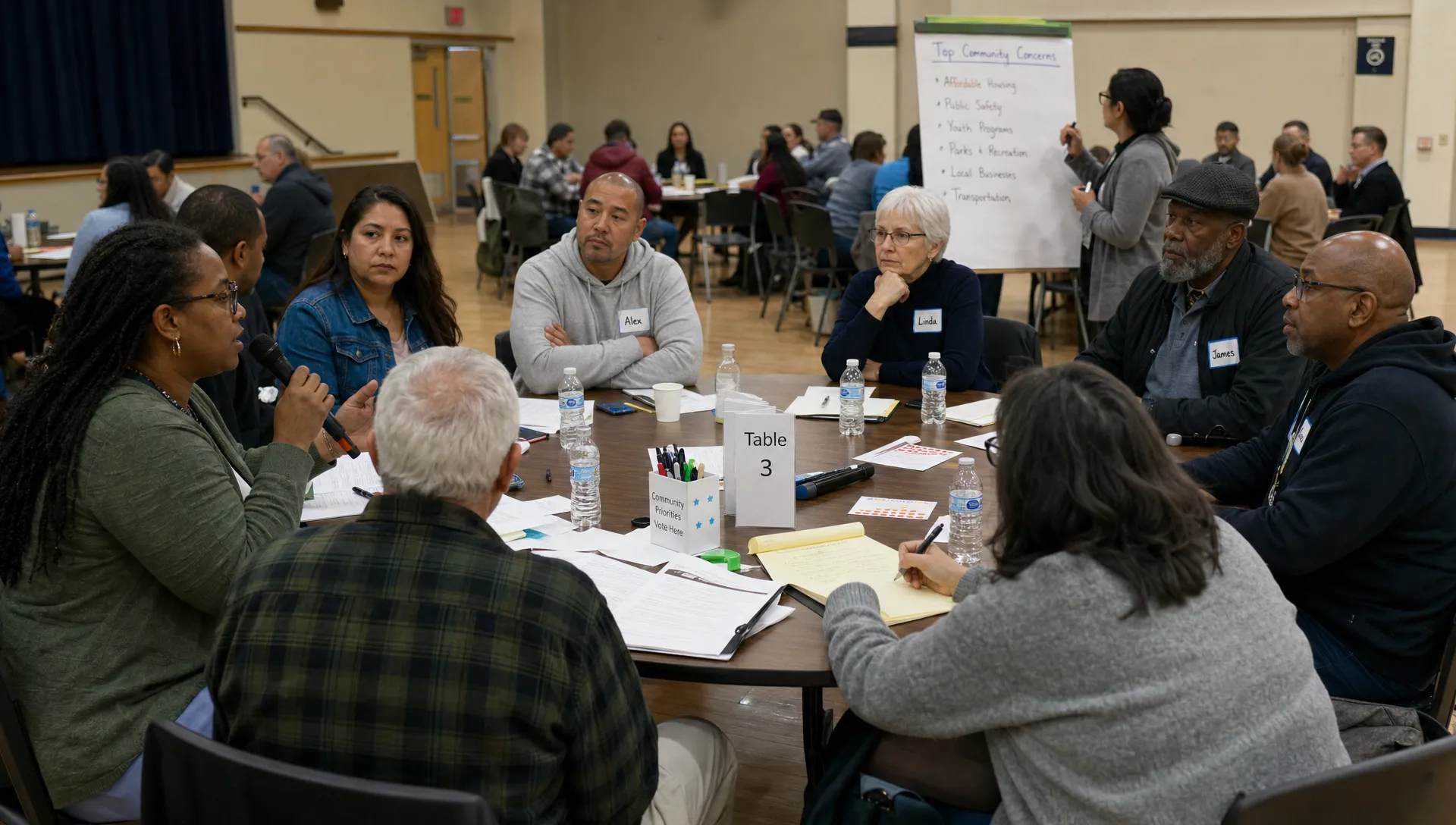
Listening needs conflict, not false harmony
A common misunderstanding is that listening means everyone must become agreeable. That is not democracy. Democratic listening does not remove conflict. It disciplines conflict so disagreement can produce knowledge instead of exhaustion.
People enter politics with different interests, histories and fears. Some conflicts are moral. Some are economic. Some come from mistrust built over years of being ignored. A discursive democracy does not pretend these tensions disappear through nicer language. It creates conditions where citizens can name conflicts clearly, test claims against evidence and hear why others see the issue differently.
This is where rules and moderation become democratic infrastructure. JustSocial has already explored practical standards for healthier public debate and the need for better moderation in civic spaces. The point is not to sanitize politics. The point is to prevent intimidation, disinformation and performative outrage from crowding out genuine public reasoning.
Listening should make room for anger, but it should not reward abuse. It should make room for identity, but it should not reduce people to demographic tokens. It should make room for expertise, but it should not allow experts to replace public judgment. The balance is hard, but representative systems already make hard choices in the dark. Discursive democracy asks them to make those choices in public.
Identity belongs in the listening system
The manifesto proposes that citizens may choose to identify parts of their identity within public democratic platforms, while preserving anonymity where needed. That idea matters because public opinion is not only a total number. A policy can affect parents differently from nonparents, renters differently from homeowners, students differently from retirees and minorities differently from majorities.
Discursive democracy should not use identity as a marketing category. It should use it as a way to ask better public questions. Who is affected? Who is missing from the conversation? Which groups carry the cost of a decision? Which objections come from direct experience and which come from ideological reflex?
This is also why minors appear in the manifesto's vision. They may not hold full voting rights in the representative system, but they live inside public decisions every day, especially in education. A listening democracy can allow young people to participate in age-appropriate ways without pretending that participation is the same as adult electoral power.
The deeper point is that people are not abstract units. They are situated human beings. A politics that refuses to hear that will keep producing policies that look neutral on paper and feel alien in life.
Technology can scale listening, but it cannot replace judgment
The current technological revolution gives democracy tools the ancient Polis never had: online platforms, cloud storage, analytics, artificial intelligence, secure identity systems and potentially blockchain-based records. JustSocial's manifesto argues that the public sector has been too slow to absorb these tools, even as private platforms use them constantly to measure behavior, optimize engagement and shape attention.
Discursive democracy should take that technological lesson seriously, but not naively. Listening at scale requires aggregation, classification and summarization. AI may help summarize public comments. Analytics may help reveal patterns across communities. Secure online voting platforms may help communities make preferences visible. Public repositories may help citizens track laws, committee records and amendments.
Yet democratic judgment cannot be outsourced to software. If an algorithm clusters citizen views, citizens should know the categories. If a platform moderates debate, the rules should be visible. If public opinion data informs representatives, the public should know how much weight that data receives. If anonymity is promised, the technical and legal safeguards must be serious.
A listening democracy cannot be a surveillance democracy. The goal is citizen empowerment, not behavioral control. The state must hear the people without owning their inner lives.
What a listening government would change
A politics of listening would alter the everyday texture of government. Public hearings would no longer be open microphones attached to closed decisions. Agencies would publish the questions they are trying to answer, the evidence they have and the citizen input they need. Parliamentary committees would make records easier to find, quote, discuss and challenge. Schools would teach civic participation by practicing it, not only by describing institutions in textbooks.
Representatives would still represent. Courts would still protect rights. Professionals would still administer complex systems. Academia, in the manifesto's proposed structure, would help create public advisories and raise standards of evidence. The difference is that the people would become a continuous democratic branch in practice, not only a symbolic source of legitimacy.
This would also change political movements. A movement built on listening cannot only broadcast slogans. It must build spaces where supporters, critics and uncertain citizens can shape the agenda. It must be willing to hear uncomfortable feedback before it gains power, not only after.
That is a harder path than normal campaigning. It is also more consistent with the claim that the people collectively have answers no individual leader can possess alone.
The risk of not listening
When institutions do not listen, citizens do not simply become quiet. They migrate to spaces that will listen to them, even if those spaces reward paranoia, rage or manipulation. A person ignored by official channels may become highly visible in extremist channels. A community dismissed by mainstream politics may become vulnerable to anyone who offers recognition.
This is one reason democracy cannot survive on elections alone. Elections choose temporary authority. They do not, by themselves, maintain the relationship between people and state. That relationship is maintained through repeated contact, visible responsiveness and shared public meaning.
Discursive democracy is not a cure for every democratic failure. It will not eliminate corruption, bad faith or inequality. But it can make democratic life harder to fake. If representatives claim to listen, the public can ask where the record is. If agencies claim consultation, citizens can ask how input changed the policy. If platforms claim neutrality, users can inspect the rules. If a political movement claims to speak for the people, people can speak back.
Frequently Asked Questions
What is discursive democracy? Discursive democracy is a model of democracy focused on public communication, reason-giving, listening and institutional response. It asks whether citizens can participate in ongoing public conversation and whether that conversation affects political judgment.
How is discursive democracy different from deliberative democracy? Deliberative democracy often focuses on structured forums where people exchange reasons. Discursive democracy includes those forums, but also looks at the broader public sphere, including media, online platforms, hearings, education and everyday civic participation.
Does listening mean the government must obey every public opinion signal? No. Listening is not the same as automatic obedience. A listening government measures public opinion, explains decisions, protects rights and remains accountable for why it accepted or rejected public input.
Why does JustSocial connect discursive democracy to technology? Modern states are too large for ancient forms of direct civic life, but technology can help organize participation, transparency and feedback at scale. The challenge is to build tools that empower citizens rather than manipulate them.
Can a political movement practice the politics of listening before it wins power? Yes. A movement can model discursive democracy by inviting criticism, documenting public input, explaining its decisions and building civic spaces where supporters are participants rather than passive audiences.
Join a politics that listens
The politics of listening begins before institutions are reformed. It begins when citizens refuse to accept a public role limited to voting, paying and consuming.
JustSocial is building a political movement around continuous civic participation, direct democratic tools and public transparency. If this vision resonates, explore JustSocial, read the manifesto, share the ideas and consider how your own community could practice listening as a form of democratic power.
A modern democracy should not fear the voice of the people. It should learn how to hear it.





