
The public cannot govern what it cannot understand.
That sentence sounds obvious, but most modern political systems behave as if it were false. Laws are written for lawyers. Budget documents are written for accountants. Public notices are written for officials who already know the process. Committee transcripts, regulatory proposals and consultation pages often assume that citizens have time, training and institutional memory before they can even form an opinion.
Discursive democracy starts from a different premise: democracy is not only the vote at the end of a process. It is also the language that shapes what people notice, how they argue, which options feel possible and whether institutions can hear them. If public language is inaccessible, civic participation becomes formally open but practically closed.
Accessible public language is not a cosmetic reform. It is infrastructure for a political movement that wants citizens to participate continuously, not once every few years. In a digital democracy, where public debate, online voting platforms and government transparency tools may sit behind screens, clarity becomes as important as cybersecurity. A secure system that ordinary people cannot understand still fails the democratic test.
Why language is a democratic gatekeeper
Every political system has thresholds for participation. Some are visible, such as age, citizenship or registration. Others are hidden inside language.
A parent may want to respond to a school policy consultation but cannot decode the procedural notice. A renter may care deeply about zoning reform but gives up after the first page of statutory language. A small business owner may want to comment on a procurement rule but cannot tell whether the proposal affects them. In each case, the door is technically open. The language is what keeps people outside.
This matters because discursive democracy depends on the exchange of public reasons. Citizens do not merely express preferences. They explain why a policy helps, harms, excludes or fails. Institutions then have a duty to interpret those reasons, respond to them and show how they influenced the decision.
When public language is obscure, the people most fluent in bureaucracy gain disproportionate influence. Lawyers, lobbyists, consultants and professional advocates can still participate. Citizens with less time, less education, disabilities, limited language access or distrust of institutions are filtered out before the debate begins.
The result is not neutral. It bends democracy toward organized insiders.
What discursive democracy adds to plain language
Plain language asks whether a reader can understand a text. Discursive democracy asks a second question: can the reader use that text to participate in public reasoning?
That difference matters. A short sentence can still hide the real stakes. A simple summary can still frame one side as reasonable and another as extreme. A beautifully designed participation page can still omit the decision timeline, budget tradeoffs or legal constraints. Accessibility is not only about reading ease. It is about civic usefulness.
The U.S. Plain Writing Act of 2010 recognized that government communication should be clear enough for the public to understand and use. Digital democracy needs to go further. If citizens are expected to weigh in through petitions, public consultations, participatory budgeting or an online voting platform, the language around those tools must explain what power people actually have.
A discursive democracy approach to public language should make six things clear:
- What decision is being made: Citizens should know whether they are influencing a law, a budget, an advisory recommendation, an enforcement priority or a symbolic statement.
- Who has authority: The public should know which office, committee, agency or representative can act on the input.
- What choices are available: Participation is stronger when people can compare real options rather than react to vague aspirations.
- What evidence is being used: Data, expert claims and assumptions should be visible in language that non-specialists can inspect.
- How disagreement will be handled: Minority views should not disappear into a final report that says stakeholders were consulted.
- What happens next: Every civic invitation should explain the timeline, feedback loop and practical consequence of participation.
Without those elements, public language may be readable but still democratically weak.
The JustSocial manifesto and the problem of being unheard
The JustSocial manifesto argues that citizens are too often reduced to three roles: voter, taxpayer and private consumer. That is a language problem as much as a structural one.
If the state speaks to citizens only in commands, forms, campaign slogans and legal notices, it teaches people that public life belongs to someone else. The citizen becomes a recipient of decisions rather than a participant in meaning. Even when people protest, post or vote, their language may not enter the machinery of government in a way that can be measured, interpreted and answered.
The manifesto's idea of continuous direct democracy depends on changing that relationship. Citizens need tools, but tools alone are not enough. A petition button, voting interface or civic dashboard only empowers people if the surrounding language explains the issue, the stakes and the route from expression to influence.
This is where accessible public language becomes central to citizen empowerment. It is the bridge between emotion and policy, between frustration and public problem framing, between scattered civic speech and accountable institutional response.
JustSocial has already explored how communities can define issues before decisions are made in its work on discursive democracy for public problem framing. Accessible language is what lets that framing include more than the loudest or most credentialed voices.
Accessible public language is not simplification of the people
One common objection to accessible language is that politics is complex. That objection gets the problem backward. Public language should be accessible because politics is complex.
Citizens can handle tradeoffs. They can understand competing values, budget limits, constitutional constraints and implementation risks. What they should not have to handle is unnecessary jargon, unexplained acronyms, procedural fog or documents written to protect institutions from accountability.
Accessible language does not mean deleting complexity. It means organizing complexity so people can reason with it.
| Barrier in public language | Democratic damage | Discursive democracy alternative |
|---|---|---|
| Legal or technical terms without definitions | Citizens cannot judge the proposal on equal footing | Define key terms near first use and link to full legal text |
| Vague civic invitations such as give feedback | People do not know what their input can change | State the decision, authority, deadline and possible outcomes |
| One-sided summaries | The public inherits the institution's preferred frame | Present major arguments, affected groups and known uncertainties |
| Long PDFs with no structure | Participation favors people with time and training | Use layered summaries, headings, source links and searchable text |
| No response after participation | Civic trust declines because speech feels performative | Publish public receipts showing what was heard and what changed |
The goal is not to make every citizen an expert in every field. The goal is to make public reasoning possible across differences in expertise, time, identity and life experience.
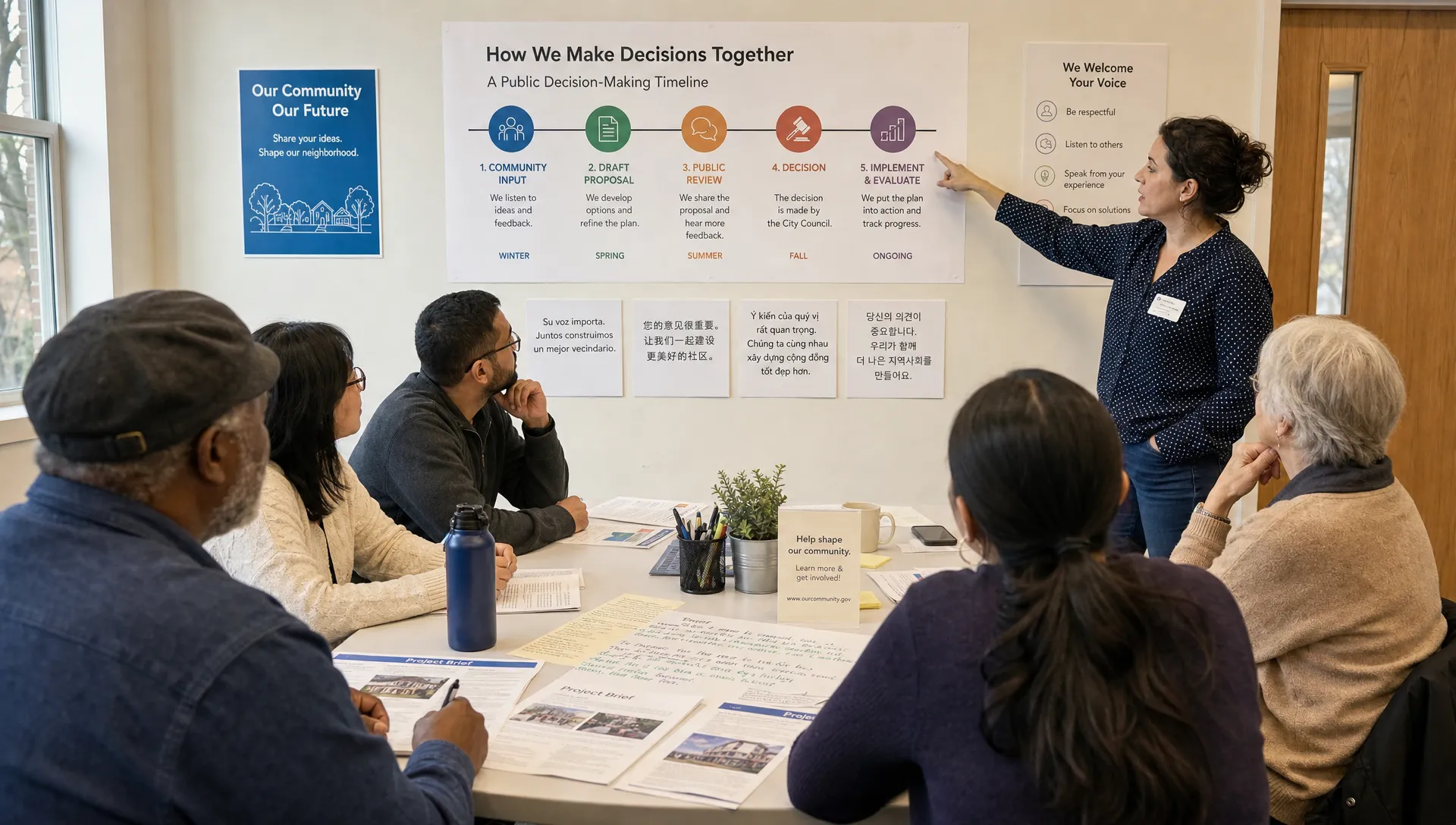
The four layers of accessible civic communication
For discursive democracy to work at scale, public language should be designed in layers. Different citizens need different levels of detail at different moments. A person encountering an issue for the first time may need a one-page civic brief. A neighborhood organizer may need datasets and full committee records. A journalist may need version history, source documents and decision logs.
A healthy public language system gives all of them a path in.
1. The civic summary
The civic summary answers the first democratic question: what is this about and why should I care?
It should name the decision, the affected public, the main tradeoffs and the deadline. It should avoid partisan framing unless the summary is explicitly presenting a party position. For example, a zoning proposal should not be described only as housing modernization or neighborhood destruction. A discursive summary would explain what changes, who may benefit, who may be burdened and what evidence each side is using.
2. The argument map
Public debate becomes more useful when citizens can see the structure of disagreement. An argument map does not need to be a complicated diagram. It can be a simple page showing the main claims, reasons, evidence and counterarguments.
This is especially important in polarized environments. When people cannot see the best version of the other side's reasoning, they often argue against caricatures. Accessible public language should make disagreement legible without forcing false consensus.
3. The source layer
Accessible language must not become a substitute for evidence. Summaries should connect to budgets, legal texts, academic advisories, committee recordings, datasets and implementation reports. The reader should be able to move from plain explanation to primary source.
This connects directly to the manifesto's proposal for transparent public infrastructure, including repositories of state laws and public records. A law repository is more democratic when it includes plain summaries, cross-references and a visible path from current law to proposed change.
4. The response layer
Citizens need to know whether their speech mattered. This is where public receipts become essential. A public receipt is a short, public record that shows how civic input moved through a decision process: what was said, how it was categorized, which evidence was attached, who reviewed it and what response followed.
JustSocial's argument for public receipts in discursive democracy fits naturally with accessible language. Receipts should not be written in bureaucratic code. They should let ordinary participants recognize their contribution and understand the institutional answer.
Accessibility also means digital and disability access
Public language is not only words. It is format, interface and availability.
A consultation page that works only on a desktop excludes people who rely on phones. A scanned PDF excludes people using screen readers. A meeting notice without captions, translation or plain agenda design excludes people before discussion begins. In digital democracy, accessibility standards are part of democratic legitimacy.
The W3C Web Content Accessibility Guidelines provide a technical foundation for making web content more perceivable, operable, understandable and robust. Civic institutions should treat these principles as democratic basics, not optional compliance tasks.
For an online voting platform or public participation tool, accessible language should appear at every step: registration, identity verification, issue explanation, ballot wording, confirmation and post-vote feedback. Citizens should understand not only what they selected but how the selection will be counted, protected and used.
This also means designing for multilingual communities. Translation cannot be an afterthought added after the public debate has already formed. If a government or civic platform asks people to participate, the invitation should reach them in the languages they actually use. Machine translation and AI summaries may help, but public institutions need human review, correction channels and transparency about how summaries were produced.
How accessible language supports deliberative democracy
Deliberative democracy usually focuses on reasoned discussion before collective decision-making. Discursive democracy is broader. It includes the public narratives, media frames, comments, hearings, posts, petitions and institutional explanations that surround formal deliberation.
Accessible public language strengthens both.
In deliberative settings, such as citizens' assemblies or participatory budgeting meetings, clear language helps participants compare options without relying on status or rhetorical force. In discursive settings, such as public debate across media and civic platforms, clear language helps scattered voices become intelligible to institutions.
The two should reinforce each other. Discursive democracy gathers and structures public meaning. Deliberative democracy slows selected questions down for deeper judgment. Continuous direct democracy then gives citizens more frequent ways to express preference, revise opinion and hold institutions accountable.
That sequence only works if people understand the words that move them through it.
Guardrails against manipulative simplicity
Accessible language can be abused. A government can write a simple slogan that hides a harmful policy. A movement can turn complexity into propaganda. A platform can use friendly wording to push users toward a preferred answer.
For that reason, accessible public language needs democratic guardrails.
First, summaries should be source-linked. If a claim rests on a budget estimate, legal interpretation or expert advisory, the public should be able to inspect the source. Second, contested claims should be labeled as contested rather than presented as fact. Third, ballot language should be reviewed for neutrality, especially when the institution writing the question has a preferred outcome.
Fourth, AI-generated summaries should be marked, versioned and open to correction. AI can help translate dense material into usable explanations, but it should not become an invisible civic editor. In a political system built around participation and transparency, the public has a right to know how public language is produced.
Finally, institutions should preserve minority reasoning. A majority decision can be legitimate without pretending dissent disappeared. Discursive democracy is healthier when losing arguments remain visible, archived and available for future reconsideration.
What this looks like in practice
A city, school district, ministry or civic technology platform can begin with a simple redesign of public-facing language.
Instead of publishing only a long proposal, publish a civic brief with the decision, timeline, options, affected groups and open questions. Instead of asking for general comments, ask structured questions that help people explain values, evidence and lived experience. Instead of reporting that the public was consulted, publish a response showing which themes emerged and how officials acted on them.
For a political movement, the same principle applies internally. Campaign pages, volunteer calls, policy statements and voting tools should be written so a newcomer can understand the mission without already speaking the language of activists. Accessible public language makes a movement easier to join, criticize and improve.
That matters for JustSocial because its vision is not merely to win attention. It is to help build continuous direct democracy through technology, transparency and citizen empowerment. A movement that wants the people to govern must speak in a way the people can use.
Frequently Asked Questions
What is discursive democracy? Discursive democracy is an approach to democracy that treats public reasoning, debate and shared meaning as central parts of self-government. It focuses on how citizens express reasons, hear one another and influence institutions before and after formal votes.
How does accessible public language improve civic participation? Accessible public language lowers the hidden barriers created by jargon, unclear procedures and inaccessible formats. It helps more citizens understand decisions, compare arguments and see how their input can affect public outcomes.
Is plain language the same as oversimplifying politics? No. Good public language does not remove complexity. It organizes complexity with definitions, summaries, evidence, tradeoffs and source links so citizens can reason about difficult issues without being excluded by bureaucratic style.
Why does this matter for online voting platforms? Online voting platforms need more than secure ballots. They need clear explanations of the issue, the authority behind the vote, the effect of each option, privacy protections and what happens after votes are counted.
How can governments start using more accessible civic language? They can begin by rewriting public notices, consultation pages and policy summaries around the user's civic task: understand the decision, evaluate the options, submit a reasoned view and receive a public response.
Help make public language democratic
A continuous direct democracy cannot run on continuous confusion. If citizens are expected to participate in public life more often, public institutions and civic platforms must speak clearly enough for that participation to matter.
JustSocial is a political movement working toward direct democracy tools, public transparency and citizen empowerment through technology. If this vision resonates with you, explore the movement at JustSocial.io and read the manifesto to see how accessible public language fits into a broader call for a modern democracy governed by the people, for the people.





