
Policy drafts are where democratic promises either become usable public rules or disappear into administrative language. A city transportation plan, an education reform proposal, a housing ordinance or a national AI regulation can all be opened for feedback, but openness alone does not make the process democratic. If people are invited to comment without seeing how their reasons are heard, categorized and answered, the exercise becomes a suggestion box with better branding.
Discursive democracy for policy draft feedback offers a more serious model. It treats public feedback as structured reasoning around a text, not as a popularity contest or a comment storm. Citizens are asked to explain what a clause would do, who it would affect, what tradeoff it creates and how it should be rewritten. Institutions, in return, must show what they accepted, what they rejected and why.
This connects directly to the civic vision in the JustSocial manifesto: citizens should not be reduced to voters, taxpayers and private consumers. They should have an integral day-to-day role in democracy. Draft feedback is one practical place to begin because it moves civic participation from protest after the fact to influence while policy is still being shaped.
Why policy draft feedback needs discursive democracy
Most public consultations fail for a simple reason: they invite expression but do not create a shared process for public reasoning. A draft is published, comments are collected, officials read what they can, then the final policy appears with little explanation of what changed. People may have spoken, but they cannot tell whether they were heard.
Discursive democracy changes the unit of participation. The unit is not only a vote, a like or a comment. The unit is an argument that can be evaluated in public. A resident can say, for example, that a proposed parking rule would harm disabled residents because enforcement zones ignore accessible entrances. A teacher can say that an education policy is unrealistic because it adds reporting obligations without reducing class hours. A small business owner can say that a procurement rule favors large vendors because compliance costs are too high.
Each of these contributions does more than express a preference. It gives decision makers something to test. Is the harm real? Is the clause too broad? Is there a less damaging alternative? Can the draft be rewritten to preserve the policy goal while reducing the burden?
That is the democratic value of discourse. It turns civic participation into a public record of reasons, evidence, lived experience and proposed language.
Where it fits between problem framing and deliberative democracy
Policy feedback should not begin at the draft stage. By then, many choices have already been made: the problem definition, the goals, the affected groups and the range of acceptable solutions. If those choices were made badly, draft feedback becomes damage control.
That is why draft feedback works best after a public problem framing phase. Communities first need to decide what problem they are solving and whose experience counts as evidence. JustSocial’s guide to discursive democracy for public problem framing covers that earlier stage. Draft feedback comes next, when the public can inspect whether the written policy actually matches the publicly defined problem.
It also differs from deliberative democracy, though the two can support each other. Deliberative democracy often uses structured panels, citizen assemblies or representative groups that study an issue deeply before making recommendations. Discursive democracy is broader. It improves the quality of public conversation across many spaces, including online platforms, community meetings, comment portals and policy repositories.
| Democratic method | Main question | Best use in policy draft feedback |
|---|---|---|
| Civic participation | Who gets to take part? | Expanding access beyond organized interest groups |
| Discursive democracy | Are public reasons visible, answerable and fair? | Structuring comments so arguments can be compared |
| Deliberative democracy | Can a group reach informed judgment after learning and discussion? | Convening panels for contested tradeoffs or unresolved disputes |
| Direct democracy | What does the public decide? | Voting on final choices when the issue is suitable for binding public decision |
A healthy system does not need to choose one model forever. It can use discursive democracy to gather and organize public reasoning, deliberative democracy to examine hard tradeoffs, then direct or representative decision making to settle the issue with a clearer public record.
Four promises every draft feedback process should make
A discursive feedback process begins with promises that citizens can understand before they contribute. Without these promises, participation is vague and trust weakens.
- Public access: The draft, summary, evidence base and timeline must be available in plain language, not hidden in technical files that only insiders can interpret.
- Reason giving: Participants should be encouraged to explain why a change is needed, not only whether they support or oppose the draft.
- Response obligation: Officials should answer recurring arguments and high-impact objections, especially when they choose not to revise the text.
- Revision traceability: The public should be able to compare versions and see which clauses changed because of feedback.
These promises echo a central claim in JustSocial’s political movement: modern technology has already transformed private communication and commerce, but the public sector has not assimilated those tools fast enough. If governments can publish budgets, stream committees, version documents and analyze public sentiment, then citizens should not be asked to trust opaque consultation summaries.
A practical workflow for policy draft feedback
Discursive democracy does not require every citizen to become a legal drafter. It requires a process that helps ordinary people connect their experience to public text. The following workflow can be used by municipalities, ministries, schools, unions, civic groups or movement organizers.
| Phase | What the public does | What the institution does | Public output |
|---|---|---|---|
| Publish the draft | Reads the plain-language summary and relevant clauses | Releases the draft, timeline, goals and evidence base | A shared starting point |
| Submit structured feedback | Identifies affected clauses, gives reasons and proposes changes | Provides forms, prompts and accessibility support | Comparable public arguments |
| Cluster arguments | Reviews visible themes and adds missing evidence | Groups comments by issue, value, risk and affected group | A public argument map |
| Revise and respond | Checks whether revisions address the concern | Publishes changes with explanations | A response matrix |
| Confirm unresolved issues | Flags remaining disagreement | Sends hard tradeoffs to elected officials, panels or votes | A transparent decision record |
The private sector has trained people to expect searchable records, filters, clear categories and guided choices. Public institutions do not need to copy commercial websites, but they can learn from how complex options are made navigable online. A wheel and rim webshop with categories, configurators and service filters illustrates a simple usability lesson: people can handle technical specifications when the interface turns complexity into guided steps. Policy drafts deserve at least that level of clarity.
Design feedback fields around arguments, not reactions
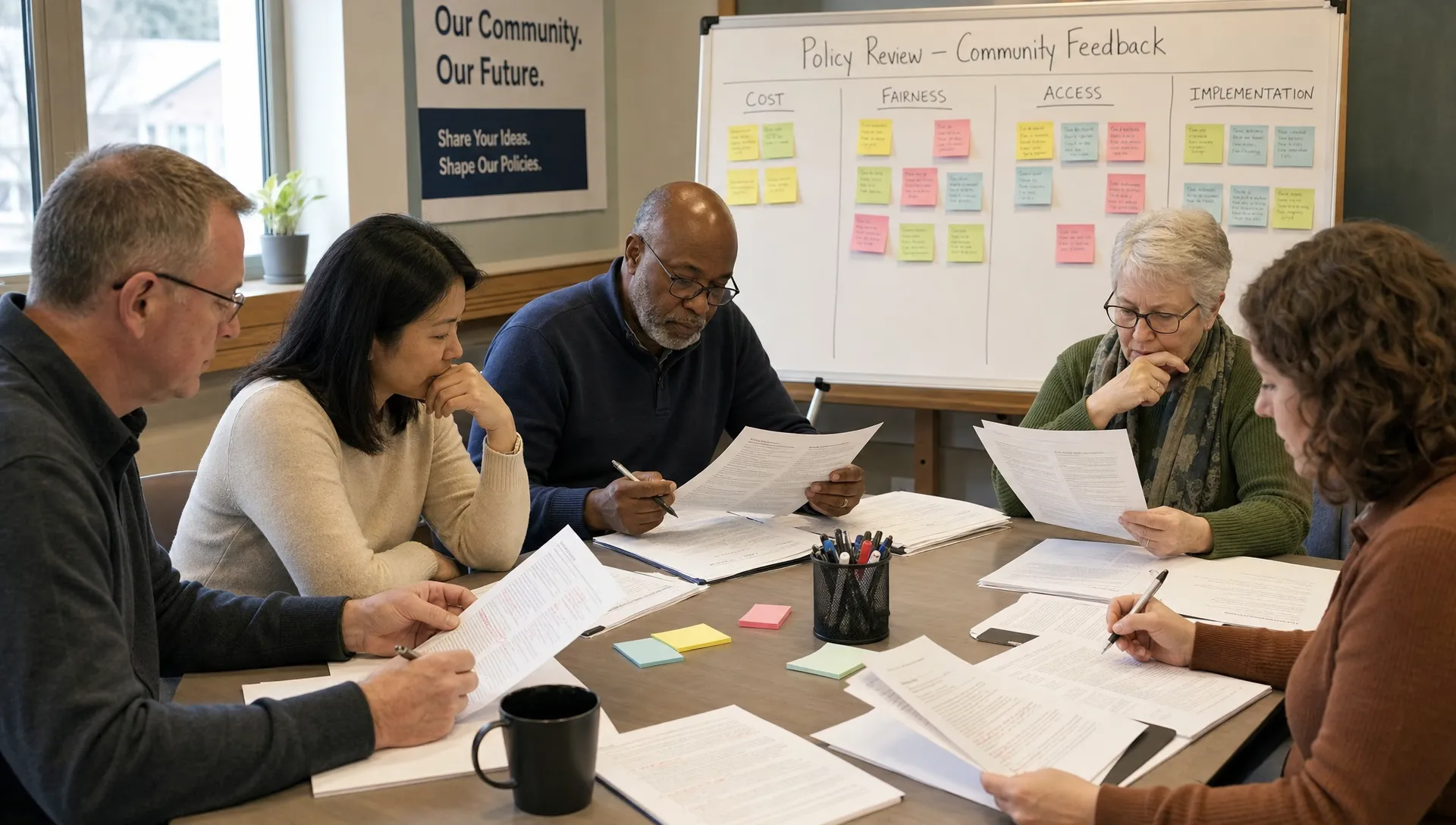
A public comment box usually asks, What do you think? That question is too broad. It rewards the fastest, loudest and most emotionally charged responses. A discursive process asks better questions so the answer can be used.
A strong feedback form should make it easy to connect a comment to a specific clause, name the affected group, explain the reason and suggest replacement wording. JustSocial’s reusable discursive democracy prompts can help organizers move from vague debate to decision-relevant questions.
| Feedback field | Why it matters | Example prompt |
|---|---|---|
| Draft section | Prevents comments from floating outside the text | Which clause, page or policy area are you addressing? |
| Claim | Clarifies the participant’s main point | What should be changed, added or removed? |
| Reason | Turns opinion into public reasoning | Why would this change improve the policy? |
| Evidence or experience | Makes knowledge visible | What data, case, personal experience or professional experience supports your claim? |
| Affected group | Identifies who bears the cost or benefit | Who is most affected by the current wording? |
| Proposed wording | Helps drafters act on feedback | If you can, suggest alternative language. |
| Tradeoff | Makes disagreement more honest | What value might be weakened if your proposal is adopted? |
| Identity tag, optional | Supports analysis without forcing disclosure | Are you commenting as a resident, student, parent, worker, owner, professional or other role? |
The optional identity field matters. The JustSocial manifesto imagines civic platforms where people may identify parts of their social and political identity voluntarily and anonymously, so public officials can understand how different groups experience policy. That idea should be handled carefully. Identity data can improve visibility for neglected groups, but it must be protected from harassment, surveillance and manipulation.
Turn comments into revisions with a response matrix
The credibility of policy draft feedback depends on what happens after comments are submitted. A response matrix is the bridge between public discourse and institutional action. It lists major arguments, shows how many people raised them, identifies affected clauses and explains the drafting decision.
Not every comment should change the draft. Discursive democracy does not mean that every claim is equally strong or that the most active group always wins. It means the public can see the reasons for accepting or rejecting arguments.
| Response status | Meaning | What officials should publish |
|---|---|---|
| Adopted | The argument led to a clear revision | The old wording, new wording and reason for change |
| Partly adopted | The concern was valid, but the proposed fix was modified | The compromise and the tradeoff involved |
| Not adopted | The institution disagreed or found the evidence insufficient | A direct explanation, not a generic dismissal |
| Needs deliberation | The issue involves unresolved value conflict | The next forum, panel or decision body that will address it |
| Out of scope | The comment concerns another policy or legal authority | Where the issue belongs and how it can be raised |
This is where draft feedback becomes a discipline. Officials must not hide behind phrases like stakeholder input was considered. Citizens should be able to trace a path from argument to decision. If a thousand comments raise the same access problem and nothing changes, the public deserves an explanation. If one detailed comment exposes a legal contradiction and the draft changes, the public should see that too.
Moderation is part of democratic design
Discursive democracy requires boundaries because a feedback process is not the same as an unrestricted social feed. A public institution should not remove disagreement because it is inconvenient, but it also should not allow threats, doxxing, slurs, impersonation or coordinated spam to dominate the record.
The key is to moderate behavior and relevance, not viewpoint. A harsh criticism of a policy should remain if it gives a reason and follows the rules. A supportive comment should be removed or deprioritized if it is abusive, fraudulent or unrelated. This protects free expression by keeping the process usable for people who would otherwise leave.
Good moderation also requires an appeal path. If a comment is rejected, the participant should know why and have a way to correct it. When moderation decisions are themselves visible in aggregate, citizens can detect whether rules are being applied unevenly.
Technology should support public judgment, not replace it
The JustSocial manifesto argues that many of the tools needed for a more continuous democracy already exist: social platforms, analytics systems, cloud storage, AI language models and possibly blockchain for confidentiality and security. For policy draft feedback, the most important point is not technological novelty. It is institutional accountability.
A digital platform can authenticate participation, allow anonymous public display, cluster repeated arguments, translate drafts into plain language, flag evidence gaps and show version history. AI can help summarize large volumes of feedback, but summaries must be auditable. If an AI system groups comments incorrectly or erases minority concerns, citizens need a way to inspect and challenge the categorization.
Policy drafts should also be versioned like public code. The manifesto proposes a Git-style repository for state laws. The same logic should apply earlier, while policy is being drafted. Every revision should have a timestamp, an authoring authority, a reason and a link to relevant public feedback when appropriate.
This creates a practical form of government transparency. It does not force representatives to obey every public comment, nor should it. It does require them to govern with the public record in view.
What a political movement can do now
A political movement does not need to wait for national reform to practice discursive democracy. It can model the behavior it asks governments to adopt.
For JustSocial and similar civic movements, policy draft feedback can become a movement practice in four concrete ways. Publish movement proposals as drafts before calling them final. Invite supporters and critics to comment by clause. Use public response matrices to show what changed. Treat disagreement as a source of design pressure, not as betrayal.
This matters because continuous direct democracy cannot be built only through slogans. It needs habits, templates, tools and expectations that make public reasoning normal. People must learn that participation is not just reacting to leaders. It is helping shape the text that leaders, institutions and communities will later use.
In that sense, discursive democracy is both procedural and cultural. It asks citizens to give reasons. It asks institutions to answer those reasons. It asks movements to prove that their democratic commitments survive contact with criticism.
Frequently Asked Questions
What is discursive democracy in policy draft feedback? It is a method for collecting, organizing and answering public reasons about a draft policy. Instead of treating comments as scattered opinions, it connects them to clauses, evidence, affected groups and proposed revisions.
How is discursive democracy different from deliberative democracy? Deliberative democracy usually focuses on structured discussion among selected or representative groups. Discursive democracy is broader and focuses on the quality, fairness and visibility of public reasoning across many participation spaces.
Should public feedback on drafts be binding? Not always. Many draft comments should inform representatives, administrators or deliberative bodies rather than automatically decide the outcome. The democratic requirement is that serious arguments receive visible, reasoned responses.
Can anonymous feedback be legitimate? Yes, if the system protects against fraud and abuse. A platform can verify that a participant is eligible while displaying the comment anonymously or pseudonymously. This helps people speak honestly without making identity exposure the price of participation.
What makes a policy feedback process trustworthy? Trust grows when drafts are accessible, comments are structured, moderation is viewpoint-neutral, revisions are traceable and officials publish clear reasons for accepting or rejecting major arguments.
Help make draft feedback a democratic habit
Discursive democracy for policy draft feedback is not a side feature of reform. It is one of the places where a more continuous democracy can become real. Every draft policy is an opportunity to ask whether the public is being managed, ignored or genuinely heard.
JustSocial’s broader vision is a society where citizens have daily influence, public institutions use modern tools responsibly and the state learns to listen before decisions harden. If that vision resonates, the next step is practical: help build, test and spread the processes that turn public speech into accountable public power.





