
A resident asks for an accessible entrance, but the meeting summary records opposition to the entire project. A community group challenges a spending figure, but the original number remains in the briefing used for the next vote. In discursive democracy, these are not merely administrative mistakes. They change whose arguments are heard and what decision-makers believe. Participation is incomplete when people can contribute to a discussion but cannot effectively challenge an inaccurate account of it.
The right to correct the record should therefore be part of how civic institutions work: an accessible route to identify errors, obtain a reasoned response and carry justified corrections into the documents that influence decisions.
Why discursive democracy needs a correction right
Discursive democracy emphasizes the exchange and contestation of reasons in public life. Deliberative democracy similarly values informed consideration, often through structured processes such as citizens’ assemblies. Neither works well when institutions preserve inaccurate claims while treating their summaries as settled accounts.
The problem is not just whether someone may speak again. A second comment does not necessarily repair the first misrepresentation. If an incorrect summary reaches a committee briefing, repeating the correct information elsewhere leaves two competing records, with the official one carrying greater institutional weight.
JustSocial’s manifesto calls for citizens to be consistently heard throughout the term, rather than only at elections. It also proposes that public opinion inform representatives without automatically determining every decision. Accurate records matter to both commitments: officials cannot meaningfully consider citizens’ views when those views have been misstated.
Being heard must include a way to challenge how your contribution was recorded. That does not mean controlling the outcome or requiring everyone to accept your interpretation. It means making the institution answer for the accuracy of its account.
What should be open to correction?
A workable process distinguishes errors from disagreements. Otherwise, a correction mechanism can become either an empty complaints inbox or a way for powerful participants to rewrite criticism.
Consider four different situations:
| Type of challenge | Example | Appropriate response |
|---|---|---|
| Verifiable factual error | A summary gives the wrong spending amount | Check the underlying evidence and amend the figure if warranted |
| Attribution error | A resident is recorded as supporting a proposal they opposed | Compare the summary with the submission or recording and correct the attribution |
| Material omission | A report includes support but omits a submitted objection relevant to its conclusion | Review the omission and add context or an attached dissent where appropriate |
| Interpretive disagreement | Participants disagree about whether a policy is fair | Preserve the competing reasons rather than label one position a factual mistake |
In discursive democracy, the distinction matters because not every contested statement has a single correct replacement. Predictions, priorities and judgments often remain open to argument.
A right to request correction should guarantee consideration and reasons, not automatic acceptance. A participant may accurately claim that their objection was omitted while still being wrong about the policy itself. Repairing the omission does not require endorsing the objection.
The process should also apply to institutional mistakes beyond individual speech: inaccurate participation counts, mislabeled consultation results and summaries that present self-selected responses as the views of an entire community.
A practical example: correcting a disputed spending claim
Imagine a community project briefing says that $48,000 has been spent. A participant identifies a possible error: the total appears to include both $24,000 in project expenses and a $24,000 transfer between the organization’s own accounts.
This is a hypothetical example, but it illustrates why a correction request needs more than an assertion that the number is wrong. Reviewers need the relevant ledger entries, the accounting treatment and supporting records that the organization is authorized to share.
When bank statements form part of that evidence, services that convert bank statements into checked CSV or Excel data can help check extracted figures against running balances and stated totals. Those checks establish numerical consistency, not whether an expense was legitimate or whether a particular transfer should count as project spending. That still requires accounting context.
Discursive democracy benefits when this distinction is explicit: evidence can support a correction without settling every surrounding political question. Correcting the spending total does not establish that the project is worthwhile, unnecessary or fairly managed.
If the challenge succeeds, the institution should amend the briefing, explain the accounting error and notify the committee that received the original figure. Quietly fixing a spreadsheet while leaving the decision document unchanged would not repair the public record.
Build a correction process citizens can actually use
Let people identify the claim without building a legal case
A request should identify the disputed passage, explain the alleged problem and point to available evidence. A recording timestamp, submission reference or document page may be enough to begin a review.
Institutions should not demand polished legal language or expensive professional assistance. Someone whose contribution was misrepresented should be able to explain the problem in ordinary words, with staff assistance or an offline submission route where needed.
A useful request might say: “The summary describes my submission as opposition to the library renovation. I supported the renovation but requested step-free access. Please compare the summary with the second paragraph of my written submission.”
For discursive democracy to support meaningful civic participation, this route must remain available after the discussion closes. Discovering an error in a published summary should not mean discovering that the only opportunity to challenge it has already expired.
Review the evidence and explain the outcome
The institution should acknowledge the request, name the responsible review function and publish its expected response times. Urgent requests deserve priority when a disputed claim is about to inform a vote, funding decision or public announcement.
The reviewer should compare the challenged account with the available source material. Where the person who prepared the summary has a conflict of interest, another reviewer should assess the request. Disagreement with a participant’s politics is not a reason to reject evidence of an attribution error.
An outcome should state what was examined, what changed and why. If evidence is incomplete, the institution can mark the claim as disputed or add a qualification instead of pretending certainty.
A refusal needs an explanation too. “We stand by the summary” is not a sufficient response when the request identifies a specific discrepancy. The answer should address that discrepancy and explain any route to reconsideration.
Carry the correction into dependent records
A correction should reach the places where the error acquired consequences. These may include committee packs, consultation reports, public dashboards or published explanations of a decision.
In discursive democracy, correcting the source while leaving its downstream use untouched creates the appearance of accountability without its substance. If an inaccurate participation count supported a recommendation, reviewers should assess whether the recommendation also needs reconsideration.
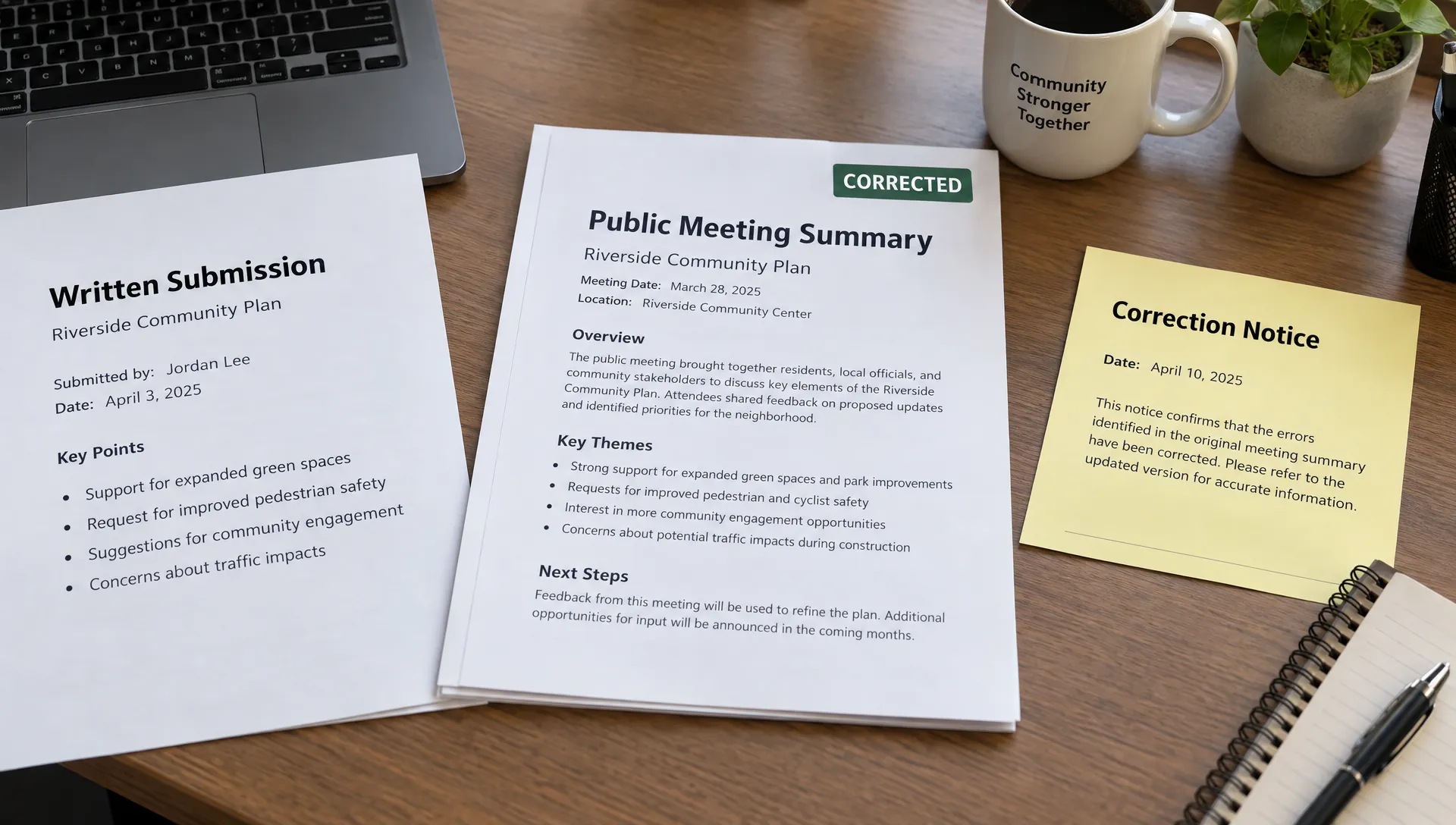
A visible notice should identify the amended passage, the correction date and the reason for the change. Where safe and lawful, the earlier version can remain available through a version history. Sensitive personal information should not be kept publicly accessible merely to demonstrate that an error once existed.
This extends the principle behind turning public debate into durable public memory: the record must preserve not only what institutions first said but also what they later learned was wrong.
Protect the process from abuse and forced exposure
A correction right must not become a veto over uncomfortable reporting. Public officials, donors and organized campaigns should face the same evidentiary standards as everyone else. A reputational complaint alone does not establish an error.
Institutions can consolidate duplicate requests and address repeated submissions that add no new evidence. They should still examine a substantive challenge rather than dismiss it because many people submitted it. Review outcomes should remain appealable to someone other than the original decision-maker where feasible.
Privacy also requires separate treatment. Verification may require a reviewer to see information that should never appear in the public correction notice. People should not have to expose their home address, financial details or sensitive identity information to correct an institutional misstatement.
There are existing legal rights in narrower contexts. For example, Article 16 of the EU General Data Protection Regulation provides a right to rectify inaccurate personal data. It is not a universal right to rewrite political debate. The broader correction process proposed here is an institutional standard for discursive democracy, not a claim that every jurisdiction already guarantees it.
What a political movement should demand from institutions
A political movement that asks institutions to listen continuously should also ask them to remain correctable continuously. That requires responsibilities, not merely a comment box beneath a report.
JustSocial’s manifesto proposes rParliament as a concept connecting committee documents, recordings and public contributions to particular proceedings. A correction mechanism would be a useful design requirement for such a system: a participant could identify the relevant proceeding, challenge a specific summary and follow the review outcome. This is a recommendation for implementation, not a claim that the proposed app already provides these functions.
The manifesto also advocates an independent role for academia. Specialists could help assess technical evidence, but their conclusions should remain open to scrutiny. Expertise can inform a correction without granting any reviewer authority to settle every political disagreement.
For discursive democracy, useful measures would include response times, the proportion of accepted corrections carried into dependent documents and whether participants can understand the reasons for rejection. Raw complaint counts alone reveal little: fewer requests might indicate accurate records, but they might also indicate an inaccessible process.
Civic education should support the same practice by teaching people to distinguish factual challenges from value disagreements and to revise their own claims when the evidence warrants it.
Frequently asked questions
Does the right to correct the record mean someone can remove criticism? No. Criticism, disagreement and unfavorable conclusions are not automatically errors. A correction process should address demonstrable inaccuracies, misleading attribution and material omissions while preserving legitimate differences of opinion.
Should an institution delete the original mistake? Usually, it should publish a corrected version with a clear amendment notice and appropriate version history. Privacy, safety or legal requirements may justify removing particular material rather than keeping it publicly accessible.
Who should decide whether a correction is justified? A designated reviewer should assess the evidence and give reasons. Cases involving conflicts of interest need independent review, and consequential disputes should have a route to reconsideration. Neither the complainant nor the institution should have unchecked authority over the record.
Can a correction require a decision to be revisited? Sometimes. If an error materially influenced a decision, the institution should assess its effect and explain whether reconsideration is needed. A corrected spelling and a corrected budget total do not have the same consequences.
Make correction part of participation
Discursive democracy needs more than opportunities to contribute. It needs institutions willing to repair inaccurate accounts of those contributions and explain what the repair changes.
When engaging with JustSocial’s proposals or organizing a local initiative, ask for a clear correction route alongside every consultation and published summary. Identify who reviews requests, how outcomes become visible and how amendments reach decision-makers. The practical test is whether a citizen can point out a mistake and obtain a reasoned, traceable response.





