
Discursive democracy can help communities map stakeholder conflicts before a public decision turns competing concerns into fixed camps. Instead of recording only who supports or opposes a proposal, it asks whose interests are affected, what reasons people give and where power shapes the discussion. The useful output is not an agreement manufactured for the meeting minutes. It is a shared, revisable account of the disagreement that residents and decision-makers can inspect.
This guide explains how to build that account, test it with affected people and connect it to institutional responsibility without treating participation as a substitute for legal rights or professional judgment.
What Discursive Democracy Adds to Conflict Mapping
A conventional stakeholder analysis often identifies groups, estimates their influence and assigns an engagement strategy. That can help a project manager, but it can also treat residents as obstacles to manage rather than participants entitled to question the proposal.
Discursive democracy changes the purpose of the map: stakeholders help describe the conflict, challenge its categories and correct how their reasons are represented. Public reasoning becomes part of the record rather than background noise around an administrative decision.
Discursive and deliberative democracy overlap. The former emphasizes how public discussion forms and contests political judgments across different settings. The latter often emphasizes structured consideration of reasons and alternatives. A conflict map can connect open public discussion with a later deliberative process without pretending they are identical.
The JustSocial manifesto proposes continuous civic participation alongside representative institutions that remain independent while taking public opinion into account. Conflict mapping gives that ambition a practical form: institutions receive more than sentiment totals, and citizens can see whether their concerns were understood.
The map describes disagreement. It does not authorize a decision, establish majority support or settle whose rights apply.
Map Relationships, Not Just Stakeholder Names
Separate positions, interests and constraints
A position states what someone wants: “Keep the building open.” An interest explains why: “My child needs uninterrupted access to specialist support.” A constraint identifies what limits the available options: “The alternative site cannot currently provide that support.”
Those distinctions matter because identical positions can conceal different needs. Two families might oppose relocation, one because of transportation costs and another because of accessibility. Conversely, stakeholders with opposing positions might share an interest in protecting students and maintaining services.
In discursive democracy, those reasons should remain open to correction by the people giving them. Do not replace a participant’s explanation with a supposedly deeper motive that they reject.
Start with the decision under consideration, not an institution’s preferred solution. If the proposed decision is already disputed, use the approach described in JustSocial’s guide to public problem framing before assigning stakeholders to camps.
Record power separately from participation
A well-attended meeting does not reveal who can actually change the outcome. Distinguish formal authority from practical influence and exposure to consequences.
A public agency might control the budget. A contractor might hold technical information. A residents’ association might organize attendance. People experiencing the greatest disruption might have none of those advantages.
Record who can approve, fund, implement, challenge or delay a decision. Alongside that, record who bears its costs and who has difficulty participating. These are separate dimensions, not a single influence score.
Avoid labels such as “low-value stakeholder” or “uncooperative group.” They convert inequalities in access into judgments about people’s worth. Stakeholder categories should also allow internal differences: a parent association cannot automatically speak for every parent, and a public comment from one employee does not establish a workforce-wide position.
Build a Conflict Register That People Can Correct
A usable register gives each disagreement its own entry. It should identify the affected parties, the disputed action, their stated reasons, relevant evidence, unresolved questions and the authority responsible for responding.
For example, “families oppose closure” is too broad. A better entry is: “Some participating families oppose relocation to Site B because the proposed transport schedule conflicts with existing care arrangements.” That entry identifies a specific concern without claiming to represent all families.
Discursive democracy benefits from this precision because reasons can be answered, whereas broad labels often invite another round of opposing labels.
Each entry should also include a date, a review status and any restrictions on publication. Participants need a visible way to submit corrections. Sensitive personal information belongs in a protected record when necessary, not in a public spreadsheet by default.
Distinguish evidence disputes from value conflicts
Not every disagreement needs the same response. A dispute over whether a building contains hazardous material calls for appropriate testing and qualified interpretation. A dispute over who should pay for disruption raises questions of responsibility and fairness.
A conflict map should distinguish four recurring issues:
- Evidence disputes: Participants disagree about facts, forecasts or the reliability of a source.
- Value conflicts: Participants prioritize different goods, such as continuity, affordability or precaution.
- Distributional conflicts: Benefits and burdens fall on different people.
- Procedural conflicts: Participants dispute who sets the agenda, controls information or has decision authority.
An entry can belong to more than one category. Publishing another technical report will not resolve a procedural complaint about an undisclosed procurement relationship.
This distinction also helps communities examine hidden tradeoffs in public decisions without treating every objection as a factual misunderstanding.
Validate the map without requiring endorsement
Return draft entries to the affected participants and ask whether their reasons have been represented accurately. Validation means checking the account, not approving the proposal or accepting another stakeholder’s argument.
In discursive democracy, a person should be able to say, “That accurately describes my objection, and I still oppose the plan.” Preserve disagreement when it remains unresolved.
Provide alternatives to speaking in a public meeting: facilitated interviews, accessible written submissions, interpretation and private reporting where appropriate. Record missing perspectives explicitly. “No submission received” is different from “no concern exists.”
Publish methodological limits, including how participants were recruited and which groups were difficult to reach. Voluntary participation does not produce a representative opinion sample merely because the resulting dashboard looks comprehensive.
Worked Example: A Public School Repair Dispute
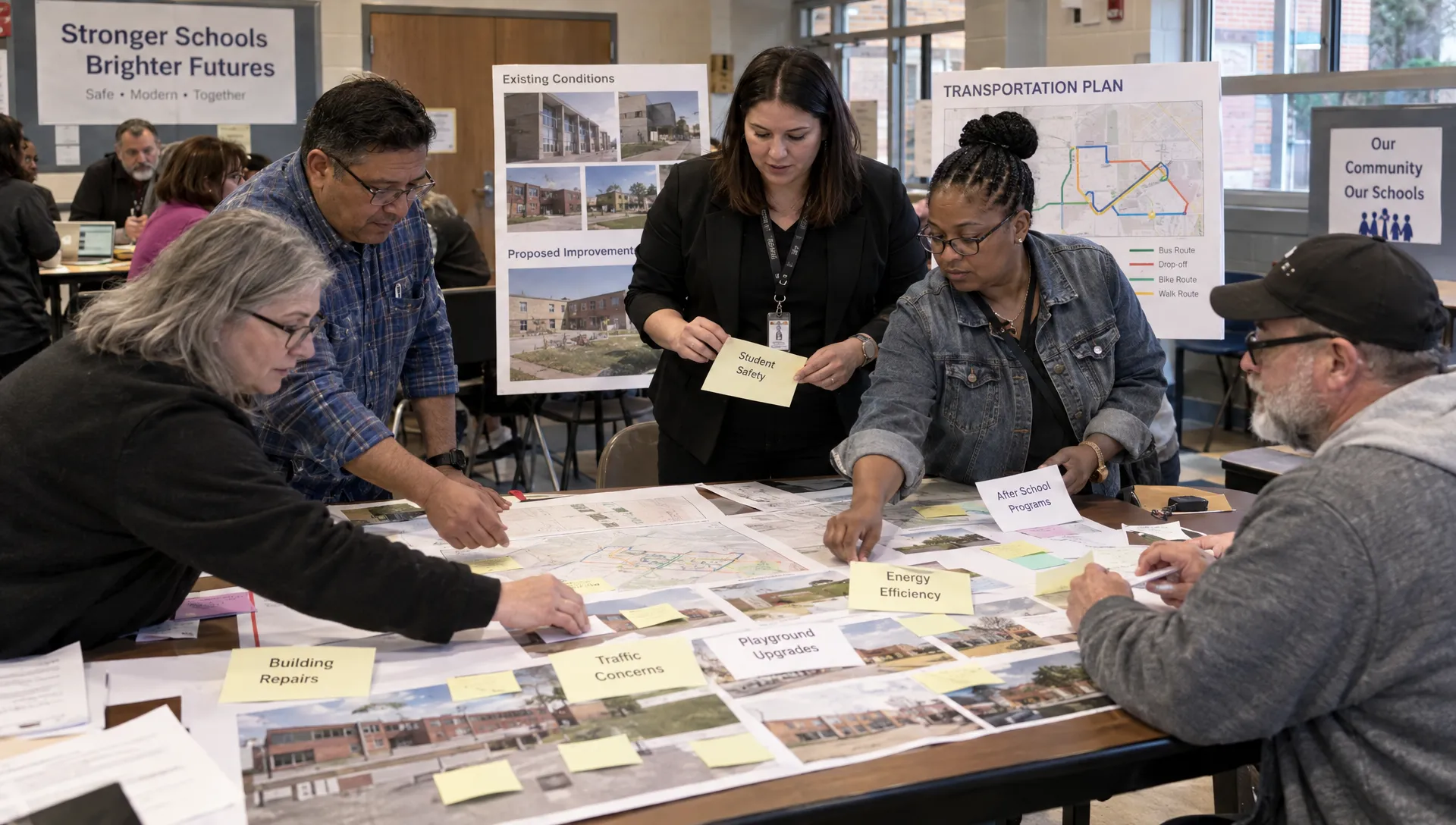
Consider a hypothetical school district deciding how to repair a building affected by water damage, with possible mold or asbestos concerns requiring qualified assessment. Families, staff, administrators, neighbors and potential contractors have different responsibilities and exposures.
Urgent protective action and applicable safety requirements come first. Civic participation should inform communication, continuity arrangements and longer-term choices, not postpone necessary protection while a discussion continues.
For a Massachusetts or Rhode Island project, technical contributors could include environmental remediation providers such as Banner Environmental Services, which lists asbestos, mold and water-damage services. Technical claims from a potential contractor belong in the evidence record, alongside disclosure of its commercial interest and any required independent review.
The following entries illustrate a conflict map, not findings about an actual school or provider.
Make the relationships visible
Discursive democracy makes this case more useful when it maps the relationship between concerns rather than sorting participants into “pro-repair” and “anti-repair” groups.
| Stakeholder relationship | Stated interests in tension | Question requiring an answer | Responsible responder |
|---|---|---|---|
| Families and district administrators | Continuity of support versus the speed and feasibility of relocation | Can the alternative site maintain accessibility, transport and specialist services? | District administrators, informed by affected families and service staff |
| Staff and facilities management | Safe working conditions versus pressure to maintain normal operations | What do qualified assessments require, and which interim protections apply? | Facilities management and relevant safety professionals |
| Nearby residents and project managers | Predictable neighborhood conditions versus construction access | How will schedules, access restrictions and complaints be handled? | Project managers and the appropriate public authority |
| Budget officials and affected households | Containing public expenditure versus avoiding uncompensated household costs | Who bears additional transport or care costs under each option? | Officials responsible for budgets and service arrangements |
| Procurement officials and potential contractors | Reliable technical advice versus commercial incentives | How will advice, contracting interests and decision authority remain distinguishable? | Procurement officials under applicable rules |
The table exposes questions that a simple preference poll would miss. It also prevents an official from answering a transportation concern with a general statement that the repair project has public support.
Connect Each Conflict to a Decision Obligation
A map becomes consequential when each material concern has a responsible responder and a stated next step. Possible responses include further investigation, revision of an option, an explanation for rejecting a request or acknowledgment that a question remains unresolved.
Discursive democracy does not require officials to accept every demand. It requires a process in which reasons can be heard, challenged and answered without disappearing between consultation and decision.
For each proposed option, identify which concerns it addresses and which burdens remain. If relocation protects health but increases household costs, state both. Do not call the conflict “resolved” because one objective has been achieved.
Some matters sit outside an ordinary preference contest. Legal rights, mandatory safety standards and protections against discrimination cannot be set aside because a majority dislikes their cost. Where an authority has discretion, its explanation should distinguish legal obligations from budget judgments and political choices.
Publish the response beside the original concern. This creates a traceable chain from submission to consideration to decision, while preserving any stakeholder objection to the final outcome.
Preserve dissent and revise the record
The register should retain minority reports, alternative proposals and unresolved evidence questions. A final decision is not proof that everyone agrees with its reasoning.
Keep a change history when new assessments, revised budgets or implementation problems alter the conflict. Participants should be able to see what changed, who authorized the update and whether affected groups had an opportunity to respond.
This fits the manifesto’s distinction between continuous public input and binding referendum decisions. Continuous participation means opportunities to revisit concerns as circumstances change, not an obligation for every citizen to vote every day.
The manifesto also proposes opportunities for minors to express views while distinguishing that participation from adult electoral rights. In a school case, students’ experiences can inform the map through age-appropriate participation. Their input should not be misrepresented as an authorized electoral decision or published without suitable privacy safeguards.
Check Whether the Map Is Fair and Useful
Judge quality by the record’s coverage and accountability, not by whether the meeting ended politely. A calm process can still exclude affected people, and an uncomfortable exchange can reveal an important omission.
Ask whether participants could correct their entries, whether important burdens have named bearers and whether unanswered concerns have responsible responders. Also check whether the map distinguishes verified findings from allegations and forecasts.
Discursive democracy loses credibility when institutions display public input but provide no account of how it influenced their choices. A useful review therefore asks what changed because of participation and what officials declined to change, with reasons for both.
For a political movement, publishing these standards matters as much as promoting participation. Supporters should be able to scrutinize the movement’s own agenda-setting, moderation and treatment of dissent. The same transparency expected of public institutions should apply to the process seeking to reform them.
Frequently Asked Questions
Is stakeholder conflict mapping the same as deliberative democracy? No. Mapping organizes disagreements, affected interests and decision responsibilities. It can support deliberative democracy by giving participants a clearer basis for considering evidence and alternatives, but it does not replace that discussion.
Does a conflict map have to produce consensus? No. Its purpose is an accurate, correctable account of disagreement. It can identify common interests while preserving unresolved conflicts and minority positions.
How can a map include people who do not attend meetings? Use accessible submissions, targeted outreach and appropriate intermediaries, while allowing people to challenge how they are represented. Document gaps rather than assigning views to absent groups.
Can online participation replace representative sampling? Not automatically. A voluntary online process records the people who participate. Claims about the wider population require an appropriate sampling method and a transparent account of its limitations.
Put Continuous Participation Into Practice
For JustSocial, the next step is to make ongoing civic participation inspectable. Start with one real public decision, publish a correctable conflict register and request a reasoned response from the responsible institution.
The immediate goal is specific: affected people can recognize their concerns in the record, officials cannot quietly discard them and unresolved disagreements remain visible after the decision. That is a practical contribution to the manifesto’s vision of citizens having an ongoing role in public affairs.





