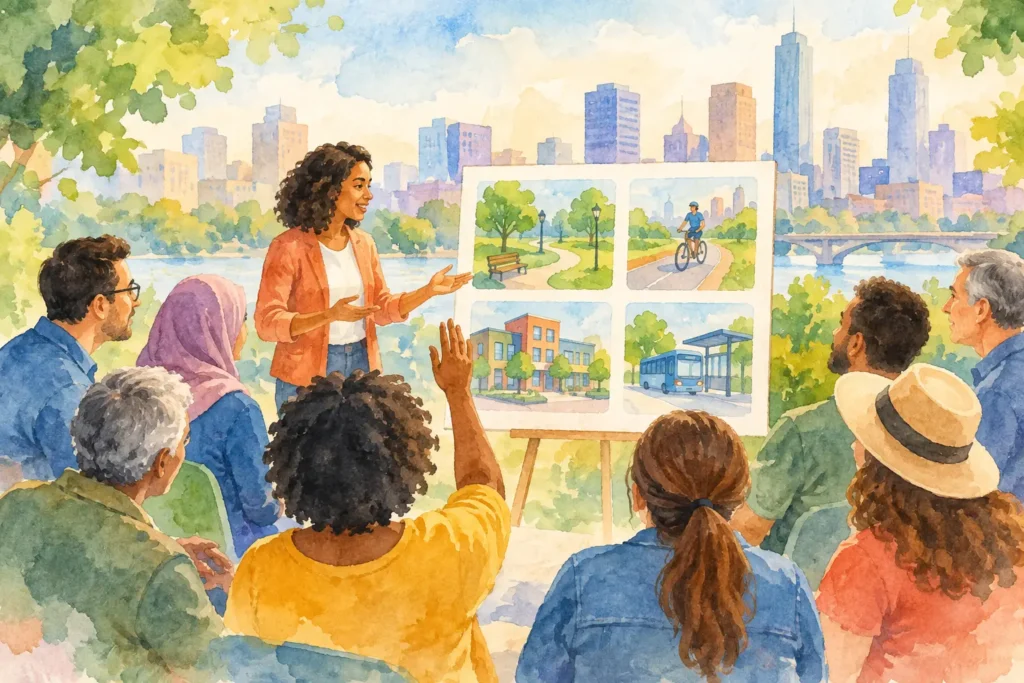
A zoning change can determine whether a family can afford to stay in its neighborhood. A transit route can decide who gets to work on time. A school budget can shape a child’s next decade. Yet many of these choices move forward with little public input. That gap is why the question, why is citizen participation important in government, is not an academic one. It is about whether people can meaningfully shape the public decisions that shape their lives.
Democracy cannot be reduced to a ballot cast every few years. Elections matter, but they are only one moment in a much longer relationship between residents and public institutions. Citizen participation gives that relationship substance. It creates ways for people to share lived experience, challenge assumptions, set priorities, and hold decision-makers accountable between election days.
Why Is Citizen Participation Important in Government?
Citizen participation matters because government has power over shared resources, public rules, and collective priorities. When the people affected by those decisions have no practical way to contribute, government can become distant, reactive, and easier for narrow interests to capture.
Participation helps correct that imbalance. A resident may see that a crosswalk is unsafe long before an agency’s data reflects the problem. A parent may understand the consequences of a school policy that looks reasonable on paper. A nonprofit serving people experiencing homelessness may identify a barrier in a benefits system that policymakers never encounter themselves. Public knowledge is not a replacement for professional expertise. It is expertise of a different and necessary kind.
When governments invite participation early enough to influence an outcome, they make stronger decisions. They also make the reasoning behind those decisions more visible. Even when a community does not get every result it wants, people are more likely to accept difficult trade-offs if the process was open, understandable, and responsive.
Participation improves the quality of public decisions
Policies are often designed from aggregate data, legal requirements, budgets, and administrative constraints. Those inputs are essential, but they cannot show the full reality of daily life. Residents add context: which bus transfer is unreliable after a late shift, why a public meeting time excludes caregivers, where a proposed development may displace small businesses, or how a form written in technical language prevents people from receiving help.
This information can make policy more accurate before it becomes expensive to reverse. Participation is particularly valuable when a decision affects groups that have historically been excluded from formal power. Government cannot claim to serve a whole community while hearing only from the people with the most time, confidence, money, or political access.
Better input does not mean every public preference can become policy. Resources are limited, rights can conflict, and officials must still make decisions. But participation helps ensure that those decisions are based on a fuller picture of the public interest rather than the loudest voices in the room.
Participation builds trust through visible accountability
Trust is not created by a polished announcement after a decision has already been made. It grows when people can see how decisions are formed, who was consulted, what evidence was considered, and how public feedback changed the final result.
That visibility creates accountability in both directions. Residents have a clearer way to ask why a promise was not met or why funding moved elsewhere. Public officials can explain constraints, correct misinformation, and demonstrate the trade-offs they are managing. This does not eliminate disagreement. A healthy democracy should leave room for principled disagreement. It does make disagreement more grounded in facts, process, and shared responsibility.
When participation is absent, frustration often appears later as cynicism: people conclude that meetings are performative, surveys disappear into a void, and decisions belong to someone else. Rebuilding trust after that point is difficult. Meaningful participation is preventive infrastructure. It gives institutions a regular way to listen and gives citizens a reason to stay connected.
Participation turns residents into civic partners
Government works best when people are treated as more than customers of public services or audiences for public announcements. Citizens are co-owners of democratic institutions. That means they should have accessible opportunities to identify problems, deliberate on options, monitor commitments, and help evaluate whether a policy worked.
This broader role strengthens communities as well as institutions. People who participate learn how public systems operate, meet neighbors with different perspectives, and develop the confidence to act together. A resident who starts by commenting on a park plan may later organize around safer streets, serve on a local board, or help a nonprofit reach people who have been left out of a public process.
Participation can also reduce the distance between local knowledge and public action. Community organizations, advocates, and service providers often already have trusted relationships with people government struggles to reach. Designing participation with these partners can expand access and improve the quality of feedback. The goal is not to outsource democratic responsibility. It is to recognize that civic capacity already exists in communities and should be respected.
Continuous participation is stronger than one-time consultation
A single public hearing is rarely enough. By the time a hearing occurs, the key choices may already be set. Attendance may be difficult, the agenda may be unclear, and a two-minute comment period may not allow for real discussion.
Continuous participation creates more useful pathways. Residents need ways to engage before decisions are drafted, while options are being considered, and after policies are implemented. Different moments call for different forms of involvement: sharing experiences, reviewing proposals, ranking priorities, participating in deliberation, voting on community choices, or tracking progress against public commitments.
Digital tools can make this participation more frequent and accessible. They can provide plain-language information, collect input outside business hours, show how others are responding, and create a public record of commitments. For a democracy-first initiative such as JustSocial, that is the larger possibility: civic technology should help make democracy an ongoing practice, not merely digitize an occasional transaction.
But digital participation is not automatically inclusive. A platform that assumes reliable broadband, strong digital literacy, English fluency, or trust in government may reproduce the same exclusions it claims to solve. Public participation must include offline options, language access, disability access, privacy protections, and support for people who need help using a tool. Technology should widen the door, not replace the room.
What meaningful participation requires
Not every request for feedback is meaningful participation. People can tell when their involvement has no connection to a real decision. For engagement to deserve public time and trust, governments and civic institutions should make several commitments.
They should state what is open for public influence and what is not. They should share information early, in language people can understand. They should reach beyond the usual participants by partnering with community groups and offering more than one way to take part. And they should close the loop by explaining what they heard, what changed, and why some recommendations could not be adopted.
This takes time and resources. It may slow an initial decision, especially when an agency must translate materials, provide facilitation, compensate community participants, or reconcile competing priorities. Those are real costs. Yet rushed decisions often produce greater costs later through litigation, public backlash, failed implementation, or programs that miss the people they were meant to serve.
The answer is not to demand public votes on every administrative detail. Participation should match the stakes. A routine operational choice may need transparent communication, while a major budget, land-use plan, public safety policy, or benefits redesign requires deeper engagement. The central test is simple: if a decision materially affects a community, that community should have a credible way to influence it.
A stronger democracy needs usable civic infrastructure
Many people do not disengage because they do not care. They disengage because civic systems are hard to find, hard to understand, and difficult to use. Meeting notices are buried. Public documents are unreadable. Opportunities arrive too late. Feedback channels disappear without an answer.
We can build a different standard. Participation should be as ordinary as checking a public project’s progress, weighing in on a neighborhood priority, or seeing how representatives responded to community concerns. It should be designed for working people, caregivers, young people, older adults, people with disabilities, and residents who have never been told that government belongs to them, too.
The next democratic advance will not come only from asking more people to care. It will come from building public systems worthy of their care. When citizens can see, understand, and influence the decisions around them, participation stops feeling like a favor granted by government. It becomes what it should be: a shared practice of self-government.