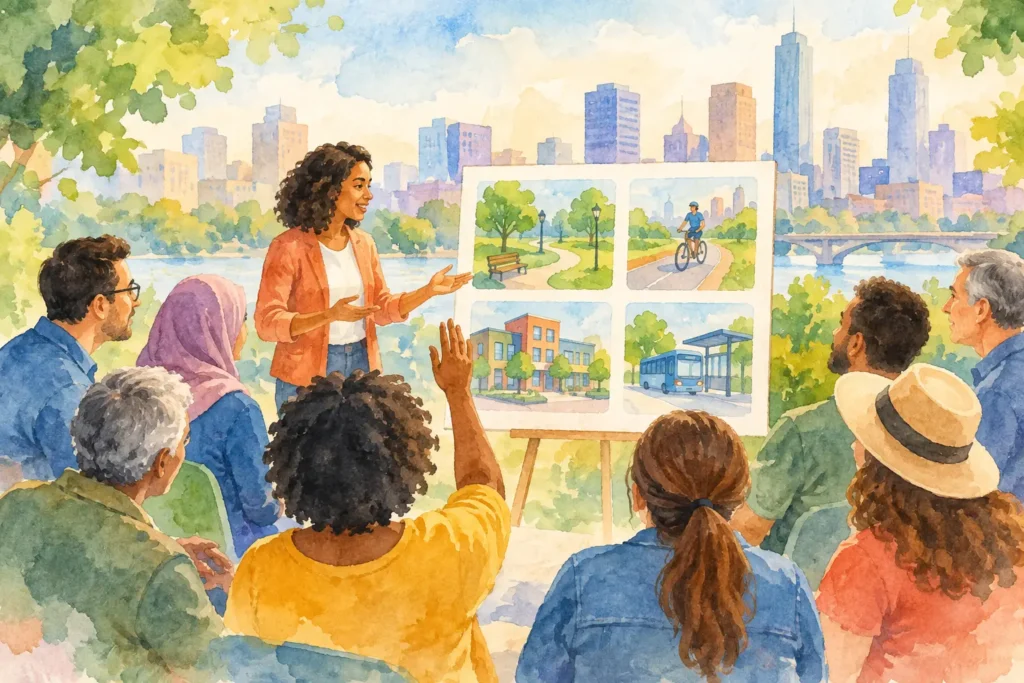
A city budget can feel distant: a dense document, a public hearing held at an inconvenient time, and decisions that seem settled before most residents hear about them. Participatory budgeting changes that relationship. So, how does participatory budgeting work? A government, school district, housing authority, or nonprofit sets aside a defined pool of money and gives community members a direct role in deciding how it will be spent.
It does not replace elected government or professional budgeting. It creates a public decision-making process inside the budget, where people can identify needs, turn ideas into workable projects, vote, and follow the results through implementation. Done well, it gives residents more than a chance to be heard. It gives them a meaningful share of power.
How does participatory budgeting work, step by step?
Participatory budgeting begins with a real commitment: an institution identifies money that can genuinely be allocated through the public process. The amount may be a portion of a city capital budget, a council district fund, a school improvement fund, or a nonprofit grant pool. The scale varies, but the rule is simple. Participants need to be deciding something that will actually happen.
The sponsoring institution then establishes the rules. Who can propose ideas? Who can vote? Is the process open to all residents, or focused on a neighborhood, students, tenants, or program participants? What kinds of expenses are eligible? Clear answers matter because they set the boundaries of public authority before the conversation starts.
1. The community identifies priorities
The process usually opens with idea collection. Residents may submit proposals online, at libraries, in classrooms, at community meetings, through neighborhood organizations, or by text and paper form. The strongest processes use more than one channel because a digital form alone can exclude people without reliable internet access, language access, or time to spare.
Ideas often begin with everyday experience: safer crossings near a school, accessible playground equipment, shade trees at bus stops, repairs to a community center, street lighting, youth programs, public art, or tools for local mutual-aid groups. At this stage, proposals do not need to be polished. The point is to make local knowledge visible.
2. Residents and staff turn ideas into feasible projects
A raw idea is not yet a ballot item. Community volunteers, sometimes called budget delegates, work with agency staff and technical experts to research proposals. They ask practical questions: Who owns the site? What will the project cost? Can it be maintained? Does it meet legal, safety, and procurement requirements? Will it benefit the people the process is meant to serve?
This is where participatory budgeting can either earn trust or lose it. If officials reject projects without explanation, residents may conclude that participation was symbolic. If staff share cost estimates, constraints, and alternatives in plain language, the process becomes a lesson in how public systems work and how residents can shape them.
Not every good idea fits the available budget or legal rules. A request for a new transit route, for example, may require authority beyond a neighborhood fund. Rather than simply discarding it, organizers can document the idea, explain the limitation, and route it to the agency or advocacy process that can address it. Participation should clarify pathways to action, not create a dead end.
3. The public votes on eligible proposals
Once proposals are developed, the community votes. Voters may choose a set number of projects, rank options, or allocate a limited number of points across priorities. The voting method should match the goal. A simple vote is easy to understand, while ranked or point-based voting can better reflect a community with several strong priorities.
Accessibility is not an extra feature here. Voting should be available in the languages residents use, on mobile-friendly platforms, and through trusted in-person locations. Some participatory budgeting programs allow young people, noncitizens, or people who are not registered voters to participate because the decision concerns their lived community, not an electoral office. That choice depends on local policy, but broad eligibility can bring people into civic life who are routinely left out.
Digital participation tools can make voting more convenient and transparent, but they should strengthen, not narrow, access. Secure systems, privacy protections, clear eligibility rules, and an offline option are essential. Technology is civic infrastructure when it helps more people participate with confidence.
4. Winning projects enter the budget and get delivered
The projects with the most support are funded until the allocated amount is spent. Then comes the test that matters most: delivery. The sponsoring institution needs to publish what won, how much each project costs, who is responsible, and when residents can expect progress.
Implementation often takes longer than a ballot cycle. Construction, permits, contracting, environmental review, and supply costs can alter timelines. That does not mean the process failed. It does mean officials owe residents candid updates. If a project becomes impossible, the community should know why and have a clear process for redirecting the funds.
Why participatory budgeting matters beyond one project
The visible result may be a repaired park, new library equipment, or safer sidewalks. The deeper result is a different civic relationship. People see that public money is not an abstraction controlled only by specialists. It is a shared resource, and communities have knowledge that should shape its use.
Participatory budgeting can also surface priorities that conventional outreach misses. Residents who do not attend formal hearings may still respond to a question such as, “What would make your block safer or more useful?” When organizers meet people where they are, participation can become more representative of the community affected by the decision.
For public institutions, the value is practical as well as democratic. Early community input can reveal problems before money is committed to an unpopular or poorly targeted project. Transparent rules and public results can strengthen trust, especially where residents have reason to doubt whether government listens.
Still, participatory budgeting is not automatically equitable. A process can reproduce existing inequalities if outreach reaches only well-connected residents, if voting is confusing, or if wealthier neighborhoods have more capacity to organize around proposals. Equity requires intentional design: language access, childcare or stipends for meetings where possible, partnerships with community groups, accessible venues, and outreach that begins with people who have historically had less influence.
What a credible process needs
Participatory budgeting works best when the institution gives up some real discretion while remaining honest about its responsibilities. It needs a meaningful funding pool, transparent eligibility rules, public cost estimates, accessible participation, and visible follow-through. It also needs independent or community-centered oversight so residents can see that votes are counted fairly and commitments are tracked.
The amount of money matters, but it is not the only measure of seriousness. A smaller pilot can build capacity if participants have genuine authority and organizers learn from each cycle. A large fund can disappoint if its rules are vague or its winning projects disappear into bureaucracy. Communities should evaluate both the dollars allocated and the quality of power shared.
For nonprofits, participatory budgeting can guide grantmaking, program funds, and neighborhood investments. For governments, it can complement council decisions, agency planning, and annual budget processes. In either setting, the process should be tied to decisions that are still open. Asking for input after the real choices have been made undermines the trust participation is meant to build.
A practical invitation to participate
Residents do not need to be policy experts to help decide public priorities. Start with what you know: the barrier on your route to work, the resource missing from a school, the public space that could serve more people, the neighbors whose voices are absent from the room. Bring that knowledge into the process, and invite others to do the same.
When institutions make room for informed public decision-making, democracy becomes something we practice between elections. Participatory budgeting is one concrete way to build that habit – together, visibly, and with public dollars accountable to the people they are meant to serve.