Polarization does not only split a community into opposing camps. It changes the way people hear each other. A road redesign becomes a culture war. A school policy becomes a referendum on identity. A budget debate becomes proof that the other side is corrupt, ignorant, or dangerous.
Discursive democracy offers a practical way out of that spiral. It does not ask people to stop disagreeing. It asks communities to make disagreement usable by structuring public speech around claims, reasons, evidence, lived experience, and decision-relevant requests.
For polarized communities, this matters because more open debate is not always better. If the format rewards outrage, repetition, status, or humiliation, it deepens the conflict. If the format creates traceable public reasoning, protected participation, and visible follow-through, the same conflict can become civic learning.
What discursive democracy means when people are divided
Discursive democracy is the democratic practice of improving the public conversation before decisions are made. It focuses on how issues are framed, how claims are tested, how identities are heard, and how disagreement is recorded.
It is different from deliberative democracy, though the two should work together. Discursive democracy opens and organizes the public sphere. Deliberative democracy usually brings a smaller, more structured group together to weigh options and produce recommendations. Civic participation then connects those outputs to real decision-makers, budgets, laws, policies, or implementation plans.
In a polarized community, the discursive layer is often the missing piece. People are asked to vote, attend a heated meeting, sign a petition, or choose a side before the community has built a shared record of what is actually being argued.
| Polarized pattern | Discursive democracy response | Public output |
|---|---|---|
| People misrepresent opponents | Require steelmanning before rebuttal | A disagreement map |
| Rumors outrun facts | Build an evidence commons | Claim cards with sources and uncertainty |
| Loud voices dominate | Use structured turns and written input | Balanced synthesis notes |
| People fear retaliation | Offer privacy-preserving participation | Anonymous or pseudonymous testimony with safeguards |
| Officials say they listened but show no proof | Require response memos | Public receipts and implementation trackers |
Discursive democracy is not civility theater. It is not a demand that angry people become polite for the comfort of institutions. It is a method for making anger legible enough to influence public action.
The JustSocial connection: from Polis to Cosmopolis
JustSocial’s manifesto, The Face of Democracy, argues that modern citizens have been reduced too often to voters, taxpayers, and consumers. The manifesto points back to the Greek Polis as a model of intense civic belonging, while recognizing that ancient direct democracy could not scale with the technology of its time.
The proposed direction is a modern Cosmopolis, a society where technology helps citizens participate continuously, not only once every election cycle. In that vision, the people become a standing civic force, not a crowd that appears briefly at the ballot box and disappears into frustration.
Discursive democracy is one of the cultural foundations of that vision. Before a community can practice continuous direct democracy responsibly, it needs habits of public reasoning. It needs ways to hear minority experience without making every discussion a shouting match. It needs a record of why people believe what they believe. It needs an institutional memory that is stronger than a viral post.
This is especially important in polarized communities because direct participation without discursive structure can become mob pressure, factional domination, or manipulated spectacle. Discursive democracy slows the public conversation just enough to make it fair, inspectable, and useful.
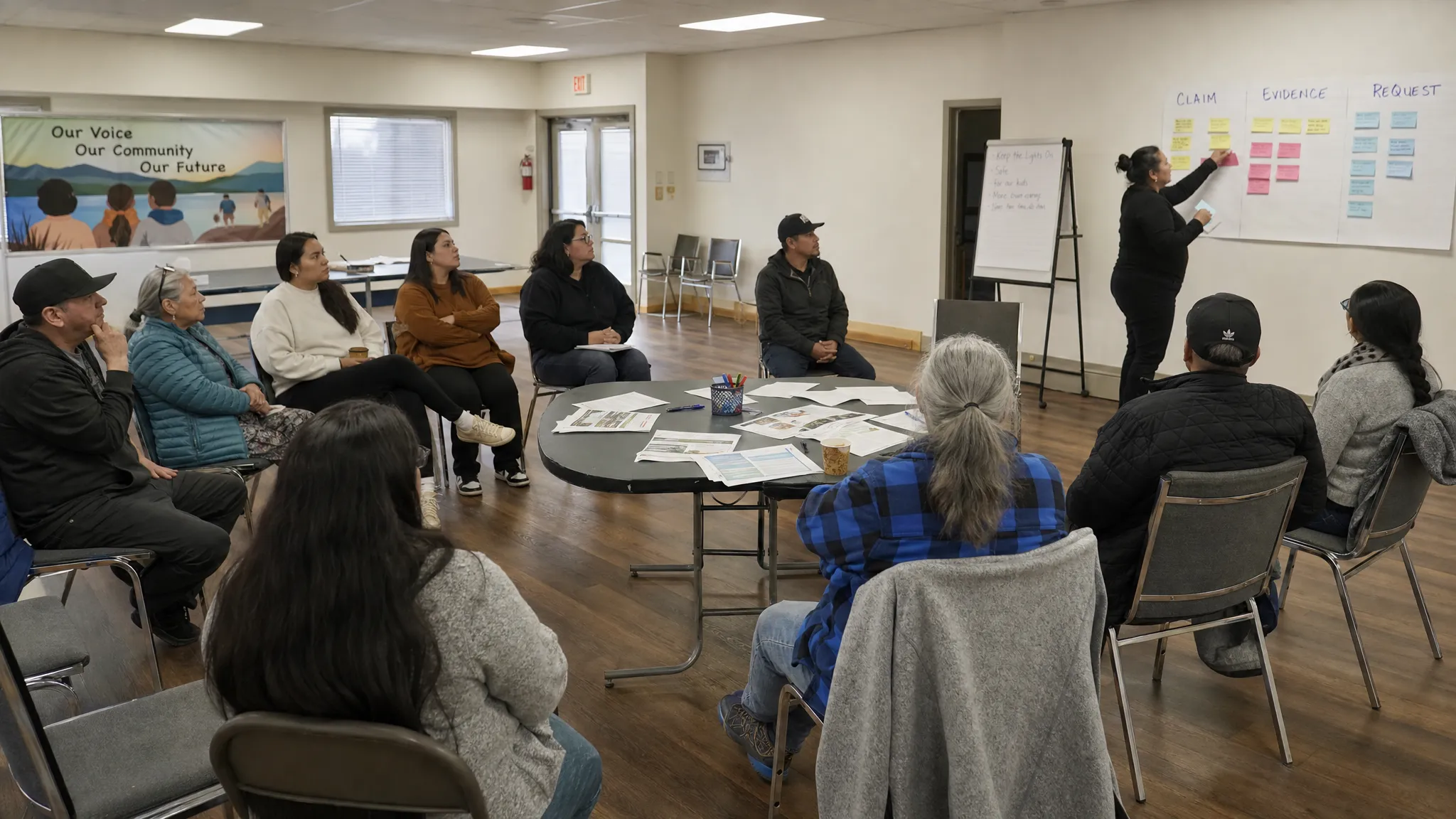
A six-part common civic room for polarized communities
A polarized community does not need everyone to share the same worldview. It needs a common civic room where disagreement can be processed without destroying trust entirely. That room can be physical, digital, or hybrid, but it must have visible rules.
- Name the actual decision : Do not begin with a vague debate such as safety, education, immigration, or housing. Begin with the concrete public decision: Who decides, by when, under what rule, and with what budget or legal constraints.
- Create a shared issue pack : Publish a short, plain-language document that explains the problem, the decision timeline, known facts, disputed facts, affected groups, available options, and open questions.
- Use a contribution grammar : Ask participants to submit input in a consistent format: claim, reason, evidence or experience, tradeoff, and request. This prevents the loudest narrative from becoming the only narrative.
- Separate public discourse from decision drafting : Let the broader public frame concerns and surface evidence, then hand the record to a smaller deliberative group or official body that drafts options.
- Publish synthesis without pretending consensus : A good synthesis should show agreement, disagreement, uncertainty, minority concerns, and unanswered questions. It should not erase conflict to create a fake feeling of unity.
- Require a response and follow-through : Decision-makers should publish what they accepted, rejected, modified, or postponed, and why. If nothing changes, the public should be able to see that too.
The key is continuity. One meeting cannot repair years of distrust. But a repeated civic room, with stable rules and public memory, can slowly make participation feel less futile.
Rules that protect dignity without flattening disagreement
Polarized communities often fail because they confuse viewpoint diversity with process chaos. People should be free to disagree sharply. They should not be free to dominate, threaten, fabricate, spam, impersonate, or derail a decision process.
Useful discursive rules focus on behavior and format, not ideology.
- Separate people from claims. Critique the argument, policy, source, or tradeoff, not the moral worth of the person.
- Steelman before rebuttal. Participants should be able to restate an opposing concern in a way the other side recognizes.
- Mark certainty. Contributions should distinguish confirmed evidence, interpretation, personal experience, prediction, and rumor.
- Protect lived experience. Personal testimony is not the same as statistical evidence, but it is often essential for understanding harm, access, dignity, and unintended consequences.
- Disclose direct interests. If someone represents an organization, vendor, campaign, agency, union, or affected business interest, that context should be visible.
- Use proportionate moderation. Remove or limit behavior that breaks the process, and publish moderation reasons when safety allows.
- Preserve minority reports. If a smaller group has a serious objection, the process should record it rather than burying it under majority preference.
These rules do not make public debate soft. They make it harder to manipulate.
Where technology helps, and where it can harm
The JustSocial manifesto correctly emphasizes that many required tools already exist: social platforms, cloud storage, analytics, AI language models, and possibly blockchain for confidentiality or auditability. The question is not whether technology can support discursive democracy. It can. The harder question is whether the technology is governed by democratic rules.
Digital tools can help polarized communities by widening access, collecting input asynchronously, translating complex documents into plain language, clustering recurring claims, producing searchable public records, and tracking official responses. They can also harm democracy by amplifying rage, hiding moderation decisions, exposing vulnerable participants, or turning civic input into surveillance.
A community platform should therefore be built around safeguards before scale. That means data minimization, accessibility, clear identity rules, transparent moderation, independent oversight, exportable records, and cybersecurity planning. For communities deploying local civic platforms, especially in regions where cloud, support, and security capacity are uneven, working with reliable managed IT and cloud specialists can be part of making democratic infrastructure resilient rather than fragile.
AI deserves special caution. It can summarize, translate, cluster, and detect duplicate claims. It should not secretly rank citizens by political value, decide which views matter, or replace human judgment in contested public questions. In polarized settings, AI must be assistive, auditable, and contestable.
A 30-day discursive democracy pilot
Polarized communities do not need to wait for national reform. A neighborhood, school district, municipality, professional association, or political movement can run a small pilot in 30 days.
| Timeline | Main task | Public artifact |
|---|---|---|
| Days 1 to 5 | Choose one concrete decision and name the decision owner | Decision statement |
| Days 6 to 10 | Gather basic evidence, constraints, and affected perspectives | Issue pack |
| Days 11 to 17 | Collect structured public input through meetings, forms, interviews, or forums | Claim and concern log |
| Days 18 to 23 | Facilitate a public synthesis session with clear rules | Disagreement map |
| Days 24 to 27 | Hand the synthesis to a deliberative group or decision-maker | Options brief |
| Days 28 to 30 | Publish the response pathway and next checkpoint | Receipt and follow-up tracker |
The pilot should be narrow enough to complete. A failed 12-month mega-process teaches cynicism. A completed 30-day loop teaches the community that participation can have memory.
Example: a community split over a public safety plan
Imagine a town divided over a public safety plan for a central park. One group argues that families no longer feel safe. Another argues that enforcement will target young people, migrants, unhoused residents, or minorities. A third group is exhausted and wants the issue to disappear.
A normal public meeting might produce accusation, applause, and resentment. A discursive process would begin differently.
The decision statement would name the actual question: Should the city adopt a new park safety plan for the next six months, and what combination of lighting, outreach, maintenance, youth programming, crisis response, and enforcement should it fund?
The issue pack would include incident data, maintenance records, budget limits, civil rights concerns, youth perspectives, business concerns, disability access, and examples from comparable parks. It would separate confirmed information from disputed claims.
Public input would follow a format. A resident might write: I support more lighting because I avoid the park after dark. My evidence is personal experience and three reported incidents near the east path. My tradeoff concern is light pollution for nearby apartments. My request is a three-month lighting pilot with a public review.
Another resident might write: I oppose increased police patrols because similar measures have led to discriminatory stops. My evidence is testimony from local youth and prior complaint records. My request is to fund outreach workers and publish monthly stop data if enforcement is expanded.
The synthesis would not pretend these views are the same. It would show areas of overlap: many residents want a safer park, better maintenance, clearer data, and review after implementation. It would show unresolved disagreement: the role of enforcement, the weight of lived experience, and the acceptable level of surveillance.
That synthesis can then feed deliberative democracy. A smaller representative group can draft three options, each with costs, benefits, risks, safeguards, and evaluation metrics. The city can then respond publicly. Even if the final decision disappoints some participants, the process leaves behind reasons, evidence, and accountability.
That is the difference between conflict as noise and conflict as civic intelligence.
How a political movement can use discursive democracy without becoming another tribe
A political movement in a polarized society faces a temptation: win attention by simplifying everything into enemies and slogans. That may mobilize quickly, but it rarely builds durable democratic capacity.
A movement committed to continuous democracy should behave differently. It should model the public system it wants to build. For JustSocial, that means treating civic participation as infrastructure, not merely messaging. It means building public habits that could eventually support a People’s Branch, stronger transparency, educational reform, and better links between citizens and government.
In practice, a movement can do five things immediately:
- Publish a participation promise before asking people to engage.
- Invite criticism into structured formats rather than treating dissent as betrayal.
- Turn supporter energy into decision-ready public artifacts.
- Keep funding, governance, and moderation rules visible.
- Measure success by public learning and decision influence, not only follower counts.
This is how a movement avoids becoming a mirror image of the broken politics it criticizes. It becomes a civic institution in miniature.
Metrics that show whether discourse is improving
Polarized communities often measure the wrong things: attendance, comments, likes, shares, or outrage. Discursive democracy should be measured by whether public reasoning becomes more inclusive, traceable, and useful for decisions.
| Metric | What it asks | Warning sign |
|---|---|---|
| Participation diversity | Are affected groups present across channels? | Only organized insiders participate |
| Claim-to-evidence ratio | Are claims linked to sources or experience? | Repeated assertions dominate |
| Reciprocity rate | Do participants engage opposing concerns accurately? | People only speak to their own side |
| Synthesis completeness | Are agreements, disagreements, and uncertainties recorded? | Official summaries erase conflict |
| Decision linkage | Did the process reach a real decision owner? | Input remains symbolic |
| Response quality | Did officials explain what changed and why? | Generic thank-you statements replace reasoning |
| Follow-through visibility | Can the public track implementation? | No one knows what happened after the meeting |
No metric is perfect. But a community that measures these signals is already treating democracy as a practice, not a performance.
Frequently Asked Questions
What is discursive democracy in simple terms? Discursive democracy is a way of organizing public conversation so citizens can make claims, give reasons, test evidence, share experience, and influence decisions without reducing politics to shouting or passive voting.
How is discursive democracy different from deliberative democracy? Discursive democracy improves the wider public debate and frames the issue. Deliberative democracy takes a more structured group through evidence, tradeoffs, and option-building. The strongest civic systems use both.
Can discursive democracy work when people strongly hate each other? It can help, but only if the process has enforceable rules, safety protections, skilled facilitation, and realistic goals. It may not create affection, but it can create a shared record and reduce manipulation.
Does discursive democracy limit free speech? It should not restrict viewpoints. It sets process boundaries for civic spaces, such as relevance, evidence labeling, time limits, anti-harassment rules, and transparency. People remain free to argue strongly within a fair process.
What role should anonymity play in polarized communities? Anonymity can protect vulnerable participants and reduce status pressure, but it needs safeguards against spam, impersonation, and manipulation. Privacy-preserving identity checks are often better than either total exposure or total chaos.
How does this connect to continuous direct democracy? Continuous direct democracy needs more than voting tools. It needs a public culture capable of reasoning continuously. Discursive democracy helps create that culture by turning everyday disagreement into structured civic input.
Build the civic room before the next crisis
Polarization will not disappear because a platform launches, a leader gives a speech, or a community holds one emotional meeting. It changes when people repeatedly experience a better civic process.
That is the work JustSocial is trying to advance: a political movement for continuous direct democracy, citizen empowerment, transparency, and technology that serves public life rather than replacing it. If the manifesto’s vision of a modern Cosmopolis is to become real, communities must first learn how to disagree without losing the ability to govern together.
Read The Face of Democracy, explore JustSocial’s civic democracy resources, and consider contributing as a citizen, organizer, technologist, educator, volunteer, or supporter. The next democratic upgrade will not be built by spectators. It will be built by communities that turn conflict into public reason, and public reason into action.