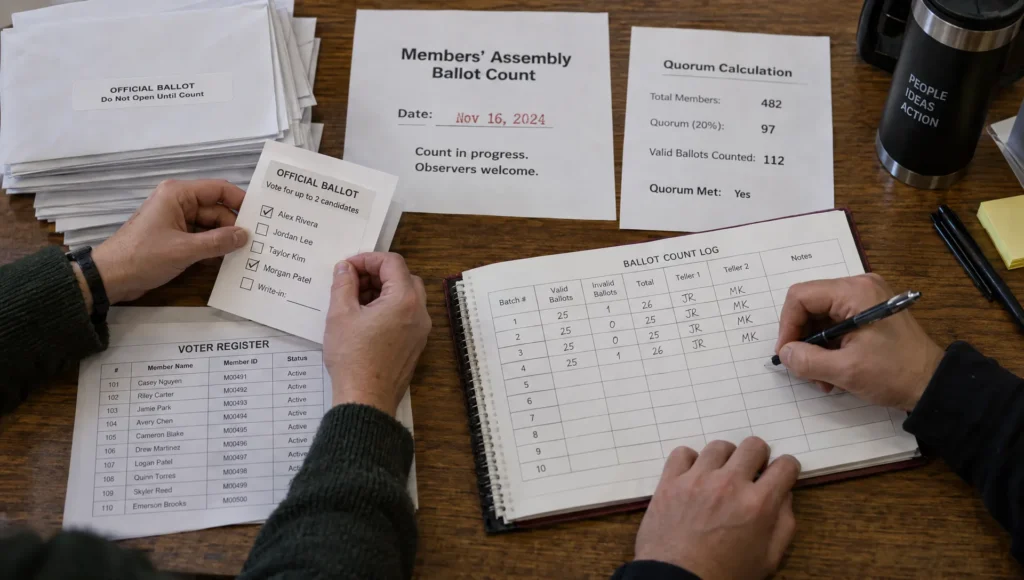
Public accountability usually arrives too late. A scandal breaks, an audit is published, a committee asks questions, an election becomes a delayed referendum on decisions citizens could barely see while they were being made. By then, the budget is spent, the contract is signed, the policy is implemented, and the public is left with outrage instead of influence.
Discursive democracy changes the timing. It treats public reasoning as civic infrastructure, not background noise. Claims, evidence, objections, tradeoffs, conflicts of interest, official replies, and implementation updates are organized while a decision is still alive. The goal is not to turn every public issue into a chaotic live vote. The goal is to make the reasoning trail visible early enough that citizens, journalists, experts, and officials can challenge it before the consequences are locked in.
This is one of the central ideas behind JustSocial’s broader vision of continuous direct democracy. In The Face of Democracy, Yuval D. Vered argues that modern technology should let people weigh in consistently, while institutions remain responsible for governing. Real-time discursive democracy is the accountability layer that makes that possible.
What Discursive Democracy Adds to Public Accountability
Discursive democracy is the democratic practice of structuring public conversation so it becomes usable for public decisions. It is broader than deliberative democracy, which usually means a structured forum where participants study evidence and produce recommendations. Discursive democracy includes the wider public sphere: media coverage, civic platforms, committee comments, movement forums, public hearings, local WhatsApp groups, livestream chats, and citizen submissions.
The problem is that most public discourse is not designed for accountability. It is designed for attention. A viral post can expose a problem, but it rarely creates a reliable public record. A public hearing can let people speak, but it often produces no structured response. A livestream can show a meeting, but without timestamps, transcripts, claim maps, and follow-up logs, it becomes passive transparency rather than practical accountability.
Discursive democracy adds four missing features:
- Structure: public claims are submitted in formats that identify the issue, evidence, affected group, and requested action.
- Traceability: citizens can see whether an argument entered the decision process, was ignored, or changed the final outcome.
- Contestability: evidence, assumptions, and official reasoning can be challenged before decisions are finalized.
- Memory: the process leaves public records that future citizens, journalists, auditors, and movements can inspect.
In short, discursive democracy turns public talk into public evidence.
Why Real-Time Accountability Matters
Real-time accountability does not mean instant judgment. It means accountable timing. Citizens should not have to wait months or years to learn what problem a decision was supposed to solve, what evidence officials relied on, who was consulted, what alternatives were rejected, and whether implementation matched the promise.
Modern citizens already live in a world of real-time tracking. We track packages, bank transfers, service tickets, deliveries, public transit delays, and product reviews. In ordinary markets, people often expect clear categories, origin information, reviews, and delivery details. A resident trying to inspect a public food procurement decision may sometimes receive less usable information than a shopper browsing restaurant-quality meat with visible product categories and delivery details. That gap should trouble us. Public decisions involve taxes, rights, services, safety, and long-term community consequences. They deserve at least the same level of legibility as a consumer transaction.
Real-time accountability is especially important because most democratic power is exercised between elections. Budgets are drafted, regulations are interpreted, school rules are revised, procurement contracts are awarded, zoning changes are negotiated, and emergency decisions are made. If accountability only appears after the fact, citizens are not participants. They are historians of decisions already made without them.
The Real-Time Accountability Stack
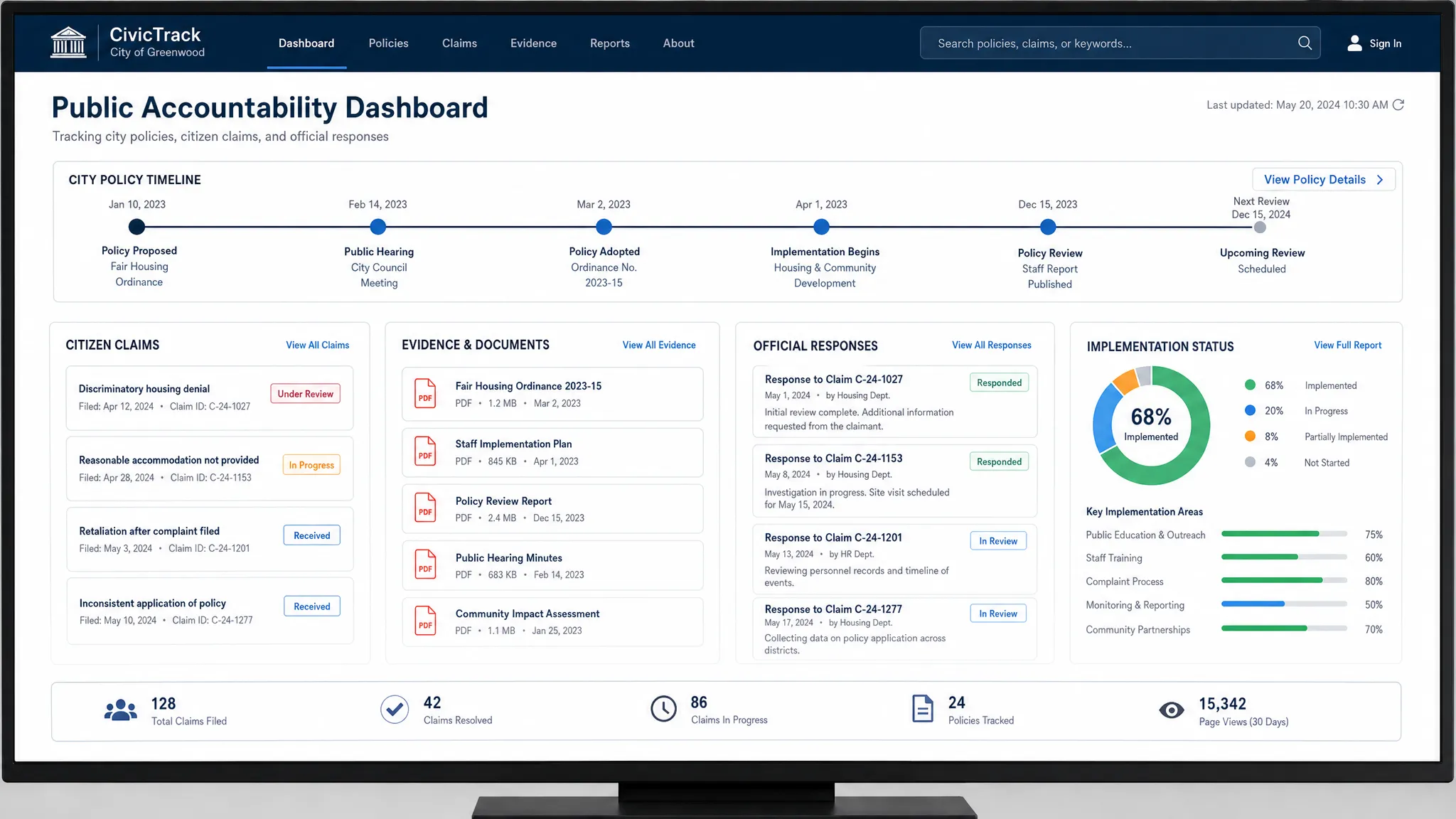
A practical discursive democracy system needs public artifacts, not just good intentions. The following stack can be used by governments, civic platforms, journalists, community organizers, or a political movement that wants to model the accountability it demands.
| Layer | Public artifact | Accountability question it answers |
|---|---|---|
| Decision clarity | Decision Docket | What decision is being made, by whom, and by when? |
| Evidence | Evidence Commons | What facts, data, testimony, and expert input are being used? |
| Public reasoning | Claim Map | What are citizens arguing, and where do they disagree? |
| Official response | Response Log | Which claims received answers, and which remain unanswered? |
| Final reasoning | Rationale Memo | Why was this option chosen over alternatives? |
| Follow-through | Implementation Tracker | Did the institution do what it said it would do? |
| Correction | Change Log | What changed, why, and who authorized the change? |
This stack matters because accountability is not one document. It is a chain. If the decision is unclear, public input becomes scattered. If evidence is hidden, debate becomes rumor-driven. If claims are not mapped, officials can say they “listened” without showing what they heard. If implementation is not tracked, even a good decision can disappear into bureaucracy.
How a Public Decision Should Work in Real Time
Start With a Decision Docket
Every accountable process begins by naming the decision. Not the theme. Not the general concern. The decision.
A useful Decision Docket should state the decision owner, legal authority, timeline, budget range, decision rule, and points where public input can still matter. For example, “The city transportation committee will decide by August 15 whether to redesign the Oak Street intersection using one of three approved safety concepts.” That sentence is far more actionable than “The city is discussing road safety.”
This connects directly to the JustSocial manifesto’s critique of citizens being reduced to voters, taxpayers, and consumers. If people do not know where decisions happen, they cannot act as citizens in any meaningful sense.
Build an Evidence Commons Before Debate Explodes
Public debate often fails because people enter with different facts, different rumors, and different definitions of the problem. An Evidence Commons does not eliminate disagreement. It gives disagreement a shared reference point.
The Evidence Commons should include official documents, budget data, legal constraints, expert summaries, public testimony, uncertainty notes, and links to source materials. It should also show what is missing. A public “unknowns” section is often more honest than pretending evidence is complete.
The role of academia, another branch proposed in JustSocial’s manifesto, becomes important here. Experts should not replace citizens, but they can help make evidence legible, contestable, and honest about uncertainty.
Convert Public Speech Into a Claim Map
A Claim Map organizes public input by argument, not by volume. Ten thousand identical comments should not automatically outweigh a well-supported concern from a small affected group. At the same time, a single expert memo should not erase lived experience.
A simple claim format can make discourse more useful:
- Claim: what the person believes is true or should happen.
- Reason: why they believe it.
- Evidence: what supports the claim.
- Affected group: who experiences the impact.
- Request: what decision-maker should do next.
Once inputs follow this structure, moderators or civic software can cluster recurring arguments, identify conflicts, surface minority concerns, and mark claims that need evidence review. This is where discursive democracy becomes more than “comments.” It becomes public reasoning in a form institutions can answer.
Require a Live Response Log
Real-time accountability requires a public response habit. Officials do not need to answer every comment individually, but they should respond to major claim clusters, credible evidence challenges, and significant affected-group concerns.
A Response Log can show four statuses: received, under review, answered, or incorporated. If a claim is rejected, the reason should be stated. If a claim changes the decision, that change should be visible. If a claim cannot be addressed because it is outside legal scope, the scope limit should be explained.
This is one of the simplest ways to reduce public cynicism. Citizens may accept losing an argument. What they increasingly reject is being unable to tell whether the argument was ever seen.
Publish the Rationale Before the Memory Fades
When the decision is made, the institution should publish a Rationale Memo. This should not be a press release. It should explain the options considered, the tradeoffs, the public input received, the evidence used, the reasons for the final choice, and the plan for implementation.
A strong Rationale Memo also includes dissent. Not every disagreement can be resolved. Public accountability improves when unresolved concerns are recorded rather than buried.
Track Implementation Like a Civic Contract
The final failure of many participation processes is that the public disappears after the decision. Implementation is where promises become real, delayed, weakened, or quietly abandoned.
An Implementation Tracker should show milestones, responsible offices, budget status, delays, changes, evaluation metrics, and next review dates. If a decision changes during implementation, the Change Log should explain why.
This is how discursive democracy supports continuous direct democracy without pretending that every citizen must monitor everything all the time. Citizens can return to the record when needed. Movements can audit patterns. Journalists can investigate delays. Officials can show good-faith progress.
Real-Time Does Not Mean Reckless
The phrase “real time” can raise legitimate concerns. Some information should not be public immediately. Some information should not be public at all. A democratic accountability system must distinguish between public reasoning and harmful exposure.
| Risk | Bad version of real time | Better discursive approach |
|---|---|---|
| Privacy harm | Publishing personal complaints without consent | Aggregate claims, redact personal data, use consent-based testimony |
| Security harm | Broadcasting sensitive operational details | Publish decision logic while withholding protected details |
| Harassment | Turning public input into target lists | Use anonymous or pseudonymous civic identity where appropriate |
| Manipulation | Ranking inputs by virality | Rank by relevance, evidence, affectedness, and representativeness |
| Misinformation | Letting false claims dominate before review | Mark evidence status and maintain correction logs |
| Participation inequality | Treating loud voices as the whole public | Track inclusion gaps and run targeted outreach |
A serious system must also provide appeals, moderation receipts, accessibility options, multilingual support, and independent oversight for high-stakes processes. Discursive democracy is not a call for open chaos. It is a call for governed openness.
What a Political Movement Can Do Before It Holds Power
A political movement does not need to wait for government permission to practice real-time accountability. It can model the standard publicly.
For JustSocial, this is strategic as well as ethical. A movement that argues for a People’s Branch, public transparency, and technology-enabled participation should show how those values operate in its own work. That means publishing participation promises, meeting notes, evidence sources, response logs, spending summaries when appropriate, and clear next steps.
A movement can run a “shadow accountability” process around one local decision. It can create its own Decision Docket, gather public claims, build an Evidence Commons, invite experts, request official responses, and publish an Implementation Tracker. Even if officials ignore the process at first, the movement creates a public record that citizens can use.
This is how civic participation becomes durable. Not by shouting once, but by building a repeatable accountability loop.
A 30-Day Pilot for Real-Time Public Accountability
The first pilot should be small enough to finish and visible enough to matter. Choose one public decision with a clear owner and timeline: a school policy change, local budget item, transportation redesign, neighborhood service issue, or public committee vote.
| Week | Main task | Public output |
|---|---|---|
| Week 1 | Name the decision and collect official materials | Decision Docket and document index |
| Week 2 | Invite structured public input | Claim Map and Evidence Commons |
| Week 3 | Cluster arguments and request official replies | Response Log and unanswered questions list |
| Week 4 | Publish findings and track next steps | Rationale Review and Implementation Tracker |
Success should not be measured only by the number of participants. Better metrics include whether the decision owner was identified, whether evidence was traceable, whether affected groups were heard, whether officials responded, and whether the final decision addressed public claims.
That is the deeper cultural shift. Democracy should not be measured only by turnout. It should be measured by whether public reason can reach public power in time.
Frequently Asked Questions
Is discursive democracy the same as direct democracy? No. Direct democracy focuses on citizens voting directly on decisions. Discursive democracy focuses on structuring public conversation so claims, evidence, and reasoning can influence institutions. The two can work together, but they are not the same.
Does real-time accountability mean officials must obey every public demand? No. Officials can still make independent decisions, especially when rights, law, security, or expert constraints matter. Real-time accountability means they must show what they heard, what they considered, and why they chose a path.
How is this different from livestreaming meetings? Livestreaming is useful, but it is not enough. Discursive democracy adds decision pages, transcripts, claim maps, evidence records, response logs, rationale memos, and implementation trackers so citizens can inspect the process without watching hours of video.
Can this work without advanced technology? Yes. A shared document, public spreadsheet, email intake form, and community meeting can run a basic version. Technology helps scale the process, but the core is institutional discipline: name the decision, structure input, publish responses, and track implementation.
What prevents manipulation or astroturfing? Strong processes use proportional identity checks, transparent moderation, evidence requirements, anomaly monitoring, appeals, and separation between open mobilization and decision-grade input. The goal is to protect participation without turning civic life into surveillance.
Build Accountability While the Decision Is Still Alive
Public accountability should not be a postmortem. Citizens deserve to see decisions forming, challenge evidence, understand tradeoffs, and track implementation before democratic memory resets.
That is the promise of discursive democracy in real time. It does not replace elections, courts, representatives, journalism, or expert advice. It connects them through visible public reasoning.
JustSocial is working toward a political culture where citizens are not reduced to occasional voters and frustrated spectators. If you believe public decisions should leave a live, inspectable trail, read the manifesto, share the idea, contribute your skills, or help build the civic tools and practices that make continuous public accountability possible.