Participation-centered politics begins with a simple reversal: the movement is not asking people to clap for leaders, share slogans, or wait for the next election cycle. It is asking people to practice power together.
That distinction matters. Many movements rise quickly because they master attention. Fewer endure because they build participation. A durable political movement turns supporters into civic actors who can identify public decisions, reason with others, produce usable proposals, demand transparent responses, and track whether promises become policy.
This is deeply connected to JustSocial’s manifesto, The Face of Democracy. The manifesto argues that modern citizens have too often been reduced to voters, taxpayers, and consumers. A movement around participation rejects that reduction. It treats citizens as a standing civic force, a people’s branch in practice before it becomes a formal institution.
The core idea: participation is the product
A political movement usually begins with a cause. Housing justice, education reform, public transparency, anti-corruption, local safety, democratic renewal, or economic fairness can all mobilize people. But if participation is only a campaign tactic, the movement will eventually become dependent on charismatic leadership, outrage cycles, and election calendars.
A participation-centered movement makes the method part of the mission. Its strongest promise is not only what it wants to achieve, but how people will share power while trying to achieve it.
That means supporters should be able to answer practical questions:
- What decision are we trying to influence?
- Who owns that decision?
- What evidence are we using?
- How can ordinary people contribute without becoming full-time activists?
- What will be published so outsiders can verify the process?
- What happens after officials, institutions, or movement leaders respond?
If those questions are unclear, the movement may still generate noise. It will not yet generate democratic capacity.
| Attention-based movement | Participation-based movement |
|---|---|
| Optimizes for visibility | Optimizes for usable civic action |
| Asks people to support leaders | Asks people to co-create public judgment |
| Measures likes, attendance, and donations | Measures decisions influenced, receipts published, and follow-through |
| Relies on urgency | Builds repeatable civic habits |
| Treats disagreement as a threat | Treats disagreement as material for deliberation |
Start with a participation promise
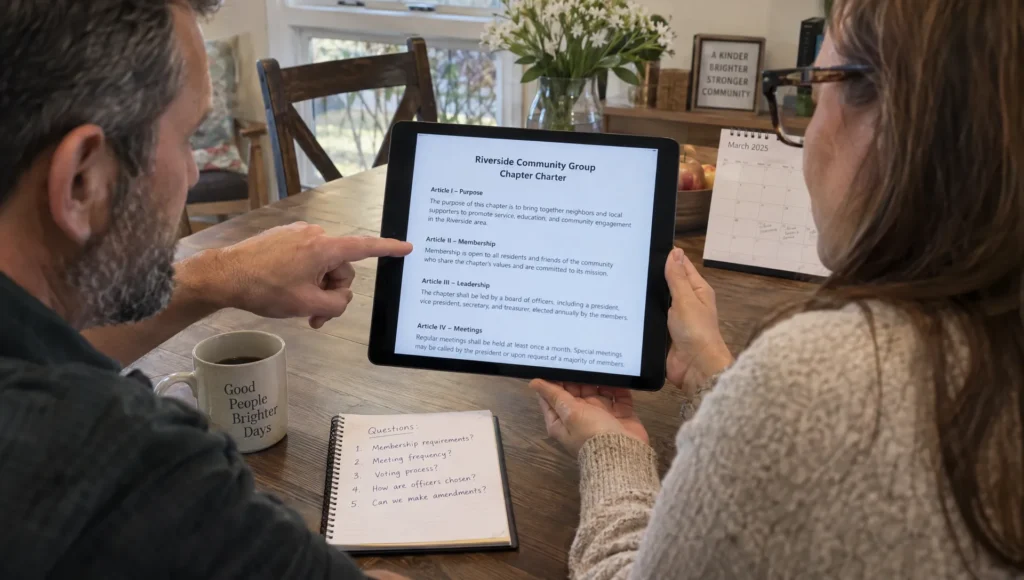
Before launching a campaign, write a participation promise. This is a short public statement explaining what supporters can expect when they give time, money, expertise, or attention to the movement.
A strong participation promise should be specific enough to constrain leadership. For example: We will publish decision notes before major campaigns, document meetings, explain tradeoffs, disclose funding categories, invite structured public input, and track whether institutions respond.
This does not mean every decision becomes a referendum. Movements still need coordination, speed, privacy, and leadership. But leadership should operate inside visible rules. The promise tells people that participation is not decorative. It will create records, shape priorities, and produce accountability.
In the language of continuous direct democracy, the participation promise is the beginning of a new social contract at movement scale. Citizens are not asked to disappear between elections or rallies. They are invited into an ongoing loop of agenda-setting, discussion, judgment, decision, and oversight.
Build three rooms: discourse, deliberation, and action
Participation becomes chaotic when every conversation is treated the same. A public argument on social media, a structured policy workshop, and a final campaign decision have different purposes. A mature movement separates them.
The most useful model is a three-room structure: discursive democracy, deliberative democracy, and civic participation.
| Room | Purpose | Typical output | Main risk |
|---|---|---|---|
| Discursive democracy | Surface concerns, frames, stories, claims, and disagreements | Claim maps, evidence shelves, synthesis notes | Virality replacing truth |
| Deliberative democracy | Weigh evidence, compare tradeoffs, and form decision-ready options | Options memo, minority report, recommendation | Capture by loud or expert voices |
| Civic participation | Link public input to real decisions and follow-through | Decision request, vote, petition, response memo, tracker | Tokenism without consequence |
Discursive democracy gives people a place to speak and contest meaning. This matters because public life is not only technical. People need to explain what they fear, what they value, what they have experienced, and what they believe is being ignored.
Deliberative democracy turns that raw public material into structured judgment. It asks participants to slow down, examine evidence, compare options, and make tradeoffs visible. It does not require fake consensus. In fact, a good deliberative process should preserve principled disagreement through minority reports and public reasoning.
Civic participation connects the process to power. It asks: where does this go, who must respond, what decision is pending, and how will we know whether anything changed?
A movement built around participation needs all three. Discourse without deliberation becomes noise. Deliberation without decision linkage becomes civic theater. Action without discourse and deliberation becomes mobilization without legitimacy.
Turn supporters into co-authors, not spectators
The easiest way to weaken a movement is to give supporters only two choices: donate or show up. People have many forms of capacity. Some can write. Some can translate. Some can facilitate. Some can analyze budgets. Some can call officials. Some can build software. Some can host a local meeting. Some can bring lived experience that no expert report can replace.
A participation-centered movement should create contribution lanes that are clear, time-boxed, and useful.
- Decision scouts identify upcoming public decisions, committee meetings, tenders, consultations, school board votes, budget windows, and regulatory deadlines.
- Evidence stewards collect sources, summarize claims, and separate verified information from rumor.
- Facilitators run structured discussions where people make claims, give reasons, and respond to opposing views.
- Deliberation hosts convene small groups to compare options and produce recommendations.
- Transparency keepers publish notes, receipts, response logs, and implementation trackers.
- Community bridges bring in people who are usually missing from political meetings, including working parents, minorities, disabled people, youth, and those without strong digital access.
These roles make participation practical. They also prevent the movement from becoming a personality cult. When many people can perform civic functions, the movement becomes harder to capture and easier to replicate.
Publish receipts before asking for trust
Trust is not a mood. It is an audit trail.
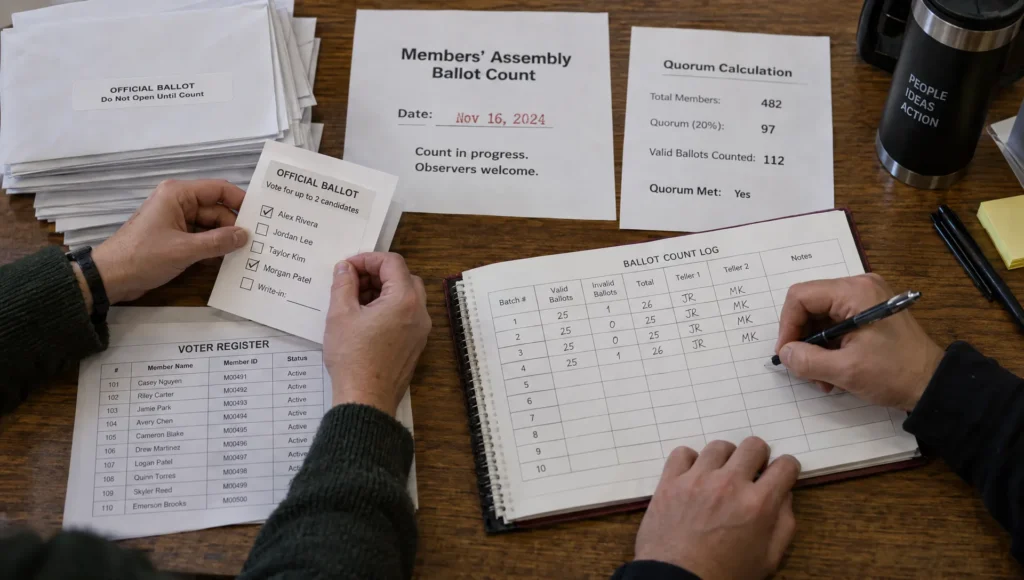
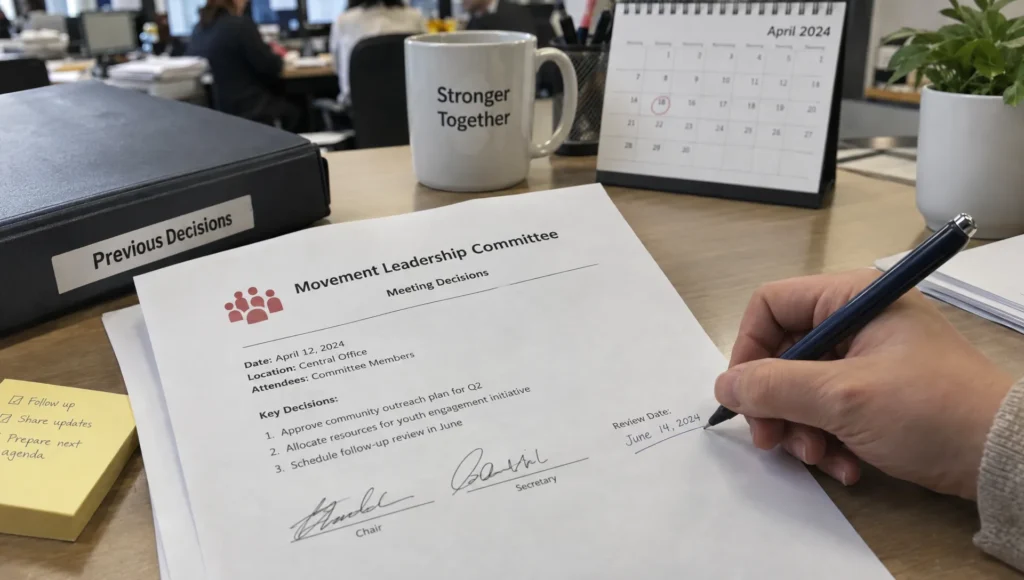
If a political movement wants to build around civic participation, it must publish public receipts. These are not glossy reports written after the fact. They are short, inspectable records that let supporters and critics see how decisions were made.
Useful receipts include a participation promise, meeting agenda, decision note, evidence index, synthesis memo, options memo, vote record, funding summary, conflict disclosure, official response, and implementation tracker. Not every small activity needs every artifact. But the movement should publish enough that people can verify the chain from input to outcome.
Funding deserves special attention. Money can strengthen participation by paying organizers, translators, designers, developers, childcare providers, accessibility support, and venue costs. It can also corrupt priorities if donors gain hidden influence. A movement should disclose funding categories, decision rules, and spending priorities in plain language.
Even small operational choices matter. At local events, pop-up assemblies, and community fundraisers, low-friction tools can make grassroots support easier. For example, using a phone-based card reader can help volunteers accept small contactless contributions without buying extra hardware, as long as the movement reports income transparently and protects donor privacy according to law.
The principle is simple: make participation easy, but make accountability easier.
Design for dignity and minority protection
A movement around participation must not confuse majority energy with democratic legitimacy. The loudest group is not always the most affected group. The largest faction is not always right. The most active participants are not always representative.
This is where safeguards become essential. Participation must be open enough to empower people, but structured enough to protect dignity, safety, and rights.
At minimum, a movement should define rules for respectful conduct, harassment response, privacy, accessibility, translation, and conflicts of interest. It should also decide when anonymity, pseudonymity, or verified identity is appropriate. A public comment on a sensitive issue may need privacy protection. A binding internal vote may require eligibility checks. A deliberative working group may need balanced recruitment to avoid domination.
Minority protection is not an obstacle to participation. It is what makes participation legitimate. A movement that cannot protect dissent internally is not ready to demand democratic power externally.
Use technology as scaffolding, not a substitute for politics
JustSocial’s broader vision includes technology-driven tools for direct democracy, decision-making, public transparency, and citizen empowerment. But the most important lesson is that technology should serve civic structure, not replace it.
A platform can collect input, organize evidence, verify eligibility, support online voting, publish documents, translate materials, summarize large volumes of comments, and track implementation. Those functions are valuable. But no app can decide the movement’s ethics. No dashboard can create legitimacy if the process is unclear. No analytics layer can substitute for public reasoning.
The right sequence is governance first, technology second. Define the participation promise, roles, safeguards, evidence standards, decision links, and publication rules. Then use digital tools to make those commitments easier to execute at scale.
This aligns with the manifesto’s idea of moving beyond industrial-era political structures. The point is not to digitize old habits of top-down leadership. The point is to create a civic operating system where people can participate continuously, transparently, and meaningfully.
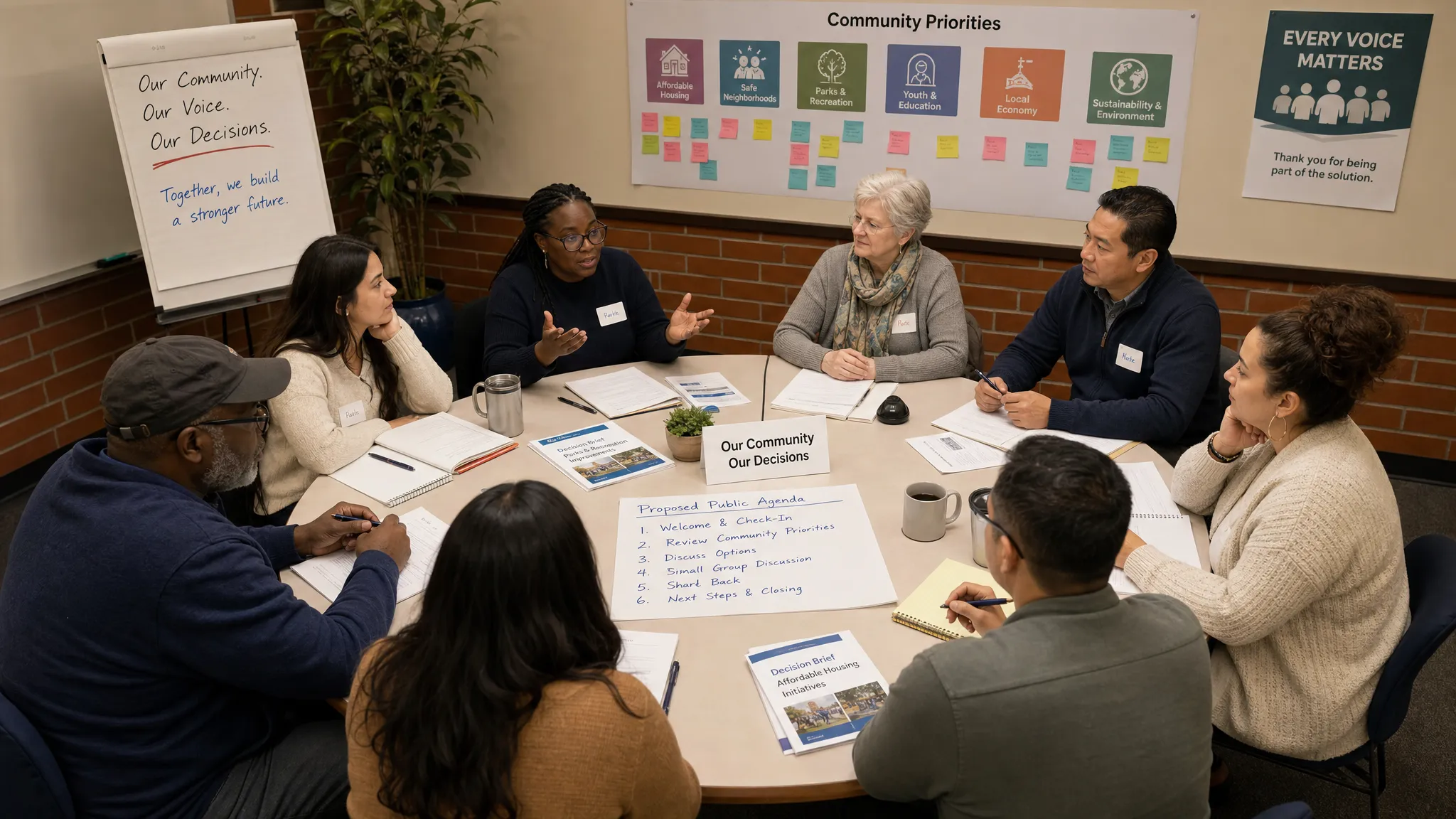
A 90-day blueprint for a participation-centered movement
A movement does not need national scale to prove its model. It needs one complete participation loop that people can inspect and repeat.
| Timeline | Main goal | Public output |
|---|---|---|
| Days 1 to 30 | Choose one real decision and map the stakeholders, timeline, evidence, and decision owner | Decision Note and Participation Promise |
| Days 31 to 60 | Run structured discourse and a small deliberative process to compare options | Synthesis Note and Options Memo |
| Days 61 to 90 | Deliver the recommendation, request a response, and track what happens | Response Log and Implementation Tracker |
The first decision should be concrete. Do not begin with a vague campaign to fix democracy, reform education, or improve transparency everywhere. Begin with one budget item, one school policy, one public committee, one procurement issue, one neighborhood safety decision, or one local service failure.
The goal is to prove that supporters can move through the full democratic cycle. They identify the decision, gather evidence, include affected voices, deliberate, produce a clear ask, deliver it to the decision owner, and publish the response.
Once one loop works, repeat it. Then train more people to run it. Then connect local loops into a wider movement.
Measure participation quality, not just movement size
A participation-centered political movement needs different metrics from a traditional campaign. Size matters, but size alone can mislead. A large mailing list that cannot produce decision-ready input is weaker than a smaller network that can repeatedly influence public decisions.
Track indicators that show civic capacity:
| Metric | What it reveals |
|---|---|
| Decision linkage rate | Whether participation is connected to real decisions |
| Evidence traceability | Whether claims can be checked and challenged |
| Deliberation completion | Whether groups produce usable options, not only discussion |
| Inclusion gaps | Which communities are missing or underrepresented |
| Response rate | Whether officials or institutions answer movement outputs |
| Follow-through visibility | Whether people can see implementation progress or failure |
| Volunteer retention | Whether participation is sustainable rather than exhausting |
These metrics help the movement learn. They also show outsiders that participation is serious. Instead of saying, trust us, the movement can say, inspect the process.
Leadership still matters, but its role changes
A movement around participation does not eliminate leadership. It disciplines leadership.
Leaders still set direction, hold the narrative, resolve operational bottlenecks, represent the movement publicly, and make urgent calls when needed. But they should not hoard interpretation or decision-making. Their deeper role is to create conditions where more people can participate intelligently.
The best participation-centered leaders behave less like owners and more like stewards. They build processes that can outlive them. They publish reasons. They invite correction. They protect dissent. They make the movement legible enough that newcomers can contribute without asking permission from an inner circle.
That is how a political movement becomes democratic in practice, not only democratic in branding.
Common mistakes to avoid
The first mistake is confusing engagement with participation. Engagement means people are paying attention. Participation means people can influence a decision and verify what happened afterward.
The second mistake is opening every question to everyone all the time. That creates overload and weakens judgment. Use wide discursive input for framing, smaller deliberative groups for option-building, and clear participation mechanisms for decisions.
The third mistake is hiding internal tradeoffs. Movements often fear that transparency will expose disagreement. In reality, honest disagreement can build credibility if the process is fair and the records are clear.
The fourth mistake is treating technology as legitimacy. A beautiful platform without safeguards, evidence, accessibility, and response duties is only a better-looking suggestion box.
The fifth mistake is demanding participation from government while refusing it internally. A movement should model the democratic culture it wants institutions to adopt.
Frequently Asked Questions
Can a political movement be participation-centered and still win elections? Yes. Participation can strengthen electoral work by creating trust, local knowledge, volunteer capacity, and policy legitimacy. The key is not to reduce people to campaign labor. If elections become relevant, they should be connected to the same transparent participation loop.
What is the difference between discursive democracy and deliberative democracy in a movement? Discursive democracy helps people surface claims, values, stories, and disagreements in public. Deliberative democracy uses structured settings to weigh evidence, compare tradeoffs, and produce decision-ready recommendations. Movements need both.
How do you prevent participation from being captured by activists with the most time? Use time-boxed roles, outreach to missing communities, accessibility support, rotating facilitation, transparent recruitment, and published minority reports. Measure inclusion gaps instead of assuming that whoever attends represents everyone.
Does every supporter need to participate in every decision? No. Continuous participation does not mean constant participation by everyone. It means there are ongoing, trustworthy opportunities for people to enter the process when an issue matters to them, and to verify what happened when they cannot attend.
What should a new movement publish first? Start with a participation promise, a clear decision note, a simple evidence index, and a response tracker. These four artifacts show what the movement is trying to influence, how people can contribute, what information is being used, and whether anyone in power responded.
Build the future you are asking for
A political movement around participation is not built by slogans alone. It is built through repeatable civic practice: speak clearly, reason together, decide transparently, publish receipts, protect dissent, and track outcomes.
That is the heart of JustSocial’s vision for continuous direct democracy. The movement is not only about replacing old political habits. It is about proving that citizens can become co-authors of public life again.
If that future feels necessary, start small. Choose one decision. Build one participation loop. Publish one set of receipts. Invite others to improve the process. Then repeat until participation becomes culture.