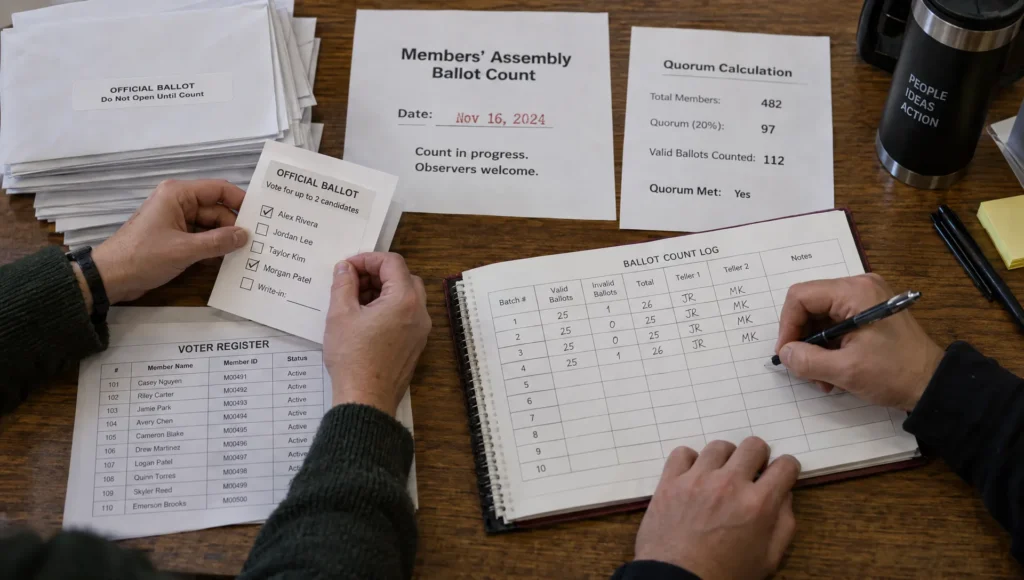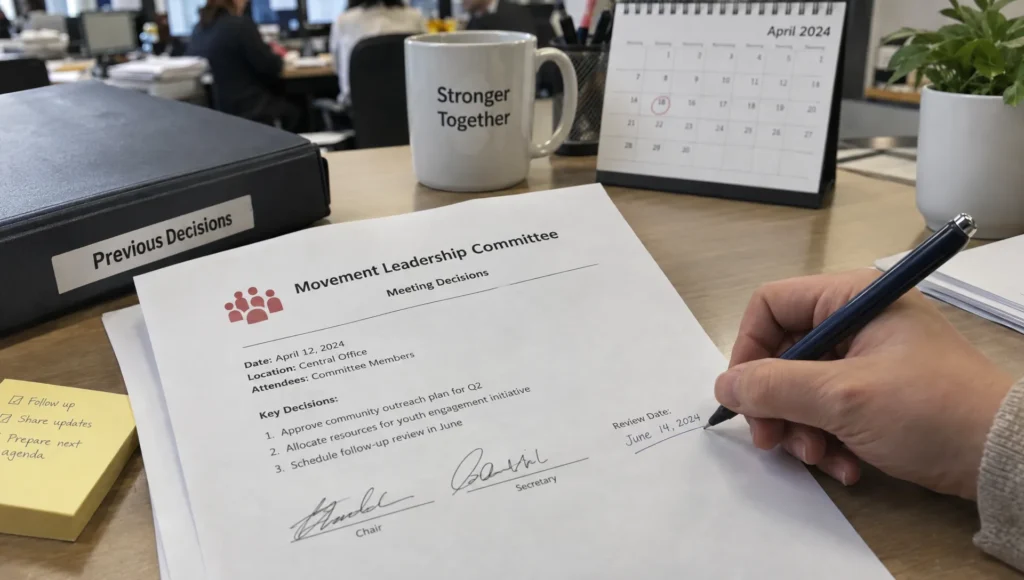
Public trust is not a mood. It is a civic asset, and once a political movement damages it, no slogan can repair the loss by itself. In 2026, citizens are surrounded by campaigns, influencers, AI-generated persuasion, and constant outrage. They have learned to ask a simple question: can I verify what this movement says, does, and decides?
A political movement breaks public trust when it asks people to believe what they cannot inspect. That is especially dangerous for movements that speak the language of civic participation, deliberative democracy, or democratic reform. If a movement says the state must listen better, but the movement itself does not listen well, citizens will notice. If it demands transparency from government, but hides its own internal power structure, citizens will notice. If it promises continuous participation, but only uses supporters as donors, voters, or share buttons, citizens will notice.
The JustSocial manifesto argues that people should no longer be reduced to voters, taxpayers, and consumers. That standard begins inside the movement itself. A movement for a more democratic society must become a small working model of the democracy it wants to build.
Why public trust breaks before a movement wins
Many movements assume trust will arrive after victory. They think the public will forgive procedural weaknesses if the cause is righteous enough. That is a mistake. Trust is built before power, because the way a movement behaves while seeking power tells citizens how it may behave after gaining it.
People rarely evaluate a political movement only by ideology. They also evaluate its habits. Does it answer questions? Does it correct mistakes? Does it publish decisions? Does it welcome dissent? Does it protect vulnerable participants? Does it distinguish facts from interpretations? Does it know the difference between civic participation and audience engagement?
Trust signals are not unique to politics. People trust organizations when expectations are clear, claims are concrete, and proof is visible. Even a non-political public-facing service, such as a bridal boutique that makes its appointments, reviews, contact details, and product categories easy to inspect, shows a basic principle that politics often forgets: people trust what they can examine. A movement asking to reshape public life should meet a much higher version of that standard.
The three-layer trust test
A trustworthy political movement does not treat participation as one big open comment box. It separates three democratic layers and makes each one visible.
| Democratic layer | What the public should be able to ask | Common trust-breaking failure |
|---|---|---|
| Discursive democracy | Can people frame problems, challenge claims, and be heard without humiliation? | Debate becomes chaos, branding, or curated agreement. |
| Deliberative democracy | Can participants weigh evidence, tradeoffs, and options in a fair process? | Leaders preselect the conclusion and call it deliberation. |
| Civic participation | Can public input connect to a real decision, response, or follow-through? | People speak, but nothing changes and no one explains why. |
When these layers collapse into each other, trust breaks. A viral hashtag is not public judgment. A town hall is not deliberation if only the loudest voices dominate. A survey is not civic participation if no decision-maker has a duty to respond.
The movement must show citizens where their voice goes, what it influences, and what happens next.
Mistake 1: confusing attention with legitimacy
Attention is not consent. A movement can trend online, fill a square, or dominate a news cycle without earning durable legitimacy. Visibility is useful because it surfaces pain, frustration, and demand. But visibility becomes manipulative when leaders treat it as proof that the public has endorsed a full agenda.
This mistake is common because attention feels like momentum. A crowd creates emotional force. A viral post gives organizers instant feedback. But democratic legitimacy requires more than intensity. It requires inclusion, reasoning, traceability, and accountability.
The repair is simple but demanding: treat attention as intake, not authorization. When an issue goes viral, the movement should capture claims, identify the decision at stake, build an evidence shelf, and invite structured responses. Discursive democracy turns raw public speech into usable civic information. It does not pretend that the loudest moment is the final mandate.
Mistake 2: promising participation without decision linkage
Nothing creates cynicism faster than participation theater. Citizens attend meetings, fill forms, share testimonies, and submit proposals. Then nothing happens. Or worse, leaders announce a decision that was already made and thank the public for its input.
A political movement breaks trust when it invites participation without explaining the decision pathway. People need to know who owns the decision, what can still change, what cannot change, when the decision will be made, and how public input will be answered.
A trustworthy participation promise should say: this is the decision, this is the timeline, this is how input will be used, this is who will respond, and this is where the response will be published. If adoption is not guaranteed, say so. It is better to promise a serious response than to imply false power.
In JustSocial terms, this is part of moving from a once-every-four-years civic ritual to continuous direct democracy. Continuous participation only matters if it connects to decisions and public records.
Mistake 3: hiding internal power
Many movements criticize political elites while reproducing elite behavior internally. A small circle decides the message, controls money, chooses partnerships, defines membership, and resolves disputes privately. Supporters are asked to trust the inner circle because the cause is important.
That may work for a short campaign. It does not work for a democratic movement.
Internal opacity tells the public that the movement wants accountability for others, not for itself. It also creates practical risks: factional conflict, donor suspicion, volunteer burnout, and accusations of capture.
The repair is to publish a basic governance charter. It does not need to be perfect. It should explain who can decide what, how leaders are selected or removed, how conflicts of interest are disclosed, how funds are approved, and how members can challenge decisions. For a movement committed to citizen empowerment, internal governance is not administrative paperwork. It is the first proof of seriousness.
Mistake 4: mistaking unstructured speech for discursive democracy
Open debate is valuable, but unstructured debate often rewards domination. The fastest speaker wins. The angriest claim spreads. Minority participants self-censor. Complex issues get flattened into slogans.
Discursive democracy is not just letting everyone talk. It is designing public discussion so that claims can be understood, challenged, improved, and handed off to deliberation. That requires rules, not censorship. A movement can protect free expression while still asking people to separate claims from insults, mark evidence clearly, disclose relevant interests, and make requests concrete.
A simple format helps: claim, reason, evidence, request. Instead of letting discussion dissolve into identity conflict, the movement asks each participant to state what they believe, why they believe it, what supports the claim, and what public action they want.
This protects trust because people can disagree without disappearing into noise.
Mistake 5: using deliberative democracy as decoration
Deliberative democracy is powerful because it slows decision-making enough for evidence, values, and tradeoffs to become visible. But it becomes decorative when leaders use it to legitimize a decision they already made.
The public can usually sense the difference. If the question is loaded, if the evidence is one-sided, if participants are handpicked for agreement, or if minority reports are suppressed, the process will look like a stage play.
Real deliberation requires fair framing. It should include a balanced issue pack, clear facilitation rules, access to relevant expertise, time to revise views, and a final output that explains tradeoffs. The goal is not forced consensus. The goal is decision-ready public reasoning.
This connects directly to JustSocial’s idea of an Academic Branch: expertise should support citizens, not replace them. Academics and experts can clarify facts, uncertainty, and likely consequences. They should not become a hidden priesthood deciding what the people are allowed to conclude.
Mistake 6: treating technology as moral authority
Digital tools can expand civic participation, but technology does not automatically create democracy. An online voting platform can be insecure. A civic app can be manipulative. Analytics can overrepresent organized groups. AI summaries can erase minority arguments. A blockchain record can preserve bad process forever.
The mistake is believing that if the platform is modern, the politics must be legitimate. That is backwards. Technology should serve a public process that has already defined its rules, safeguards, and accountability standards.
A trustworthy movement should publish its technology principles before asking people to use its tools. That means explaining identity and privacy choices, moderation rules, data ownership, auditability, accessibility, and human oversight. It also means admitting where digital participation is not enough and where offline access is needed.
Technology can help build the modern Polis or Cosmopolis described in the JustSocial vision, but only if it strengthens human agency instead of replacing it.
Mistake 7: ignoring dissent and minority safeguards
Majority energy can build a movement. Majority arrogance can destroy it.
A movement that treats dissenters as enemies teaches the public that participation is safe only for those who agree. That is fatal for democratic legitimacy. Citizens need to know that disagreement will be recorded fairly, not punished socially or erased procedurally.
Minority safeguards should not be treated as obstacles to action. They are trust infrastructure. Publish minority reports. Protect privacy for vulnerable participants. Allow appeals in moderation decisions. Separate criticism of ideas from harassment of people. Track whether certain groups are missing from participation and ask why.
The public does not need every movement to be neutral on values. But it does need movements to be fair in process.
Mistake 8: asking for sacrifice without receipts
Movements ask for time, money, reputational risk, emotional energy, and sometimes physical presence in the streets. If supporters give those resources and receive only motivational updates, trust will decay.
A receipt is not just a financial document. It is any public artifact that lets supporters verify what happened. A movement can publish meeting notes, donation summaries, volunteer hours, decision logs, issue packs, options memos, response letters, implementation trackers, and corrections.
Receipts reduce the amount of blind trust required. They also respect supporters as citizens, not just as a crowd. If a movement believes government should be transparent, it should practice transparency before it demands it.
Mistake 9: pretending to have certainty where uncertainty exists
Political communication often rewards confidence. Movements fear that admitting uncertainty will make them look weak. In reality, false certainty breaks trust faster than honest complexity.
Public problems are rarely simple. Education reform, housing, crisis response, welfare, security, digital privacy, and public budgeting all involve tradeoffs. A serious movement should be able to say: here is what we know, here is what we do not know, here are the risks, here is what we will measure, and here is when we will revise our position.
This is where deliberative democracy improves political culture. It makes uncertainty visible without freezing action. Citizens can still choose, but they choose with a clearer view of consequences.
Mistake 10: failing to close the loop
The final trust-breaking mistake is forgetting the public after the public participates. Movements often organize around the dramatic moment: the launch, the protest, the petition, the assembly, the vote. But trust is built after the moment, when people see whether anything changed.
Closing the loop means publishing what was heard, what was decided, what was rejected, why it was rejected, who is responsible for next steps, and when the public will be updated again.
Without loop closure, participation becomes emotional extraction. With loop closure, participation becomes civic memory.
What a trustworthy political movement publishes
A movement does not need a massive bureaucracy to become more trustworthy. It needs a small set of predictable public artifacts.
- A participation promise that explains what public input can influence.
- A governance charter that explains who can make internal decisions.
- An evidence shelf that separates facts, claims, uncertainties, and sources.
- A deliberation record that shows options, tradeoffs, and dissent.
- A decision log that explains what the movement decided and why.
- A response tracker that records replies from institutions, partners, or officials.
- An implementation tracker that follows promises after the public moment passes.
These artifacts do not eliminate conflict. They make conflict inspectable. That is the difference between a movement built on trust and a movement built on charisma.
A 30-day trust repair protocol
If a political movement has already lost credibility, it should not begin with a rebrand. It should begin with a public repair cycle.
| Week | Public action | Trust artifact |
|---|---|---|
| Week 1 | Name the trust problem and invite structured criticism. | Public audit note |
| Week 2 | Publish decision rules, roles, and current commitments. | Governance and commitments page |
| Week 3 | Run one focused discursive intake on a real issue. | Claims map and evidence shelf |
| Week 4 | Hold a small deliberative session and publish next steps. | Options memo, response rule, and tracker |
The key is to complete one full loop. Do not promise to fix all democracy in a month. Prove that the movement can listen, reason, decide, and report back.
How this connects to JustSocial
JustSocial’s manifesto, The Face of Democracy, argues for continuous direct democracy powered by civic technology, public transparency, a People’s Branch, and a stronger role for academia in public reasoning. But the deeper message is institutional: citizens need more than occasional elections and campaign slogans. They need ongoing ways to shape, inspect, and improve public decisions.
That means the movement itself must operate as a civic prototype. It must show how discursive democracy can make public debate healthier, how deliberative democracy can turn disagreement into decision-ready options, and how civic participation can produce follow-through instead of frustration.
The point is not that any movement has all the answers. The point is that a trustworthy movement creates conditions where the public can help find better answers together.
Frequently Asked Questions
Can a political movement rebuild public trust after losing it? Yes, but not through messaging alone. It must publish records, admit mistakes, clarify decision rules, and complete visible participation loops that show citizens what changed.
Is full transparency always the right answer? No. Privacy, security, and minority protection matter. The goal is proportional transparency: publish enough for public accountability while protecting people from harm.
How is deliberative democracy different from a normal public meeting? A normal meeting often collects opinions. Deliberative democracy structures evidence, facilitation, tradeoffs, and outputs so participants can produce reasoned recommendations or options.
Why does discursive democracy matter for movements? It improves the quality of public conversation before formal decisions are made. It helps movements avoid chaos, misinformation, and domination by the loudest voices.
What is the fastest way for a movement to become more trustworthy? Publish a participation promise, a decision log, and an implementation tracker. These three artifacts quickly show whether the movement respects citizens as participants, not just supporters.
Build a movement people can verify
A political movement that wants public trust must be more than loud, righteous, or popular. It must be inspectable. It must give people reasons, records, safeguards, and follow-through.
If you believe democracy should become more continuous, transparent, and participatory, explore JustSocial’s manifesto and join the effort to build the civic tools, public processes, and community habits that can make that future real.