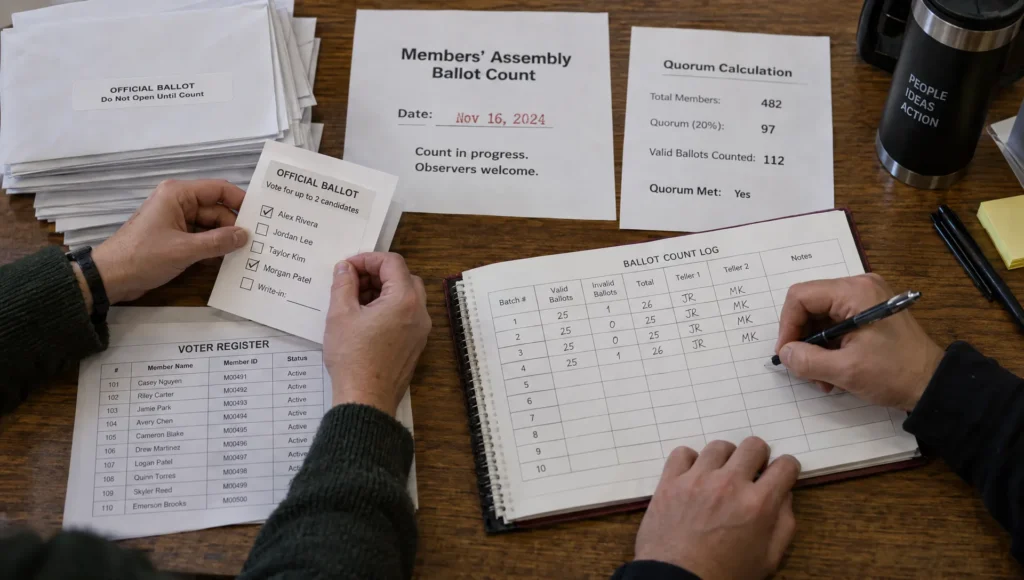
Parliament is supposed to be the place where public conflict becomes public judgment. In theory, it gathers the nation into a lawful forum, tests ideas, scrutinizes power, and turns disagreement into policy. In practice, many citizens experience parliament as distant, theatrical, and captured by party discipline, lobby pressure, short media cycles, and elections that happen too rarely to feel like real civic participation.
Deliberative democracy offers a practical way to strengthen parliament without abolishing representative government. It does not ask elected officials to disappear. It asks them to listen better, reason more openly, and build institutional channels where citizens can study evidence, question experts, discuss tradeoffs, and produce recommendations before major decisions are made.
This matters deeply to the JustSocial vision. The manifesto argues that modern society still relies on public institutions shaped by the Industrial Revolution, while citizens already live in a technological age of constant communication, data, and participation. If people can speak, organize, learn, and collaborate every day, democracy should not reduce them to a ballot every few years. A stronger parliament is not one that hoards power. It is one that becomes more responsive, more transparent, and more capable of turning public intelligence into public policy.
What deliberative democracy adds to parliament
Deliberative democracy is a model of democratic decision-making where legitimacy comes not only from counting votes, but from the quality of public reasoning that happens before those votes. Citizens are given balanced information, time to reflect, access to experts, and structured opportunities to discuss with people who may disagree with them.
That changes the role of the public. Instead of treating citizens as a noisy audience outside parliament, deliberation treats them as a civic resource. Instead of assuming public opinion is only what appears in polls, demonstrations, social media comments, or election results, it asks a better question: what would citizens think after they had time, evidence, and a fair process?
This is why deliberative democracy is especially relevant to parliaments. Legislators already deliberate, at least formally. They debate bills, hold hearings, question ministers, and work through committees. But parliamentary deliberation often happens under partisan incentives. Citizen deliberation can add a complementary layer, one that is not designed to replace elected judgment, but to improve the information environment around it.
The OECD has documented a global rise in representative deliberative processes, including citizens' assemblies, juries, and panels, noting their usefulness for complex policy questions that require public trust and value-based tradeoffs. These processes are not magic. They work when they are designed carefully, connected to institutions, and taken seriously by decision-makers.
Parliament does not become weaker when citizens deliberate
A common fear is that deliberative democracy undermines parliament. If citizens deliberate on policy, what are elected representatives for?
The better answer is that deliberation can clarify the job of parliament. Representatives should still legislate, oversee government, allocate budgets, and be accountable at elections. But they should not pretend that a four-year mandate gives them a full understanding of public priorities on every issue. Nor should they treat protests, polls, and social media outrage as the only available signals from the public.
Deliberative democracy gives parliament a more serious form of civic input. It helps representatives understand informed public judgment, not just raw public reaction.
| Parliamentary function | Common weakness | How deliberative democracy helps |
|---|---|---|
| Lawmaking | Bills are shaped by party bargaining and lobby access | Citizens test tradeoffs and expose lived consequences |
| Committee scrutiny | Evidence can be expert-heavy but publicly distant | Citizen panels translate technical evidence into public judgment |
| Oversight | Accountability often becomes partisan performance | Deliberative reports create clearer public benchmarks |
| Budgeting | Spending choices feel remote and opaque | Citizens compare priorities and explain acceptable tradeoffs |
| Long-term reform | Elections reward short-term promises | Deliberation creates space for future-focused decisions |
This is not anti-parliamentary. It is pro-parliamentary. It gives representatives better material to work with and gives citizens a reason to believe that parliament is not merely performing democracy, but practicing it.
Why committees are the natural starting point
Parliamentary committees are the best place to begin because they already sit between expertise, lawmaking, and public accountability. They can hear witnesses, request documents, review evidence, and recommend changes. But many committee processes remain invisible to ordinary citizens, even when they affect schools, taxes, housing, policing, healthcare, transportation, and digital rights.
Deliberative processes can make committees more grounded. Before a committee finalizes recommendations on a major bill, a citizen panel could review balanced briefing materials, hear from competing experts, deliberate in facilitated groups, and submit a public report. The committee would not be forced to obey the panel, but it would be required to respond.
That response mechanism is crucial. Deliberation becomes symbolic if parliament can ignore it without explanation. A stronger model would require committees to publish whether they accept, partially accept, or reject citizen recommendations, and why.
JustSocial has already explored this committee-level angle in more detail in its article on how deliberative democracy can improve committee work. The parliamentary question is the next step: how do these committee practices become part of the larger architecture of representative government?
A practical model for parliamentary deliberation
For deliberative democracy to strengthen parliament, it needs a repeatable institutional design. One-off citizens' assemblies can be useful, but parliament needs durable procedures that citizens, journalists, civil servants, academics, and elected officials understand.
A practical parliamentary deliberation cycle could include six stages.
- Issue selection: Parliament identifies bills, reforms, budget questions, or national dilemmas that would benefit from public deliberation.
- Citizen selection: Participants are chosen through stratified random selection, with attention to age, gender, geography, socioeconomic background, political identity, and minority representation.
- Evidence preparation: A balanced advisory group prepares briefing materials that include competing arguments, costs, risks, uncertainties, and legal constraints.
- Public deliberation: Citizens question experts, discuss in facilitated groups, revise views, and identify points of agreement and disagreement.
- Recommendation delivery: The panel submits clear recommendations to the relevant committee or parliamentary body.
- Parliamentary response: Representatives publish a formal response and track whether accepted recommendations are implemented.
This structure respects both civic participation and constitutional responsibility. Citizens help clarify the public interest. Parliament remains responsible for law.

From discursive democracy to decision-grade input
Deliberative democracy works best when it is connected to discursive democracy. Discursive democracy is the wider culture of public reasoning: the conversations, arguments, explanations, and narratives through which people form political meaning. Deliberation is more structured. Discourse is broader and more continuous.
Parliament needs both.
A citizens' assembly can produce careful recommendations, but it cannot contain the whole democratic conversation. Public forums, civic platforms, local meetings, school debates, expert explainers, media analysis, and digital participation all shape the democratic environment. The challenge is to turn that wide public discourse into decision-grade input rather than noise.
This is where the JustSocial manifesto connects directly to institutional design. It imagines tools such as public-facing parliamentary records, civic voting systems, analytics that help decision-makers understand public opinion, and a more transparent repository of laws. These ideas point toward a future where parliament is not a sealed building that occasionally broadcasts debate, but a living civic interface.
That does not mean every online reaction should become policy. It means citizens should be able to see what parliament is doing, understand the arguments, contribute in structured ways, and trace how public input affects decisions. For a broader view of how deliberation can fit into a more continuous democratic structure, JustSocial's essay on deliberative democracy and the Five Branches idea is a useful companion.
Transparency is not a slogan, it is infrastructure
Parliamentary transparency often means publishing documents online. That is necessary, but not enough. A document dump is not the same as public understanding. Citizens need accessible records, searchable proceedings, plain-language summaries, visible amendments, cost estimates, expert submissions, and clear explanations of who argued what and why.
In ordinary life, people already expect comparison before important decisions. A homeowner can review local pricing and customer feedback through a UK tradesperson comparison platform before deciding who to hire. Public decisions are far more consequential, so parliament should meet an even higher standard: comparable policy options, transparent costs, visible tradeoffs, and evidence that citizens can inspect before decisions are made.
This is one of the strongest arguments for connecting deliberative democracy with digital democracy tools. Technology can make parliamentary work legible at scale. It can help citizens follow a bill from proposal to committee to amendment to vote. It can connect testimony, public comments, citizen panel recommendations, and final legislative outcomes.
But technology must be designed as democratic infrastructure, not as a gimmick. Online voting platforms, decision-making software, and participation tools should support informed judgment. They should not reduce democracy to instant clicking. JustSocial's broader question, explored in its piece on whether deliberative democracy can scale with modern tech, is exactly the question parliaments now face.
The role of academia as a democratic safeguard
The manifesto proposes academia as a more independent branch of government, tasked with raising standards of evidence and public education. Whether one accepts that full institutional proposal or not, the underlying point is powerful: democracy needs knowledge systems that citizens can trust.
Parliamentary deliberation should not be controlled by experts, but it should be informed by them. Academic institutions, public researchers, statisticians, legal scholars, economists, historians, technologists, and civil society specialists can help prepare balanced materials. Their role is not to dictate outcomes. Their role is to clarify reality, uncertainty, and tradeoffs.
This matters because many parliamentary failures begin with bad information. A debate can be passionate and still be shallow. A law can be popular and still be poorly designed. A reform can sound moral and still produce unintended harm. Deliberative democracy creates a civic checkpoint where evidence and lived experience meet before power acts.
Answering the objection that citizens are not qualified
One of the oldest arguments against deeper democracy is that ordinary citizens are too uninformed, emotional, or divided to contribute meaningfully to governance. The JustSocial manifesto confronts this argument directly, especially the idea that people should remain shouting into the void while elected elites retain serious power.
The answer is not to romanticize the public. Citizens can be misinformed. They can be polarized. They can be manipulated. But elected officials are also vulnerable to misinformation, ideology, donors, party incentives, career ambition, and media pressure. The real question is not whether citizens are perfect. No branch of government is perfect. The question is which process helps people reason better.
Deliberative democracy improves the conditions under which citizens participate. It slows down reaction. It exposes participants to disagreement. It gives them evidence. It asks them to justify views. It records conclusions publicly. That is a better democratic environment than comment sections, campaign ads, or party slogans.
A parliament strengthened by deliberation would not ask citizens to become full-time legislators. It would ask them to periodically serve as a civic jury for the nation, bringing ordinary judgment into contact with public evidence.
How deliberation can reduce polarization inside parliament
Polarization is not only a public problem. It is also a parliamentary problem. When parties treat each issue as a battlefield, representatives have fewer incentives to change their minds. Compromise becomes betrayal. Evidence becomes ammunition. Citizens watch the performance and lose trust.
Deliberative democracy can create a different reference point. If a representative supports a compromise that emerged from a balanced citizen panel, they can defend it not only as a party deal, but as a response to considered public judgment. This can create political cover for serious decisions, especially on issues where the public knows tradeoffs are unavoidable.
Examples include climate adaptation, electoral reform, constitutional design, education policy, housing density, public health prioritization, and national budgets. These are not simple yes-or-no questions. They involve competing goods. Deliberation helps parliament acknowledge that complexity without becoming paralyzed by it.
What a stronger parliament would look like
A parliament strengthened by deliberative democracy would feel different to citizens. Its committees would be easier to follow. Its evidence would be easier to inspect. Its debates would respond more often to citizen recommendations. Its laws would include clearer explanations of public tradeoffs. Its members would still disagree, but they would do so in a system where public reasoning has institutional weight.
The cultural change may be even more important than the procedural one. Citizens would no longer be treated only as voters, taxpayers, and consumers. They would be treated as co-authors of the public world. That is the deeper meaning of the JustSocial manifesto's movement from the old industrial state toward a more participatory Cosmopolis.
Parliament should not fear this. If representative institutions continue to close themselves off, they will become weaker, not stronger. If they open structured channels for civic participation, they can regain legitimacy and capacity.
Frequently Asked Questions
Does deliberative democracy replace parliament? No. It strengthens parliament by giving representatives better informed public input before they legislate, scrutinize, and allocate resources.
How is deliberative democracy different from a referendum? A referendum usually asks the public to vote on a fixed question. Deliberative democracy gives citizens time, evidence, expert access, and structured discussion before they make recommendations.
Can deliberative democracy work in polarized societies? Yes, if the process is carefully designed. Balanced information, skilled facilitation, diverse participant selection, and a formal parliamentary response can reduce the pressure of partisan performance.
Should citizen recommendations be legally binding? Not always. In many parliamentary systems, the strongest first step is an advisory model with a mandatory public response. Parliament keeps authority, but must explain its reasoning.
What role should technology play? Technology should make participation, transparency, and follow-up easier. It should help citizens understand and influence parliament, not replace deliberation with shallow instant voting.
Building the modern democracy
Deliberative democracy can strengthen parliament because it repairs the missing link between public voice and public power. It gives citizens a serious role between elections. It gives representatives better evidence of what the public thinks after reflection. It gives committees richer scrutiny. It gives democracy a way to become continuous without becoming chaotic.
That is the political movement JustSocial is working to advance: a future where technology, civic participation, and transparent institutions help citizens take a real stake in public life. If you share that direction, start with the JustSocial manifesto, share the ideas, and consider how your skills, community, or local initiative can help build a democracy that listens every day, not only every election cycle.