In 2026, the problem for many citizens is not that politics feels too distant. It is that politics feels distant while demanding obedience, taxes, attention, and emotional energy. People are asked to vote every few years, react daily to crisis-driven media, and trust institutions that often fail to show how public input actually shaped public decisions.
A political movement that wants to grow in this environment cannot rely on charisma, slogans, or outrage alone. It has to build a different relationship with the public. That relationship begins with evidence.
Evidence does not mean drowning people in reports. It means showing citizens what is known, what is uncertain, who was heard, what arguments were considered, why a decision was made, and what happened afterward. Trust grows when people can inspect the chain between civic participation and public action.
This is closely aligned with the argument in the JustSocial manifesto: the old social contract reduces people to voters, taxpayers, and private consumers. A modern political movement should instead help citizens become active participants in public life, not only during elections, but continuously.
Trust is not a message, it is a method
Political trust is often treated as a communications problem. Leaders ask, “How do we persuade people to believe us?” A better question is, “What would we need to show so people do not have to rely on belief alone?”
That shift matters. A movement that says “trust us” places the burden on citizens. A movement that publishes evidence accepts the burden itself.
For political movement building, evidence should answer five public questions:
- What problem are we trying to solve?
- What do we know, and how do we know it?
- Who is affected, and who has been invited to speak?
- What options were considered before choosing a direction?
- How will citizens know whether the movement followed through?
This is not bureaucracy for its own sake. It is democratic infrastructure. When people can see the record, disagreement becomes more productive because everyone is arguing with reference to something visible.
A movement built this way does not pretend to eliminate conflict. It makes conflict legible.
Evidence must connect to civic participation
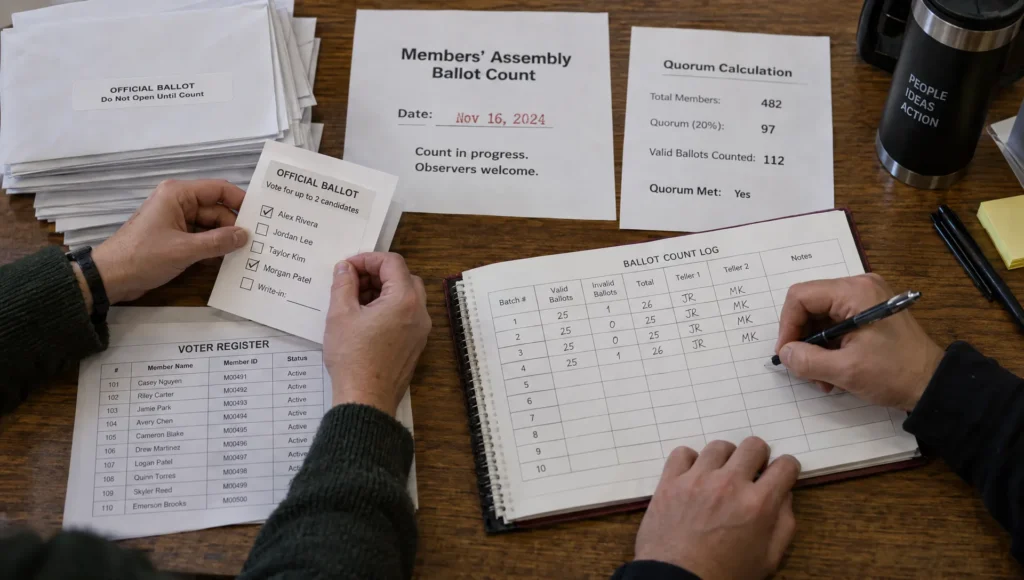
Civic participation becomes hollow when citizens are invited to speak but cannot see what happened to their input. Surveys, town halls, petitions, and online voting can all become symbolic if the movement never closes the loop.
The evidence loop is simple: invite participation, record it clearly, deliberate around it, decide transparently, and report back. The public should be able to trace how citizen input moved from expression to consideration to action.
This is where evidence differs from public relations. Public relations highlights the best story. Evidence preserves the full civic trail, including uncomfortable objections, minority concerns, failed assumptions, and course corrections.
JustSocial has already explored the idea of publishing public receipts that make political promises auditable. Evidence-centered movement building goes one step further: it treats those receipts not as a communications accessory, but as the core operating system of democratic legitimacy.
Deliberative democracy needs visible standards
Deliberative democracy asks citizens to do more than vote or react. It asks them to examine tradeoffs, listen to others, weigh evidence, and help shape better decisions. That is demanding work. It requires standards that are clear enough for ordinary people to trust.
A political movement should define those standards before controversy begins. Otherwise, every decision looks improvised, and every disappointed group suspects manipulation.
| Democratic practice | What citizens do | What the movement must show |
|---|---|---|
| Civic participation | Share preferences, needs, testimony, and priorities | Who participated, what was asked, and how input was used |
| Deliberative democracy | Consider evidence and tradeoffs before a decision | The evidence pack, arguments for and against, and decision criteria |
| Discursive democracy | Continue public reasoning through disagreement | The debate record, minority views, and responses to criticism |
| Political movement building | Turn shared concern into organized public power | Commitments, funding logic, governance rules, and follow-through |
The point is not to make every citizen read every document. The point is to make the record available, understandable, and challengeable. People do not need to inspect every bridge to trust a bridge system, but they do need to know inspections exist, standards are public, and failures are not hidden.
Discursive democracy makes disagreement useful
Discursive democracy emphasizes the role of public conversation in shaping legitimate decisions. It recognizes that democracy is not only the final vote. It is also the ongoing exchange of reasons, stories, objections, evidence, and counter-evidence.
For a political movement, this is crucial. Movements often attract people who agree on a general problem but disagree sharply on priorities, tactics, language, or timelines. If leaders suppress those disagreements, trust weakens. If they let disagreement become chaos, trust also weakens.
The task is to structure disagreement so it produces learning.
That means publishing summaries of competing arguments, making it easy to see where people disagree, and requiring leadership to answer serious objections. It also means distinguishing between bad-faith disruption and legitimate dissent. A movement that cannot protect dissent internally will struggle to defend democracy externally.
Outside politics, people already expect evidence-rich environments before making high-stakes decisions. A person comparing homes can review filters, photos, listing details, and market context through a UAE real estate platform with detailed property data; citizens weighing public policy deserve at least the same respect for evidence, comparison, and informed choice.
The manifesto connection: from the Polis to modern trust
The JustSocial manifesto looks back to the Greek Polis as a model of intense civic belonging. In the Polis, public life was not an abstract system far away from ordinary life. It was immediate, communal, and identity-forming. The manifesto’s argument is not that modern societies can simply copy ancient city-states. It is that technology now makes it possible to recover some of that daily civic intensity at a larger scale.
That ambition depends on evidence. A large society cannot rely on face-to-face familiarity alone. Citizens need systems that let them understand what is happening, participate meaningfully, and verify that participation was not ignored.
The manifesto also proposes a stronger role for academia as a separate public force, one that can educate citizens, compile advisories, and hold representatives to higher standards. This is a vital trust mechanism. Evidence should not be controlled only by the loudest faction, the wealthiest donor, or the most effective campaign team. A democracy that takes public learning seriously needs independent knowledge institutions that can challenge both government and movements.

The same applies to technology. The manifesto mentions social platforms, analytics, secure participation systems, cloud storage, and AI. These tools can either deepen democracy or manipulate it. The difference lies in governance. Are citizens being measured without agency, or are they using public systems to make their voices visible? Are analytics used to listen, or to control? Are platforms designed for public reasoning, or for emotional addiction?
A trustworthy political movement must answer these questions before asking citizens to adopt its tools.
A practical evidence architecture for movement builders
Evidence and trust need more than good intentions. They need a structure that can survive growth, conflict, and public pressure. A small movement can begin with simple tools, but the principles should be clear from the start.
| Evidence layer | Trust question it answers | Practical movement habit |
|---|---|---|
| Participation promise | What can citizens actually influence? | State the scope before asking for input |
| Evidence library | What facts, testimony, and sources are being considered? | Keep a public, organized record in plain language |
| Deliberation record | Were tradeoffs seriously discussed? | Summarize arguments for, against, and undecided |
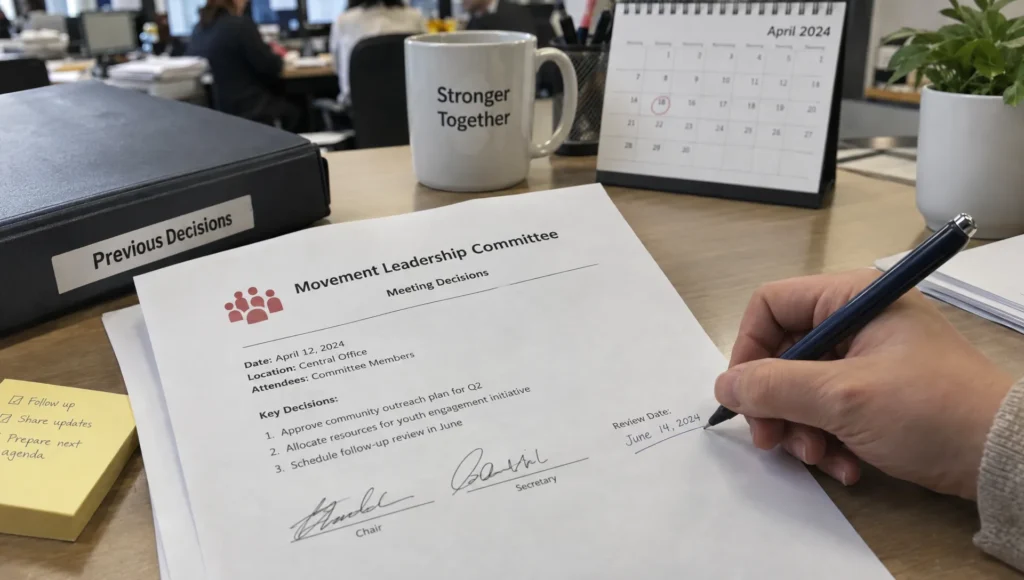
| Decision memo | Why did the movement choose this path? | Publish criteria, reasoning, dissent, and next steps |
| Implementation tracker | Did the promise become action? | Report progress, delays, failures, and changes |
| Learning review | What should change next time? | Invite public correction and update the method |
This architecture can support many kinds of movement activity: policy development, local organizing, campaign decisions, civic technology pilots, funding choices, and internal governance.
For example, before launching a participation tool, a movement should not only ask whether the software works. It should ask whether the civic promise is honest. Can people influence the outcome, or are they only being consulted? Who is excluded by language, disability, internet access, fear, or lack of time? What happens if public opinion changes after more evidence emerges?
Those questions are especially important for civic technology. If a movement wants to test democratic tools responsibly, it should begin with limited, transparent experiments. JustSocial’s guide to building civic tech pilots is relevant here because pilots allow movements to prove process before claiming scale.
Evidence without humility becomes technocracy
There is a danger in evidence-centered politics: it can become cold, elite, and dismissive. Citizens may hear “evidence-based” and suspect that experts are preparing to ignore lived experience.
A trustworthy political movement must reject that posture. Evidence includes quantitative data, but it also includes testimony, local knowledge, historical memory, and moral argument. A parent describing a failing school is offering evidence. A worker explaining how policy affects shifts, wages, or childcare is offering evidence. A minority community warning that a proposal will harm them is offering evidence.
The role of deliberative democracy is not to replace people with experts. It is to help people and experts reason together.
That requires humility in public language. Movement leaders should say what they know, what they believe, what they fear, and what remains uncertain. They should avoid pretending that every value disagreement can be solved by a chart. Some disagreements are about priorities, identity, risk, dignity, and justice. Evidence can clarify those conflicts, but it cannot erase them.
The first 90 days of evidence-based movement building
A political movement does not need a perfect platform to begin building trust. It can start with disciplined public habits.
| Timeframe | Movement focus | Public evidence to publish |
|---|---|---|
| Days 1 to 30 | Define the civic question | Problem statement, participation promise, initial source list, known uncertainties |
| Days 31 to 60 | Invite participation and deliberation | Citizen testimony summary, argument map, expert input, unanswered objections |
| Days 61 to 90 | Decide, act, and report back | Decision memo, implementation plan, accountability owner, follow-up schedule |
This rhythm is powerful because it teaches the public what to expect. Instead of treating trust as a feeling that appears after a charismatic speech, the movement turns trust into a repeated civic experience.
People begin to learn: when we speak, it is recorded. When we disagree, the disagreement is summarized. When leaders decide, they explain. When they fail, they report it. When the evidence changes, the position can change too.
That is how political maturity becomes contagious.
What this means for the future of political movements
The next generation of political movement building will not be defined only by who has the best message. It will be defined by who can build the most trustworthy participation systems.
A movement that grows without evidence may gain attention quickly, but it will struggle when conflict arrives. A movement that builds with evidence may grow more slowly at first, but it creates deeper legitimacy. It gives citizens a reason to stay involved after the emotional peak fades.
This is the deeper promise in JustSocial’s vision: politics can become a daily structure for public learning, not just a periodic contest for control. Civic participation can become continuous. Deliberative democracy can make decisions wiser. Discursive democracy can make disagreement less destructive. A political movement can become not only a vehicle for winning power, but a prototype of the society it wants to build.
Trust is not built when leaders ask people to believe. Trust is built when citizens can see.
Frequently Asked Questions
How can a political movement build trust with evidence? A political movement builds trust with evidence by making its reasoning visible. That includes publishing participation records, evidence summaries, deliberation notes, decision memos, dissenting views, and follow-up reports so citizens can trace how input becomes action.
What is the difference between deliberative democracy and discursive democracy? Deliberative democracy focuses on structured decision-making after citizens weigh evidence and tradeoffs. Discursive democracy focuses on the wider public conversation where arguments, identities, objections, and values are continuously expressed and challenged.
Does evidence-based politics reduce the role of ordinary citizens? It should do the opposite. Evidence-based politics becomes democratic when citizen testimony, lived experience, local knowledge, and moral concern are treated as part of the evidence, not as noise beneath expert opinion.
Can online civic participation be trusted? It can be trusted only with strong safeguards. Digital participation needs clear identity rules, privacy protections, transparent moderation, accessible design, security practices, and public records that show how input was used.
Why is follow-through so important for political trust? Citizens lose trust when participation disappears into a void. Follow-through proves that the movement respects people’s time and attention. Even when leaders cannot act immediately, explaining delays and constraints helps preserve legitimacy.
If politics is going to become worthy of public trust again, movements must stop asking citizens to shout into the void. They must build systems that listen, show their work, and let people verify the results. That is the path from passive frustration to active civic power, and it is the work JustSocial exists to advance.