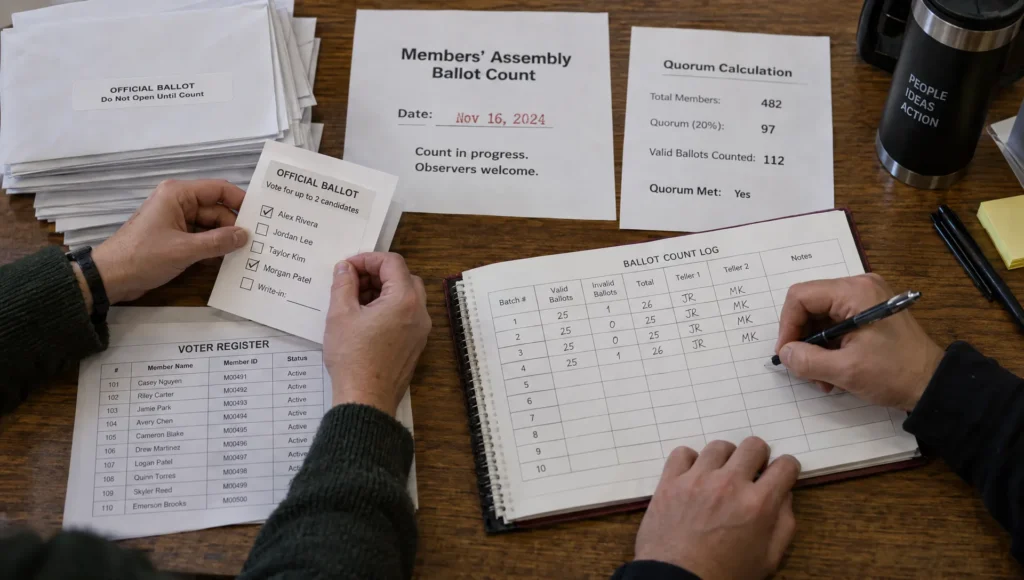
Public opinion is often treated as if it were a volume meter. A post trends, a poll spikes, a protest fills a square, a comment section explodes, and suddenly everyone claims to know what “the people” think.
But volume is not the same as judgment. Anger is not the same as consensus. Silence is not the same as consent. In 2026, democracy does not suffer from a lack of public expression. It suffers from a lack of democratic listening.
That is where discursive democracy matters. It asks a different question from ordinary political media: not “Who is winning the argument today?” but “How can public opinion become clearer, fairer, more traceable, and more useful for collective decision-making?”
The goal is not to remove conflict from politics. Conflict is unavoidable in a free society. The goal is to reduce noise so that civic participation can become meaningful signal, something citizens can trust and institutions can answer.
Public Opinion Has a Signal Problem, Not a Citizen Problem
When people say public debate is broken, they often blame citizens. They say people are too emotional, too polarized, too uninformed, or too easily manipulated. There is some truth in the fact that democratic participation requires knowledge, patience, and responsibility. But blaming citizens misses the deeper design failure.
Most modern channels of public expression were not built to create democratic understanding. They were built to capture attention, win elections, sell advertising, or manage institutional risk. A social platform rewards the sharpest emotional reaction. A campaign rewards simplification. A news cycle rewards conflict. A bureaucracy rewards delay. None of these systems naturally produces wise public opinion.
Pew Research Center has documented how many Americans view political discourse as negative, disrespectful, and factually careless. Freedom House has also repeatedly warned that democratic freedoms face pressure around the world. These are not separate problems. When public speech becomes distorted, public trust weakens. When public trust weakens, authoritarian and cynical political forces gain room to operate.
Discursive democracy begins from a more generous assumption: citizens are not the noise. Poorly designed public channels create noise around citizens.
| Source of noise | What it distorts | Discursive democracy response |
|---|---|---|
| Virality | Makes intensity look like majority opinion | Separate popularity from representativeness |
| Performative certainty | Rewards confidence over reflection | Make room for uncertainty and revision |
| Single-question polling | Reduces complex views to thin answers | Capture reasons, trade-offs, and context |
| Comment chaos | Mixes evidence, insults, jokes, and propaganda | Structure contributions by claim, evidence, and value |
| Institutional silence | Makes citizens feel ignored | Require visible public response and follow-up |
Public opinion without noise does not mean public opinion without passion. It means public opinion with structure.
What Discursive Democracy Adds to Deliberative Democracy
Discursive democracy is closely related to deliberative democracy, but the two are not identical.
Deliberative democracy usually focuses on structured decision-making processes, such as citizens’ assemblies, participatory budgeting, public hearings, or carefully moderated forums where people weigh evidence and discuss trade-offs before reaching a recommendation. These processes are valuable because they slow politics down and give citizens time to think together. The OECD has highlighted the growth of such processes in its work on innovative citizen participation.
Discursive democracy is broader. It concerns the whole public conversation around politics: journalism, social media, community meetings, parliamentary committees, local campaigns, civic education, activist networks, and everyday discussion. It asks whether public communication helps people form opinions that can survive contact with facts, opposing views, and institutional reality.
A healthy democracy needs both. Deliberative democracy creates focused spaces for judgment. Discursive democracy improves the wider atmosphere in which judgment is formed.
Without the discursive layer, formal participation can become shallow. People may vote in a poll, sign a petition, or attend a meeting, but their input may still be fragmented, reactive, or disconnected from policy. Without deliberative spaces, public discourse may remain expressive but never become decision-ready.
The missing bridge is structured public opinion.
What “Public Opinion Without Noise” Actually Means
A noisy political environment is not just loud. It is illegible. People are speaking, but nobody can reliably tell what the public actually understands, values, fears, or prioritizes.
Public opinion without noise has five qualities.
First, it is traceable. Citizens and institutions can see how an issue moved from concern to debate to decision. A complaint about housing, education, public safety, or taxation should not disappear into a comment thread. It should become part of a visible civic record.
Second, it is reasoned. Not every citizen must write a policy paper, but democratic input should make room for reasons. “I support this” is useful. “I support this because rent is rising faster than wages in my city” is more useful. “I support this, but I worry about the tax burden” is better still.
Third, it is plural. Discursive democracy should not flatten disagreement into artificial consensus. It should show where people agree, where they disagree, and what different groups are actually saying. A democracy that hides disagreement does not become more stable. It becomes more brittle.
Fourth, it is connected to institutions. Public opinion should not be treated as background noise that officials may ignore until the next election. It should be measured, summarized, answered, and reflected in public reasoning. This does not mean every majority preference becomes law. It means public institutions must show how citizen input was considered.
Fifth, it is revisable. People learn. Facts change. Policies fail. Better arguments emerge. A mature democratic system should allow citizens to update their views without treating every change of mind as weakness.
This is why JustSocial’s broader vision matters. In the JustSocial manifesto, Yuval D. Vered argues that citizens should no longer be reduced to occasional voters, taxpayers, and consumers. The manifesto imagines continuous civic participation, supported by technology, where people can weigh in on public affairs more regularly and where institutions can measure public opinion more precisely.
That idea is powerful only if the measurement is democratic. If technology simply counts outrage, it will reproduce the worst incentives of today’s platforms. If it structures public discourse, protects privacy, and connects citizen input to accountable institutions, it can make public opinion more useful without making it less free.
The JustSocial Link: From the Polis to the Cosmopolis
One of the manifesto’s most important themes is the movement from industrial-era public systems toward a more alive civic culture. The critique is simple: our political and educational institutions still carry the shape of older social structures, while citizens now live in a technological environment that could support far more continuous participation.
The manifesto’s discussion of the Greek Polis is especially relevant. In the Polis, political life was immediate. Citizens did not experience the state as a distant machine. They experienced it as part of communal life. Of course, the ancient Polis was limited, exclusionary, and impossible to scale with the tools of its time. But it showed something modern mass democracies often lack: the feeling that public life belongs to the people who live it.
Discursive democracy is one path toward making that feeling scalable. It does not try to recreate the ancient city-state. It asks how a large modern society can recover some of that civic intimacy through better communication, better public memory, and better institutional listening.
The manifesto’s idea of a “people” branch of government also depends on this distinction. A people’s branch cannot merely be a permanent referendum machine. That would risk reducing politics to instant majoritarian pressure. The stronger model is one in which citizens continuously express concerns, priorities, and arguments, while elected officials, courts, public agencies, and academic institutions remain responsible for interpretation, safeguards, and long-term judgment.
In other words, public opinion should not automatically rule every decision. But it should be impossible to ignore.
A Practical Model for Cleaner Public Opinion
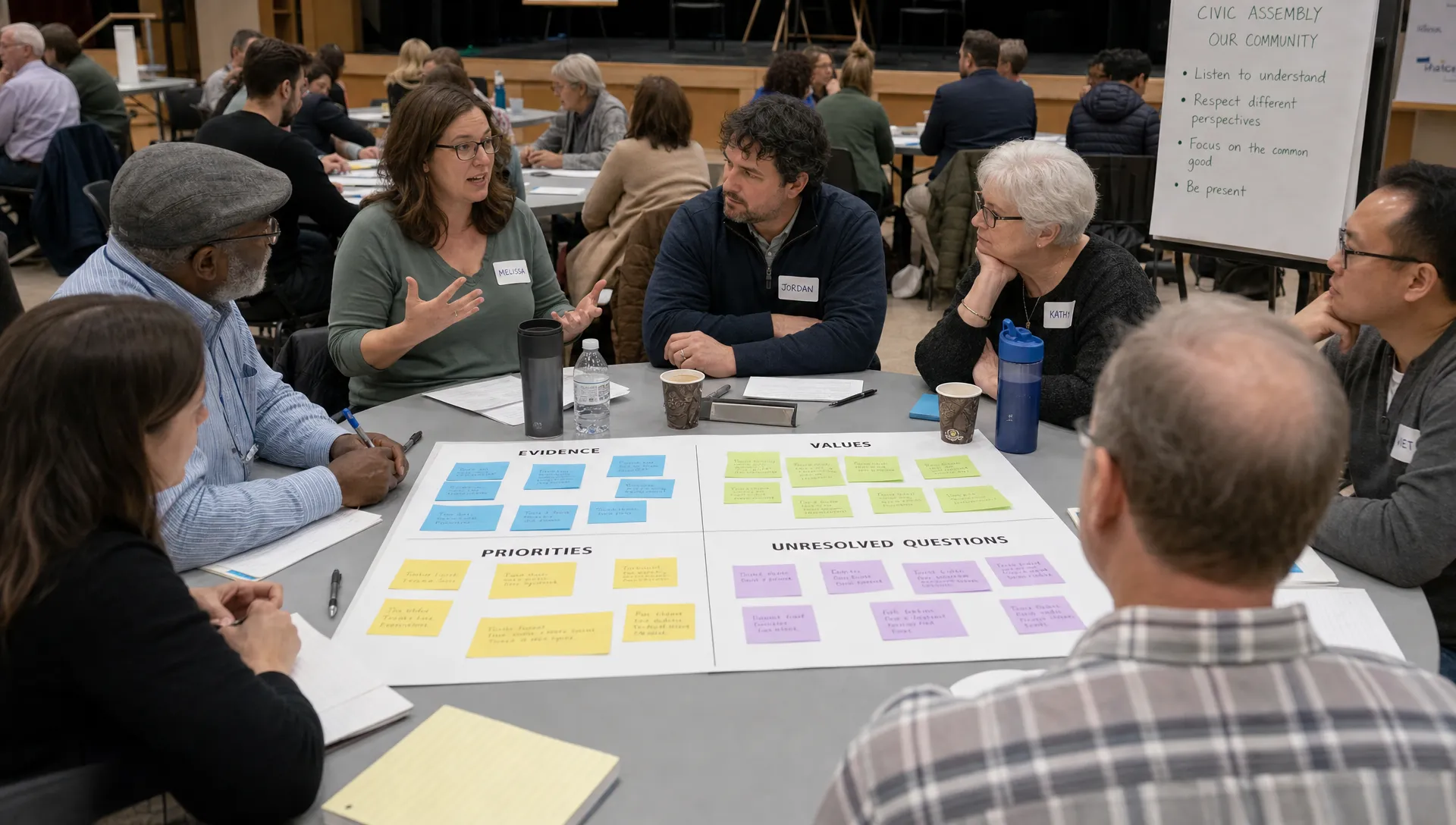
To reduce noise, democratic systems need to stop treating all public input as the same type of data. A personal story, a factual claim, a moral value, a policy preference, and a vote are different things. Mixing them together creates confusion. Separating them creates civic clarity.
| Layer of public opinion | Core question | What should be captured | Why it reduces noise |
|---|---|---|---|
| Experience | What are people living through? | Testimonies, local problems, recurring harms | Prevents elites from defining every agenda |
| Claim | What is being asserted? | Clear statements that can be supported or challenged | Turns vague anger into discussable propositions |
| Reason | Why do people think this? | Evidence, lived experience, values, assumptions | Separates preference from justification |
| Trade-off | What are people willing to prioritize? | Costs, risks, alternatives, urgency | Reduces unrealistic or contradictory demands |
| Public response | What did institutions do with the input? | Official summaries, decisions, explanations | Prevents participation from disappearing into the void |
| Revision | What changed after debate or evidence? | Updated views, minority reports, follow-up input | Makes learning part of democratic life |
This kind of structure does not require citizens to become policy experts overnight. It simply respects their input enough to organize it properly.
A citizen who says “my child’s school is failing” is offering experience. A teacher who says “standardized testing is narrowing learning” is making a claim. A researcher who brings evidence about project-based learning is contributing reasons. A parent who supports reform but worries about implementation is naming trade-offs. A ministry that explains what it will change is providing public response. A community that revisits the policy six months later is practicing revision.
That is public opinion becoming intelligent over time.
The Design Principles That Matter Most
The first principle is shared context. Citizens cannot debate well if they do not know what decision is actually being made, which institution controls it, what the budget constraints are, or what evidence is already available. This is why discursive democracy needs shared civic context before it can produce better public judgment.
The second principle is privacy with accountability. The JustSocial manifesto points toward willing and anonymous identification, including the possibility that citizens can express aspects of identity while remaining protected. This is crucial. People should be able to participate without fear of harassment, employer retaliation, or political targeting. At the same time, civic systems need safeguards against manipulation, duplication, bots, and coordinated deception.
The third principle is transparent moderation. Noise reduction must never become censorship disguised as civility. A democratic platform should be clear about what it removes, what it labels, what it downranks, and what it preserves as dissent. This is why the question of better moderation in online civic spaces is not a side issue. It is central infrastructure.
The fourth principle is institutional duty. If citizens contribute to a civic process, public bodies should respond in visible ways. A parliament committee, city council, school district, or ministry does not need to obey every input, but it should explain what was heard and why a decision was made. Discursive democracy fails when citizens speak into a civic black hole.
The fifth principle is civic education. Public opinion improves when people learn how systems work. Here again, the manifesto’s educational reform argument connects directly. A society that wants serious civic participation must teach students how to ask questions, examine evidence, disagree responsibly, and understand public institutions. Democracy is not only a voting method. It is a learned culture.
Why This Matters for a Political Movement
A political movement can either amplify noise or organize meaning.
The easy path is to exploit frustration. Find an enemy, repeat a slogan, punish doubt, and treat every disagreement as betrayal. That path can mobilize people quickly, but it rarely builds a freer society.
The harder path is to build civic capacity. That means helping citizens understand issues, compare arguments, identify trade-offs, and turn emotion into action. It means creating tools that make participation more continuous without making it more chaotic. It means insisting that public opinion belongs not only to media professionals, party leaders, donors, or influencers, but to the people themselves.
For JustSocial, this is the heart of the project. The movement’s call for continuous participation is not just a technological proposal. It is a cultural one. It asks citizens to stop accepting a democracy where their role peaks once every election cycle. It asks institutions to stop pretending that silence between elections means legitimacy. And it asks technology builders to stop designing public life around addiction, outrage, and fragmentation.
Public opinion without noise is not quiet politics. It is politics that can finally hear.
What Citizens Can Do Now
Discursive democracy does not begin only when new platforms are built. It can begin in how citizens speak today.
- State your claim clearly before attacking someone else’s.
- Separate what you know from what you suspect.
- Name the value behind your position, such as fairness, liberty, security, dignity, or responsibility.
- Ask what trade-off your preferred policy requires.
- Treat changing your mind as democratic strength, not defeat.
- Demand that institutions answer public input with reasons, not slogans.
These habits will not fix democracy alone. But they prepare citizens for better systems. A future of continuous civic participation will only be as strong as the public culture that fills it.
Frequently Asked Questions
Is discursive democracy the same as deliberative democracy? Not exactly. Deliberative democracy usually refers to structured forums where citizens weigh evidence and discuss decisions. Discursive democracy is broader, covering the wider public conversation that shapes opinion before, during, and after formal decision-making.
Does public opinion without noise mean filtering out anger? No. Anger can reveal real injustice, neglect, or fear. The goal is not to remove emotion, but to organize public expression so anger can become understandable claims, priorities, and demands that institutions can answer.
Can technology measure public opinion fairly? Technology can help, but only if it is designed with privacy, transparency, security, and accountability. A civic platform should not simply copy the incentives of social media. It must structure input, protect users, and show how data is interpreted.
Why should institutions listen if public opinion is not always right? Listening is not the same as obeying. Institutions should remain responsible for law, rights, evidence, and long-term consequences. But in a democracy, they must also show that citizen voices were measured, understood, and considered.
How does this support civic participation? It makes participation more meaningful. Instead of asking citizens only to vote every few years or shout online, discursive democracy creates pathways for everyday input to become part of a visible civic process.
Help Build a Public Sphere That Can Hear
If democracy is going to survive the age of constant communication, it must learn to listen better. That means better civic tools, better public norms, and a political movement willing to treat citizens as participants in public life, not spectators.
JustSocial is working toward that future through the idea of continuous, technology-supported civic participation. If this vision resonates with you, explore JustSocial.io, read the manifesto, and consider how you can help turn public opinion from noise into democratic power.