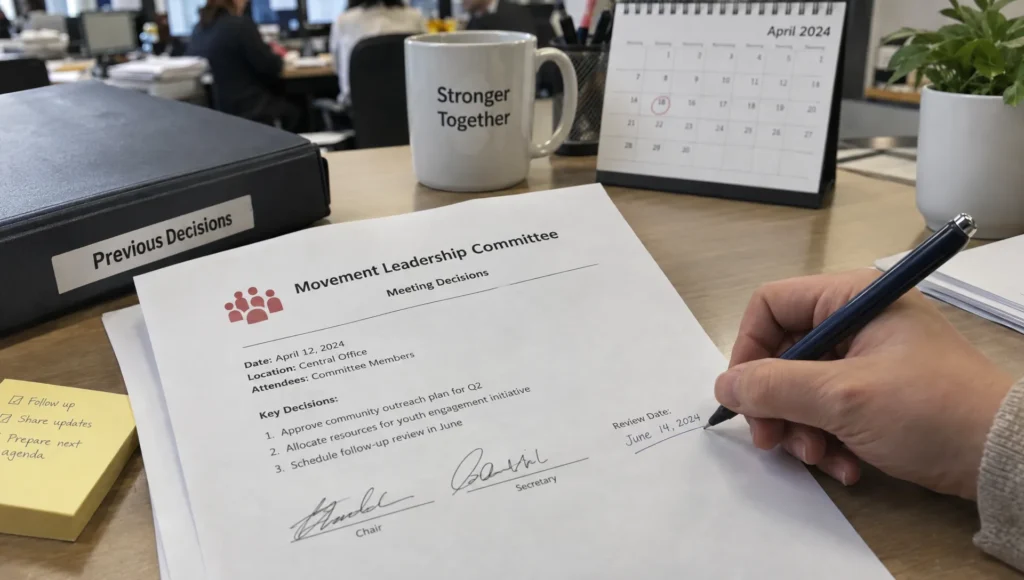
Public accountability usually appears only after something has gone wrong: a scandal breaks, a budget disappears, a promise is abandoned, or a public official refuses to answer a hard question. That is too late. A serious political movement should treat accountability as an operating model, not as crisis management.
The goal is not to replace representative institutions with permanent outrage. The goal is to make public promises, public reasoning, public participation, and public implementation visible enough that citizens can understand where power is flowing and whether it is being used responsibly.
The JustSocial manifesto frames the democratic failure sharply: citizens are too often reduced to voters, taxpayers, and private consumers. Public accountability begins when people are recognized as continuous participants in public life, capable of questioning, learning, deliberating, and shaping the institutions that govern them.
Accountability is a chain, not a press release
A political movement that wants public accountability needs to build a chain of answerability. A promise must be traceable to a decision. A decision must be traceable to evidence and public reasoning. Implementation must be traceable to named responsibilities and timelines. Results must be traceable to consequences, correction, or learning.
When any link disappears, accountability becomes symbolic. A campaign promise without a timeline is branding. A public consultation without a response is theater. A vote without accessible reasoning is a black box. A reform without follow-up is a slogan.
This is why models matter. Different democratic tasks require different accountability structures. A broad public conversation is not the same as a citizen panel. A petition is not the same as deliberative democracy. An open comment thread is not the same as discursive democracy. A political movement needs to know which model it is using, what each model can do, and where each model can fail.
| Model | Core accountability question | Best used for |
|---|---|---|
| Public mandate model | What exactly did the movement promise? | Campaign commitments, reform agendas, coalition agreements |
| Discursive democracy model | Were reasons, objections, and replies visible? | Public debate, issue framing, dissent tracking |
| Deliberative democracy model | Did citizens weigh evidence before recommendations? | Complex policy choices, tradeoffs, constitutional questions |
| Civic participation audit model | Who participated, who was missing, and why? | Inclusion, legitimacy, access, participation quality |
| Public receipts model | What happened after the decision? | Follow-through, implementation tracking, institutional memory |
| Distributed stewardship model | Who guards accountability inside the movement? | Internal governance, leadership limits, volunteer networks |
The strongest movements combine these models. They do not ask citizens to simply trust the leadership. They build systems that make trust easier to verify.
1. The public mandate model: make promises auditable
Public accountability starts before power is won. A political movement should not wait until it enters an institution to clarify what it stands for. It should publish commitments in a form that citizens can later audit.
A public mandate is not a vague platform. It is a structured record of what the movement is trying to change, why that change matters, what tradeoffs it recognizes, and how success will be evaluated. This model is especially useful for movements that want to reform public institutions without becoming another personality-driven campaign.
A strong public mandate should include:
- A clear public problem that the movement claims to address.
- The evidence or lived experience that supports the claim.
- The proposed decision rule, such as majority support, expert review, citizen panel recommendation, or legislative vote.
- The responsible team, spokesperson, or working group.
- A review date when the movement must explain progress, failure, or revision.
This matters because most political promises are designed to inspire, not to be checked. The public mandate model reverses that habit. It makes promises specific enough to be challenged by supporters, critics, journalists, and public officials.
For JustSocial, this connects directly to the manifesto's critique of a public sector stuck in industrial-era habits. If institutions are slow, opaque, and insulated from the people, a movement for reform must avoid copying those same habits. Its own promises should be easier to inspect than the systems it criticizes.
2. The discursive democracy model: make reasoning public
Discursive democracy focuses on the quality of public reasoning. It asks whether citizens can see the arguments behind a position, the objections raised against it, and the reasons a movement accepted or rejected those objections.
This is crucial in a digital public square where attention often rewards speed, anger, and tribal signaling. A political movement that wants accountability cannot rely only on likes, shares, petitions, or viral clips. Those signals can reveal urgency, but they do not always reveal understanding.
In a discursive democracy model, accountability comes from the public trail of reasoning. A proposal should have a visible argument map: what problem it addresses, what values are at stake, what evidence is contested, what alternatives exist, and what changed after public criticism.
This model also protects dissent. A movement that hides internal disagreement may look united, but it becomes less accountable. Public accountability requires the ability to say: these were the strongest objections, this is how we answered them, and this is where we changed course.
The manifesto's suggested concepts, including public records of committee activity, participatory community tools, and organized public data, point toward this principle. Public life should not be trapped in private rooms or scattered across unsearchable feeds. If citizens are expected to participate, the reasoning environment must be navigable.
Discursive democracy is not endless debate. It needs moderation, issue tagging, summaries, evidence standards, and clear transitions from discussion to decision. Without that structure, discourse becomes noise. With that structure, it becomes a public accountability asset.
3. The deliberative democracy model: slow down before decisions harden
Deliberative democracy is especially useful when an issue is complex, emotionally charged, or full of tradeoffs. Instead of asking citizens for instant reactions, it gives a representative group time to hear evidence, question experts, discuss with one another, and produce recommendations.
The OECD's work on innovative citizen participation documents how citizens' assemblies, panels, and juries have been used by governments to support better public decision-making. These processes are not magic, but they can strengthen accountability when they are transparent, well-designed, and connected to formal responses.
For a political movement, the deliberative democracy model answers a key question: before we claim to speak for the public, have we created a fair process for citizens to learn, reflect, and disagree?
A deliberative process should not be used as decoration. If a movement convenes citizens but ignores their recommendations, it damages trust. The accountability mechanism is the formal response: leadership must say which recommendations it accepts, which it rejects, why, and what happens next.
This fits the manifesto's deeper argument that the people should be more than a passive audience. It also connects to the role of education and public learning. People cannot deliberate well if they are denied context, rushed into slogans, or treated as too ignorant to understand public affairs.
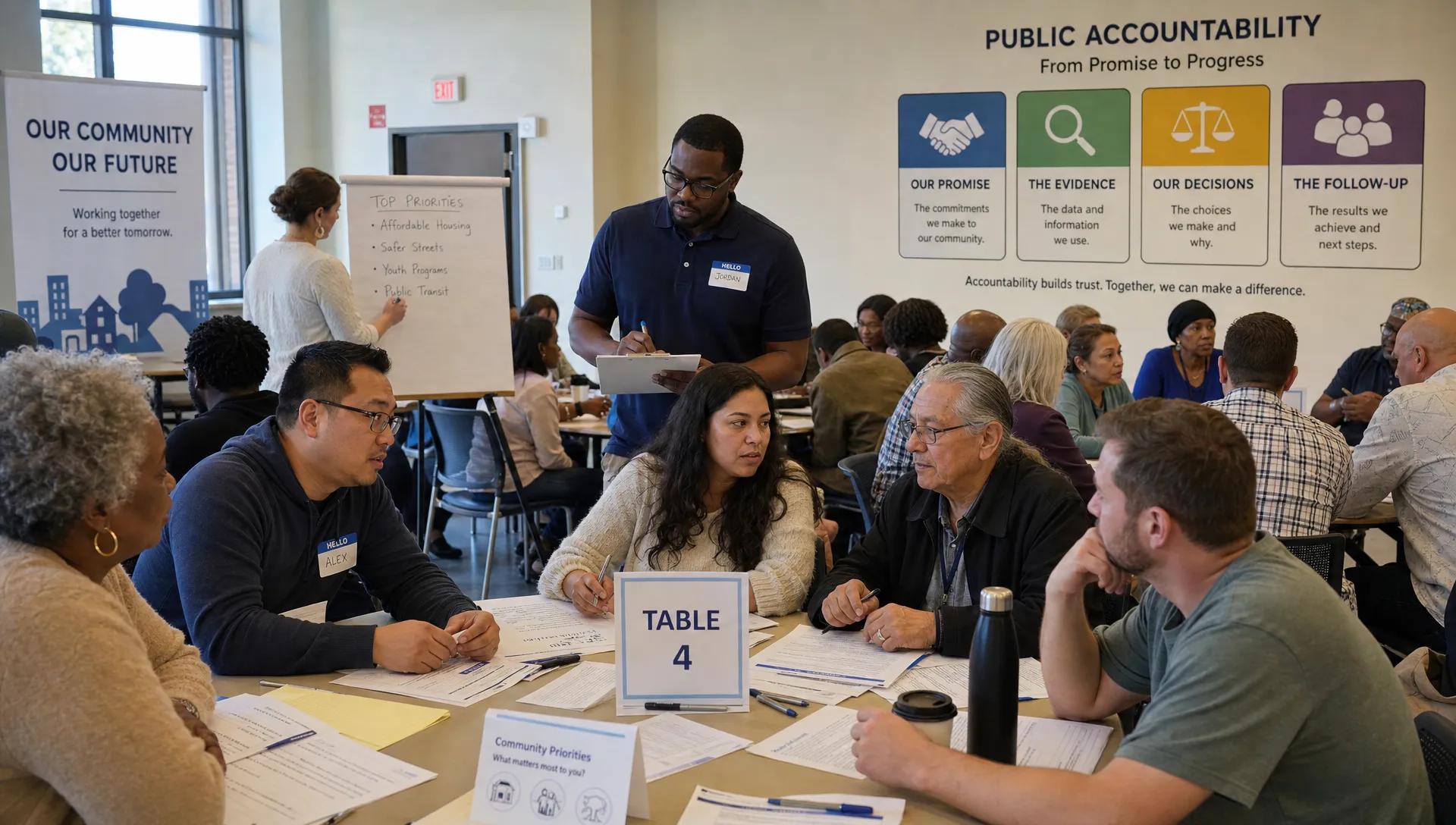
4. The civic participation audit model: measure who gets heard
Civic participation can become symbolic if participation is open in theory but narrow in practice. A town hall held at the wrong hour excludes workers and parents. A digital consultation excludes people without access, confidence, language support, or trust. A movement that listens only to its most active supporters may confuse mobilization with legitimacy.
The civic participation audit model makes participation itself accountable. It asks not only how many people participated, but whether the process reached the people most affected by the decision.
| Audit area | Accountability question | Practical signal |
|---|---|---|
| Reach | Did the invitation reach beyond existing supporters? | Source mix, referral channels, local partnerships |
| Inclusion | Were affected groups able to participate? | Language access, disability access, time options, offline options |
| Continuity | Could people participate more than once? | Repeat engagement, follow-up opportunities, issue updates |
| Responsiveness | Did input receive an answer? | Published summaries, response memos, accepted and rejected proposals |
| Integrity | Was the process protected from manipulation? | Verification standards, moderation rules, abuse reporting |
| Learning | Did participation improve public understanding? | Briefing materials, summaries, evidence notes, public Q&A |
This model is important because public accountability is not only about leaders answering questions. It is also about whether the public process is honest about its own limits.
A political movement should publish participation gaps. If young people are absent, say so. If low-income residents are missing, say so. If participation came mostly from insiders, say so. Accountability improves when the movement refuses to inflate its legitimacy.
The manifesto includes a provocative idea that minors may be able to voice civic opinions while being identified as minors, without treating that input as the same as adult voting power. Whether one agrees with the exact design or not, the accountability principle is valuable: different forms of participation should be visible, categorized responsibly, and interpreted honestly.
5. The public receipts model: prove what happened after the decision
Public accountability often collapses after the announcement. A movement wins attention, publishes a statement, holds a meeting, or secures a commitment. Then the public loses the thread.
The public receipts model solves this by creating durable, checkable records of decisions and follow-through. JustSocial has already explored how movements can build trust through public receipts, and this model belongs at the center of any accountability architecture.
A receipt should answer simple questions. What was promised? Who was responsible? What evidence was considered? What decision was made? What changed because of public input? What is the next checkpoint?
The power of this model is its simplicity. Receipts turn accountability into a habit rather than a scandal response. They also help supporters defend the movement honestly. Instead of asking people to repeat talking points, the movement gives them records they can inspect.
Public receipts should also include reversals and failures. If a proposal was delayed, say why. If a promise was unrealistic, revise it publicly. If leadership made a mistake, document the correction. Movements that hide failure train citizens to distrust them. Movements that record failure can turn it into public learning.
6. The distributed stewardship model: accountability without a single hero
Many movements begin with a founder, a charismatic organizer, or a small core team. That may be necessary at the start, but it is dangerous if accountability remains dependent on personal virtue. A democratic political movement must outgrow hero politics.
Distributed stewardship means that accountability is held by multiple roles: citizens, volunteers, technologists, policy contributors, local organizers, researchers, and public representatives. Each group has a distinct responsibility. Citizens challenge and participate. Organizers maintain process. Technologists protect systems. Researchers improve evidence. Representatives translate public will into institutional action.
This model connects strongly to the manifesto's proposal for broader public structures, including a more active role for academia and a public empowered through technology. The exact institutional design can be debated, but the accountability insight is clear: no single branch, leader, platform, or party should be trusted with unchecked interpretive power.
A movement can begin practicing this internally. It can rotate facilitation roles, publish decision minutes, separate fundraising oversight from campaign messaging, invite outside review of major claims, and create clear channels for internal dissent.
For broader context on how accountability can become part of reform work rather than a side issue, JustSocial's article on political movement strategy for public institution reform expands the institutional angle.
How the models work together
These models are strongest when they form a cycle. Discursive democracy helps the public name problems and test arguments. Deliberative democracy helps citizens weigh evidence and tradeoffs. Civic participation audits reveal who is missing from the process. Public mandates turn priorities into auditable commitments. Public receipts track what happened next. Distributed stewardship keeps the movement from concentrating power in one personality or faction.
A practical accountability cycle might look like this:
- Public issue raised through civic participation channels.
- Discursive process maps arguments, objections, evidence, and affected groups.
- Deliberative panel studies the issue and produces recommendations.
- Movement publishes a public mandate explaining what it will pursue.
- Leaders or working groups act, then publish public receipts.
- Participation audit reviews who was heard and what should improve next time.
This cycle does not remove conflict. It makes conflict more useful. Citizens will still disagree, leaders will still make judgment calls, and institutions will still move slowly. But the disagreements become easier to inspect, and the judgment calls become harder to hide.
Guardrails: accountability is not mob rule
Public accountability must be strong, but it must also be principled. A movement that simply follows every online surge will become unstable and easy to manipulate. A movement that ignores public input will become elitist and irrelevant.
The balance is to treat public participation as legitimate input, not automatic command. The manifesto makes a similar distinction: public opinion should be precisely measured and taken seriously, while institutions still retain responsibility for judgment. That distinction matters. Accountability does not mean every majority impulse becomes policy by midnight. It means power must explain itself to the people continuously and honestly.
Digital tools also require restraint. Verification should not become surveillance. Anonymity should not become impunity. Data should not become a substitute for human judgment. Public platforms should protect privacy, publish rules, and allow independent scrutiny wherever possible.
The Stanford Encyclopedia of Philosophy's overview of deliberative democracy highlights a core democratic idea: legitimacy improves when citizens participate in reason-giving under fair conditions. For a modern political movement, that means accountability is not only about counting preferences. It is about building fair conditions for public judgment.
The movement model that democracy needs
Public accountability cannot be reduced to anti-corruption slogans or election-day choice. It needs institutions, records, habits, and civic confidence. It needs citizens who are treated as capable participants and leaders who accept that public power must remain answerable after the campaign ends.
The JustSocial vision is ambitious because it asks whether modern technology can help recover something older: a sense that public life belongs to the people who live inside it. The manifesto's image of a renewed public community is not only about tools. It is about dignity, agency, and the belief that citizens should not be politically awake only once every few years.
A political movement model for public accountability should therefore do three things at once. It should make power visible. It should make participation meaningful. It should make learning continuous.
If a movement can do that, it will not merely demand better democracy from the outside. It will begin practicing it from within.
Frequently Asked Questions
What is a political movement model for public accountability? It is a structured way for a movement to make promises, decisions, reasoning, participation, and follow-through visible to the public. The model defines how citizens can inspect power and how leaders must respond.
How does deliberative democracy improve accountability? Deliberative democracy gives citizens time, evidence, and facilitation before recommendations are made. It improves accountability when leaders must formally respond to those recommendations and explain acceptance, rejection, or revision.
How is discursive democracy different from civic participation? Civic participation describes public involvement in democratic processes. Discursive democracy focuses specifically on the quality and visibility of public reasoning, including arguments, objections, evidence, and replies.
Why should a political movement audit participation? Participation audits reveal whether a process actually reached affected communities or mostly captured the voices of insiders. They help movements avoid false legitimacy and improve access over time.
Can digital tools create public accountability on their own? No. Digital tools can help record, organize, and scale participation, but accountability also requires clear rules, privacy protections, independent review, public learning, and leaders willing to answer for decisions.
Help build a more accountable public life
If you believe citizens should be more than voters, taxpayers, and spectators, explore JustSocial and the ideas behind its movement for continuous civic participation. Read the manifesto, challenge the models, share the work, and consider contributing your skills to a political movement built around public accountability.