Rural and small-town communities do not experience politics as an abstract national theater. A school board decision changes the future of a child you know. A road repair affects the farmer down the road, the school bus route and the shop owner who depends on weekend traffic. A zoning hearing can reshape the edge of town for decades.
That intimacy is a strength, but it also makes civic participation harder. Disagreement can follow people into the grocery store. The same few voices often attend every meeting. Public officials may be part-time, underpaid or personally known to everyone in the room. Broadband gaps, long driving distances and thin local media make participation uneven.
For rural and small-town communities, stronger civic participation is not about copying big-city activism. It is about building a local rhythm where neighbors can speak, listen, weigh trade-offs and create public pressure without tearing the social fabric apart.
That idea connects directly to JustSocial's manifesto, which argues that modern democratic life has left too many people reduced to voters, taxpayers and consumers. Rural communities often feel that distance most sharply. The goal is to make public life immediate again, not by romanticizing the past, but by using modern tools and old community habits together.
Why civic participation looks different in rural places
Rural America is not a single culture. A farming county, a mountain town, a tribal community, a coastal fishing village and a small industrial town all face different realities. Still, several patterns show up again and again.
The first is distance. A county meeting may be 40 minutes away. A public hearing may be held during work hours. A parent may want to speak about school transportation but cannot miss a shift, find child care or drive across the county for a three minute comment.
The second is visibility. In a large city, public participation can be anonymous in practice, even when comments are public. In a small town, everyone may know who opposed the tax levy, who criticized the police budget or who challenged the school superintendent. That visibility can strengthen accountability, but it can also silence people who fear retaliation or social conflict.
The third is institutional thinness. Many rural governments operate with small staffs and limited capacity. One clerk may handle records, agendas, public notices and citizen questions. Local newspapers have declined in many regions, which means fewer people are watching agendas before decisions are made.
The fourth is unequal digital access. Pew Research Center has documented persistent gaps in home broadband adoption between rural, suburban and urban adults. That matters because a civic process that assumes everyone can stream a meeting, download a packet or vote in an app will exclude some of the people most affected.
A serious political movement for civic participation has to start from these realities. Digital tools can help rural communities, but only when they reduce barriers instead of replacing human trust.
Start with the decision trail
The most common failure in civic participation is starting with anger and ending with exhaustion. Residents know something is wrong, but they do not know where the decision sits, who controls it, when action is possible or what evidence would change the outcome.
A better starting point is the decision trail. Before launching a petition, meeting or campaign, map the path from problem to public decision.
| Local issue | Likely decision point | Useful public evidence | Best participation window |
|---|---|---|---|
| Road safety | Town council, county commission or transportation department | Crash reports, photos, school bus routes, resident testimony | Before budget approval or project list adoption |
| School consolidation | School board, district administration or state education agency | Enrollment data, travel times, parent testimony, student impact | Before formal recommendation or final board vote |
| Broadband access | County commission, state broadband office or provider partnership | Coverage maps, speed tests, business needs, homework access | Before grant applications or contract approval |
| Water quality | Utility board, town council or state regulator | Test results, repair records, resident reports, cost estimates | Before rate changes or infrastructure plans |
| Housing and zoning | Planning board, town council or county board | Vacancy data, employer needs, traffic concerns, public comments | Before public hearing or zoning amendment vote |
This kind of mapping turns civic participation from general pressure into targeted public influence. It also makes participation less intimidating because residents can see the next concrete step.
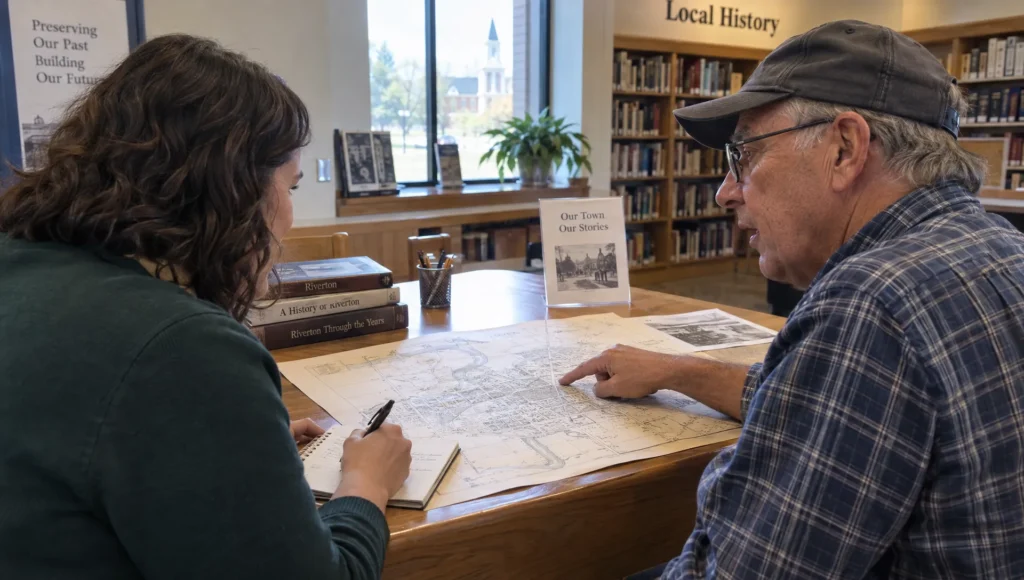
A town does not need a professional campaign team to do this. A small group can watch agendas, summarize upcoming decisions and explain who is responsible. The summary should be plain, local and short enough to be read at a diner, library desk, church hall or feed store counter.
Discursive democracy starts before the official meeting
Discursive democracy is the work of improving the public conversation before a decision is made. It is not just speech. It is the process of making opinions clearer, more informed and more honest through conversation.
In small towns, discursive democracy often already exists informally. People talk after school pickup, at the volunteer fire station, outside a local business, at religious gatherings or during youth sports. The problem is that these conversations can become rumor networks. People hear fragments, assume motives and harden positions before anyone has seen the actual proposal.
A healthier approach is to create simple local listening practices:
- Ask residents what they believe the decision is, then correct factual confusion without shaming them.
- Write down the strongest argument for each side so people feel heard before they are asked to compromise.
- Ask what evidence would change someone’s mind, since that question separates firm values from missing information.
- Share short summaries in physical places as well as online, especially when broadband or social media use is uneven.
- Invite quiet stakeholders before the public meeting, including shift workers, caregivers, young adults and people who depend on public services.
This is not soft work. It is how a community prevents public decisions from being captured by the loudest faction. If your town needs more offline methods for building this kind of participation, JustSocial has a related guide to civic participation without social media.
Deliberative democracy gives disagreement a structure
Deliberative democracy goes one step further. It asks residents to weigh options, evidence, costs and trade-offs before recommending or supporting a decision.
A standard public hearing is usually not deliberation. People line up, speak for a few minutes and leave. Officials listen or appear to listen. The format is useful for public record, but it rarely helps neighbors reason together.
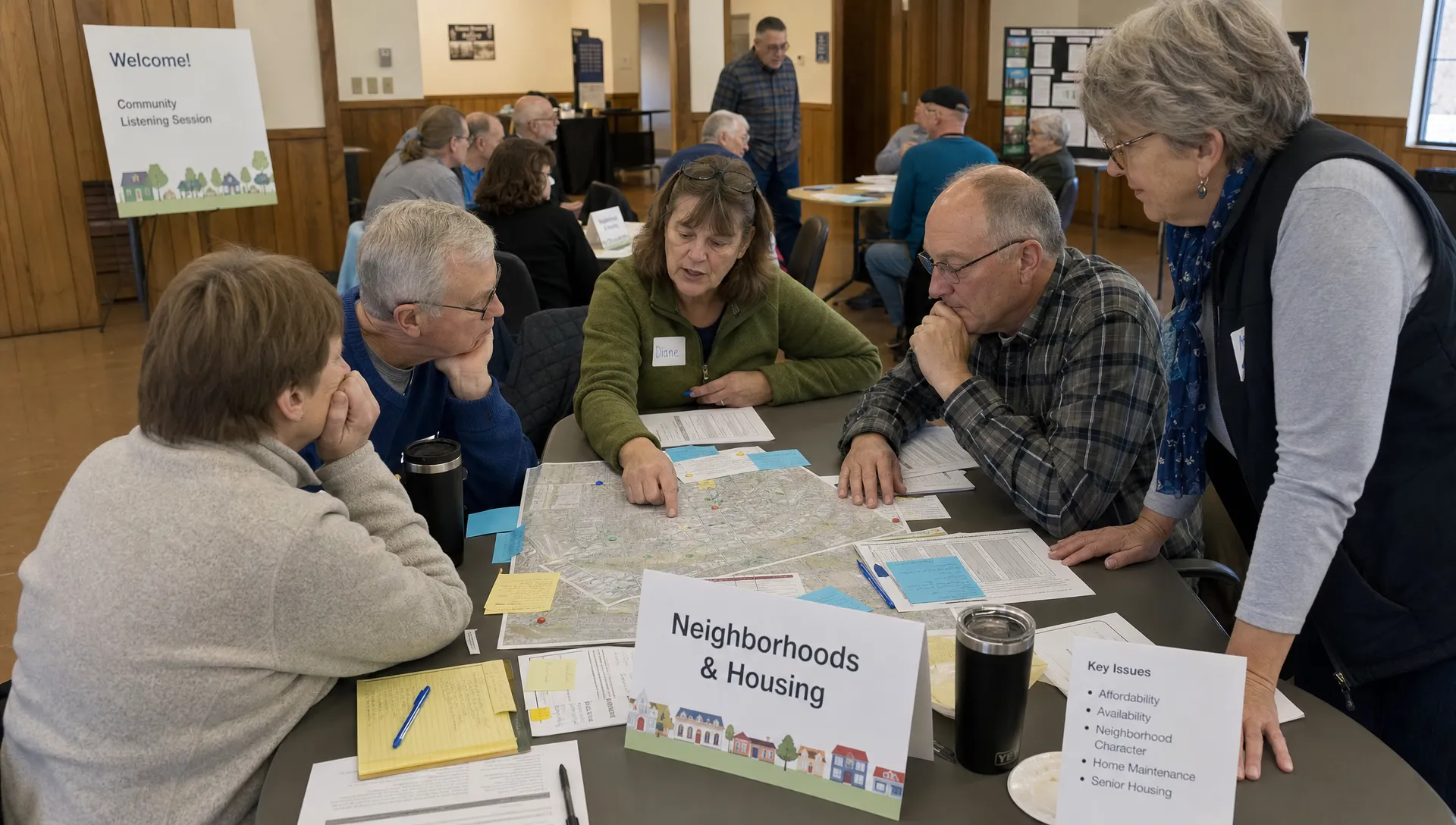
A deliberative process can happen in a library, school cafeteria, community center, union hall, tribal office, church basement or fire station. It does not need to be fancy. It does need a structure that people trust.
A strong small-town deliberation has four parts. First, the group receives a neutral issue brief that explains the decision, the timeline and the real options. Second, participants hear from people affected in different ways. Third, residents discuss in small groups with a facilitator or clear ground rules. Fourth, the results are summarized publicly and sent to the decision-making body.
The value is not that everyone agrees. The value is that disagreement becomes legible. Officials can see where the community stands, what trade-offs people accept and what concerns remain unresolved.
| Rural participation challenge | What it can cause | Deliberative design response |
|---|---|---|
| Everyone knows everyone | Fear of speaking honestly | Allow written input, anonymous question cards and small group discussion |
| Same people attend meetings | Narrow public feedback | Rotate venues, times and outreach networks |
| Long distances | Low turnout from outlying areas | Combine in-person meetings with phone input and mailed summaries |
| Limited broadband | Exclusion from digital tools | Use paper notices, local radio, SMS updates and public bulletin boards |
| Part-time officials | Slow response and weak documentation | Create simple public summaries and decision receipts |
| Political tension | Personal conflict | Use ground rules focused on evidence, lived impact and specific proposals |
Technology should reduce distance, not replace trust
JustSocial’s manifesto argues that the tools for a more continuous democracy already exist, but public institutions have not absorbed them fast enough. That point matters in rural communities because the right technology can reduce distance, preserve records and help people participate between election cycles.
But technology must be designed for rural conditions. A video stream is useful only if residents can access it. An online form helps only if people trust where the information goes. An online voting platform can support community input, but formal public authority still requires legal safeguards, identity verification, cybersecurity and clear rules.
The practical principle is simple: use technology as connective tissue, not as a replacement for community life.
A rural civic participation system might include meeting recordings, SMS reminders, printed agenda summaries, public comment forms, phone lines, local bulletin boards and anonymous sentiment tools. The technology should create a public memory of what was said, what was promised and what happened next.
This also connects to the JustSocial idea of a people-centered public layer. The article on civic participation through a People’s Branch explores how public input could become continuous, structured and accountable rather than occasional and symbolic.
For rural communities, that vision should not mean handing local life over to software. It should mean that a resident outside town, a caregiver at home, a teenager without voting rights, a disabled veteran, a small business owner and a farmworker all have more practical ways to be heard.
Build a small-town civic circle
A civic circle is a small, reliable group that helps the community follow decisions and participate before it is too late. It is not a party committee. It is not a protest group by default. It is local democratic infrastructure.
The circle can begin with eight to twelve people who are trusted across different parts of town. They do not need to agree politically. In fact, it is better if they do not. The point is to make public issues easier to understand and harder to ignore.
A monthly rhythm works well:
- Week 1: Review agendas from the town council, county commission, school board and planning board.
- Week 2: Choose one issue that affects daily life and prepare a one page public summary.
- Week 3: Host a listening table at a familiar local place and collect questions or concerns.
- Week 4: Send a public summary to officials, publish the next decision date and report what changed.
This rhythm is small enough to survive volunteer fatigue. It also creates civic muscle memory. People begin to understand where decisions happen, when they can intervene and how their input is recorded.
In a town of 2,000 people, a dozen steady organizers can change the political atmosphere. Not by controlling decisions, but by making them visible.
Make room for people who cannot speak freely
Small-town participation often fails because it assumes public speech is equally safe for everyone. It is not.
A teacher may fear criticizing the school district. A town employee may avoid speaking about budget priorities. A tenant may not want to challenge a landlord who sits on a local board. A small business owner may hesitate to oppose a project backed by powerful families. A young person may think adults will dismiss them before they begin.
If civic participation only counts the people willing to speak into a microphone, it will misread the community.
Better participation design gives people multiple ways to contribute. Written questions, anonymous comment cards, phone interviews, youth listening sessions, translated materials, child care and meetings outside standard work hours all change who appears in the public record.
The manifesto’s argument that minors should be able to voice civic opinions, without confusing that voice with formal adult voting rights, is especially relevant in small towns. Young people understand school transportation, public spaces, internet access and community belonging in ways adults often miss. A rural civic process that excludes youth is excluding evidence.
A 90 day starter plan for rural civic participation
A community does not need to redesign democracy all at once. It can begin with one issue, one calendar and one public habit.
| Timeframe | Action | Output |
|---|---|---|
| Days 1 to 15 | Map the local decision bodies and meeting calendars | A shared civic calendar |
| Days 16 to 30 | Interview residents from different parts of town | A list of recurring concerns and missing information |
| Days 31 to 45 | Choose one issue and prepare a neutral public brief | A one page summary with decision timeline |
| Days 46 to 60 | Hold a small deliberative meeting | Notes showing options, trade-offs and concerns |
| Days 61 to 75 | Send findings to the relevant public body | A public comment packet or testimony summary |
| Days 76 to 90 | Report back to residents | A decision receipt showing what officials did or did not do |
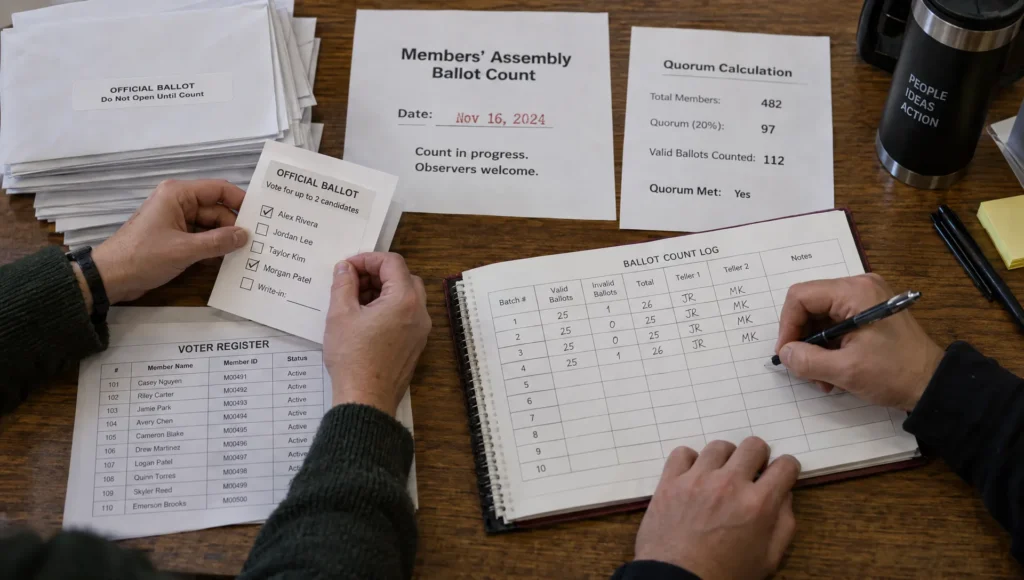
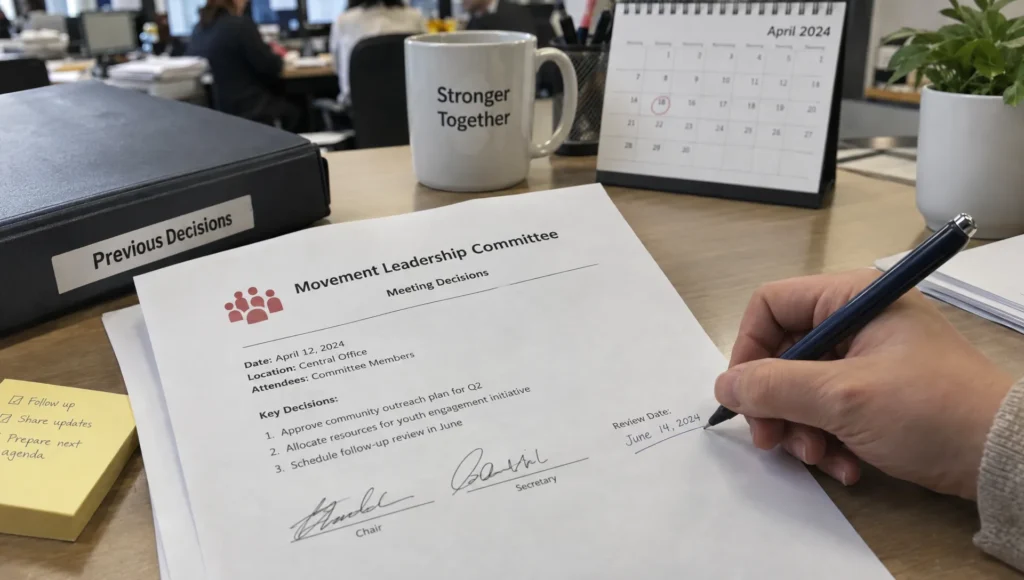
The decision receipt is crucial. People stop participating when they feel their input disappears. A receipt can be simple: we asked for this, officials said that, the next vote is on this date, these questions remain unanswered.
That record changes the emotional experience of civic life. Participation becomes less like shouting into the void and more like building a shared civic memory.
How rural civic participation becomes a political movement
A political movement in a small town rarely begins with a slogan. It begins when people discover that public life can be made practical again.
The movement grows when residents learn how to read agendas, ask better questions, protect minority voices, deliberate before decisions and keep receipts after decisions. It grows when officials realize that public input is not just anger at the podium, but organized knowledge from the people who live with the consequences.
This is where rural civic participation connects to the larger JustSocial vision. The manifesto calls for a culture where the people are not passive subjects of a distant state, but active participants in shaping public policy. In small towns, that future can be tested at human scale.
The old Polis that inspired political thinkers was intimate because citizens could feel the public realm around them. Rural and small-town communities still have some of that intimacy. Modern tools can help scale the listening, documentation and participation that older democracies could not sustain.
The task is to combine both: the trust of place and the accountability of technology.
Frequently Asked Questions
What does civic participation mean in a rural or small-town community? It means taking part in local public decisions before, during and after official action. That can include agenda watching, listening sessions, public comments, deliberative meetings, school board engagement, issue briefs and follow-up reports.
How is deliberative democracy different from a normal town hall? A town hall often lets people speak one at a time. Deliberative democracy gives residents shared information, time to compare options and a structured way to weigh trade-offs before a recommendation or decision.
Can civic participation work without strong broadband? Yes. Rural participation should combine digital tools with paper notices, phone calls, local radio, bulletin boards, in-person meetings and mailed summaries. Online tools are helpful, but they should not be the only doorway into public life.
How can small towns avoid personal conflict when politics gets tense? Use clear ground rules, neutral issue summaries, small group discussion and public decision receipts. The goal is not to erase disagreement, but to keep it specific, evidence-based and connected to decisions.
Is this a partisan project? Civic participation can support people across political lines because it focuses on how communities make decisions. A political movement for participation may challenge parties and officials, but its core demand is that people be heard continuously and seriously.
Join the work of making democracy local again
Rural and small-town communities do not need to wait for national politics to repair democratic life. They can start by making local decisions visible, structured and accountable.
If this vision resonates with you, explore JustSocial.io, share the manifesto, organize a local civic circle or volunteer your skills to help build tools and habits for continuous public participation. Democracy becomes real when people can see where their voice goes and what it changes.