Disability policy often fails for a simple reason: it is designed around a public that does not exist. The imagined citizen is mobile, sighted, hearing, digitally confident, neurotypical, financially stable and able to attend meetings during work hours. Real citizens are not built that way.
According to the World Health Organization, about 1.3 billion people experience significant disability. That is not a small interest group. It is a major part of every city, workplace, school system, transit network and voting public. Disability policy that works cannot be written as an afterthought by officials who hear from disabled people only after a building is finished, a website is launched or a benefit rule has already created harm.
Civic participation changes the starting point. Instead of treating disabled people as service recipients, it treats them as co-governors of the systems that shape daily life. That shift is deeply aligned with JustSocial’s call for a modern democracy in which citizens are not reduced to voters, taxpayers and consumers. The question is not only whether government “helps” disabled people. The question is whether disabled people have continuous, structured and meaningful power over disability policy itself.
Why disability policy needs more than consultation
Traditional consultation usually happens late. A ministry publishes a draft. A municipality holds a hearing. A committee invites a few disability advocates to speak for three minutes. Officials thank everyone for their input, then move forward with a version of the plan that was mostly decided before the public entered the room.
That is not real civic participation. It is a pressure valve.
Disability policy touches too many daily systems for occasional consultation to be enough: housing, education, employment, health care, transportation, emergency planning, public benefits, policing, courts, digital identity and government websites. A small design mistake in one of these areas can create a life-size barrier. A bus stop without seating is not a minor inconvenience for someone with chronic pain. A benefits form that times out after ten minutes is not neutral for someone who uses assistive technology. A school policy that ignores sensory overload is not just inefficient, it can exclude a child from learning.
This is why disability policy should be built through civic participation from the first problem definition to the final audit. Disabled people need influence before the procurement contract is signed, before the regulations are finalized and before the public service workflow becomes embedded in software.
The disability rights principle often summarized as “nothing about us without us” is also reflected in international law. The UN Convention on the Rights of Persons with Disabilities requires governments to closely consult with and actively involve people with disabilities, including through their representative organizations, in decisions that affect them.
Continuous participation, not one-off hearings
JustSocial’s manifesto argues that representative democracy should be surrounded by continuous public input, supported by technology, transparency and a stronger civic role for the people. That idea matters for disability policy because disability is not static. Needs change with age, illness, injury, caregiving, climate events, local infrastructure and the tools available at a given moment.
A city cannot ask once every four years whether its sidewalks, schools, benefits offices and emergency alerts are accessible. A national government cannot treat disability policy as a single legislative package and assume the work is done. The lived experience of policy must be measured continuously.
In this sense, civic participation is not only a democratic ideal. It is a quality-control system for public life.
The JustSocial manifesto imagines citizens as an active branch of democratic life, able to weigh in consistently while institutions still retain responsibility for judgment, law and implementation. For disability policy, that means public officials should not wait for lawsuits, viral stories or protests to discover that a policy is failing. They should maintain open, accessible channels where disabled people can report barriers, propose fixes, compare tradeoffs and see how government responds.
Discursive democracy: making disability barriers visible
Discursive democracy is about the quality of public reasoning. It asks whether people can explain problems, challenge assumptions and make experiences legible to others. For disability policy, this is essential because many barriers are invisible to those who do not experience them.
A policymaker may see an online form and think it is efficient. A blind resident using a screen reader may experience it as a locked door. A transit planner may see a route map and think coverage is adequate. A wheelchair user may know that two broken curb cuts make the route unusable. A school administrator may call a classroom “inclusive” while a neurodivergent student spends the day in distress because the sensory environment is unmanageable.
Discursive democracy gives these realities a public structure. It does not mean every comment carries equal evidentiary weight. It means the process is designed so that lived experience, professional expertise, academic research and administrative data can be compared in the open.
A disability-focused discursive process should include several types of evidence:
- First-person accounts from disabled residents, students, workers, parents and caregivers.
- Data from public agencies, including wait times, denial rates, complaint categories and service outcomes.
- Technical accessibility reviews of buildings, software, transportation systems and communication channels.
- Input from frontline workers who understand where policy instructions fail in practice.
- Research from universities, disability studies scholars, public health experts and independent auditors.
This connects directly to the manifesto’s argument that academia should have a stronger public role. Disability policy benefits when universities and research institutions do not merely publish papers, but help translate evidence into public advisories that citizens can debate and officials can act on.
Deliberative democracy: turning lived experience into priorities
Discursive democracy helps a community understand the problem. Deliberative democracy helps it make choices.
Disability policy always involves tradeoffs. Which accessibility upgrades should a city fund first? How should a school district balance individualized support with universal design? What should be mandatory for government websites, and what timeline is realistic for small public agencies? Which employment supports should be prioritized when budgets are limited?
Deliberative democracy creates a structured setting where disabled people, officials, service providers, employers, educators and other residents can weigh options together. The goal is not to produce a shallow consensus. The goal is to make disagreement useful.
A serious deliberative process needs accessible materials in plain language, sign language interpretation where needed, captioning, screen-reader compatible documents, flexible meeting formats, remote participation and compensation for participants whose expertise comes from lived experience. It also needs a clear decision rule. If the process is advisory, say so. If a ranked public recommendation will trigger a formal response, publish the timeline. If a citizens’ panel controls part of a participatory budget, define the budget before the process begins.
JustSocial has argued elsewhere that civic participation must have a visible link between participation and the decision. Disability policy especially needs that link because disabled communities have often been asked to share painful experiences without seeing institutional change.
| Policy area | What participation can reveal | What deliberation can decide | What government should publish |
|---|---|---|---|
| Public transit | Routes that look accessible on paper but fail in practice | Priority stations, routes and fixes | Repair timelines, outage data and funding choices |
| Digital services | Forms, portals and alerts that exclude assistive technology users | Accessibility standards and testing rules | Audit results, vendor obligations and remediation dates |
| Education | Gaps between inclusion policy and classroom reality | Support models, training needs and escalation paths | Service levels, complaint data and student outcome metrics |
| Employment | Barriers in hiring, accommodations and workplace design | Procurement rules, incentives and enforcement priorities | Employer guidance, inspection results and complaint resolution data |
| Emergency planning | Evacuation and alert systems that miss disabled residents | Communication protocols and local support networks | Accessible emergency plans and drill evaluations |
The disability participation loop
A practical participation model should operate as a loop, not a campaign. That loop can be used by a city council, a national ministry, a school district or a public agency building a new digital service.
- Map the affected communities: Identify who is affected across disability type, age, income, geography, language, race, gender, immigration status and caregiving role.
- Define the decision early: Publish the actual policy question, the decision owner, the budget range, the legal limits and the timeline.
- Open accessible evidence channels: Accept testimony, surveys, service data, audits, community reports and expert submissions in accessible formats.
- Deliberate with real constraints: Give participants the facts, tradeoffs and costs so recommendations are grounded rather than symbolic.
- Publish the response: Explain what was accepted, what was rejected, why it was rejected and who is accountable for next steps.
- Audit the lived result: Return to the community after implementation and measure whether the change improved daily life.
This approach also strengthens public service design because it treats accessibility as part of the service itself, not as a compliance layer added at the end.
Who must be included, and how
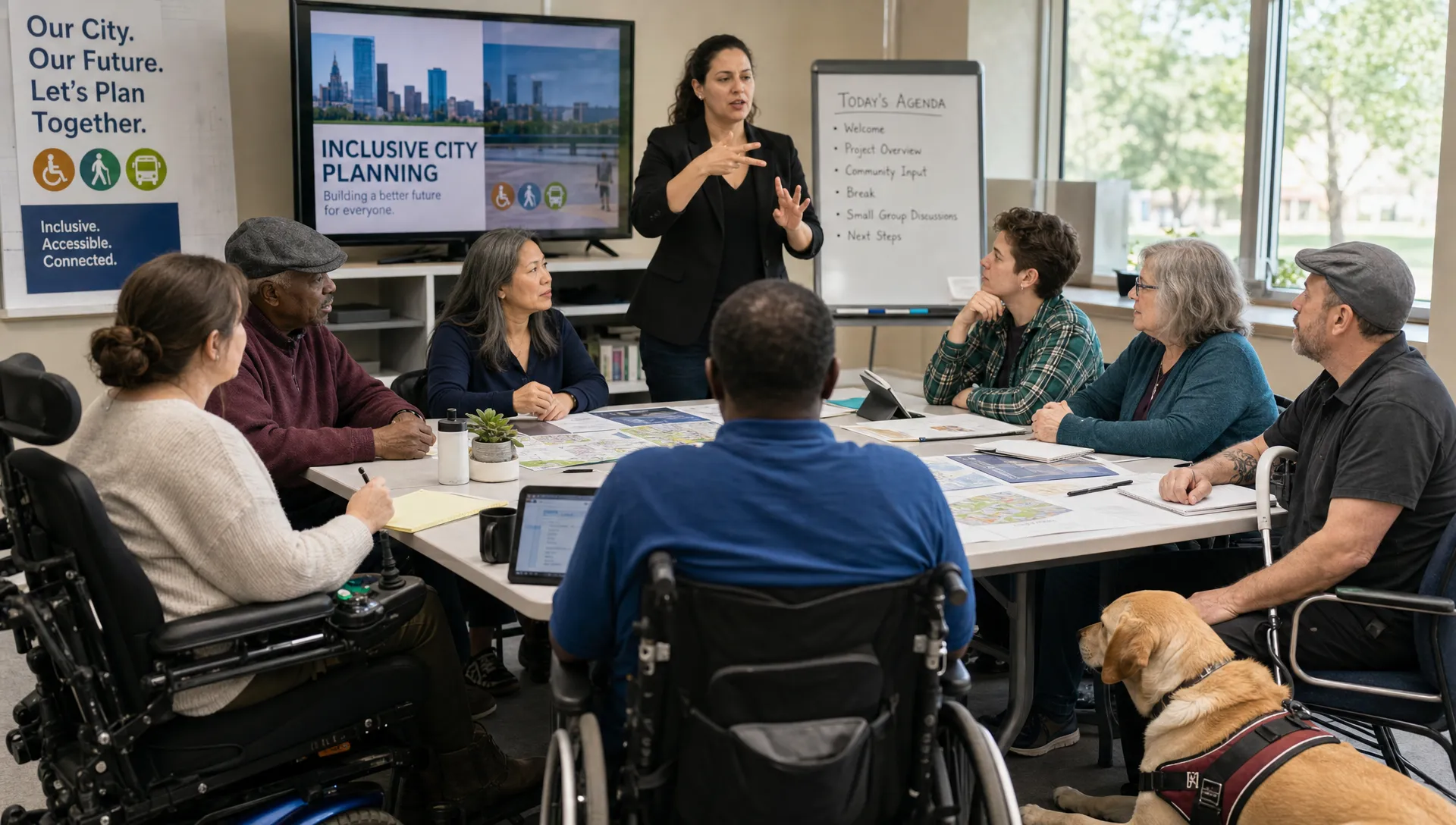
A disability participation process should not depend on one charismatic advocate or one large organization. Disability communities are plural. A person with a spinal cord injury, a Deaf resident, a blind student, an autistic employee, a veteran with PTSD, a person with chronic illness and a parent supporting a child with complex needs may all face different barriers.
Governments should include disability-led organizations, independent advocates, people who are not affiliated with formal groups, caregivers, service workers, accessibility professionals and researchers. They should also make room for people who distrust public institutions because previous systems harmed them.
Inclusion is not only about invitations. It is about conditions. If meetings are unpaid, held in inaccessible buildings, conducted only in legal language or scheduled at times when caregivers cannot attend, the process will reproduce the same exclusions it claims to solve.
| Participation barrier | Better design choice |
|---|---|
| Meetings only during work hours | Offer multiple times, remote access and asynchronous input |
| Technical policy documents | Provide plain-language summaries and accessible formats |
| Unpaid lived-experience labor | Compensate participants and cover transport or support costs |
| Single public hearing format | Use workshops, surveys, interviews, panels and community visits |
| No feedback after input | Publish a response matrix showing how input affected decisions |
Disability policy is also economic and industrial policy
Disability policy is too often limited to welfare, health care or legal compliance. Those areas matter, but they are not the whole picture. A serious democracy asks how all public policy affects disabled people, including infrastructure, procurement, labor markets and industrial innovation.
For example, public procurement can shape whether workplaces become safer and more accessible. If a government contracts with food processing facilities, hospitals, schools or public kitchens, it can ask whether the tools used in those environments reduce unnecessary physical strain, improve hygiene and support safer work. In sectors such as food production, technologies like sustainable cleaning and contamination-control solutions can be part of a broader conversation about worker safety, public health and operational design, especially when procurement teams consult disabled workers and occupational health specialists before setting standards.
This does not mean every technology is automatically disability policy. It means disability policy should have a seat wherever public money shapes the built, digital and industrial environment. The same logic applies to public transit vehicles, school furniture, emergency alert systems, voting machines, court software and housing renovations.
A political movement for continuous direct democracy should treat accessibility as a democratic infrastructure question. If people cannot travel, communicate, work, learn, vote, file forms or attend public meetings, they are formally citizens but practically excluded.
The role of education in disability-inclusive democracy
JustSocial’s manifesto links democratic renewal to educational reform. That connection is vital for disability policy. Children learn democracy not only from civics textbooks, but from how schools treat difference.
If disabled students are segregated from ordinary school life, democracy teaches exclusion. If students with disabilities are physically present but unsupported, democracy teaches symbolism. If classrooms use project-based learning, peer collaboration, accessible technology and student voice, democracy becomes something children practice before adulthood.
Disability-inclusive civic education can start early. Students can help audit school accessibility, deliberate over shared classroom needs, propose sensory-friendly spaces, discuss inclusive playground design or compare how different public policies affect families. Minors may not vote in formal elections, but they can still participate in democratic learning. This aligns with the manifesto’s idea that young people should have ways to voice civic opinions while being identified as minors.
The result is not only better disability policy. It is a citizenry trained to notice barriers before they become normalized.
Guardrails for disability civic participation
Civic participation can be badly designed. It can become performative, captured by the loudest voices or used to legitimize decisions already made. Disability participation also carries privacy risks when people are asked to disclose medical, financial or family information.
A trustworthy system needs guardrails.
First, participation data must be protected. People should not have to expose private diagnoses to influence public policy. Anonymous or pseudonymous input may be necessary, especially in small communities or workplaces where retaliation is possible.
Second, participation should not replace rights. A majority should not be able to vote away accessibility obligations or civil protections. Deliberative democracy can help set priorities and implementation details, but basic rights must remain enforceable.
Third, government must separate popularity from evidence. A barrier that affects a small number of people can still require urgent action. The fact that few residents report a problem may mean the reporting process is inaccessible, not that the problem is minor.
Fourth, public agencies should be required to answer. If disabled citizens give time, testimony and expertise, officials owe them a reasoned response. Silence teaches apathy. A response, even when imperfect, keeps the democratic loop alive.
What local leaders can do now
Disability policy does not need to wait for a constitutional transformation. Local leaders can begin with practical reforms that match the spirit of continuous civic participation.
A mayor can create an accessible disability policy panel with a published work plan. A school district can require student and parent input before changing support models. A transit authority can publish outage data and invite disabled riders to rank repair priorities. A national ministry can require every new digital service to pass accessibility testing with real users before launch. A public procurement office can add accessibility and worker-safety consultation to major contracts.
The deeper shift is cultural. Government must stop treating disabled citizens as exceptions to a normal public. Disability is part of the public. Once institutions accept that, civic participation becomes less about accommodation and more about democratic accuracy.
Frequently Asked Questions
What is civic participation in disability policy? Civic participation in disability policy means disabled people, caregivers, advocates, workers and affected communities help define problems, compare options, influence decisions and review outcomes. It goes beyond public comment by connecting participation to real policy authority.
How does deliberative democracy improve disability policy? Deliberative democracy gives participants time, evidence and structure to weigh tradeoffs. In disability policy, it helps communities decide priorities such as which accessibility barriers to fix first, how to allocate limited budgets and how to balance universal design with individualized support.
What is the role of discursive democracy? Discursive democracy improves the public conversation before decisions are made. It helps make invisible barriers visible by combining lived experience, service data, accessibility audits and expert knowledge in a format that officials and citizens can understand.
Should disability policy be decided by majority vote? Not entirely. Civic participation can guide priorities, reveal barriers and improve implementation, but fundamental disability rights should not depend on majority approval. Participation should strengthen rights, not make them conditional.
How can technology support disability civic participation? Technology can make participation more continuous through accessible surveys, public dashboards, online deliberation, transparent decision records and digital reporting tools. It must be designed with disabled users from the beginning, including people who rely on assistive technology or need non-digital options.
Build disability policy with the people it affects
Disability policy that works is not written for disabled people from above. It is built with disabled people as civic equals.
That is the democratic promise at the heart of JustSocial’s political movement: citizens should have meaningful influence between elections, public institutions should listen continuously and technology should help people shape the systems they live inside. For disability policy, this is not abstract. It is the difference between a ramp that exists on paper and a city that people can actually move through.
If we want a democracy worthy of the name, civic participation must become part of the policy machinery itself. Disability is one of the clearest places to begin.